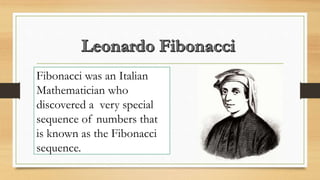

Fibonacci was an Italian
Mathematician who
discovered a very special
sequence of numbers that
is known as the Fibonacci
sequence.
The Fibonacci sequence is
0, 1, 1, 2, 3, 5, 8, 13, 21, 34, …
Basically when we add 2 consecutive
numbers starting at 0 , we get a new
number.
These sequences are found everywhere in
nature , humans , music and art.
Pines Cones
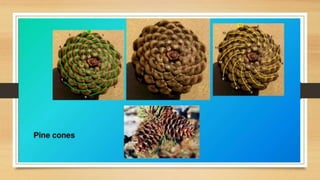
Pines cones show excellent Fibonacci sequence . Here(next
slide) there are 8 clockwise and 13 anticlockwise spirals
(both Fibonacci numbers). If you look at pinecone from
the side, each level has a certain numbers of scales that
match a Fibonacci numbers
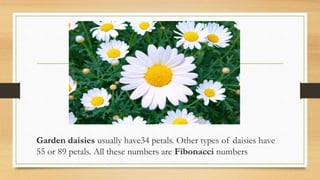
Garden daisies usually have34 petals. Other types of daisies have
55 or 89 petals. All these numbers are Fibonacci numbers
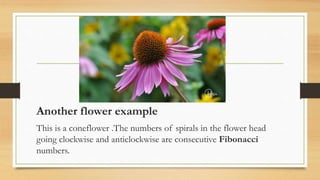
Another flower example
This is a coneflower .The numbers of spirals in the flower head
going clockwise and anticlockwise are consecutive Fibonacci
numbers.
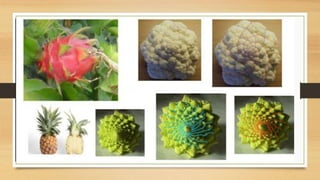
Vegetables and fruits
Broccoli and Cauliflower are the main two vegetables that
show the Fibonacci sequence in the spiraling of the florets
. Some fruits also show the Fibonacci sequence such that
star fruit , pineapples and dragonfruit.
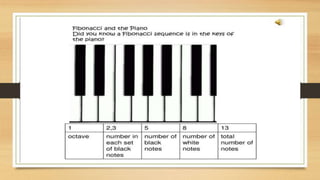
Piano & Fibonacci
You will be amazed to know that a Fibonacci
sequence lies in keys of the Piano
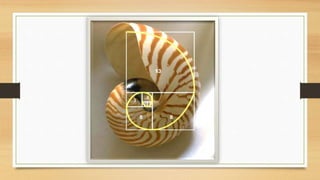
The Fibonacci Spirals directly correspond to
the spirals found in sea shells .
Fibonacci sequence
Fibonacci sequence
Fibonacci sequence
Fibonacci sequence
Fibonacci sequence

Fibonacci sequence

  • 2.
    Fibonacci was anItalian Mathematician who discovered a very special sequence of numbers that is known as the Fibonacci sequence.
  • 3.
    The Fibonacci sequenceis 0, 1, 1, 2, 3, 5, 8, 13, 21, 34, … Basically when we add 2 consecutive numbers starting at 0 , we get a new number. These sequences are found everywhere in nature , humans , music and art.
  • 4.
    Pines Cones Pines conesshow excellent Fibonacci sequence . Here(next slide) there are 8 clockwise and 13 anticlockwise spirals (both Fibonacci numbers). If you look at pinecone from the side, each level has a certain numbers of scales that match a Fibonacci numbers
  • 6.
    Garden daisies usuallyhave34 petals. Other types of daisies have 55 or 89 petals. All these numbers are Fibonacci numbers
  • 7.
    Another flower example Thisis a coneflower .The numbers of spirals in the flower head going clockwise and anticlockwise are consecutive Fibonacci numbers.
  • 8.
    Vegetables and fruits Broccoliand Cauliflower are the main two vegetables that show the Fibonacci sequence in the spiraling of the florets . Some fruits also show the Fibonacci sequence such that star fruit , pineapples and dragonfruit.
  • 10.
    Piano & Fibonacci Youwill be amazed to know that a Fibonacci sequence lies in keys of the Piano
  • 12.
    The Fibonacci Spiralsdirectly correspond to the spirals found in sea shells .