Prime Number
A prime number is a natural number greater than 1 that has 
no positive divisors other than 1 and itself. 
A natural number greater than 1 that is not a prime number is 
called a composite number. 
For example, 5 is prime because 1 and 5 are its only positive 
integer factors, whereas 6 is composite because it has the 
divisors 2 and 3 in addition to 1 and 6.
PATTERN IN PRIME NUMBERS
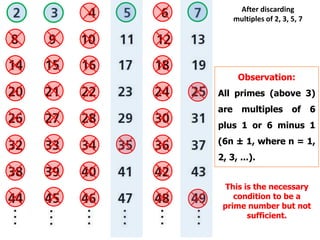
After discarding 
multiples of 2, 3, 5, 7 
Observation: 
All primes (above 3) 
are multiples of 6 
plus 1 or 6 minus 1 
(6n ± 1, where n = 1, 
2, 3, ...). 
This is the necessary 
condition to be a 
prime number but not 
sufficient.
How to identify PRIME NUMBER
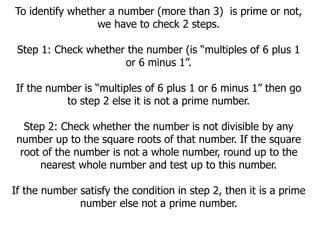
To identify whether a number (more than 3) is prime or not, 
we have to check 2 steps. 
Step 1: Check whether the number (is “multiples of 6 plus 1 
or 6 minus 1”. 
If the number is “multiples of 6 plus 1 or 6 minus 1” then go 
to step 2 else it is not a prime number. 
Step 2: Check whether the number is not divisible by any 
number up to the square roots of that number. If the square 
root of the number is not a whole number, round up to the 
nearest whole number and test up to this number. 
If the number satisfy the condition in step 2, then it is a prime 
number else not a prime number.
Thanks 
arddhendu2005@yahoo.com

Prime Number

  • 1.
  • 2.
    A prime numberis a natural number greater than 1 that has no positive divisors other than 1 and itself. A natural number greater than 1 that is not a prime number is called a composite number. For example, 5 is prime because 1 and 5 are its only positive integer factors, whereas 6 is composite because it has the divisors 2 and 3 in addition to 1 and 6.
  • 3.
  • 4.
    After discarding multiplesof 2, 3, 5, 7 Observation: All primes (above 3) are multiples of 6 plus 1 or 6 minus 1 (6n ± 1, where n = 1, 2, 3, ...). This is the necessary condition to be a prime number but not sufficient.
  • 5.
    How to identifyPRIME NUMBER
  • 6.
    To identify whethera number (more than 3) is prime or not, we have to check 2 steps. Step 1: Check whether the number (is “multiples of 6 plus 1 or 6 minus 1”. If the number is “multiples of 6 plus 1 or 6 minus 1” then go to step 2 else it is not a prime number. Step 2: Check whether the number is not divisible by any number up to the square roots of that number. If the square root of the number is not a whole number, round up to the nearest whole number and test up to this number. If the number satisfy the condition in step 2, then it is a prime number else not a prime number.
  • 7.