FIBONACCI & THE GOLD NUMBER
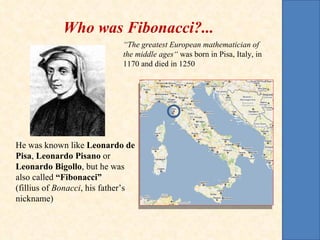
Who was Fibonacci?... “ The greatest European mathematician of the middle ages“  was born in Pisa, Italy, in 1170 and died in 1250 He was known like  Leonardo de Pisa ,  Leonardo Pisano  or  Leonardo Bigollo , but he was also called  “Fibonacci”  (fillius of  Bonacci , his father’s  nickname)
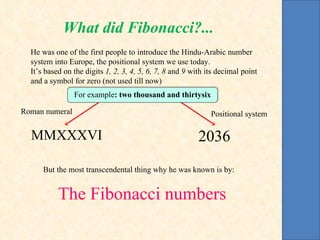
He was one of the first people to introduce the Hindu-Arabic number system into Europe, the positional system we use today. It’s based on the digits  1, 2, 3, 4, 5, 6, 7, 8  and  9  with its decimal point and a symbol for zero (not used till now) But the most transcendental thing why he was known is by: The Fibonacci numbers Roman numeral Positional system 2036 MMXXXVI For example : two thousand and thirtysix What did Fibonacci?...
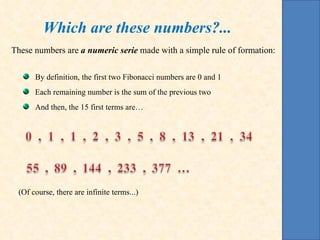
Which are these numbers?... By definition, the first two Fibonacci numbers are 0 and 1 These numbers are  a numeric serie  made with a simple rule of formation: Each remaining number is the sum of the previous two
By definition, the first two Fibonacci numbers are 0 and 1 Each remaining number is the sum of the previous two And then, the 15 first terms are… Which are these numbers?... These numbers are  a numeric serie  made with a simple rule of formation: (Of course, there are infinite terms...)
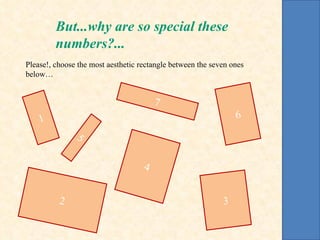
1 3 4 6 7 2 5 Please!, choose the most aesthetic rectangle between the seven ones below… But...why are so special these numbers?...
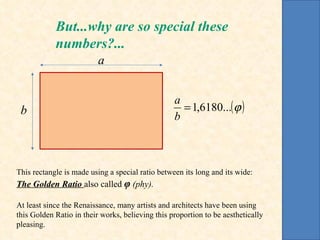
This rectangle is made using a special ratio between its long and its wide: The Golden Ratio  also called  φ   (phy). At least since the Renaissance, many artists and architects have been using this Golden Ratio in their works, believing this proportion to be aesthetically pleasing. But...why are so special these numbers?... a b
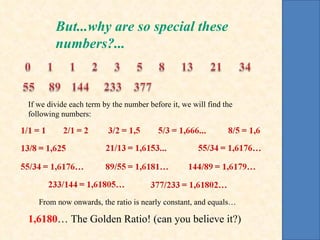
If we divide each term by the number before it, we will find the following numbers: From now onwards, the ratio is nearly constant, and equals… But...why are so special these numbers?... 1,6180 … The Golden Ratio! (can you believe it?)
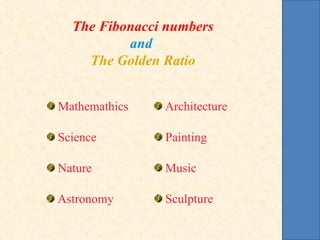
The Fibonacci numbers and  The Golden Ratio Mathemathics Science Architecture Painting Music Nature Astronomy Sculpture
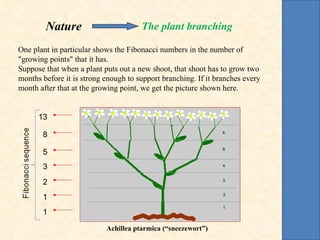
One plant in particular shows the Fibonacci numbers in the number of "growing points" that it has. Suppose that when a plant puts out a new shoot, that shoot has to grow two months before it is strong enough to support branching. If it branches every month after that at the growing point, we get the picture shown here. Nature   The plant branching 1 1 2 3 5 8 13 Achillea ptarmica (“sneezewort”)
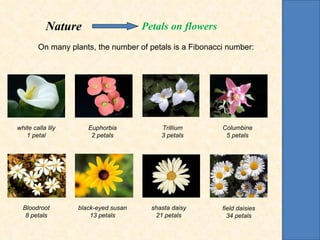
On many plants, the number of petals is a Fibonacci number: Nature   Petals on flowers white calla lily 1 petal Euphorbia 2 petals Trillium 3 petals Columbine 5 petals Bloodroot 8 petals black-eyed susan 13 petals shasta daisy 21 petals field daisies 34 petals
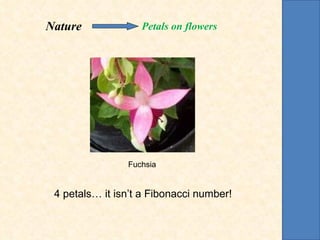
Fuchsia 4 petals… it isn’t a Fibonacci number! Nature   Petals on flowers
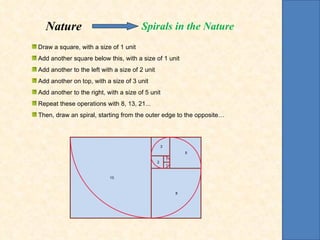
1 1 2 3 5 8 13 Add another square below this, with a size of 1 unit Add another to the left with a size of 2 unit Add another on top, with a size of 3 unit Add another to the right, with a size of 5 unit Repeat these operations with 8, 13, 21... Draw a square, with a size of 1 unit Then, draw an spiral, starting from the outer edge to the opposite… Nature   Spirals in the Nature
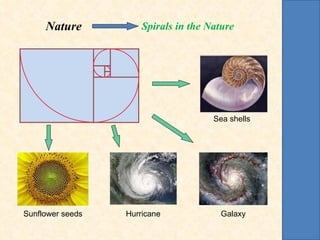
Nature   Spirals in the Nature Sunflower seeds Hurricane Galaxy Sea shells
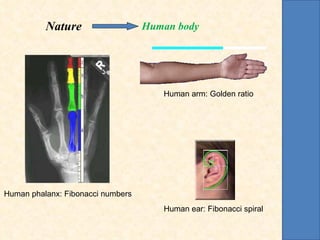
Nature   Human body Human ear: Fibonacci spiral Human arm: Golden ratio Human phalanx: Fibonacci numbers
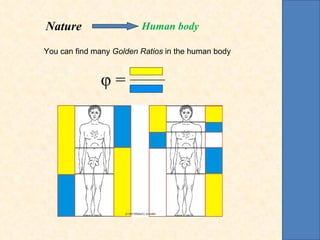
You can find many  Golden Ratios  in the human body Nature   Human body φ  =
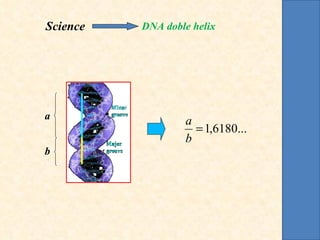
Science   DNA doble helix a b
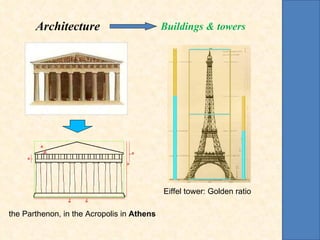
Architecture   Buildings & towers Eiffel tower: Golden ratio the Parthenon, in the Acropolis in  Athens
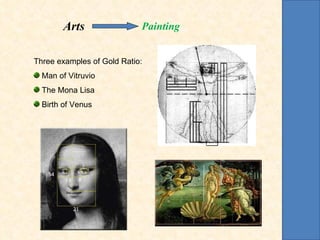
Three examples of Gold Ratio: Man of Vitruvio The Mona Lisa Birth of Venus Arts   Painting
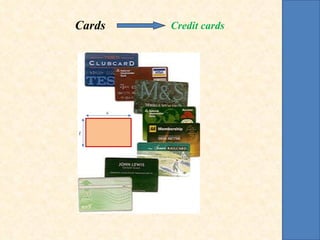
Cards   Credit cards a b
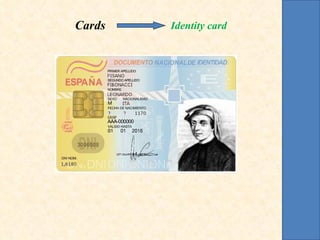
Cards   Identity card

Fibonacci gold number

  • 1.
    FIBONACCI & THEGOLD NUMBER
  • 2.
    Who was Fibonacci?...“ The greatest European mathematician of the middle ages“ was born in Pisa, Italy, in 1170 and died in 1250 He was known like Leonardo de Pisa , Leonardo Pisano or Leonardo Bigollo , but he was also called “Fibonacci” (fillius of Bonacci , his father’s nickname)
  • 3.
    He was oneof the first people to introduce the Hindu-Arabic number system into Europe, the positional system we use today. It’s based on the digits 1, 2, 3, 4, 5, 6, 7, 8 and 9 with its decimal point and a symbol for zero (not used till now) But the most transcendental thing why he was known is by: The Fibonacci numbers Roman numeral Positional system 2036 MMXXXVI For example : two thousand and thirtysix What did Fibonacci?...
  • 4.
    Which are thesenumbers?... By definition, the first two Fibonacci numbers are 0 and 1 These numbers are a numeric serie made with a simple rule of formation: Each remaining number is the sum of the previous two
  • 5.
    By definition, thefirst two Fibonacci numbers are 0 and 1 Each remaining number is the sum of the previous two And then, the 15 first terms are… Which are these numbers?... These numbers are a numeric serie made with a simple rule of formation: (Of course, there are infinite terms...)
  • 6.
    1 3 46 7 2 5 Please!, choose the most aesthetic rectangle between the seven ones below… But...why are so special these numbers?...
  • 7.
    This rectangle ismade using a special ratio between its long and its wide: The Golden Ratio also called φ (phy). At least since the Renaissance, many artists and architects have been using this Golden Ratio in their works, believing this proportion to be aesthetically pleasing. But...why are so special these numbers?... a b
  • 8.
    If we divideeach term by the number before it, we will find the following numbers: From now onwards, the ratio is nearly constant, and equals… But...why are so special these numbers?... 1,6180 … The Golden Ratio! (can you believe it?)
  • 9.
    The Fibonacci numbersand The Golden Ratio Mathemathics Science Architecture Painting Music Nature Astronomy Sculpture
  • 10.
    One plant inparticular shows the Fibonacci numbers in the number of "growing points" that it has. Suppose that when a plant puts out a new shoot, that shoot has to grow two months before it is strong enough to support branching. If it branches every month after that at the growing point, we get the picture shown here. Nature The plant branching 1 1 2 3 5 8 13 Achillea ptarmica (“sneezewort”)
  • 11.
    On many plants,the number of petals is a Fibonacci number: Nature Petals on flowers white calla lily 1 petal Euphorbia 2 petals Trillium 3 petals Columbine 5 petals Bloodroot 8 petals black-eyed susan 13 petals shasta daisy 21 petals field daisies 34 petals
  • 12.
    Fuchsia 4 petals…it isn’t a Fibonacci number! Nature Petals on flowers
  • 13.
    1 1 23 5 8 13 Add another square below this, with a size of 1 unit Add another to the left with a size of 2 unit Add another on top, with a size of 3 unit Add another to the right, with a size of 5 unit Repeat these operations with 8, 13, 21... Draw a square, with a size of 1 unit Then, draw an spiral, starting from the outer edge to the opposite… Nature Spirals in the Nature
  • 14.
    Nature Spirals in the Nature Sunflower seeds Hurricane Galaxy Sea shells
  • 15.
    Nature Human body Human ear: Fibonacci spiral Human arm: Golden ratio Human phalanx: Fibonacci numbers
  • 16.
    You can findmany Golden Ratios in the human body Nature Human body φ =
  • 17.
    Science DNA doble helix a b
  • 18.
    Architecture Buildings & towers Eiffel tower: Golden ratio the Parthenon, in the Acropolis in  Athens
  • 19.
    Three examples ofGold Ratio: Man of Vitruvio The Mona Lisa Birth of Venus Arts Painting
  • 20.
    Cards Credit cards a b
  • 21.
    Cards Identity card