1V.RAMYA
2V.RAMYA
3V.RAMYA
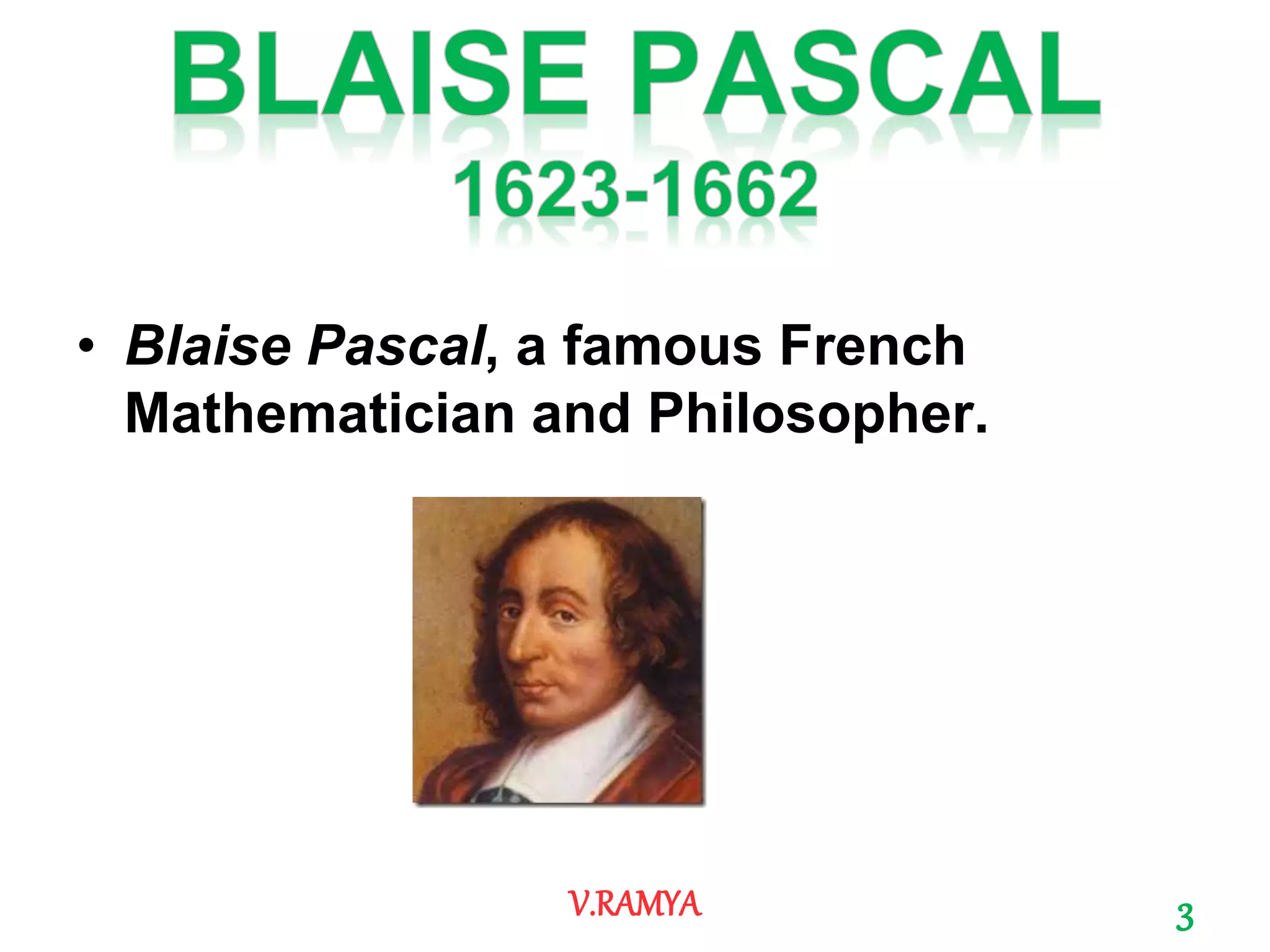
• Blaise Pascal, a famous French
Mathematician and Philosopher.
4V.RAMYA
• One of the most interesting Number
Patterns is Pascal's Triangle (named
after Blaise Pascal, a famous French
Mathematician and Philosopher).
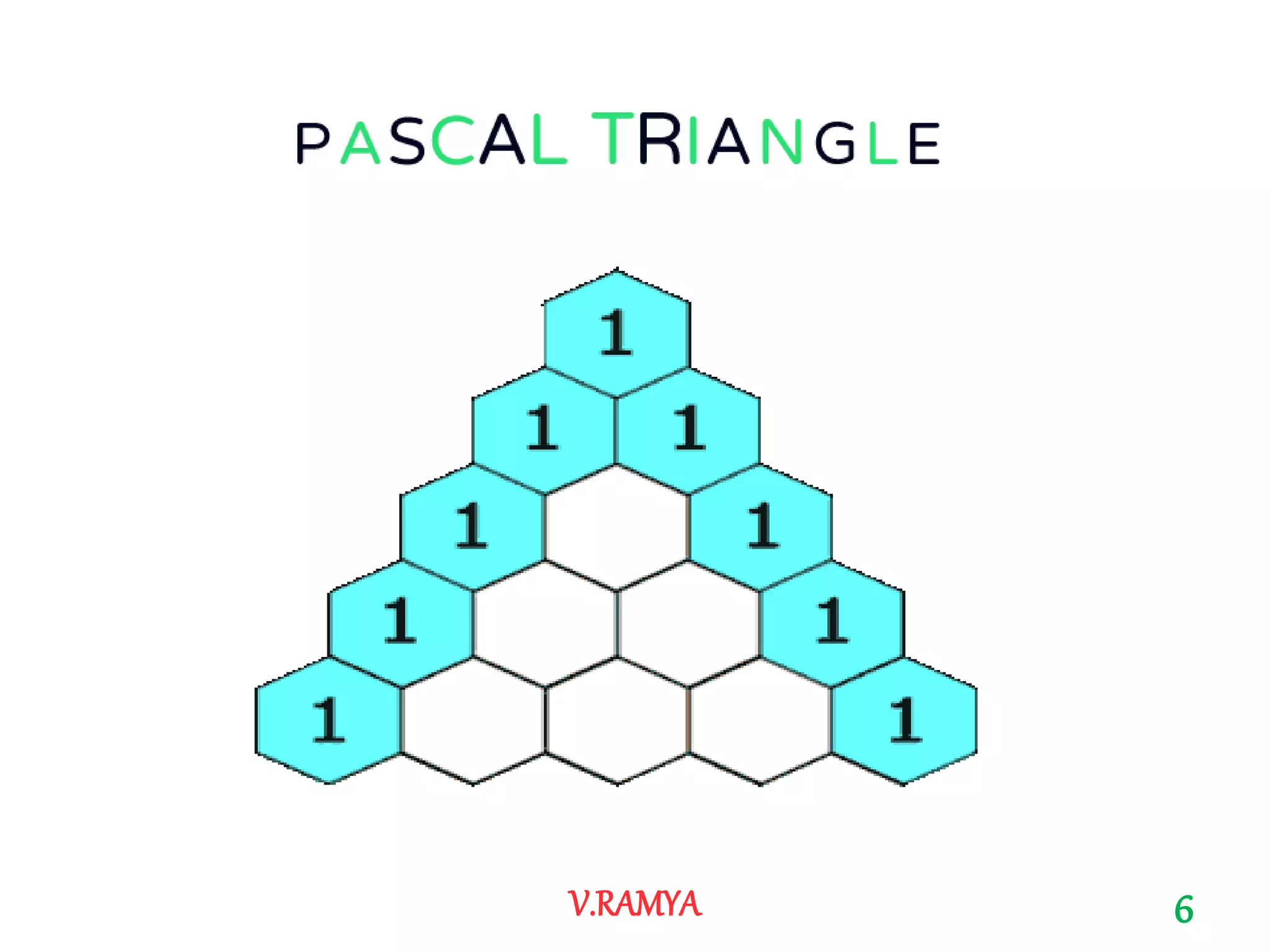
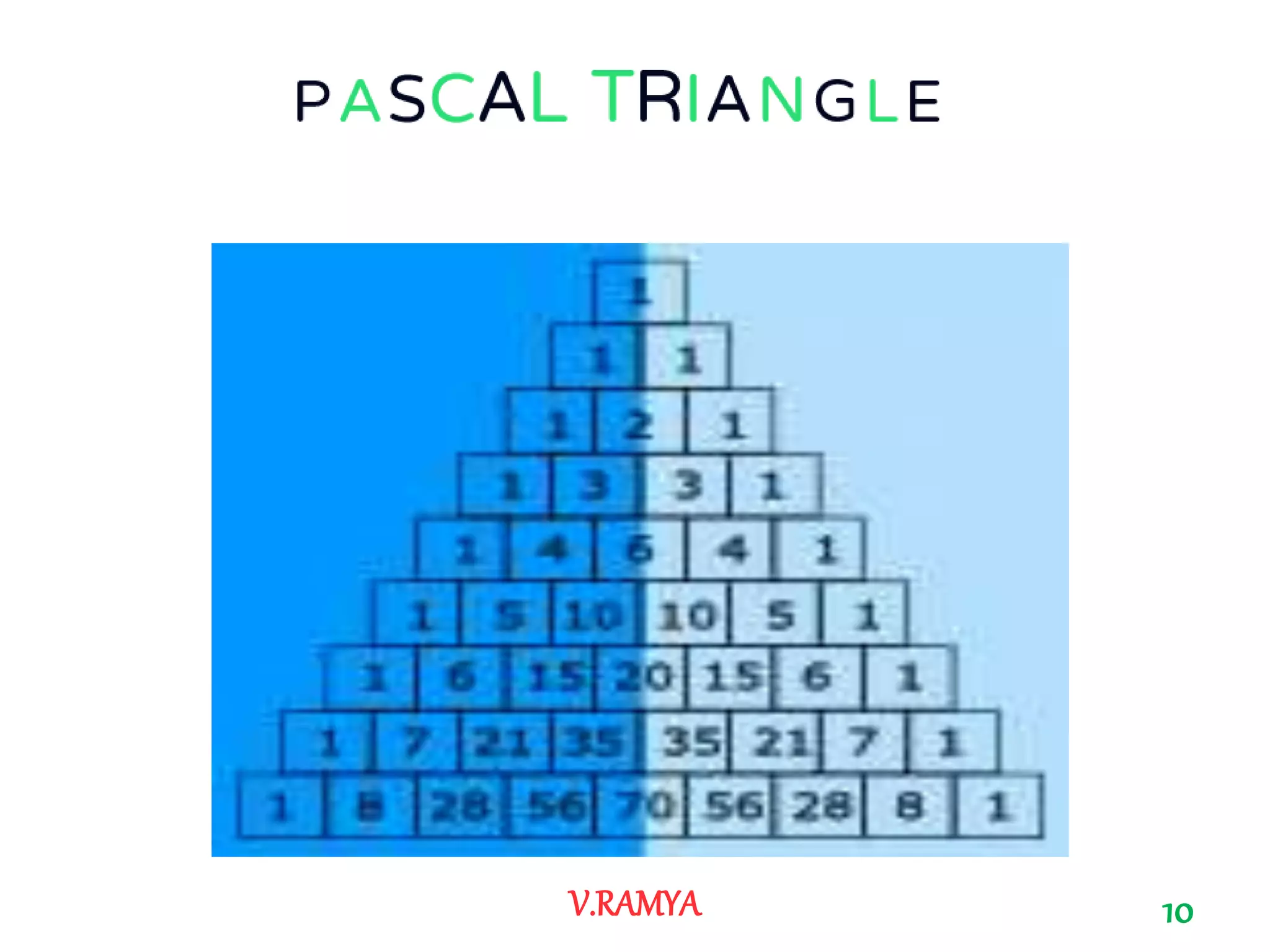
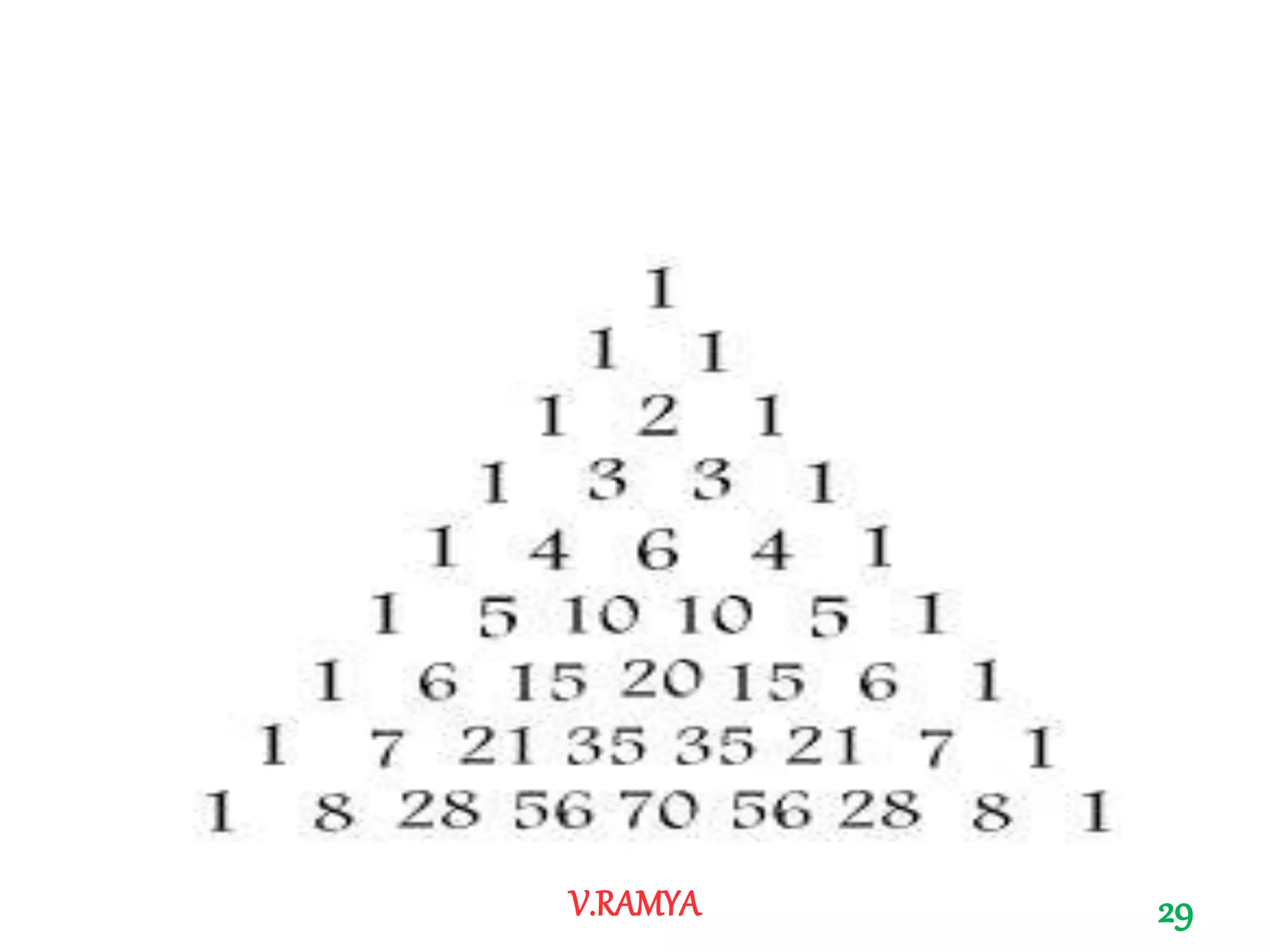
• To build the triangle, start with "1" at
the top, then continue placing numbers
below it in a triangular pattern.
Each number is the numbers directly
above it added together.
5V.RAMYA
6V.RAMYA
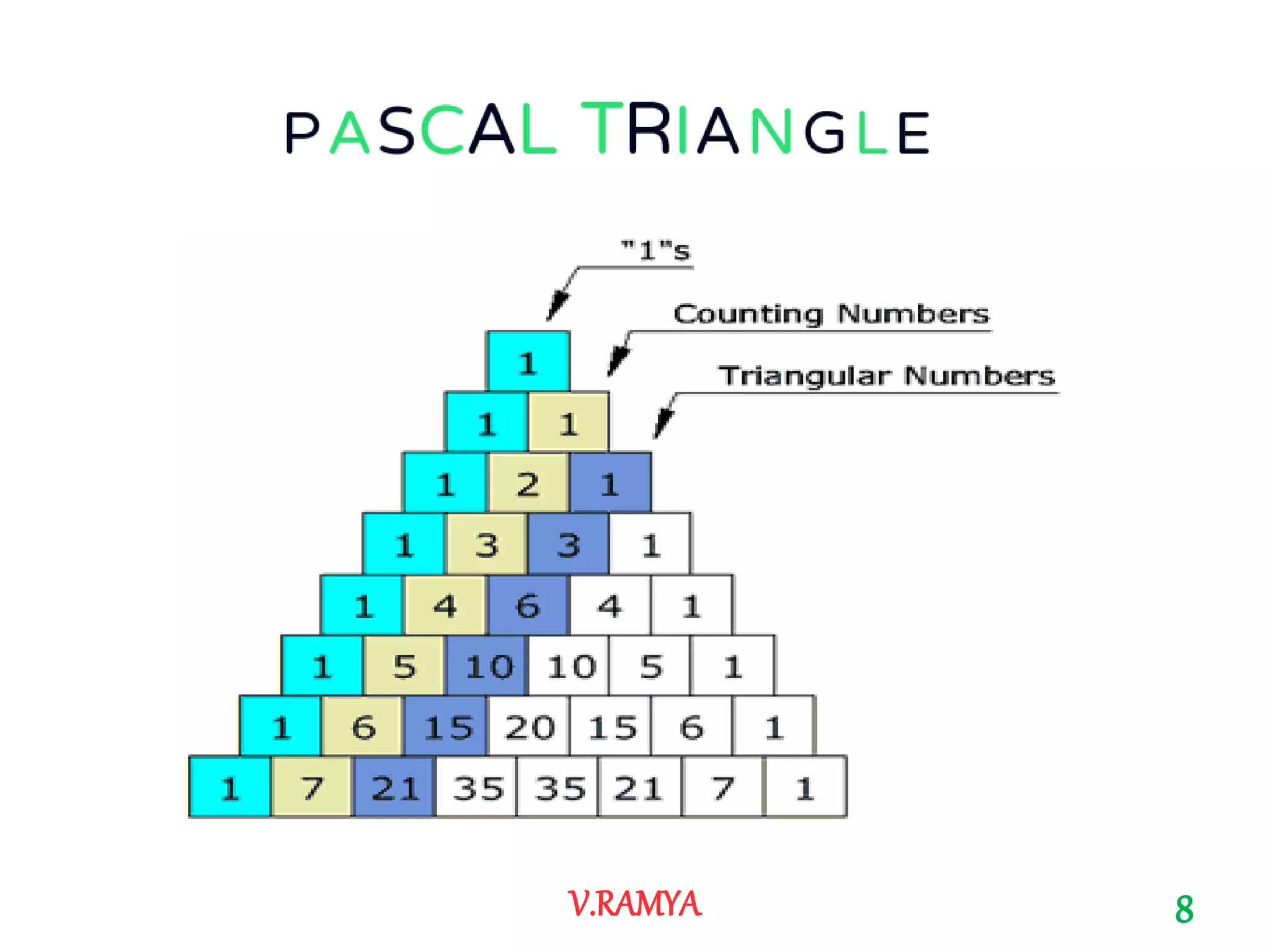
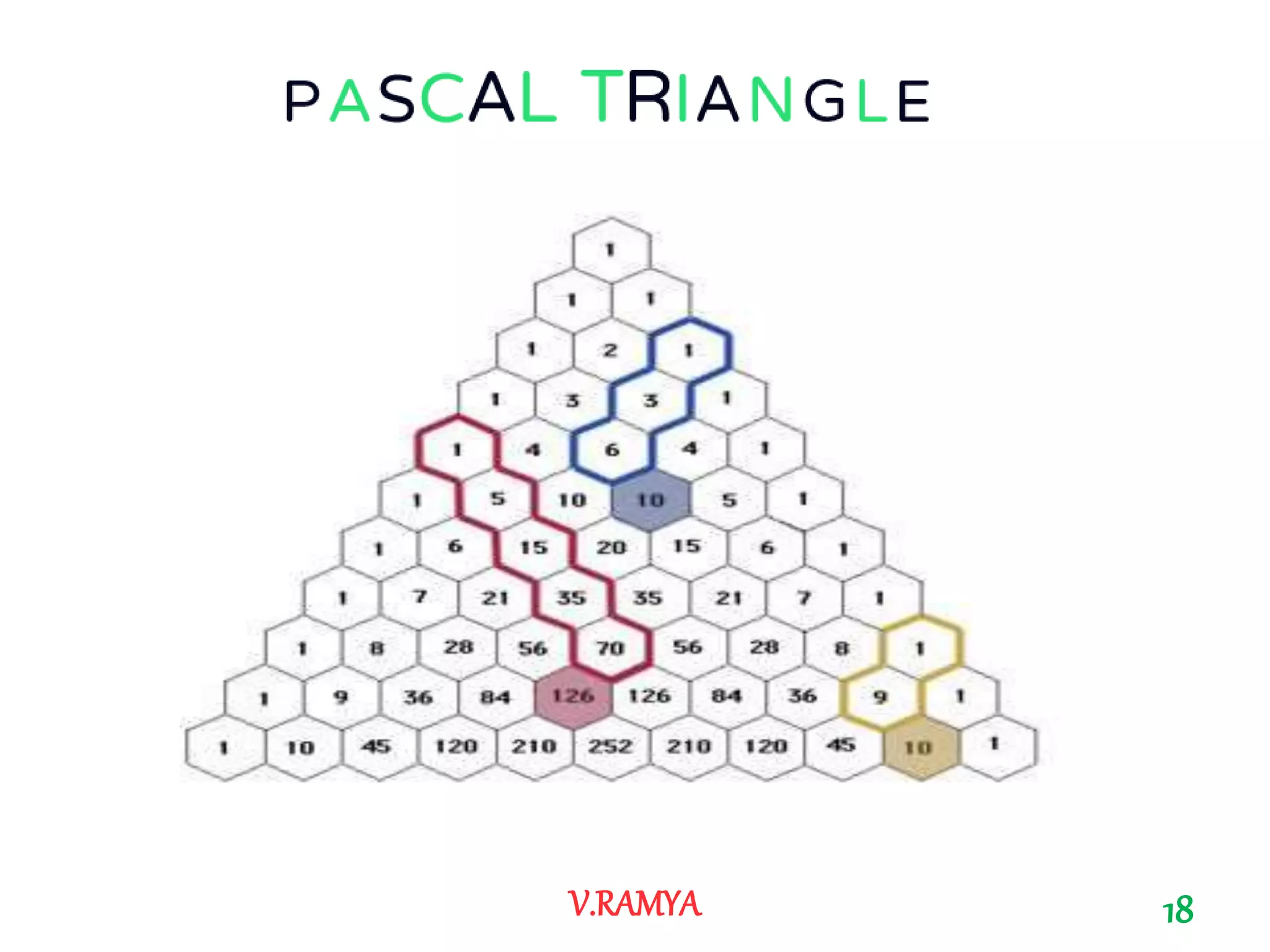
• The first diagonal is, of course, just "1"s
• The next diagonal has the Counting
Numbers (1,2,3, etc).
• The third diagonal has the triangular
numbers
• (The fourth diagonal, not highlighted, has
the tetrahedral numbers.)
7V.RAMYA
8V.RAMYA
• The triangle is also symmetrical. The
numbers on the left side have identical
matching numbers on the right side,
like a mirror image.
9V.RAMYA
10V.RAMYA
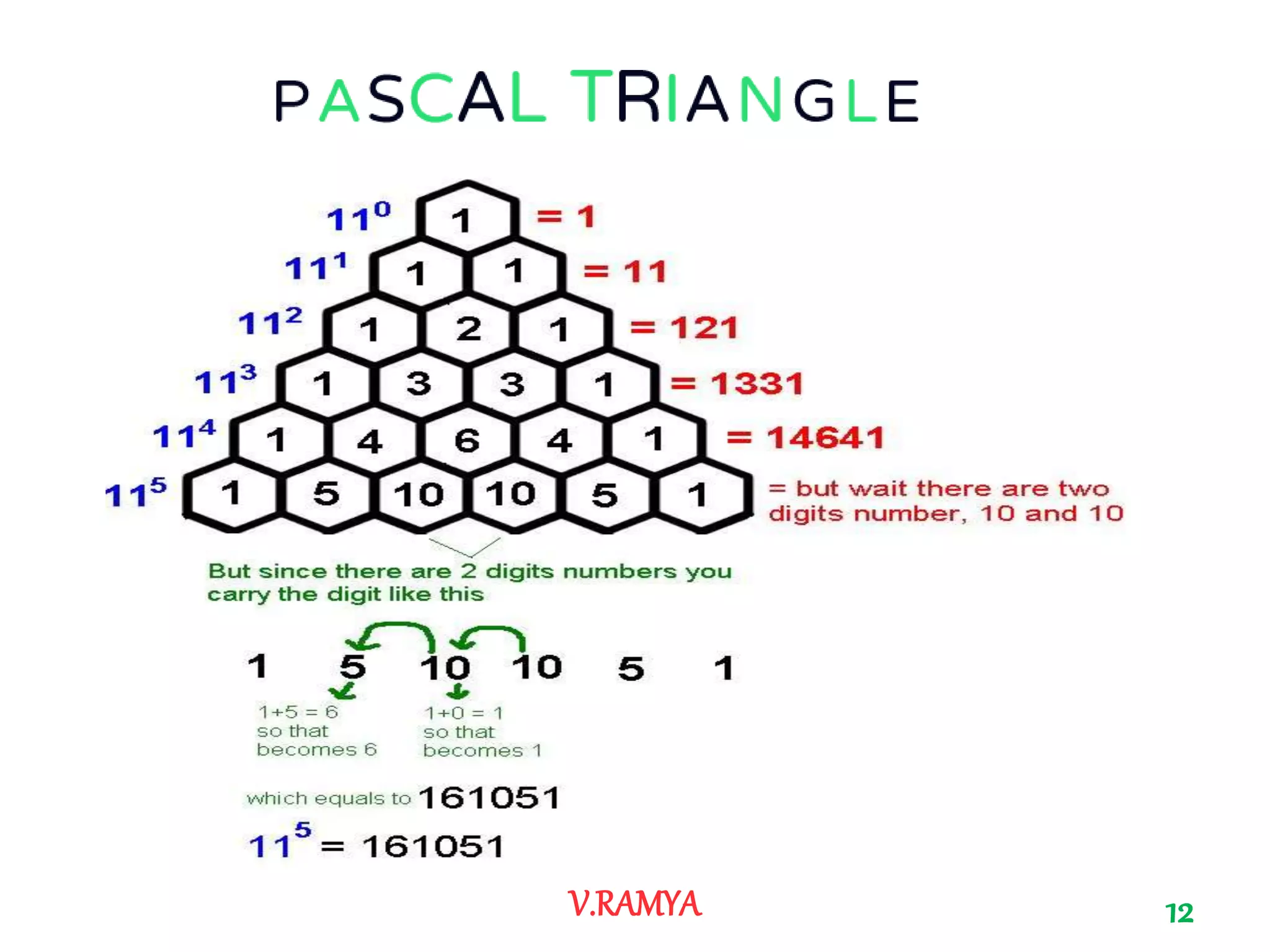
• Each line is also the powers
(exponents) of 11:
• 110=1 (the first line is just a "1")
• 111=11 (the second line is "1" and "1")
• 112=121 (the third line is "1", "2", "1")
• etc!
11V.RAMYA
12V.RAMYA
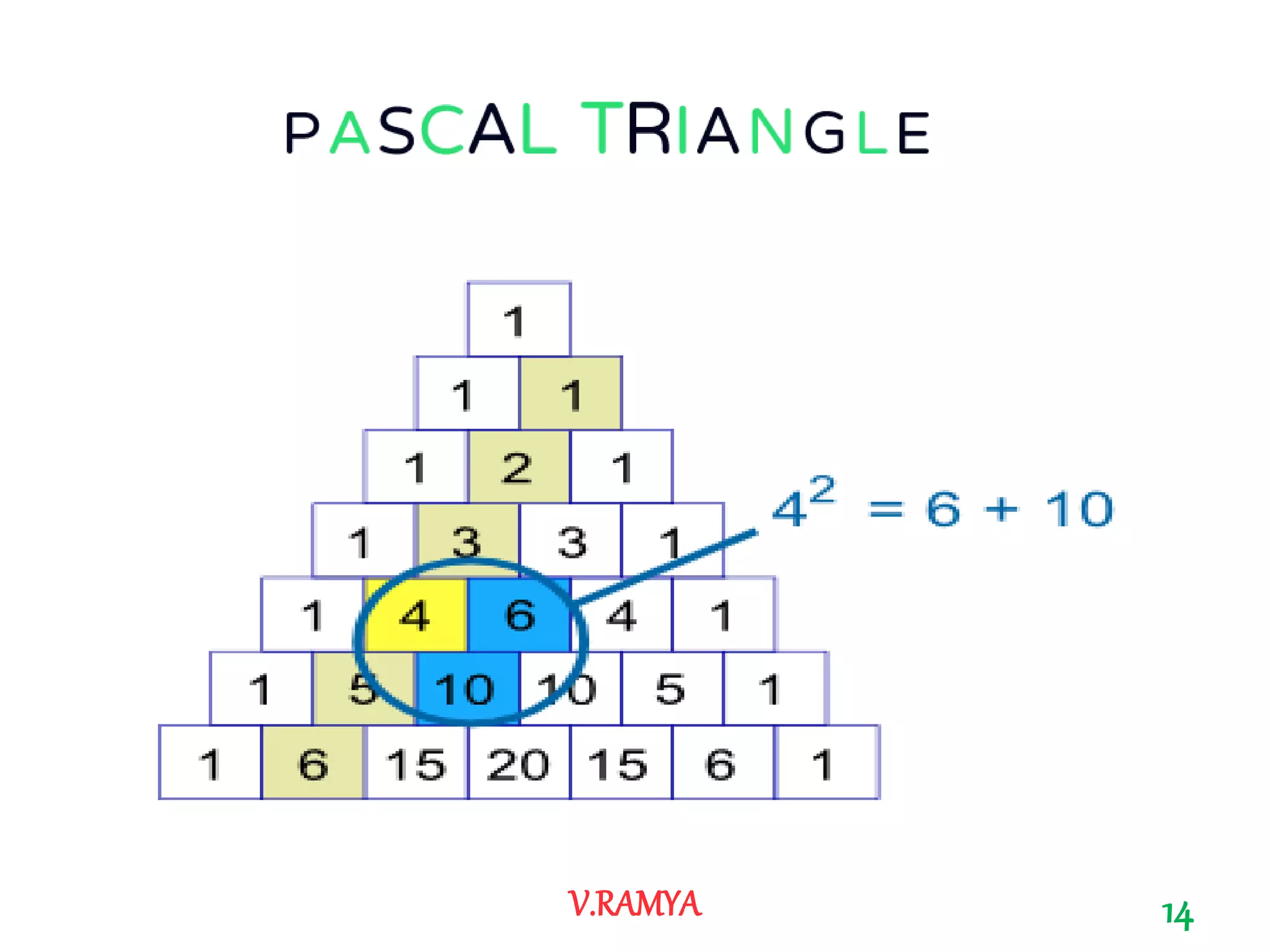
• For the second diagonal, the square of a
number is equal to the sum of the
numbers next to it and below both of
those.
• Examples:
• 32 = 3 + 6 = 9,
• 42 = 6 + 10 = 16,
• 52 = 10 + 15 = 25,
13V.RAMYA
14V.RAMYA
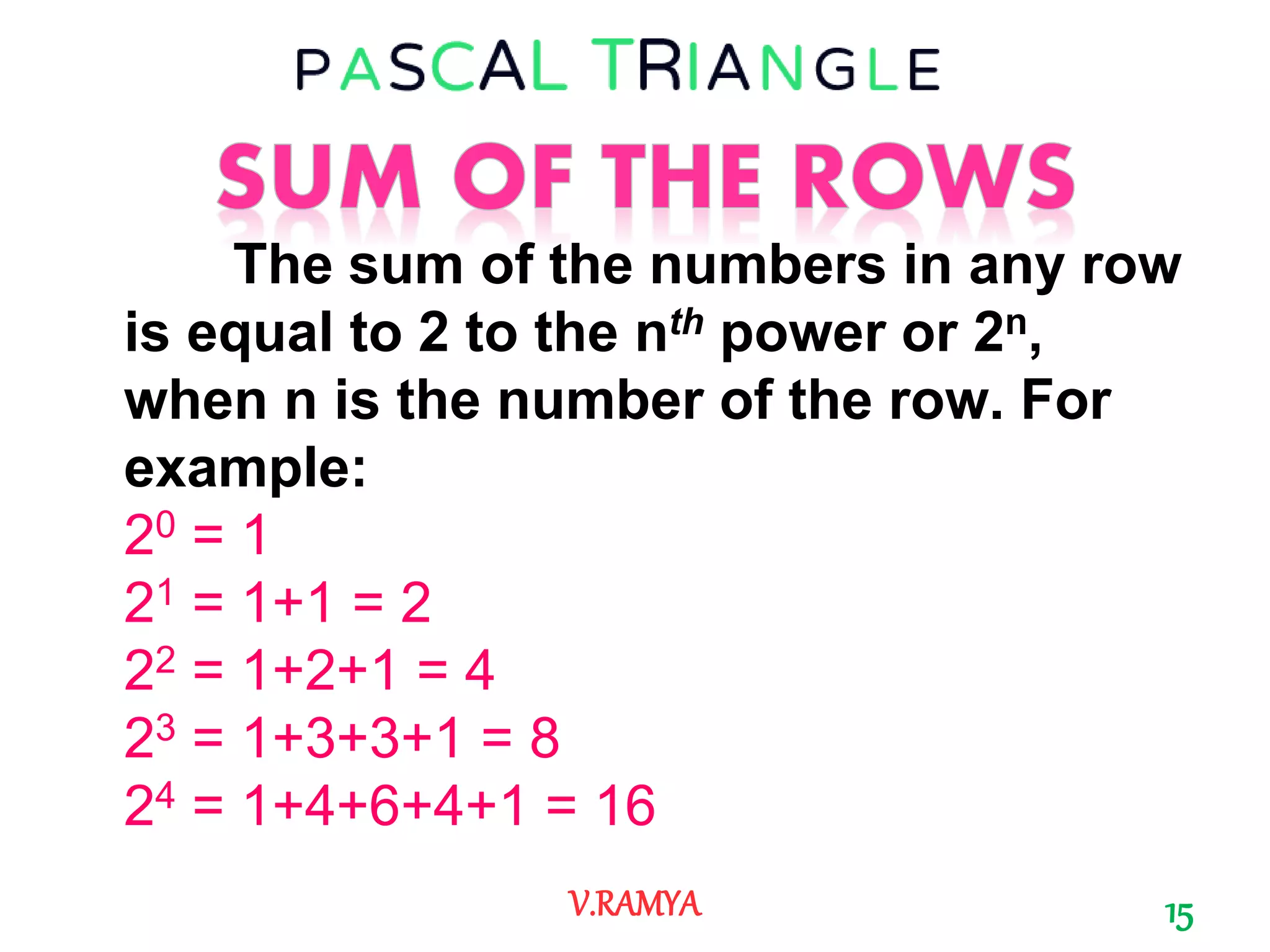
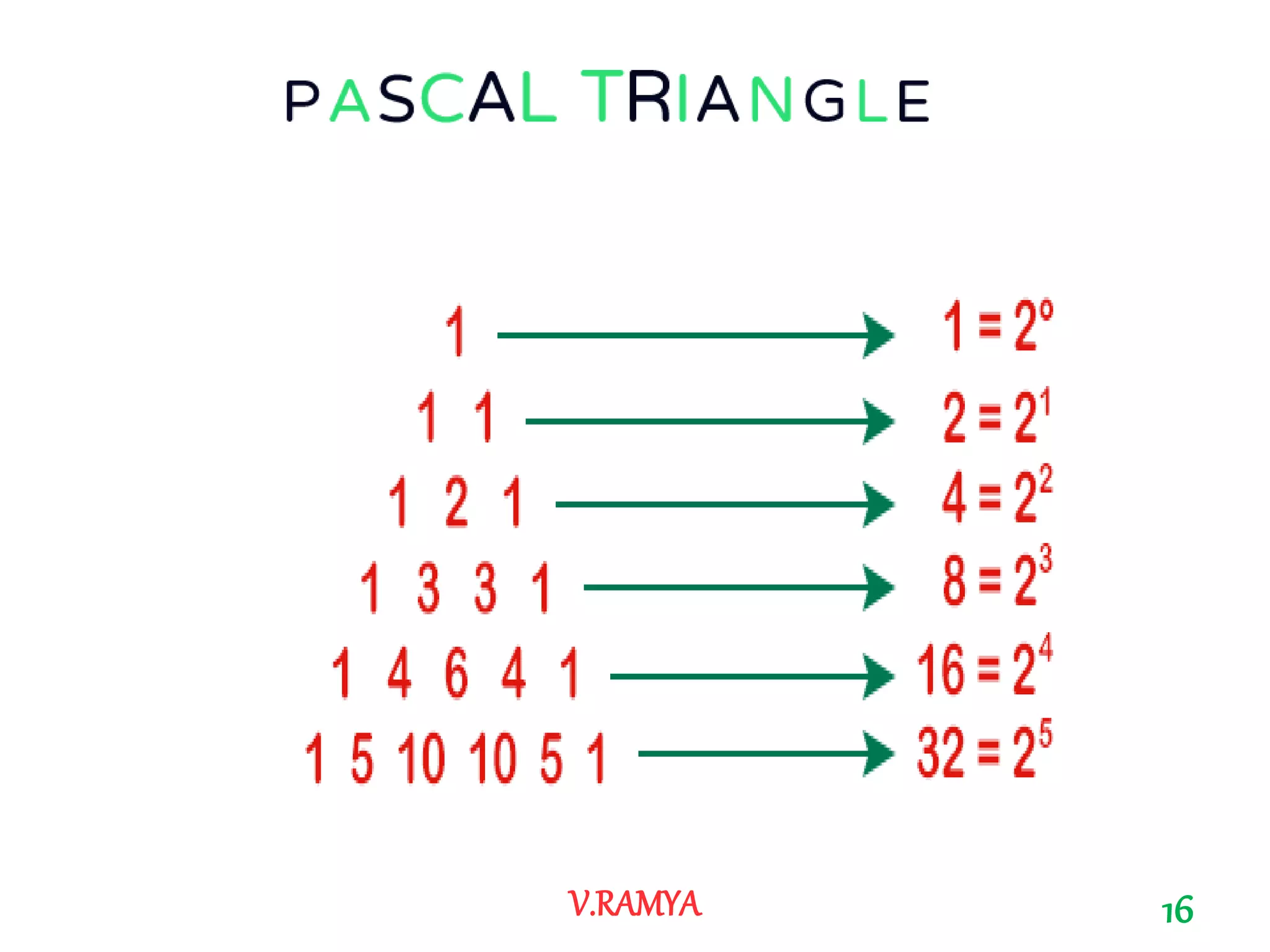
The sum of the numbers in any row
is equal to 2 to the nth power or 2n,
when n is the number of the row. For
example:
20 = 1
21 = 1+1 = 2
22 = 1+2+1 = 4
23 = 1+3+3+1 = 8
24 = 1+4+6+4+1 = 16
15V.RAMYA
16V.RAMYA
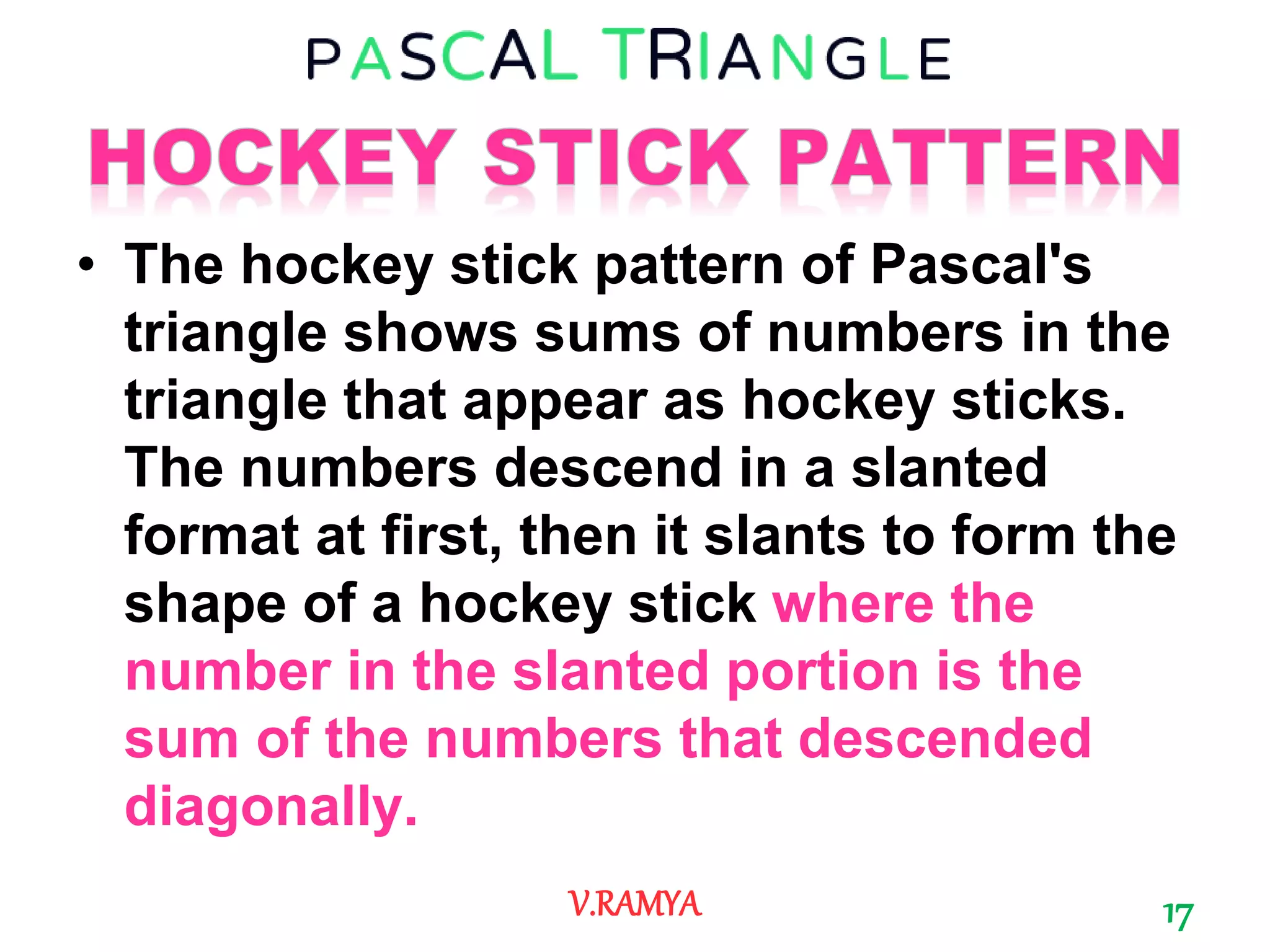
• The hockey stick pattern of Pascal's
triangle shows sums of numbers in the
triangle that appear as hockey sticks.
The numbers descend in a slanted
format at first, then it slants to form the
shape of a hockey stick where the
number in the slanted portion is the
sum of the numbers that descended
diagonally.
17V.RAMYA
18V.RAMYA
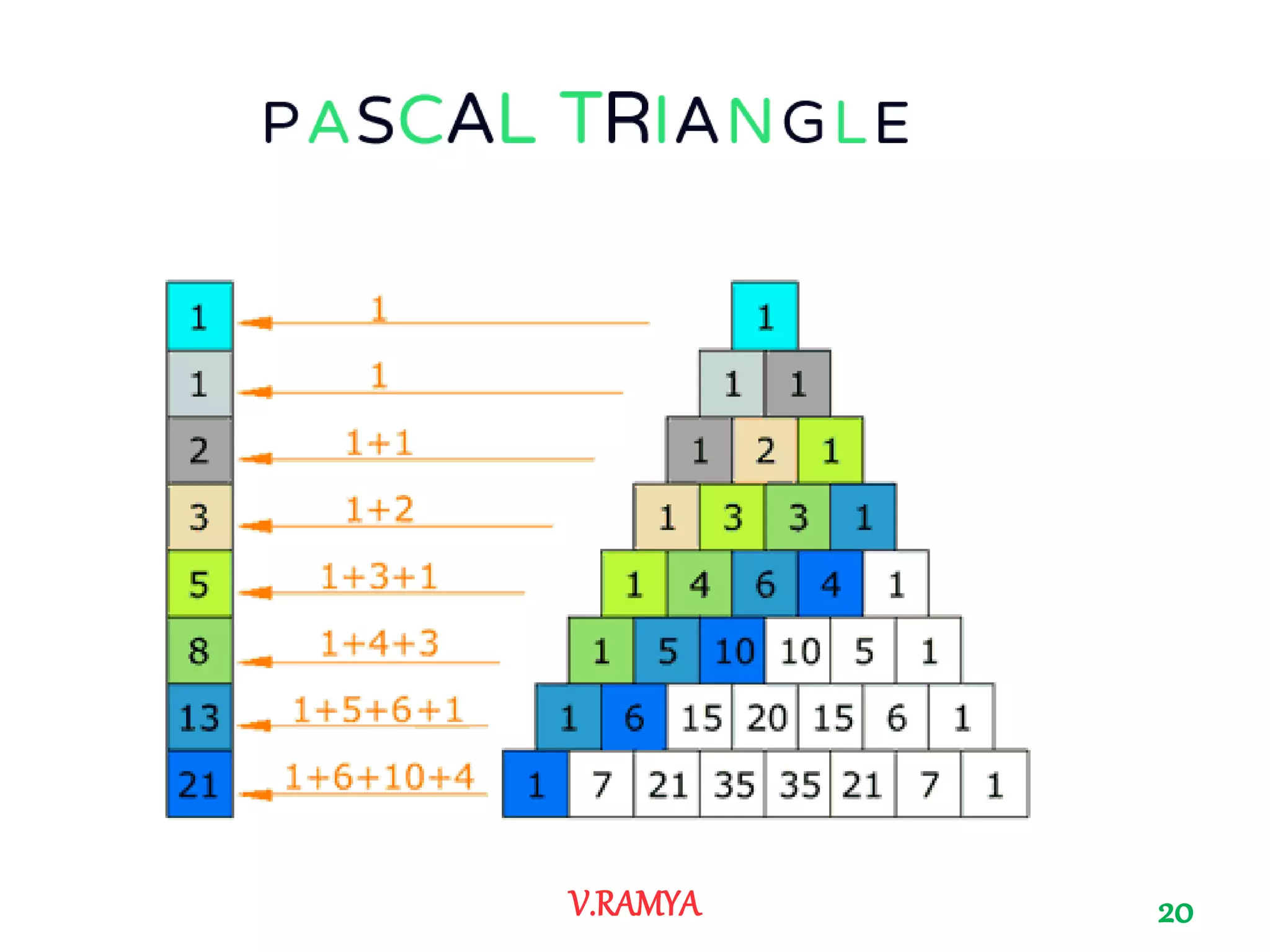
• Fibonacci Sequence sum the
diagonals of the left-justified Pascal
Triangle.
19V.RAMYA
20V.RAMYA
• Using the original orientation of
Pascal’s Triangle, shade in all the odd
numbers and you’ll get a picture that
looks similar to the famous fractal
Sierpinski Triangle.
21V.RAMYA
V.RAMYA 22
V.RAMYA 23
24V.RAMYA
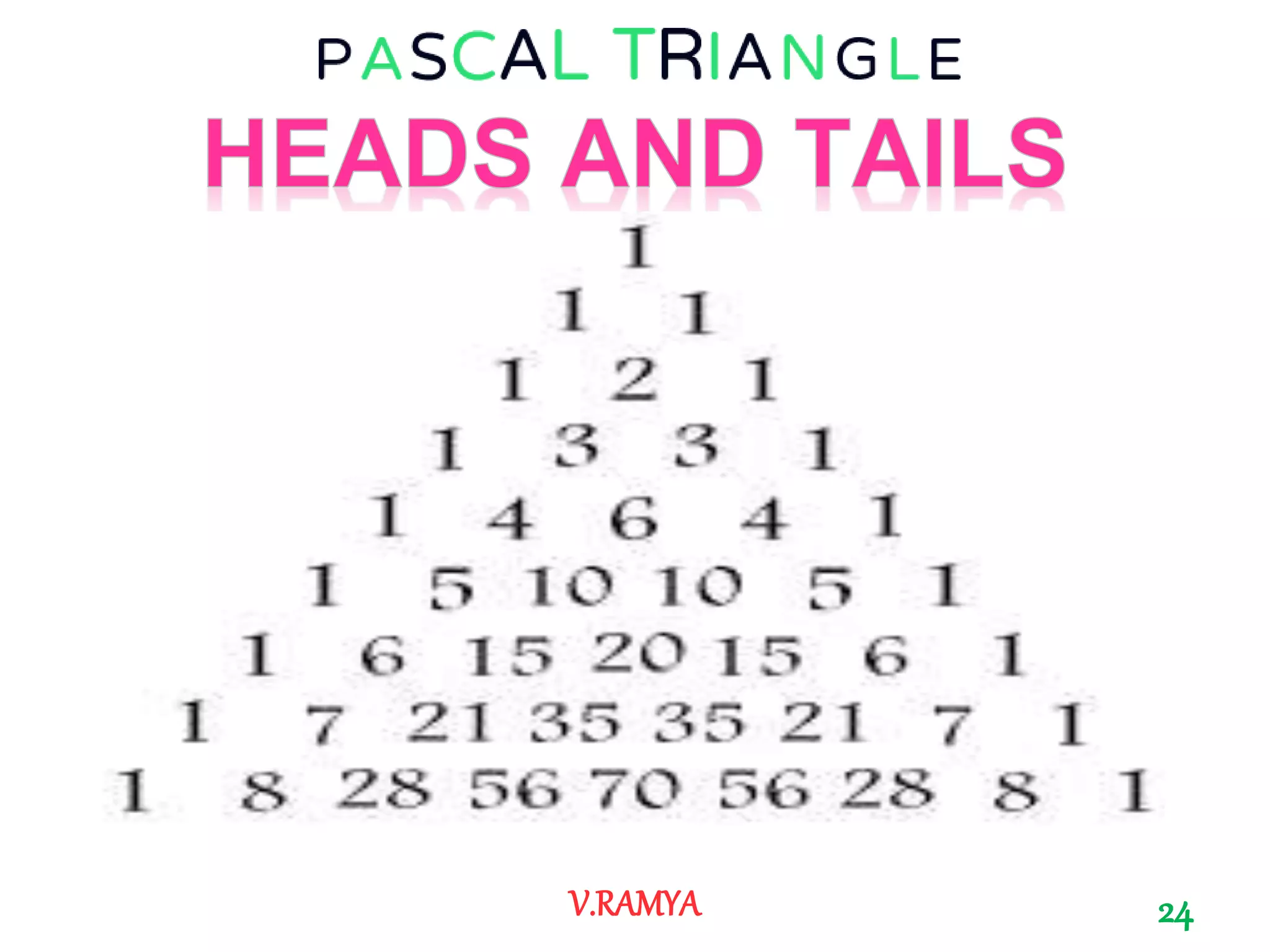
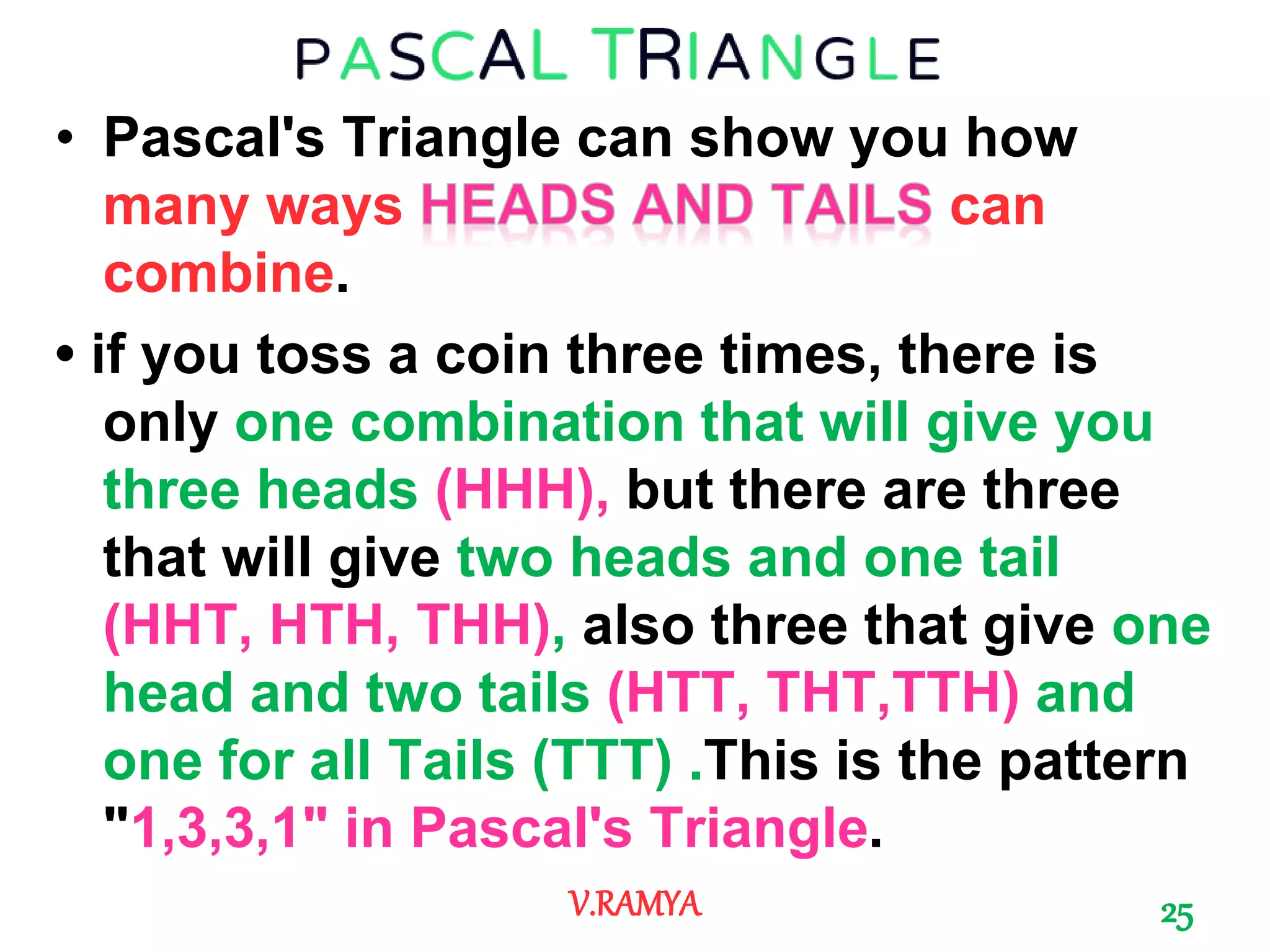
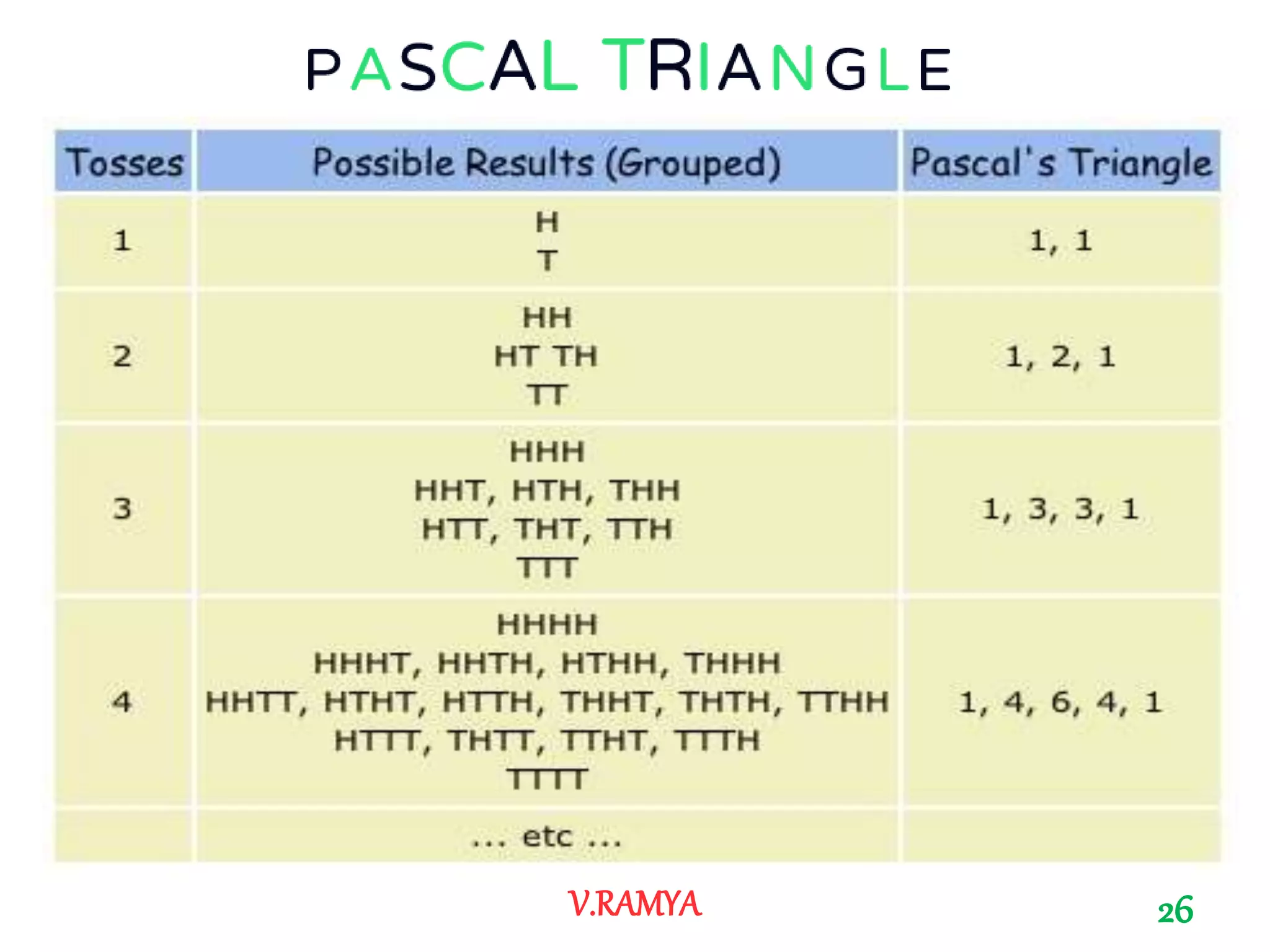
• Pascal's Triangle can show you how
many ways can
combine.
• if you toss a coin three times, there is
only one combination that will give you
three heads (HHH), but there are three
that will give two heads and one tail
(HHT, HTH, THH), also three that give one
head and two tails (HTT, THT,TTH) and
one for all Tails (TTT) .This is the pattern
"1,3,3,1" in Pascal's Triangle.
25V.RAMYA
26V.RAMYA
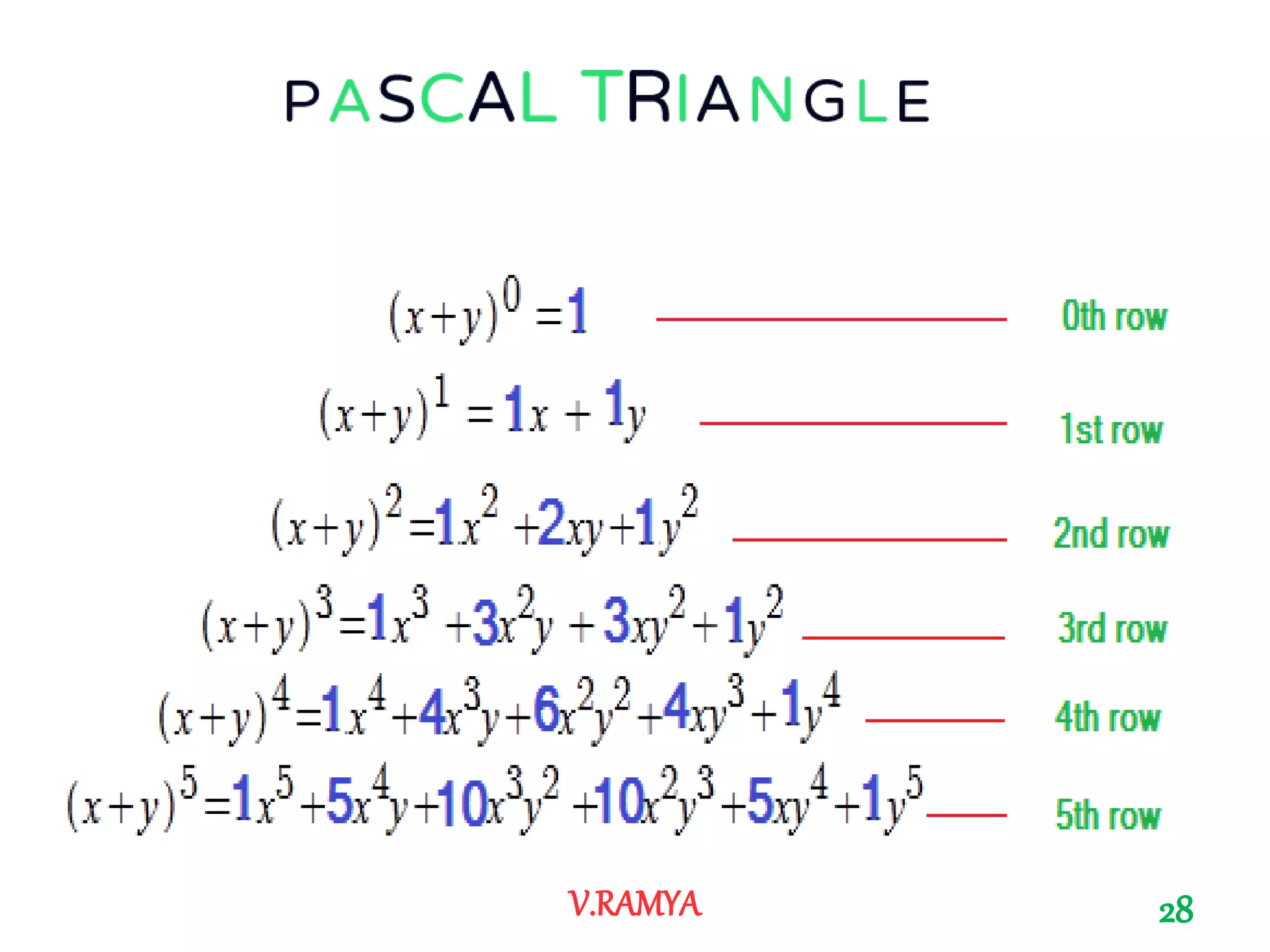
• Pascal's Triangle can also show you
the coefficients in binomial expansion
27V.RAMYA
28V.RAMYA
29V.RAMYA
V.RAMYA 30
31V.RAMYA
32V.RAMYA

Pascal- triangle- 134929855

  • 1.
  • 2.
  • 3.
    3V.RAMYA • Blaise Pascal,a famous French Mathematician and Philosopher.
  • 4.
  • 5.
    • One ofthe most interesting Number Patterns is Pascal's Triangle (named after Blaise Pascal, a famous French Mathematician and Philosopher). • To build the triangle, start with "1" at the top, then continue placing numbers below it in a triangular pattern. Each number is the numbers directly above it added together. 5V.RAMYA
  • 6.
  • 7.
    • The firstdiagonal is, of course, just "1"s • The next diagonal has the Counting Numbers (1,2,3, etc). • The third diagonal has the triangular numbers • (The fourth diagonal, not highlighted, has the tetrahedral numbers.) 7V.RAMYA
  • 8.
  • 9.
    • The triangleis also symmetrical. The numbers on the left side have identical matching numbers on the right side, like a mirror image. 9V.RAMYA
  • 10.
  • 11.
    • Each lineis also the powers (exponents) of 11: • 110=1 (the first line is just a "1") • 111=11 (the second line is "1" and "1") • 112=121 (the third line is "1", "2", "1") • etc! 11V.RAMYA
  • 12.
  • 13.
    • For thesecond diagonal, the square of a number is equal to the sum of the numbers next to it and below both of those. • Examples: • 32 = 3 + 6 = 9, • 42 = 6 + 10 = 16, • 52 = 10 + 15 = 25, 13V.RAMYA
  • 14.
  • 15.
    The sum ofthe numbers in any row is equal to 2 to the nth power or 2n, when n is the number of the row. For example: 20 = 1 21 = 1+1 = 2 22 = 1+2+1 = 4 23 = 1+3+3+1 = 8 24 = 1+4+6+4+1 = 16 15V.RAMYA
  • 16.
  • 17.
    • The hockeystick pattern of Pascal's triangle shows sums of numbers in the triangle that appear as hockey sticks. The numbers descend in a slanted format at first, then it slants to form the shape of a hockey stick where the number in the slanted portion is the sum of the numbers that descended diagonally. 17V.RAMYA
  • 18.
  • 19.
    • Fibonacci Sequencesum the diagonals of the left-justified Pascal Triangle. 19V.RAMYA
  • 20.
  • 21.
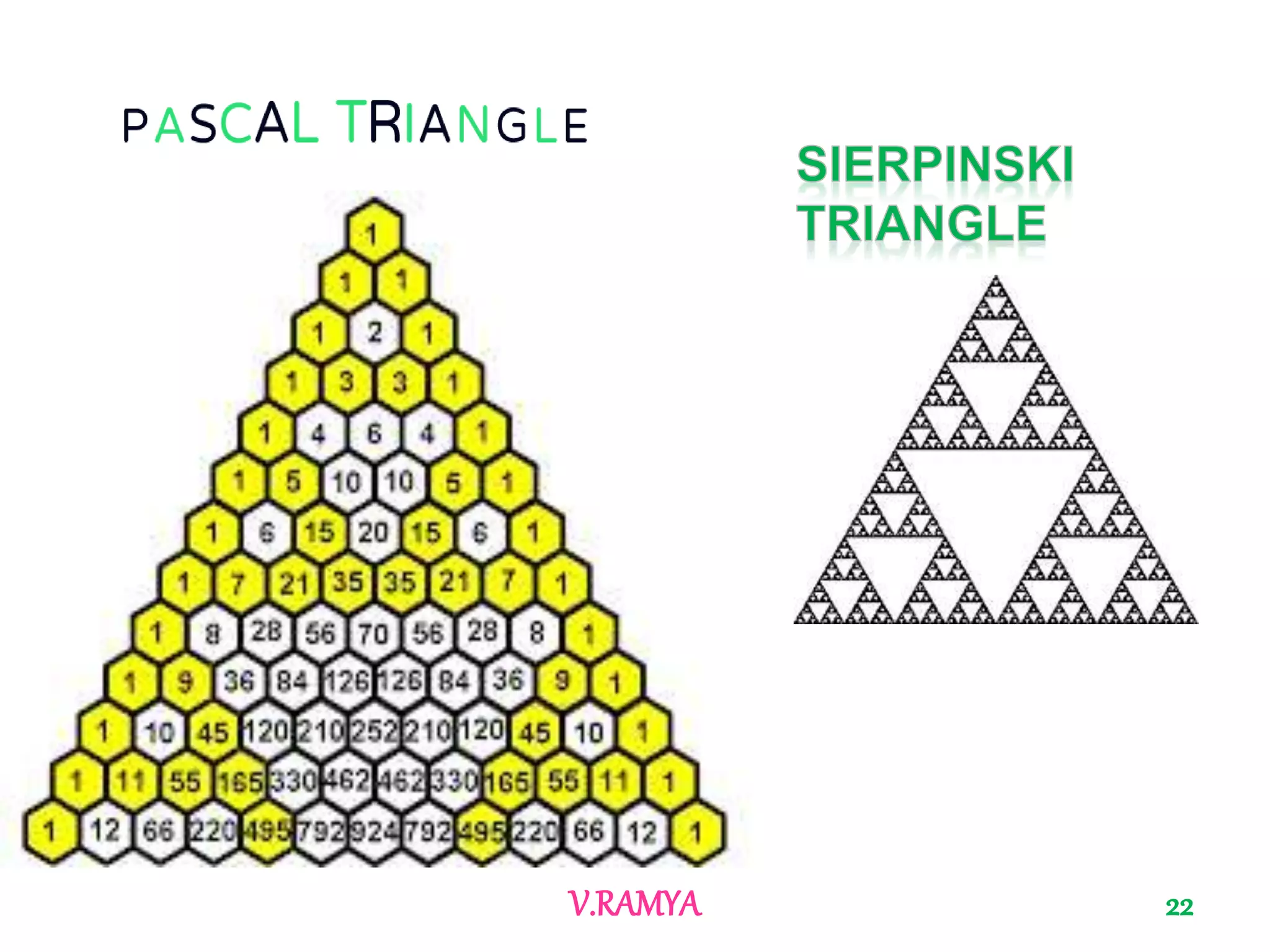
    • Using theoriginal orientation of Pascal’s Triangle, shade in all the odd numbers and you’ll get a picture that looks similar to the famous fractal Sierpinski Triangle. 21V.RAMYA
  • 22.
  • 23.
  • 24.
  • 25.
    • Pascal's Trianglecan show you how many ways can combine. • if you toss a coin three times, there is only one combination that will give you three heads (HHH), but there are three that will give two heads and one tail (HHT, HTH, THH), also three that give one head and two tails (HTT, THT,TTH) and one for all Tails (TTT) .This is the pattern "1,3,3,1" in Pascal's Triangle. 25V.RAMYA
  • 26.
  • 27.
    • Pascal's Trianglecan also show you the coefficients in binomial expansion 27V.RAMYA
  • 28.
  • 29.
  • 30.
  • 31.
  • 32.