Ma. Julita B. Obiles
BICOL
UNIVERSITY
Legazpi City
16TH CENTURY MATHEMATICS
 Cultural, intellectual and artistic movement of the
Renaissance began in Italy around the 14th Century
 Gradually spread across most of Europe over the next two
centuries
 Science and art were still very much interconnected and
intermingled at this time, as exemplified by the work of
artist/scientists such as Leonardo da Vinci
 Just as in art, revolutionary work in the fields of philosophy and
science was took place
LATE 15TH, EARLY 16TH CENTURY
 Albrecht Dürer (German Artist)
- included an order-4 magic square in his engraving
“Melencolia I”
- super magic square” with many more lines of addition
symmetry than a regular 4 x 4 magic square (1514).
 Luca Pacioli (Italian Franciscan friar)
- published a book on arithmetic, geometry and book-keeping
at the end of the 15th Century
LATE 15TH, EARLY 16TH CENTURY
 Luca Pacioli (Italian Franciscan friar)
- became quite popular for the mathematical puzzles it
contained
- also introduced symbols for plus and minus for the first
time in a printed book (sometimes attributed to Giel Vander
Hoecke, Johannes Widmann and others)
- symbols that were to become standard notation
LATE 15TH, EARLY 16TH CENTURY
 Luca Pacioli (Italian Franciscan friar)
- also investigated the Golden Ratio of 1 : 1.618 in
his 1509 book “The Divine Proportion”
- concluded that the number was a message from
God and a source of secret knowledge about the
inner beauty of things.
16TH AND EARLY 17TH CENTURY
 The equals, multiplication, division,
radical (root), decimal and inequality
symbols were gradually introduced and
standardized
16TH CENTURY MATHEMATICS
Simon Stevin Niccoloi
Tartaglia
Significant Names
Gerolamo
Cardano
Lodovico
Ferrari
16TH CENTURY MATHEMATICS
Mathematical Contributions
Simon Stevin
 use of decimal fractions and decimal arithmetic
 enjoined that all types of numbers, whether
fractions, negatives, real numbers or surds (such
as √2) should be treated equally as numbers in
their own right.
Note: the decimal point notation was not popularized until
early in the 17th century
16TH CENTURY MATHEMATICS
Mathematical Contributions and Short
Biography
Niccoloi Tartaglia
 Niccolò Fontana became known as Tartaglia (meaning
“the stammerer”) for a speech defect he suffered due to an
injury he received in a battle against the invading French
army
 a poor engineer known for designing fortifications, a
surveyor of topography (seeking the best means of defence
or offence in battles) and a bookkeeper in the Republic of
Venice.
16TH CENTURY MATHEMATICS
 self-taught, but wildly ambitious, mathematician.
 distinguised himself by producing, among other
things, the first Italian translations of works
by Archimedes and Euclid from uncorrupted Greek
texts
Niccoloi Tartaglia
16TH CENTURY MATHEMATICS
Niccoloi Tartaglia
 revealed to the world the formula for solving first one
type, and later all types, of cubic equations
(equations with terms including x3)
 in the Renaissance Italy of the early 16th Century,
Bologna University in one of its famed public
mathematics competitions
 stumped the best mathematicians of China, India and
the Islamic world.
16TH CENTURY MATHEMATICS
 Encoded his solution in the form of a poem in an
attempt to make it more difficult for other
mathematicians to steal it
 His definitive method was leaked to Gerolamo
Cardano
 Engaged Cardano in a decade-long fight over the
publication of “Ars Magna” that included his cubic
solution.
Niccoloi Tartaglia
16TH CENTURY MATHEMATICS
Niccoloi Tartaglia
 was thoroughly discredited and became effectively
unemployable when he decided not to show up when
challenged to a public debate (he initially accepted) by
Ferrari.
died penniless and unknown despite having produced
(in addition to his cubic equation solution) the
following:
16TH CENTURY MATHEMATICS
 the first translation of Euclid’s “Elements” in a
modern European language
 formulated Tartaglia’s Formula for the volume of a
tetrahedron, devised a method to obtain binomial
coefficients called Tartaglia’s Triangle (an earlier
version of Pascal‘s Triangle)
Niccoloi Tartaglia
16TH CENTURY MATHEMATICS
Niccoloi Tartaglia
 became the first to apply mathematics to the
investigation of the paths of cannonballs (work
which was later validated by Galileo’s studies on
falling bodies)
Even today, the solution to cubic equations is usually
known as Cardano’s Formula and not Tartgalia’s.
16TH CENTURY MATHEMATICS
Gerolamo Cardano
a celebrated Italian Renaissance mathematician,
physician, astrologer and gambler.
 (or Cardan), a rather eccentric and confrontational
mathematician
doctor and Renaissance man, and author throughout
his lifetime of some 131 books.
16TH CENTURY MATHEMATICS
Gerolamo Cardano
 Published himself in his 1545 book “Ars Magna”
(despite having promised Tartaglia that he would
not), Tartaglia’s cubic solution along with the work
of his own brilliant student Lodovico Ferrari
Even today, the solution to cubic equations is
usually known as Cardano’s Formula and not
Tartgalia’s.
16TH CENTURY MATHEMATICS
Gerolamo Cardano
 an accomplished gambler and chess player, wrote a book
called “Liber de ludo aleae” (“Book on Games of
Chance“) when he was just 25 years old, which contains
perhaps the first systematic treatment of probability (as
well as a section on effective cheating methods).
 The book described the insight that, if a random event
has several equally likely outcomes, the chance of any
individual outcome is equal to the proportion of that
outcome to all possible outcomes.
16TH CENTURY MATHEMATICS
Gerolamo Cardano
His “Liber de ludo aleae” remained unpublished
until 1663, nearly a century after his death.
It was the only serious work on probability
until Pascal‘s work in the 17th Century
 was also the first to describe hypocycloids, the
pointed plane curves generated by the trace of a
fixed point on a small circle that rolls within a larger
circle
16TH CENTURY MATHEMATICS
Gerolamo Cardano
 The generating circles were later named Cardano
(or Cardanic) circles.
 colourful life remained notoriously short of money
thoughout his life, largely due to his gambling habits
 was accused of heresy in 1570 after publishing a
horoscope of Jesus (apparently, his own son
contributed to the prosecution, bribed by Tartaglia).
16TH CENTURY MATHEMATICS
 an Italian mathematician famed for solving the
quartic equation.
 was born in 1522 in Bologna
 at the age of 14, became the servant of Gerolamo
Cardan.
Lodovico Ferrari
16TH CENTURY MATHEMATICS
Lodovico Ferrari
 obtained a prestigious teaching post while still in his
teens after Cardano resigned from it and
recommended him, and was eventually able to retired
young and quite rich, despite having started out as
Cardano’s servant.
 Based on Tartaglia's formula, he and Cardan found
proofs for all cases of the cubic and, more impressively,
solved the quartic equation - this was reportedly
largely due to his work.
16TH CENTURY MATHEMATICS
Lodovico Ferrari
 Won by default on a public debate with Tartaglia
when the later did not show up to the challenge
which he initially accepted
 After the win, fame soared and he was
inundated with offers of employment, including a
request from the emperor.
16TH CENTURY MATHEMATICS
Lodovico Ferrari
 was appointed tax assessor to the governor of Milan
 after transferring to the service of the church,
retired as a young (aged 42) and rich man.
 He moved back to his home town of Bologna and in
with his widowed sister Maddalena.
16TH CENTURY MATHEMATICS
Lodovico Ferrari
 Died in 1565 of white arsenic poisoning, most
likely administered by Maddalena.
 Maddalena did not grieve at his funeral and having
inherited his fortune, remarried two weeks later.
 Her new husband promptly left her with all her
fortune and she died in poverty.
17TH CENTURY MATHEMATICS
 an unprecedented explosion of mathematical and
scientific ideas across Europe
 a period sometimes called the Age of Reason
 Hard on the heels of the “Copernican Revolution” of
Nicolaus Copernicus in the 16th Century, scientists
like Galileo Galilei, Tycho Brahe and Johannes Kepler
were making equally revolutionary discoveries in the
exploration of the Solar system, leading to Kepler’s
formulation of mathematical laws of planetary motion.
17TH CENTURY MATHEMATICS
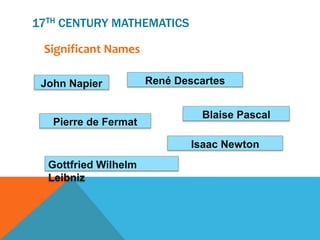
Significant Names
John Napier
Pierre de Fermat
René Descartes
Blaise Pascal
Isaac Newton
Gottfried Wilhelm
Leibniz
17TH CENTURY MATHEMATICS
Significant Mathematical Contributions
 also spelled Neper, (born 1550, Merchiston Castle,
near Edinburgh, Scotland
 died April 4, 1617, Merchiston Castle)
 Scottish mathematician and theological writer who
originated the concept of logarithms as a
mathematical device to aid in calculations
John Napier
17TH CENTURY MATHEMATICS
John Napier
His logarithm contributed to the advance of science,
astronomy and mathematics by making some
difficult calculations relatively easy
It was one of the most significant mathematical
developments of the age, and 17th Century
physicists like Kepler and Newton could never
have performed the complex calculatons needed for
their innovations without it
17TH CENTURY MATHEMATICS
John Napier
 The logarithm of a number is the exponent when that
number is expressed as a power of 10 (or any other
base). It is effectively the inverse of exponentiation
 1622 William Oughted had produced a logarithmic
slide rule, an instrument which became indispensible
in technological innovation for the next 300 years.
17TH CENTURY MATHEMATICS
John Napier
Improved Simon Stevin’s decimal notation and
popularized the use of the decimal point
and made lattice multiplication (originally developed
by the Persian mathematician Al-Khwarizmi and
introduced into Europe by Fibonacci) more
convenient with the introduction of “Napier’s Bones”,
a multiplication tool using a set of numbered rods.
17TH CENTURY MATHEMATICS
RENé DESCARTES
 Sometimes considered the first of the modern school
of mathematics.
His development of analytic geometry and Cartesian
coordinates in the mid-17th Century soon allowed
the orbits of the planets to be plotted on a graph, as
well as laying the foundations for the later
development of calculus (and much later multi-
dimensional geometry).
17TH CENTURY MATHEMATICS
RENé DESCARTES
 also credited with the first use of superscripts for powers
or exponents.
As a young man, he found employment for a time as a
soldier
After a series of dreams or visions, and after meeting
the Dutch philosopher and scientist Isaac Beeckman,
who sparked his interest in mathematics and the New
Physics, he concluded that his real path in life was the
pursuit of true wisdom and science.
17TH CENTURY MATHEMATICS
RENé DESCARTES
 In France, as a young man he came to the conclusion
that the key to philosophy, with all its uncertainties and
ambiguity, was to build it on the indisputable facts of
mathematics.
 He moved from the restrictions of Catholic France to the
more liberal environment of the Netherlands, where he
spent most of his adult life, and where he worked on his
dream of merging algebra and geometry.
17TH CENTURY MATHEMATICS
RENé DESCARTES
 In 1637, he published his ground-breaking
philosophical and mathematical treatise “Discours de
la méthode” (the “Discourse on Method”)
 one of its appendices in particular, “La Géométrie”, is
now considered a landmark in the history of
mathematics
17TH CENTURY MATHEMATICS
RENé DESCARTES
introduced what has become known as the standard
algebraic notation, using lowercase a, b and c for
known quantities and x, y and z for unknown
quantities.
the first book to look like a modern mathematics
textbook, full of a‘s and b‘s, x2‘s, etc.
17TH CENTURY MATHEMATICS
RENé DESCARTES
 In “La Géométrie” he first proposed that each point in two
dimensions can be described by two numbers on a plane,
one giving the point’s horizontal location and the other
the vertical location, which have come to be known as
Cartesian coordinates.
 He used perpendicular lines (or axes), crossing at a point
called the origin, to measure the horizontal (x) and
vertical (y) locations, both positive and negative, thus
effectively dividing the plane up into four quadrants.
17TH CENTURY MATHEMATICS
RENé DESCARTES
Descartes’ ground-breaking work, usually referred
to as analytic geometry or Cartesian geometry, had
the effect of allowing the conversion of geometry
into algebra (and vice versa).
Thus, a pair of simultaneous equations could now be
solved either algebraically or graphically (at the
intersection of two lines).
17TH CENTURY MATHEMATICS
RENé DESCARTES
 It allowed the development of Newton’s
and Leibniz’s subsequent discoveries of calculus.
 It also unlocked the possibility of navigating
geometries of higher dimensions, impossible to
physically visualize – a concept which was to become
central to modern technology and physics – thus
transforming mathematics forever.
17TH CENTURY MATHEMATICS
RENé DESCARTES
 He also developed a “rule of signs” technique for
determining the number of positive or negative real roots
of a polynomial; “invented” (or at least popularized) the
superscript notation for showing powers or exponents
(e.g. 24 to show 2 x 2 x 2 x 2)
and re-discovered Thabit ibn Qurra’s general formula for
amicable numbers, as well as the amicable pair
9,363,584 and 9,437,056 (which had also been
discovered by another Islamic mathematician, Yazdi,
almost a century earlier).
17TH CENTURY MATHEMATICS
RENé DESCARTES
He is perhaps best known today as a philosopher who
espoused rationalism and dualism.
His philosophy consisted of a method of doubting
everything, then rebuilding knowledge from the
ground, and he is particularly known for the often-
quoted statement “Cogito ergo sum”(“I think,
therefore I am”).
17TH CENTURY MATHEMATICS
RENé DESCARTES
 Had an influential rôle in the development of modern
physics, a rôle which has been, until quite recently,
generally under-appreciated and under-investigated.
 Provided the first distinctly modern formulation of
laws of nature and a conservation principle of
motion, made numerous advances in optics and the
study of the reflection and refraction of light, and
constructed what would become the most popular
theory of planetary motion of the late 17th Century.
17TH CENTURY MATHEMATICS
RENé DESCARTES
 His commitment to the scientific method was met
with strident opposition by the church officials of the
day.
 His revolutionary ideas made him a centre of
controversy in his day.
 Died in 1650 far from home in Stockholm, Sweden.
 13 years later, his works were placed on the
Catholic Church’s “Index of Prohibited Books”.
17TH CENTURY MATHEMATICS
PIERRE DE FERMAT
born August 17, 1601, Beaumont-de-Lomagne, France
died January 12, 1665, Castres
French mathematician who is often called the founder
of the modern theory of numbers.
Together with Rene Descartes, he was one of the two
leading mathematicians of the first half of the 17th
century
17TH CENTURY MATHEMATICS
PIERRE DE FERMAT
 Independently of Descartes, Fermat discovered the
fundamental principle of analytic geometry.
 His methods for finding tangents to curves and their
maximum and minimum points led him to be
regarded as the inventor of the differential calculus.
 Through his correspondence with Blaise Pascal he
was a co-founder of the theory of probability.
17TH CENTURY MATHEMATICS
PIERRE DE FERMAT
 One example of his many theorems is the Two
Square Theorem, which shows that any prime
number which, when divided by 4, leaves a
remainder of 1 (i.e. can be written in the form 4n + 1),
can always be re-written as the sum of two square
numbers.
17TH CENTURY MATHEMATICS
PIERRE DE FERMAT
 His so-called Little Theorem is often used in the testing of
large prime numbers, and is the basis of the codes which
protect our credit cards in Internet transactions today.
 In simple (sic) terms, it says that if we have two
numbers a and p, where p is a prime number and not a factor
of a, then a multiplied by itself p-1 times and then divided
by p, will always leave a remainder of 1. In mathematical
terms, this is written: ap-1 = 1(mod p). For example, if a = 7
and p = 3, then 72 ÷ 3 should leave a remainder of 1, and 49 ÷
3 does in fact leave a remainder of 1.
17TH CENTURY MATHEMATICS
PIERRE DE FERMAT
He identified a subset of numbers, now known as Fermat
numbers, which are of the form of one less than 2 to the
power of a power of 2, or, written mathematically, 22n + 1. The
first five such numbers are: 21 + 1 = 3; 22 + 1 = 5; 24 + 1 = 17;
28 + 1 = 257; and 216 + 1 = 65,537.
Interestingly, these are all prime numbers (and are known as
Fermat primes), but all the higher Fermat numbers which
have been painstakingly identified over the years are NOT
prime numbers, which just goes to to show the value of
inductive proof in mathematics.
17TH CENTURY MATHEMATICS
PIERRE DE FERMAT
 Fermat’s pièce de résistance, though, was his famous
Last Theorem, a conjecture left unproven at his death,
and which puzzled mathematicians for over 350 years
 It states that no three positive integers a, b and c can
satisfy the equation an + bn = cn for any integer value
of n greater than two (i.e. squared). This seemingly
simple conjecture has proved to be one of the world’s
hardest mathematical problems to prove.
17TH CENTURY MATHEMATICS
PIERRE DE FERMAT
 Over the centuries, several mathematical and scientific
academies offered substantial prizes for a proof of the
theorem, and to some extent it single-handedly stimulated
the development of algebraic number theory in the 19th
and 20th Centuries.
 It was finally proved for ALL numbers only in 1995 (a
proof usually attributed to British mathematician Andrew
Wiles, although in reality it was a joint effort of several
steps involving many mathematicians over several years).
17TH CENTURY MATHEMATICS
The final proof made use of complex modern
mathematics, such as the modularity theorem for
semi-stable elliptic curves, Galois representations and
Ribet’s epsilon theorem, all of which were unavailable
in Fermat’s time, so it seems clear that Fermat’s claim
to have solved his last theorem was almost certainly
an exaggeration (or at least a misunderstanding).
PIERRE DE FERMAT
17TH CENTURY MATHEMATICS
PIERRE DE FERMAT
 In addition to his work in number theory, he
anticipated the development of calculus to some
extent, and his work in this field was invaluable later
to Newton and Leibniz.
 While investigating a technique for finding the centres
of gravity of various plane and solid figures, he
developed a method for determining maxima, minima
and tangents to various curves that was essentially
equivalent to differentiation.
17TH CENTURY MATHEMATICS
 Also, using an ingenious trick, he was able to reduce
the integral of general power functions to the sums of
geometric series
 Fermat’s correspondence with his friend Pascal also
helped mathematicians grasp a very important
concept in basic probability which, although perhaps
intuitive to us now, was revolutionary in 1654, namely
the idea of equally probable outcomes and expected
values.
PIERRE DE FERMAT
17TH CENTURY MATHEMATICS
BLAISE PASCAL
A Frenchman who was a prominent 17th Century
scientist, philosopher and mathematician.
a child prodigy and pursued many different avenues of
intellectual endeavour throughout his life.
17TH CENTURY MATHEMATICS
BLAISE PASCAL
Much of his early work was in the area of natural and
applied sciences, and he has a physical law named after him
(that “pressure exerted anywhere in a confined liquid is
transmitted equally and undiminished in all directions
throughout the liquid”), as well as the international unit for
the meaurement of pressure.
In philosophy, Pascals’ Wager is his pragmatic approach to
believing in God on the grounds that is it is a better “bet”
than not to.
17TH CENTURY MATHEMATICS
BLAISE PASCAL
a mathematician of the first order.
At the age of sixteen, wrote a significant treatise on the
subject of projective geometry, known as Pascal’s
Theorem, which states that, if a hexagon is inscribed in
a circle, then the three intersection points of opposite
sides lie on a single line, called the Pascal line.
 As a young man, he built a functional calculating
machine, able to perform additions and subtractions, to
help his father with his tax calculations
17TH CENTURY MATHEMATICS
BLAISE PASCAL
 Best known for Pascal’s Triangle, a
convenient tabular presentation of binomial co-
efficients, where each number is the sum of the two
numbers directly above it.
 The co-efficients produced when a binomial is
expanded form a symmetrical triangle.
17TH CENTURY MATHEMATICS
BLAISE PASCAL
 The Persian mathematician Al-Karaji had produced
something very similar as the Pascal’s Triangle as early as
the 10th Century, and the Triangle is called Yang Hui’s
Triangle in China after the 13th Century Chinese
mathematician, and Tartaglia’s Triangle in Italy after the
eponymous 16th Century Italian.
 But Pascal did contribute an elegant proof by defining the
numbers by recursion, and he also discovered many useful
and interesting patterns among the rows, columns and
diagonals of the array of numbers.
17TH CENTURY MATHEMATICS
BLAISE PASCAL
For instance, looking at the diagonals alone, after the
outside “skin” of 1’s, the next diagonal (1, 2, 3, 4, 5,…)
is the natural numbers in order. The next diagonal
within that (1, 3, 6, 10, 15,…) is the triangular
numbers in order. The next (1, 4, 10, 20, 35,…) is the
pyramidal triangular numbers, etc, etc.
It is also possible to find prime numbers, Fibonacci
numbers, Catalan numbers, and many other series,
and even to find fractal patterns within it.
17TH CENTURY MATHEMATICS
BLAISE PASCAL
 It fell to Pascal (with Fermat‘s help) to bring together
the separate threads of prior knowledge
(including Cardano‘s early work) and to introduce
entirely new mathematical techniques for the solution
of problems that had hitherto resisted solution.
17TH CENTURY MATHEMATICS
 Two such intransigent problems which Pascal
and Fermat applied themselves to were the Gambler’s
Ruin (determining the chances of winning for each of two
men playing a particular dice game with very specific rules)
and the Problem of Points (determining how a game’s
winnings should be divided between two equally skilled
players if the game was ended prematurely).
 His work on the Problem of Points in particular, although
unpublished at the time, was highly influential in the
unfolding new field.
BLAISE PASCAL
17TH CENTURY MATHEMATICS
 Later in life, he and his sister Jacqueline strongly
identified with the extreme Catholic religious movement
of Jansenism.
 Following the death of his father and a “mystical
experience” in late 1654, he had his “second conversion”
and abandoned his scientific work completely, devoting
himself to philosophy and theology.
BLAISE PASCAL
17TH CENTURY MATHEMATICS
 His two most famous works, the “Lettres provinciales”
and the “Pensées“, date from this period, the latter left
incomplete at his death in 1662.
 They remain Pascal’s best known legacy
 usually remembered today as one of the most
important authors of the French Classical Period
 one of the greatest masters of French prose, much more
than for his contributions to mathematics.
BLAISE PASCAL
17TH CENTURY MATHEMATICS
ISAAC NEWTON
 Born December 25, 1642 [January 4, 1643, New
Style], Woolsthorpe, Lincolnshire, England
 Died March 20 [March 31], 1727, London
 Physicist, mathematician, astronomer, natural
philosopher, alchemist and theologian
17TH CENTURY MATHEMATICS
ISAAC NEWTON
 considered by many to be one of the most influential
men in human history.
 His 1687 publication, the “Philosophiae Naturalis
Principia Mathematica” (usually called simply the
“Principia”), is considered to be among the most
influential books in the history of science, and it
dominated the scientific view of the physical
universe for the next three centuries.
17TH CENTURY MATHEMATICS
ISAAC NEWTON
 A giant in the minds of mathematicians everywhere (on a
par with the all-time greats like Archimedes and Gauss)
 greatly influenced the subsequent path of mathematical
development.
 Over two miraculous years, during the time of the Great
Plague of 1665-6, he developed a new theory of light,
discovered and quantified gravitation, and pioneered a
revolutionary new approach to mathematics: infinitesimal
calculus.
17TH CENTURY MATHEMATICS
ISAAC NEWTON
His theory of calculus was built on earlier work by
his fellow Englishmen.
Calculus allowed mathematicians and engineers to
make sense of the motion and dynamic change in
the changing world around us, such as the orbits of
planets, the motion of fluids, etc
17TH CENTURY MATHEMATICS
ISAAC NEWTON
Without going into too much complicated detail, he
(and his contemporary Gottfried
Leibniz independently) calculated a derivative
function f ‘(x) which gives the slope at any point of a
function f(x).
This process of calculating the slope or derivative of a
curve or function is called differential calculus or
differentiation (or, in Newton’s terminology, the
“method of fluxions”
17TH CENTURY MATHEMATICS
ISAAC NEWTON
 instantaneous rate of change at a particular point on a
curve the “fluxion”
 the changing values of x and y the “fluents”.
His Fundamental Theorem of Calculus states that
differentiation and integration are inverse operations,
so that, if a function is first integrated and then
differentiated (or vice versa), the original function is
retrieved.
17TH CENTURY MATHEMATICS
ISAAC NEWTON
Newton chose not to publish his revolutionary
mathematics straight away, worried about being
ridiculed for his unconventional ideas, and contented
himself with circulating his thoughts among friends.
in 1684, the German Leibniz published his own
independent version of the theory, whereas Newton
published nothing on the subject until 1693.
17TH CENTURY MATHEMATICS
ISAAC NEWTON
 the Royal Society, after due deliberation, gave credit
for the first discovery to Newton (and credit for the
first publication to Leibniz)
 when it was made public that the Royal Society’s
subsequent accusation of plagiarism
against Leibniz was actually authored by none other
Newton himself, something of a scandal arose
causing an ongoing controversy which marred the
careers of both men.
17TH CENTURY MATHEMATICS
ISAAC NEWTON
 credited with the generalized binomial theorem,
which describes the algebraic expansion of powers of
a binomial (an algebraic expression with two terms,
such as a2 – b2)
 made substantial contributions to the theory of finite
differences (mathematical expressions of the
form f(x + b) – f(x + a))
17TH CENTURY MATHEMATICS
ISAAC NEWTON
 one of the first to use fractional exponents and
coordinate geometry to derive solutions to
Diophantine equations (algebraic equations with
integer-only variables)
 developed the so-called “Newton’s method” for
finding successively better approximations to the
zeroes or roots of a function; he was the first to use
infinite power series with any confidence; etc
17TH CENTURY MATHEMATICS
ISAAC NEWTON
published his “Principia” or “The Mathematical
Principles of Natural Philosophy” in 1687
generally recognized as the greatest scientific book
ever written.
In it, he presented his theories of motion, gravity and
mechanics, explained the eccentric orbits of comets,
the tides and their variations, the precession of the
Earth’s axis and the motion of the Moon.
17TH CENTURY MATHEMATICS
ISAAC NEWTON
 Later in life, he wrote a number of religious tracts
dealing with the literal interpretation of the Bible
 devoted a great deal of time to alchemy
 acted as Member of Parliament for some years
 became perhaps the best-known Master of the Royal
Mint in 1699, a position he held until his death in
1727.
17TH CENTURY MATHEMATICS
ISAAC NEWTON
 In 1703, he was made President of the Royal Society
 in 1705, became the first scientist ever to be
knighted.
 Mercury poisoning from his alchemical pursuits
perhaps explained Newton’s eccentricity in later
life, and possibly also his eventual death.
16th-to-17th-Renaissance-mathematics.pptx

16th-to-17th-Renaissance-mathematics.pptx

  • 1.
    Ma. Julita B.Obiles BICOL UNIVERSITY Legazpi City
  • 2.
    16TH CENTURY MATHEMATICS Cultural, intellectual and artistic movement of the Renaissance began in Italy around the 14th Century  Gradually spread across most of Europe over the next two centuries  Science and art were still very much interconnected and intermingled at this time, as exemplified by the work of artist/scientists such as Leonardo da Vinci  Just as in art, revolutionary work in the fields of philosophy and science was took place
  • 3.
    LATE 15TH, EARLY16TH CENTURY  Albrecht Dürer (German Artist) - included an order-4 magic square in his engraving “Melencolia I” - super magic square” with many more lines of addition symmetry than a regular 4 x 4 magic square (1514).  Luca Pacioli (Italian Franciscan friar) - published a book on arithmetic, geometry and book-keeping at the end of the 15th Century
  • 4.
    LATE 15TH, EARLY16TH CENTURY  Luca Pacioli (Italian Franciscan friar) - became quite popular for the mathematical puzzles it contained - also introduced symbols for plus and minus for the first time in a printed book (sometimes attributed to Giel Vander Hoecke, Johannes Widmann and others) - symbols that were to become standard notation
  • 5.
    LATE 15TH, EARLY16TH CENTURY  Luca Pacioli (Italian Franciscan friar) - also investigated the Golden Ratio of 1 : 1.618 in his 1509 book “The Divine Proportion” - concluded that the number was a message from God and a source of secret knowledge about the inner beauty of things.
  • 6.
    16TH AND EARLY17TH CENTURY  The equals, multiplication, division, radical (root), decimal and inequality symbols were gradually introduced and standardized
  • 7.
    16TH CENTURY MATHEMATICS SimonStevin Niccoloi Tartaglia Significant Names Gerolamo Cardano Lodovico Ferrari
  • 8.
    16TH CENTURY MATHEMATICS MathematicalContributions Simon Stevin  use of decimal fractions and decimal arithmetic  enjoined that all types of numbers, whether fractions, negatives, real numbers or surds (such as √2) should be treated equally as numbers in their own right. Note: the decimal point notation was not popularized until early in the 17th century
  • 9.
    16TH CENTURY MATHEMATICS MathematicalContributions and Short Biography Niccoloi Tartaglia  Niccolò Fontana became known as Tartaglia (meaning “the stammerer”) for a speech defect he suffered due to an injury he received in a battle against the invading French army  a poor engineer known for designing fortifications, a surveyor of topography (seeking the best means of defence or offence in battles) and a bookkeeper in the Republic of Venice.
  • 10.
    16TH CENTURY MATHEMATICS self-taught, but wildly ambitious, mathematician.  distinguised himself by producing, among other things, the first Italian translations of works by Archimedes and Euclid from uncorrupted Greek texts Niccoloi Tartaglia
  • 11.
    16TH CENTURY MATHEMATICS NiccoloiTartaglia  revealed to the world the formula for solving first one type, and later all types, of cubic equations (equations with terms including x3)  in the Renaissance Italy of the early 16th Century, Bologna University in one of its famed public mathematics competitions  stumped the best mathematicians of China, India and the Islamic world.
  • 12.
    16TH CENTURY MATHEMATICS Encoded his solution in the form of a poem in an attempt to make it more difficult for other mathematicians to steal it  His definitive method was leaked to Gerolamo Cardano  Engaged Cardano in a decade-long fight over the publication of “Ars Magna” that included his cubic solution. Niccoloi Tartaglia
  • 13.
    16TH CENTURY MATHEMATICS NiccoloiTartaglia  was thoroughly discredited and became effectively unemployable when he decided not to show up when challenged to a public debate (he initially accepted) by Ferrari. died penniless and unknown despite having produced (in addition to his cubic equation solution) the following:
  • 14.
    16TH CENTURY MATHEMATICS the first translation of Euclid’s “Elements” in a modern European language  formulated Tartaglia’s Formula for the volume of a tetrahedron, devised a method to obtain binomial coefficients called Tartaglia’s Triangle (an earlier version of Pascal‘s Triangle) Niccoloi Tartaglia
  • 15.
    16TH CENTURY MATHEMATICS NiccoloiTartaglia  became the first to apply mathematics to the investigation of the paths of cannonballs (work which was later validated by Galileo’s studies on falling bodies) Even today, the solution to cubic equations is usually known as Cardano’s Formula and not Tartgalia’s.
  • 16.
    16TH CENTURY MATHEMATICS GerolamoCardano a celebrated Italian Renaissance mathematician, physician, astrologer and gambler.  (or Cardan), a rather eccentric and confrontational mathematician doctor and Renaissance man, and author throughout his lifetime of some 131 books.
  • 17.
    16TH CENTURY MATHEMATICS GerolamoCardano  Published himself in his 1545 book “Ars Magna” (despite having promised Tartaglia that he would not), Tartaglia’s cubic solution along with the work of his own brilliant student Lodovico Ferrari Even today, the solution to cubic equations is usually known as Cardano’s Formula and not Tartgalia’s.
  • 18.
    16TH CENTURY MATHEMATICS GerolamoCardano  an accomplished gambler and chess player, wrote a book called “Liber de ludo aleae” (“Book on Games of Chance“) when he was just 25 years old, which contains perhaps the first systematic treatment of probability (as well as a section on effective cheating methods).  The book described the insight that, if a random event has several equally likely outcomes, the chance of any individual outcome is equal to the proportion of that outcome to all possible outcomes.
  • 19.
    16TH CENTURY MATHEMATICS GerolamoCardano His “Liber de ludo aleae” remained unpublished until 1663, nearly a century after his death. It was the only serious work on probability until Pascal‘s work in the 17th Century  was also the first to describe hypocycloids, the pointed plane curves generated by the trace of a fixed point on a small circle that rolls within a larger circle
  • 20.
    16TH CENTURY MATHEMATICS GerolamoCardano  The generating circles were later named Cardano (or Cardanic) circles.  colourful life remained notoriously short of money thoughout his life, largely due to his gambling habits  was accused of heresy in 1570 after publishing a horoscope of Jesus (apparently, his own son contributed to the prosecution, bribed by Tartaglia).
  • 21.
    16TH CENTURY MATHEMATICS an Italian mathematician famed for solving the quartic equation.  was born in 1522 in Bologna  at the age of 14, became the servant of Gerolamo Cardan. Lodovico Ferrari
  • 22.
    16TH CENTURY MATHEMATICS LodovicoFerrari  obtained a prestigious teaching post while still in his teens after Cardano resigned from it and recommended him, and was eventually able to retired young and quite rich, despite having started out as Cardano’s servant.  Based on Tartaglia's formula, he and Cardan found proofs for all cases of the cubic and, more impressively, solved the quartic equation - this was reportedly largely due to his work.
  • 23.
    16TH CENTURY MATHEMATICS LodovicoFerrari  Won by default on a public debate with Tartaglia when the later did not show up to the challenge which he initially accepted  After the win, fame soared and he was inundated with offers of employment, including a request from the emperor.
  • 24.
    16TH CENTURY MATHEMATICS LodovicoFerrari  was appointed tax assessor to the governor of Milan  after transferring to the service of the church, retired as a young (aged 42) and rich man.  He moved back to his home town of Bologna and in with his widowed sister Maddalena.
  • 25.
    16TH CENTURY MATHEMATICS LodovicoFerrari  Died in 1565 of white arsenic poisoning, most likely administered by Maddalena.  Maddalena did not grieve at his funeral and having inherited his fortune, remarried two weeks later.  Her new husband promptly left her with all her fortune and she died in poverty.
  • 26.
    17TH CENTURY MATHEMATICS an unprecedented explosion of mathematical and scientific ideas across Europe  a period sometimes called the Age of Reason  Hard on the heels of the “Copernican Revolution” of Nicolaus Copernicus in the 16th Century, scientists like Galileo Galilei, Tycho Brahe and Johannes Kepler were making equally revolutionary discoveries in the exploration of the Solar system, leading to Kepler’s formulation of mathematical laws of planetary motion.
  • 27.
    17TH CENTURY MATHEMATICS SignificantNames John Napier Pierre de Fermat René Descartes Blaise Pascal Isaac Newton Gottfried Wilhelm Leibniz
  • 28.
    17TH CENTURY MATHEMATICS SignificantMathematical Contributions  also spelled Neper, (born 1550, Merchiston Castle, near Edinburgh, Scotland  died April 4, 1617, Merchiston Castle)  Scottish mathematician and theological writer who originated the concept of logarithms as a mathematical device to aid in calculations John Napier
  • 29.
    17TH CENTURY MATHEMATICS JohnNapier His logarithm contributed to the advance of science, astronomy and mathematics by making some difficult calculations relatively easy It was one of the most significant mathematical developments of the age, and 17th Century physicists like Kepler and Newton could never have performed the complex calculatons needed for their innovations without it
  • 30.
    17TH CENTURY MATHEMATICS JohnNapier  The logarithm of a number is the exponent when that number is expressed as a power of 10 (or any other base). It is effectively the inverse of exponentiation  1622 William Oughted had produced a logarithmic slide rule, an instrument which became indispensible in technological innovation for the next 300 years.
  • 31.
    17TH CENTURY MATHEMATICS JohnNapier Improved Simon Stevin’s decimal notation and popularized the use of the decimal point and made lattice multiplication (originally developed by the Persian mathematician Al-Khwarizmi and introduced into Europe by Fibonacci) more convenient with the introduction of “Napier’s Bones”, a multiplication tool using a set of numbered rods.
  • 32.
    17TH CENTURY MATHEMATICS RENéDESCARTES  Sometimes considered the first of the modern school of mathematics. His development of analytic geometry and Cartesian coordinates in the mid-17th Century soon allowed the orbits of the planets to be plotted on a graph, as well as laying the foundations for the later development of calculus (and much later multi- dimensional geometry).
  • 33.
    17TH CENTURY MATHEMATICS RENéDESCARTES  also credited with the first use of superscripts for powers or exponents. As a young man, he found employment for a time as a soldier After a series of dreams or visions, and after meeting the Dutch philosopher and scientist Isaac Beeckman, who sparked his interest in mathematics and the New Physics, he concluded that his real path in life was the pursuit of true wisdom and science.
  • 34.
    17TH CENTURY MATHEMATICS RENéDESCARTES  In France, as a young man he came to the conclusion that the key to philosophy, with all its uncertainties and ambiguity, was to build it on the indisputable facts of mathematics.  He moved from the restrictions of Catholic France to the more liberal environment of the Netherlands, where he spent most of his adult life, and where he worked on his dream of merging algebra and geometry.
  • 35.
    17TH CENTURY MATHEMATICS RENéDESCARTES  In 1637, he published his ground-breaking philosophical and mathematical treatise “Discours de la méthode” (the “Discourse on Method”)  one of its appendices in particular, “La Géométrie”, is now considered a landmark in the history of mathematics
  • 36.
    17TH CENTURY MATHEMATICS RENéDESCARTES introduced what has become known as the standard algebraic notation, using lowercase a, b and c for known quantities and x, y and z for unknown quantities. the first book to look like a modern mathematics textbook, full of a‘s and b‘s, x2‘s, etc.
  • 37.
    17TH CENTURY MATHEMATICS RENéDESCARTES  In “La Géométrie” he first proposed that each point in two dimensions can be described by two numbers on a plane, one giving the point’s horizontal location and the other the vertical location, which have come to be known as Cartesian coordinates.  He used perpendicular lines (or axes), crossing at a point called the origin, to measure the horizontal (x) and vertical (y) locations, both positive and negative, thus effectively dividing the plane up into four quadrants.
  • 38.
    17TH CENTURY MATHEMATICS RENéDESCARTES Descartes’ ground-breaking work, usually referred to as analytic geometry or Cartesian geometry, had the effect of allowing the conversion of geometry into algebra (and vice versa). Thus, a pair of simultaneous equations could now be solved either algebraically or graphically (at the intersection of two lines).
  • 39.
    17TH CENTURY MATHEMATICS RENéDESCARTES  It allowed the development of Newton’s and Leibniz’s subsequent discoveries of calculus.  It also unlocked the possibility of navigating geometries of higher dimensions, impossible to physically visualize – a concept which was to become central to modern technology and physics – thus transforming mathematics forever.
  • 40.
    17TH CENTURY MATHEMATICS RENéDESCARTES  He also developed a “rule of signs” technique for determining the number of positive or negative real roots of a polynomial; “invented” (or at least popularized) the superscript notation for showing powers or exponents (e.g. 24 to show 2 x 2 x 2 x 2) and re-discovered Thabit ibn Qurra’s general formula for amicable numbers, as well as the amicable pair 9,363,584 and 9,437,056 (which had also been discovered by another Islamic mathematician, Yazdi, almost a century earlier).
  • 41.
    17TH CENTURY MATHEMATICS RENéDESCARTES He is perhaps best known today as a philosopher who espoused rationalism and dualism. His philosophy consisted of a method of doubting everything, then rebuilding knowledge from the ground, and he is particularly known for the often- quoted statement “Cogito ergo sum”(“I think, therefore I am”).
  • 42.
    17TH CENTURY MATHEMATICS RENéDESCARTES  Had an influential rôle in the development of modern physics, a rôle which has been, until quite recently, generally under-appreciated and under-investigated.  Provided the first distinctly modern formulation of laws of nature and a conservation principle of motion, made numerous advances in optics and the study of the reflection and refraction of light, and constructed what would become the most popular theory of planetary motion of the late 17th Century.
  • 43.
    17TH CENTURY MATHEMATICS RENéDESCARTES  His commitment to the scientific method was met with strident opposition by the church officials of the day.  His revolutionary ideas made him a centre of controversy in his day.  Died in 1650 far from home in Stockholm, Sweden.  13 years later, his works were placed on the Catholic Church’s “Index of Prohibited Books”.
  • 44.
    17TH CENTURY MATHEMATICS PIERREDE FERMAT born August 17, 1601, Beaumont-de-Lomagne, France died January 12, 1665, Castres French mathematician who is often called the founder of the modern theory of numbers. Together with Rene Descartes, he was one of the two leading mathematicians of the first half of the 17th century
  • 45.
    17TH CENTURY MATHEMATICS PIERREDE FERMAT  Independently of Descartes, Fermat discovered the fundamental principle of analytic geometry.  His methods for finding tangents to curves and their maximum and minimum points led him to be regarded as the inventor of the differential calculus.  Through his correspondence with Blaise Pascal he was a co-founder of the theory of probability.
  • 46.
    17TH CENTURY MATHEMATICS PIERREDE FERMAT  One example of his many theorems is the Two Square Theorem, which shows that any prime number which, when divided by 4, leaves a remainder of 1 (i.e. can be written in the form 4n + 1), can always be re-written as the sum of two square numbers.
  • 47.
    17TH CENTURY MATHEMATICS PIERREDE FERMAT  His so-called Little Theorem is often used in the testing of large prime numbers, and is the basis of the codes which protect our credit cards in Internet transactions today.  In simple (sic) terms, it says that if we have two numbers a and p, where p is a prime number and not a factor of a, then a multiplied by itself p-1 times and then divided by p, will always leave a remainder of 1. In mathematical terms, this is written: ap-1 = 1(mod p). For example, if a = 7 and p = 3, then 72 ÷ 3 should leave a remainder of 1, and 49 ÷ 3 does in fact leave a remainder of 1.
  • 48.
    17TH CENTURY MATHEMATICS PIERREDE FERMAT He identified a subset of numbers, now known as Fermat numbers, which are of the form of one less than 2 to the power of a power of 2, or, written mathematically, 22n + 1. The first five such numbers are: 21 + 1 = 3; 22 + 1 = 5; 24 + 1 = 17; 28 + 1 = 257; and 216 + 1 = 65,537. Interestingly, these are all prime numbers (and are known as Fermat primes), but all the higher Fermat numbers which have been painstakingly identified over the years are NOT prime numbers, which just goes to to show the value of inductive proof in mathematics.
  • 49.
    17TH CENTURY MATHEMATICS PIERREDE FERMAT  Fermat’s pièce de résistance, though, was his famous Last Theorem, a conjecture left unproven at his death, and which puzzled mathematicians for over 350 years  It states that no three positive integers a, b and c can satisfy the equation an + bn = cn for any integer value of n greater than two (i.e. squared). This seemingly simple conjecture has proved to be one of the world’s hardest mathematical problems to prove.
  • 50.
    17TH CENTURY MATHEMATICS PIERREDE FERMAT  Over the centuries, several mathematical and scientific academies offered substantial prizes for a proof of the theorem, and to some extent it single-handedly stimulated the development of algebraic number theory in the 19th and 20th Centuries.  It was finally proved for ALL numbers only in 1995 (a proof usually attributed to British mathematician Andrew Wiles, although in reality it was a joint effort of several steps involving many mathematicians over several years).
  • 51.
    17TH CENTURY MATHEMATICS Thefinal proof made use of complex modern mathematics, such as the modularity theorem for semi-stable elliptic curves, Galois representations and Ribet’s epsilon theorem, all of which were unavailable in Fermat’s time, so it seems clear that Fermat’s claim to have solved his last theorem was almost certainly an exaggeration (or at least a misunderstanding). PIERRE DE FERMAT
  • 52.
    17TH CENTURY MATHEMATICS PIERREDE FERMAT  In addition to his work in number theory, he anticipated the development of calculus to some extent, and his work in this field was invaluable later to Newton and Leibniz.  While investigating a technique for finding the centres of gravity of various plane and solid figures, he developed a method for determining maxima, minima and tangents to various curves that was essentially equivalent to differentiation.
  • 53.
    17TH CENTURY MATHEMATICS Also, using an ingenious trick, he was able to reduce the integral of general power functions to the sums of geometric series  Fermat’s correspondence with his friend Pascal also helped mathematicians grasp a very important concept in basic probability which, although perhaps intuitive to us now, was revolutionary in 1654, namely the idea of equally probable outcomes and expected values. PIERRE DE FERMAT
  • 54.
    17TH CENTURY MATHEMATICS BLAISEPASCAL A Frenchman who was a prominent 17th Century scientist, philosopher and mathematician. a child prodigy and pursued many different avenues of intellectual endeavour throughout his life.
  • 55.
    17TH CENTURY MATHEMATICS BLAISEPASCAL Much of his early work was in the area of natural and applied sciences, and he has a physical law named after him (that “pressure exerted anywhere in a confined liquid is transmitted equally and undiminished in all directions throughout the liquid”), as well as the international unit for the meaurement of pressure. In philosophy, Pascals’ Wager is his pragmatic approach to believing in God on the grounds that is it is a better “bet” than not to.
  • 56.
    17TH CENTURY MATHEMATICS BLAISEPASCAL a mathematician of the first order. At the age of sixteen, wrote a significant treatise on the subject of projective geometry, known as Pascal’s Theorem, which states that, if a hexagon is inscribed in a circle, then the three intersection points of opposite sides lie on a single line, called the Pascal line.  As a young man, he built a functional calculating machine, able to perform additions and subtractions, to help his father with his tax calculations
  • 57.
    17TH CENTURY MATHEMATICS BLAISEPASCAL  Best known for Pascal’s Triangle, a convenient tabular presentation of binomial co- efficients, where each number is the sum of the two numbers directly above it.  The co-efficients produced when a binomial is expanded form a symmetrical triangle.
  • 58.
    17TH CENTURY MATHEMATICS BLAISEPASCAL  The Persian mathematician Al-Karaji had produced something very similar as the Pascal’s Triangle as early as the 10th Century, and the Triangle is called Yang Hui’s Triangle in China after the 13th Century Chinese mathematician, and Tartaglia’s Triangle in Italy after the eponymous 16th Century Italian.  But Pascal did contribute an elegant proof by defining the numbers by recursion, and he also discovered many useful and interesting patterns among the rows, columns and diagonals of the array of numbers.
  • 59.
    17TH CENTURY MATHEMATICS BLAISEPASCAL For instance, looking at the diagonals alone, after the outside “skin” of 1’s, the next diagonal (1, 2, 3, 4, 5,…) is the natural numbers in order. The next diagonal within that (1, 3, 6, 10, 15,…) is the triangular numbers in order. The next (1, 4, 10, 20, 35,…) is the pyramidal triangular numbers, etc, etc. It is also possible to find prime numbers, Fibonacci numbers, Catalan numbers, and many other series, and even to find fractal patterns within it.
  • 60.
    17TH CENTURY MATHEMATICS BLAISEPASCAL  It fell to Pascal (with Fermat‘s help) to bring together the separate threads of prior knowledge (including Cardano‘s early work) and to introduce entirely new mathematical techniques for the solution of problems that had hitherto resisted solution.
  • 61.
    17TH CENTURY MATHEMATICS Two such intransigent problems which Pascal and Fermat applied themselves to were the Gambler’s Ruin (determining the chances of winning for each of two men playing a particular dice game with very specific rules) and the Problem of Points (determining how a game’s winnings should be divided between two equally skilled players if the game was ended prematurely).  His work on the Problem of Points in particular, although unpublished at the time, was highly influential in the unfolding new field. BLAISE PASCAL
  • 62.
    17TH CENTURY MATHEMATICS Later in life, he and his sister Jacqueline strongly identified with the extreme Catholic religious movement of Jansenism.  Following the death of his father and a “mystical experience” in late 1654, he had his “second conversion” and abandoned his scientific work completely, devoting himself to philosophy and theology. BLAISE PASCAL
  • 63.
    17TH CENTURY MATHEMATICS His two most famous works, the “Lettres provinciales” and the “Pensées“, date from this period, the latter left incomplete at his death in 1662.  They remain Pascal’s best known legacy  usually remembered today as one of the most important authors of the French Classical Period  one of the greatest masters of French prose, much more than for his contributions to mathematics. BLAISE PASCAL
  • 64.
    17TH CENTURY MATHEMATICS ISAACNEWTON  Born December 25, 1642 [January 4, 1643, New Style], Woolsthorpe, Lincolnshire, England  Died March 20 [March 31], 1727, London  Physicist, mathematician, astronomer, natural philosopher, alchemist and theologian
  • 65.
    17TH CENTURY MATHEMATICS ISAACNEWTON  considered by many to be one of the most influential men in human history.  His 1687 publication, the “Philosophiae Naturalis Principia Mathematica” (usually called simply the “Principia”), is considered to be among the most influential books in the history of science, and it dominated the scientific view of the physical universe for the next three centuries.
  • 66.
    17TH CENTURY MATHEMATICS ISAACNEWTON  A giant in the minds of mathematicians everywhere (on a par with the all-time greats like Archimedes and Gauss)  greatly influenced the subsequent path of mathematical development.  Over two miraculous years, during the time of the Great Plague of 1665-6, he developed a new theory of light, discovered and quantified gravitation, and pioneered a revolutionary new approach to mathematics: infinitesimal calculus.
  • 67.
    17TH CENTURY MATHEMATICS ISAACNEWTON His theory of calculus was built on earlier work by his fellow Englishmen. Calculus allowed mathematicians and engineers to make sense of the motion and dynamic change in the changing world around us, such as the orbits of planets, the motion of fluids, etc
  • 68.
    17TH CENTURY MATHEMATICS ISAACNEWTON Without going into too much complicated detail, he (and his contemporary Gottfried Leibniz independently) calculated a derivative function f ‘(x) which gives the slope at any point of a function f(x). This process of calculating the slope or derivative of a curve or function is called differential calculus or differentiation (or, in Newton’s terminology, the “method of fluxions”
  • 69.
    17TH CENTURY MATHEMATICS ISAACNEWTON  instantaneous rate of change at a particular point on a curve the “fluxion”  the changing values of x and y the “fluents”. His Fundamental Theorem of Calculus states that differentiation and integration are inverse operations, so that, if a function is first integrated and then differentiated (or vice versa), the original function is retrieved.
  • 70.
    17TH CENTURY MATHEMATICS ISAACNEWTON Newton chose not to publish his revolutionary mathematics straight away, worried about being ridiculed for his unconventional ideas, and contented himself with circulating his thoughts among friends. in 1684, the German Leibniz published his own independent version of the theory, whereas Newton published nothing on the subject until 1693.
  • 71.
    17TH CENTURY MATHEMATICS ISAACNEWTON  the Royal Society, after due deliberation, gave credit for the first discovery to Newton (and credit for the first publication to Leibniz)  when it was made public that the Royal Society’s subsequent accusation of plagiarism against Leibniz was actually authored by none other Newton himself, something of a scandal arose causing an ongoing controversy which marred the careers of both men.
  • 72.
    17TH CENTURY MATHEMATICS ISAACNEWTON  credited with the generalized binomial theorem, which describes the algebraic expansion of powers of a binomial (an algebraic expression with two terms, such as a2 – b2)  made substantial contributions to the theory of finite differences (mathematical expressions of the form f(x + b) – f(x + a))
  • 73.
    17TH CENTURY MATHEMATICS ISAACNEWTON  one of the first to use fractional exponents and coordinate geometry to derive solutions to Diophantine equations (algebraic equations with integer-only variables)  developed the so-called “Newton’s method” for finding successively better approximations to the zeroes or roots of a function; he was the first to use infinite power series with any confidence; etc
  • 74.
    17TH CENTURY MATHEMATICS ISAACNEWTON published his “Principia” or “The Mathematical Principles of Natural Philosophy” in 1687 generally recognized as the greatest scientific book ever written. In it, he presented his theories of motion, gravity and mechanics, explained the eccentric orbits of comets, the tides and their variations, the precession of the Earth’s axis and the motion of the Moon.
  • 75.
    17TH CENTURY MATHEMATICS ISAACNEWTON  Later in life, he wrote a number of religious tracts dealing with the literal interpretation of the Bible  devoted a great deal of time to alchemy  acted as Member of Parliament for some years  became perhaps the best-known Master of the Royal Mint in 1699, a position he held until his death in 1727.
  • 76.
    17TH CENTURY MATHEMATICS ISAACNEWTON  In 1703, he was made President of the Royal Society  in 1705, became the first scientist ever to be knighted.  Mercury poisoning from his alchemical pursuits perhaps explained Newton’s eccentricity in later life, and possibly also his eventual death.