Pascal’s Triangle WALT: investigate and describe patterns
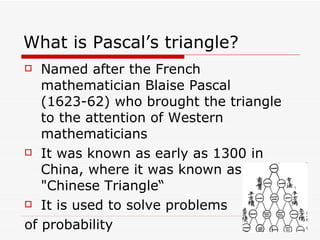
What is Pascal’s triangle? Named after the French mathematician Blaise Pascal (1623-62) who brought the triangle to the attention of Western mathematicians  It was known as early as 1300 in China, where it was known as the "Chinese Triangle“ It is used to solve problems  of probability
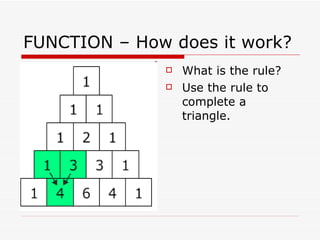
FUNCTION – How does it work? What is the rule?  Use the rule to complete a triangle.
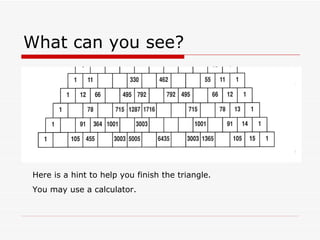
What can you see?  Here is a hint to help you finish the triangle. You may use a calculator.
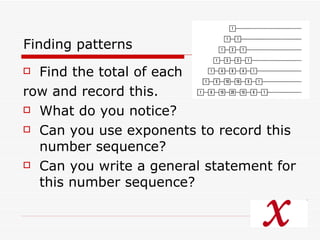
Finding patterns Find the total of each  row and record this.  What do you notice? Can you use exponents to record this number sequence? Can you write a general statement for this number sequence?
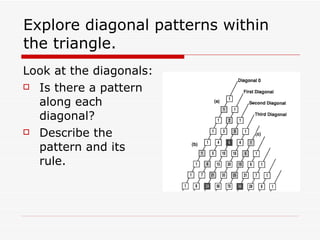
Explore diagonal patterns within the triangle.  Look at the diagonals: Is there a pattern along each diagonal? Describe the pattern and its rule.
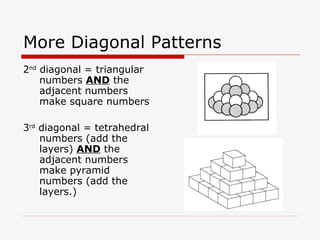
More Diagonal Patterns 2 nd  diagonal = triangular numbers  AND  the adjacent numbers make square numbers  3 rd  diagonal = tetrahedral numbers (add the layers)  AND  the adjacent numbers make pyramid numbers (add the layers.)
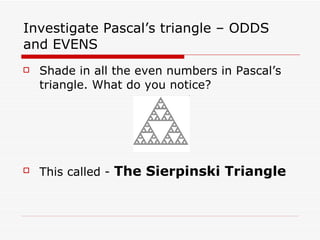
Investigate Pascal’s triangle – ODDS and EVENS Shade in all the even numbers in Pascal’s triangle. What do you notice? This called -  The Sierpinski Triangle
Are there more odd or even numbers? Can you remember the addition properties of odd and even numbers?  ODD + ODD =  EVEN + ODD = EVEN +EVEN = How can you relate this to your prediction?
Are there more odd or even numbers? Design a table or graph to record your data in two ways: By row Accumulative Challenge! What is the ratio of even to odd numbers after 3, 7,15 rows?
Find your own patterns! Colour multiples of nine What do you see? Try multiples of other numbers are there repeating patterns?
More information http://www.mathsisfun.com/pascals-triangle.html

Pascal's triangle Maths Investigation

  • 1.
    Pascal’s Triangle WALT:investigate and describe patterns
  • 2.
    What is Pascal’striangle? Named after the French mathematician Blaise Pascal (1623-62) who brought the triangle to the attention of Western mathematicians It was known as early as 1300 in China, where it was known as the "Chinese Triangle“ It is used to solve problems of probability
  • 3.
    FUNCTION – Howdoes it work? What is the rule? Use the rule to complete a triangle.
  • 4.
    What can yousee? Here is a hint to help you finish the triangle. You may use a calculator.
  • 5.
    Finding patterns Findthe total of each row and record this. What do you notice? Can you use exponents to record this number sequence? Can you write a general statement for this number sequence?
  • 6.
    Explore diagonal patternswithin the triangle. Look at the diagonals: Is there a pattern along each diagonal? Describe the pattern and its rule.
  • 7.
    More Diagonal Patterns2 nd diagonal = triangular numbers AND the adjacent numbers make square numbers 3 rd diagonal = tetrahedral numbers (add the layers) AND the adjacent numbers make pyramid numbers (add the layers.)
  • 8.
    Investigate Pascal’s triangle– ODDS and EVENS Shade in all the even numbers in Pascal’s triangle. What do you notice? This called - The Sierpinski Triangle
  • 9.
    Are there moreodd or even numbers? Can you remember the addition properties of odd and even numbers? ODD + ODD = EVEN + ODD = EVEN +EVEN = How can you relate this to your prediction?
  • 10.
    Are there moreodd or even numbers? Design a table or graph to record your data in two ways: By row Accumulative Challenge! What is the ratio of even to odd numbers after 3, 7,15 rows?
  • 11.
    Find your ownpatterns! Colour multiples of nine What do you see? Try multiples of other numbers are there repeating patterns?
  • 12.

Editor's Notes

  • #5 Symmetry
  • #6 Exponents – power of 2 If x is the previous number the answer to the following row is x to the power of 2.
  • #7 0 = 1s all the way 1 = counting 2= triangular numbers but adjacent numbers make square numbers 3 = tetrahedral numbers
  • #10 Odd + odd = even Even + odd = odd Even + even = even