
TOPIC:- SQUARES AND SQUARE
ROOT
CONTENTS

 Squares
 Square root
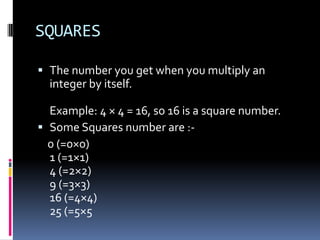
SQUARES

 The number you get when you multiply an
  integer by itself.

  Example: 4 × 4 = 16, so 16 is a square number.
 Some Squares number are :-
  0 (=0×0)
  1 (=1×1)
  4 (=2×2)
  9 (=3×3)
  16 (=4×4)
  25 (=5×5
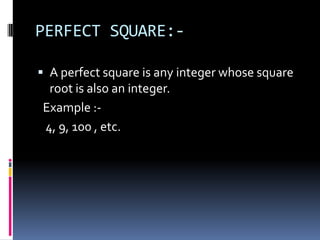
PERFECT SQUARE:-

 A perfect square is any integer whose square
 root is also an integer.
Example :-
4, 9, 100 , etc.
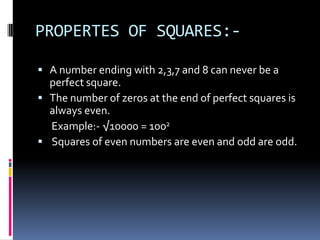
PROPERTES OF SQUARES:-

 A number ending with 2,3,7 and 8 can never be a
  perfect square.
 The number of zeros at the end of perfect squares is
  always even.
  Example:- √10000 = 1002
 Squares of even numbers are even and odd are odd.
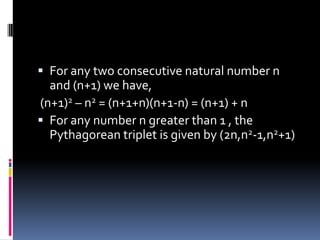
 For any two consecutive natural number n
  and (n+1) we have,
(n+1)2 – n2 = (n+1+n)(n+1-n) = (n+1) + n
 For any number n greater than 1 , the
  Pythagorean triplet is given by (2n,n2-1,n2+1)
SQUARE ROOT


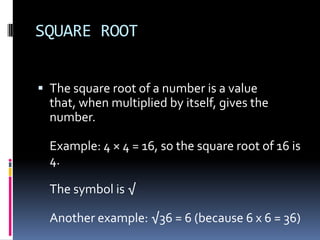
 The square root of a number is a value
  that, when multiplied by itself, gives the
  number.

  Example: 4 × 4 = 16, so the square root of 16 is
  4.

  The symbol is √

  Another example: √36 = 6 (because 6 x 6 = 36)
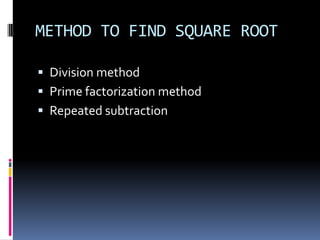
METHOD TO FIND SQUARE ROOT

 Division method
 Prime factorization method
 Repeated subtraction
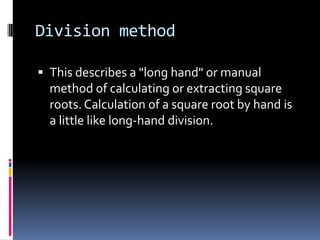
Division method

 This describes a "long hand" or manual
  method of calculating or extracting square
  roots. Calculation of a square root by hand is
  a little like long-hand division.
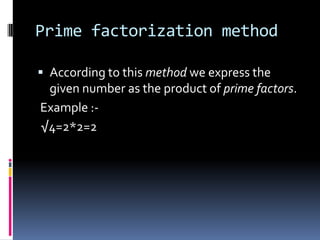
Prime factorization method

 According to this method we express the
 given number as the product of prime factors.
Example :-
√4=2*2=2
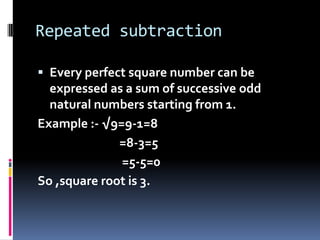
Repeated subtraction

 Every perfect square number can be
  expressed as a sum of successive odd
  natural numbers starting from 1.
Example :- √9=9-1=8
              =8-3=5
              =5-5=0
So ,square root is 3.
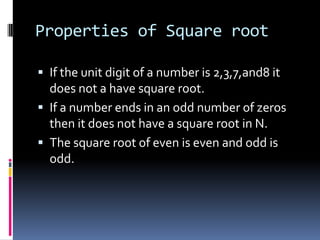
Properties of Square root

 If the unit digit of a number is 2,3,7,and8 it
  does not a have square root.
 If a number ends in an odd number of zeros
  then it does not have a square root in N.
 The square root of even is even and odd is
  odd.
BY:-
NEELABH SHUKLA
Class-8th A
ROLL NO. - 25

Maths

  • 1.
  • 2.
  • 3.
    SQUARES  The numberyou get when you multiply an integer by itself. Example: 4 × 4 = 16, so 16 is a square number.  Some Squares number are :- 0 (=0×0) 1 (=1×1) 4 (=2×2) 9 (=3×3) 16 (=4×4) 25 (=5×5
  • 4.
    PERFECT SQUARE:-  Aperfect square is any integer whose square root is also an integer. Example :- 4, 9, 100 , etc.
  • 5.
    PROPERTES OF SQUARES:- A number ending with 2,3,7 and 8 can never be a perfect square.  The number of zeros at the end of perfect squares is always even. Example:- √10000 = 1002  Squares of even numbers are even and odd are odd.
  • 6.
     For anytwo consecutive natural number n and (n+1) we have, (n+1)2 – n2 = (n+1+n)(n+1-n) = (n+1) + n  For any number n greater than 1 , the Pythagorean triplet is given by (2n,n2-1,n2+1)
  • 7.
    SQUARE ROOT  Thesquare root of a number is a value that, when multiplied by itself, gives the number. Example: 4 × 4 = 16, so the square root of 16 is 4. The symbol is √ Another example: √36 = 6 (because 6 x 6 = 36)
  • 8.
    METHOD TO FINDSQUARE ROOT  Division method  Prime factorization method  Repeated subtraction
  • 9.
    Division method  Thisdescribes a "long hand" or manual method of calculating or extracting square roots. Calculation of a square root by hand is a little like long-hand division.
  • 10.
    Prime factorization method According to this method we express the given number as the product of prime factors. Example :- √4=2*2=2
  • 11.
    Repeated subtraction  Everyperfect square number can be expressed as a sum of successive odd natural numbers starting from 1. Example :- √9=9-1=8 =8-3=5 =5-5=0 So ,square root is 3.
  • 12.
    Properties of Squareroot  If the unit digit of a number is 2,3,7,and8 it does not a have square root.  If a number ends in an odd number of zeros then it does not have a square root in N.  The square root of even is even and odd is odd.
  • 13.