The document discusses dynamic programming and its application to solving the longest common subsequence (LCS) problem. It presents the LCS algorithm, which uses dynamic programming to find the length and sequence of the longest subsequence common to two strings X and Y in O(mn) time, where m and n are the lengths of X and Y, respectively. It provides an example running the LCS algorithm on strings X="ABCB" and Y="BDCAB" to determine their longest common subsequence is "BCB".


![LCS Algorithm First we’ll find the length of LCS. Later we’ll modify the algorithm to find LCS itself. Define X i , Y j to be the prefixes of X and Y of length i and j respectively Define c[i,j] to be the length of LCS of X i and Y j Then the length of LCS of X and Y will be c[m,n]](https://image.slidesharecdn.com/24-1224487972954231-8/85/lecture-24-5-320.jpg)
![LCS recursive solution We start with i = j = 0 (empty substrings of x and y) Since X 0 and Y 0 are empty strings, their LCS is always empty (i.e. c[0,0] = 0 ) LCS of empty string and any other string is empty, so for every i and j: c[0, j] = c[i,0] = 0](https://image.slidesharecdn.com/24-1224487972954231-8/85/lecture-24-6-320.jpg)
![LCS recursive solution When we calculate c[i,j], we consider two cases: First case: x[i]=y[j] : one more symbol in strings X and Y matches, so the length of LCS X i and Y j equals to the length of LCS of smaller strings X i-1 and Y i-1 , plus 1](https://image.slidesharecdn.com/24-1224487972954231-8/85/lecture-24-7-320.jpg)
![LCS recursive solution Second case: x[i] != y[j] As symbols don’t match, our solution is not improved, and the length of LCS(X i , Y j ) is the same as before (i.e. maximum of LCS(X i , Y j-1 ) and LCS(X i-1 ,Y j ) Why not just take the length of LCS(X i-1 , Y j-1 ) ?](https://image.slidesharecdn.com/24-1224487972954231-8/85/lecture-24-8-320.jpg)
![LCS Length Algorithm LCS-Length(X, Y) 1. m = length(X) // get the # of symbols in X 2. n = length(Y) // get the # of symbols in Y 3. for i = 1 to m c[i,0] = 0 // special case: Y 0 4. for j = 1 to n c[0,j] = 0 // special case: X 0 5. for i = 1 to m // for all X i 6. for j = 1 to n // for all Y j 7. if ( X i == Y j ) 8. c[i,j] = c[i-1,j-1] + 1 9. else c[i,j] = max( c[i-1,j], c[i,j-1] ) 10. return c](https://image.slidesharecdn.com/24-1224487972954231-8/85/lecture-24-9-320.jpg)

![LCS Example (0) j 0 1 2 3 4 5 0 1 2 3 4 i Xi A B C B Yj B B A C D X = ABCB; m = |X| = 4 Y = BDCAB; n = |Y| = 5 Allocate array c[5,4] ABCB BDCAB](https://image.slidesharecdn.com/24-1224487972954231-8/85/lecture-24-11-320.jpg)
![LCS Example (1) j 0 1 2 3 4 5 0 1 2 3 4 i Xi A B C B Yj B B A C D 0 0 0 0 0 0 0 0 0 0 for i = 1 to m c[i,0] = 0 for j = 1 to n c[0,j] = 0 ABCB BDCAB](https://image.slidesharecdn.com/24-1224487972954231-8/85/lecture-24-12-320.jpg)
![LCS Example (2) j 0 1 2 3 4 5 0 1 2 3 4 i Xi A B C B Yj B B A C D 0 0 0 0 0 0 0 0 0 0 if ( X i == Y j ) c[i,j] = c[i-1,j-1] + 1 else c[i,j] = max( c[i-1,j], c[i,j-1] ) 0 A BCB B DCAB](https://image.slidesharecdn.com/24-1224487972954231-8/85/lecture-24-13-320.jpg)
![LCS Example (3) j 0 1 2 3 4 5 0 1 2 3 4 i Xi A B C B Yj B B A C D 0 0 0 0 0 0 0 0 0 0 if ( X i == Y j ) c[i,j] = c[i-1,j-1] + 1 else c[i,j] = max( c[i-1,j], c[i,j-1] ) 0 0 0 A BCB B DC AB](https://image.slidesharecdn.com/24-1224487972954231-8/85/lecture-24-14-320.jpg)
![LCS Example (4) j 0 1 2 3 4 5 0 1 2 3 4 i Xi A B C B Yj B B A C D 0 0 0 0 0 0 0 0 0 0 if ( X i == Y j ) c[i,j] = c[i-1,j-1] + 1 else c[i,j] = max( c[i-1,j], c[i,j-1] ) 0 0 0 1 A BCB BDC A B](https://image.slidesharecdn.com/24-1224487972954231-8/85/lecture-24-15-320.jpg)
![LCS Example (5) j 0 1 2 3 4 5 0 1 2 3 4 i Xi A B C B Yj B B A C D 0 0 0 0 0 0 0 0 0 0 if ( X i == Y j ) c[i,j] = c[i-1,j-1] + 1 else c[i,j] = max( c[i-1,j], c[i,j-1] ) 0 0 0 1 1 A BCB BDCA B](https://image.slidesharecdn.com/24-1224487972954231-8/85/lecture-24-16-320.jpg)
![LCS Example (6) j 0 1 2 3 4 5 0 1 2 3 4 i Xi A B C B Yj B B A C D 0 0 0 0 0 0 0 0 0 0 if ( X i == Y j ) c[i,j] = c[i-1,j-1] + 1 else c[i,j] = max( c[i-1,j], c[i,j-1] ) 0 0 1 0 1 1 A B CB B DCAB](https://image.slidesharecdn.com/24-1224487972954231-8/85/lecture-24-17-320.jpg)
![LCS Example (7) j 0 1 2 3 4 5 0 1 2 3 4 i Xi A B C B Yj B B A C D 0 0 0 0 0 0 0 0 0 0 if ( X i == Y j ) c[i,j] = c[i-1,j-1] + 1 else c[i,j] = max( c[i-1,j], c[i,j-1] ) 1 0 0 0 1 1 1 1 1 A B CB B DCA B](https://image.slidesharecdn.com/24-1224487972954231-8/85/lecture-24-18-320.jpg)
![LCS Example (8) j 0 1 2 3 4 5 0 1 2 3 4 i Xi A B C B Yj B B A C D 0 0 0 0 0 0 0 0 0 0 if ( X i == Y j ) c[i,j] = c[i-1,j-1] + 1 else c[i,j] = max( c[i-1,j], c[i,j-1] ) 1 0 0 0 1 1 1 1 1 2 A B CB BDCA B](https://image.slidesharecdn.com/24-1224487972954231-8/85/lecture-24-19-320.jpg)
![LCS Example (10) j 0 1 2 3 4 5 0 1 2 3 4 i Xi A B C B Yj B B A C D 0 0 0 0 0 0 0 0 0 0 if ( X i == Y j ) c[i,j] = c[i-1,j-1] + 1 else c[i,j] = max( c[i-1,j], c[i,j-1] ) 1 0 0 0 1 2 1 1 1 1 1 1 AB C B BD CAB](https://image.slidesharecdn.com/24-1224487972954231-8/85/lecture-24-20-320.jpg)
![LCS Example (11) j 0 1 2 3 4 5 0 1 2 3 4 i Xi A B C B Yj B B A C D 0 0 0 0 0 0 0 0 0 0 if ( X i == Y j ) c[i,j] = c[i-1,j-1] + 1 else c[i,j] = max( c[i-1,j], c[i,j-1] ) 1 0 0 0 1 1 2 1 1 1 1 1 2 AB C B BD C AB](https://image.slidesharecdn.com/24-1224487972954231-8/85/lecture-24-21-320.jpg)
![LCS Example (12) j 0 1 2 3 4 5 0 1 2 3 4 i Xi A B C B Yj B B A C D 0 0 0 0 0 0 0 0 0 0 if ( X i == Y j ) c[i,j] = c[i-1,j-1] + 1 else c[i,j] = max( c[i-1,j], c[i,j-1] ) 1 0 0 0 1 1 2 1 1 1 1 2 1 2 2 AB C B BDC AB](https://image.slidesharecdn.com/24-1224487972954231-8/85/lecture-24-22-320.jpg)
![LCS Example (13) j 0 1 2 3 4 5 0 1 2 3 4 i Xi A B C B Yj B B A C D 0 0 0 0 0 0 0 0 0 0 if ( X i == Y j ) c[i,j] = c[i-1,j-1] + 1 else c[i,j] = max( c[i-1,j], c[i,j-1] ) 1 0 0 0 1 1 2 1 1 1 1 2 1 2 2 1 ABC B B DCAB](https://image.slidesharecdn.com/24-1224487972954231-8/85/lecture-24-23-320.jpg)
![LCS Example (14) j 0 1 2 3 4 5 0 1 2 3 4 i Xi A B C B Yj B B A C D 0 0 0 0 0 0 0 0 0 0 if ( X i == Y j ) c[i,j] = c[i-1,j-1] + 1 else c[i,j] = max( c[i-1,j], c[i,j-1] ) 1 0 0 0 1 1 2 1 1 1 1 2 1 2 2 1 1 2 2 ABC B B DCA B](https://image.slidesharecdn.com/24-1224487972954231-8/85/lecture-24-24-320.jpg)
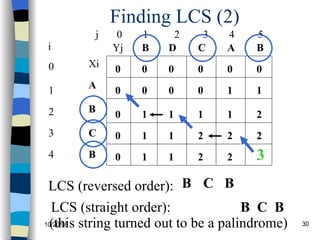
![LCS Example (15) j 0 1 2 3 4 5 0 1 2 3 4 i Xi A B C B Yj B B A C D 0 0 0 0 0 0 0 0 0 0 if ( X i == Y j ) c[i,j] = c[i-1,j-1] + 1 else c[i,j] = max( c[i-1,j], c[i,j-1] ) 1 0 0 0 1 1 2 1 1 1 1 2 1 2 2 1 1 2 2 3 ABC B BDCA B](https://image.slidesharecdn.com/24-1224487972954231-8/85/lecture-24-25-320.jpg)
![LCS Algorithm Running Time LCS algorithm calculates the values of each entry of the array c[m,n] So what is the running time? O(m*n) since each c[i,j] is calculated in constant time, and there are m*n elements in the array](https://image.slidesharecdn.com/24-1224487972954231-8/85/lecture-24-26-320.jpg)
![How to find actual LCS So far, we have just found the length of LCS, but not LCS itself. We want to modify this algorithm to make it output Longest Common Subsequence of X and Y Each c[i,j] depends on c[i-1,j] and c[i,j-1] or c[i-1, j-1] For each c[i,j] we can say how it was acquired: 2 2 3 2 For example, here c[i,j] = c[i-1,j-1] +1 = 2+1=3](https://image.slidesharecdn.com/24-1224487972954231-8/85/lecture-24-27-320.jpg)
![How to find actual LCS - continued Remember that So we can start from c[m,n] and go backwards Whenever c[i,j] = c[i-1, j-1]+1 , remember x[i] (because x[i] is a part of LCS) When i=0 or j=0 (i.e. we reached the beginning), output remembered letters in reverse order](https://image.slidesharecdn.com/24-1224487972954231-8/85/lecture-24-28-320.jpg)



![Pascal's triangle [compatibility mode]](https://cdn.slidesharecdn.com/ss_thumbnails/pascalstrianglecompatibilitymode-120812113022-phpapp02-thumbnail.jpg?width=640&height=640&fit=bounds)


