TRIANGULAR NUMBERS
ALAN S. ABERILLA
The triangular number is a figurate number that can be
represented in the form of a triangular grid of points where
the first row contains a single element and each subsequent
row contains one more element than the previous one.
More formally, a triangular number is a number obtained by
adding all positive integers less than or equal to a given
positive integer n.
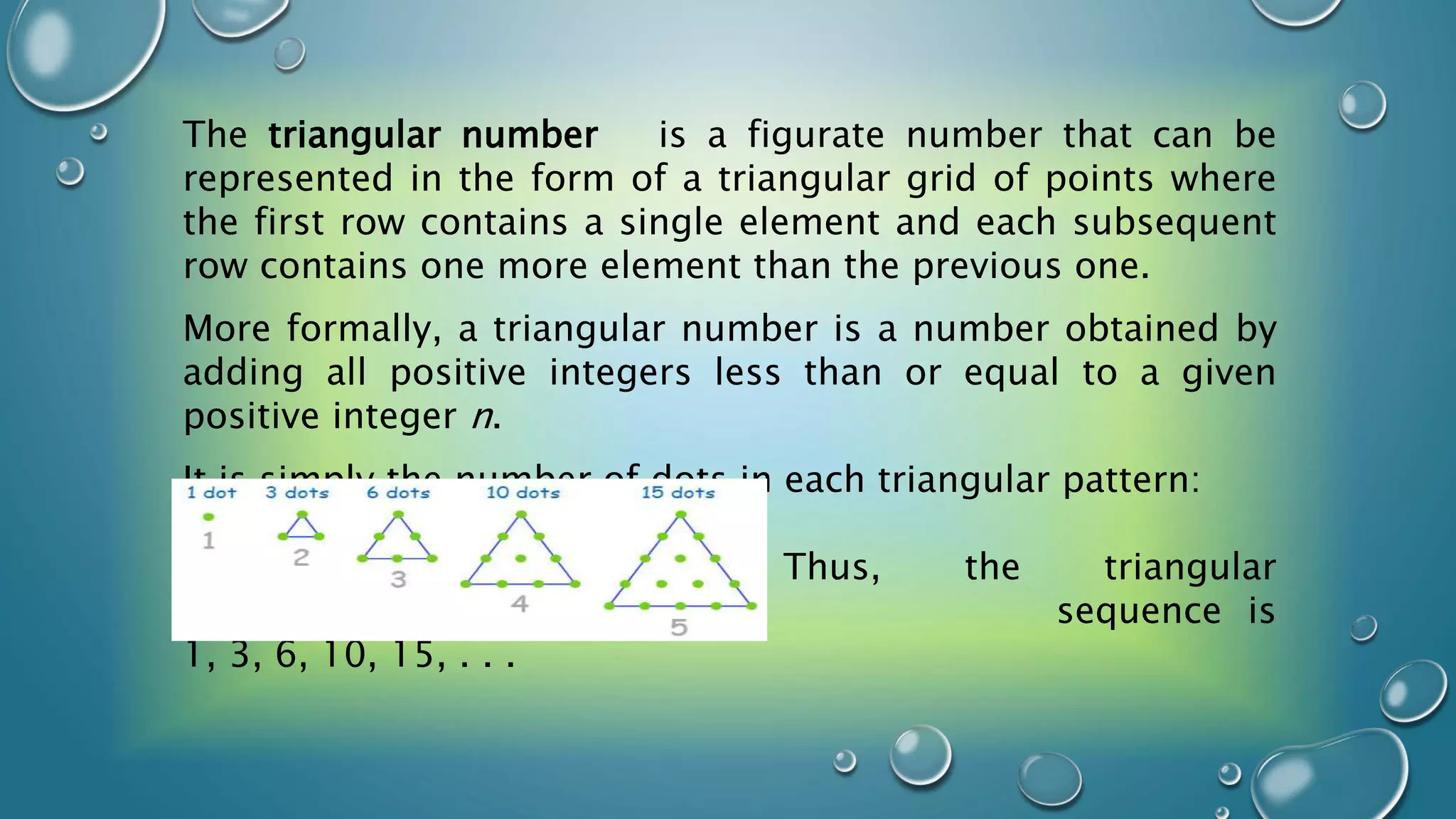
It is simply the number of dots in each triangular pattern:
Thus, the triangular
number is sequence is
1, 3, 6, 10, 15, . . .
By adding another row of dots and counting all the dots we
can
find the next number of the sequence.
The first triangle has just one dot.
The second triangle has another row with 2 extra dots,
making 1 + 2 = 3
The third triangle has another row with 3 extra dots, making
1 + 2 + 3 = 6
The fourth has 1 + 2 + 3 + 4 = 10
etc!
How may dots in the 60th triangle?
A Rule
We can make a "Rule" so we can calculate any triangular number.
First, rearrange the dots like this:
Then double the number of dots, and form them into a rectangle:
Now it is easy to work out how many dots: just multiply n by n+1
Dots in rectangle = n(n+1)
But remember we doubled the number of dots, so
Dots in triangle = n(n+1)/2
We can use xn to mean "dots in triangle n", so we get the rule:
Rule: xn = n(n+1)/2
ACTIVITY 7:
How many dots in the 10th and 15th triangle?
Solve it through rectangular pattern and double
check it using the formula.
Use short bond paper (handwritten or
computerized) – utilize the folder of assignment
1
triangle
Lesson 8   triangular numbers

Lesson 8 triangular numbers

  • 1.
  • 2.
    The triangular numberis a figurate number that can be represented in the form of a triangular grid of points where the first row contains a single element and each subsequent row contains one more element than the previous one. More formally, a triangular number is a number obtained by adding all positive integers less than or equal to a given positive integer n. It is simply the number of dots in each triangular pattern: Thus, the triangular number is sequence is 1, 3, 6, 10, 15, . . .
  • 3.
    By adding anotherrow of dots and counting all the dots we can find the next number of the sequence. The first triangle has just one dot. The second triangle has another row with 2 extra dots, making 1 + 2 = 3 The third triangle has another row with 3 extra dots, making 1 + 2 + 3 = 6 The fourth has 1 + 2 + 3 + 4 = 10 etc!
  • 4.
    How may dotsin the 60th triangle? A Rule We can make a "Rule" so we can calculate any triangular number. First, rearrange the dots like this:
  • 5.
    Then double thenumber of dots, and form them into a rectangle: Now it is easy to work out how many dots: just multiply n by n+1 Dots in rectangle = n(n+1) But remember we doubled the number of dots, so Dots in triangle = n(n+1)/2 We can use xn to mean "dots in triangle n", so we get the rule: Rule: xn = n(n+1)/2
  • 7.
    ACTIVITY 7: How manydots in the 10th and 15th triangle? Solve it through rectangular pattern and double check it using the formula. Use short bond paper (handwritten or computerized) – utilize the folder of assignment 1 triangle