Dr. C.V. Suresh Babu
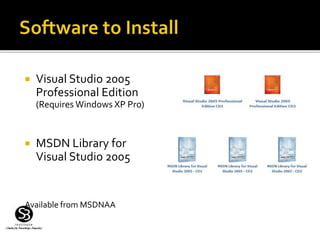
 Visual Studio 2005
Professional Edition
(Requires Windows XP Pro)
 MSDN Library for
Visual Studio 2005
Available from MSDNAA
 A platform that allows the development and
deployment of desktop and web applications
 Allows user choice of many .NET languages
 May program in One of them
 May create different parts of application in different
languages
▪ Visual Basic
▪ C# (C Sharp)
▪ C++
▪ J++
▪ Etc.
 Integrated Development Environment –
allows the automation of many of the
common programming tasks in one
environment
 Writing the code
 Checking for Syntax (Language) errors
 Compiling and Interpreting(Transferring to
computer language)
 Debugging (Fixing Run-time or Logic Errors)
 Running the Application
 4th Generation Programming Environment /
Development Language
 Based on BASIC language
 Beginners All-Purpose Symbolic Instructional
Code
 Most widely used tool for developing
Windows Applications
 Graphical User Interface (GUI)
 Menus, Buttons, Icons to help the user
 Full Object-Oriented Programming Language
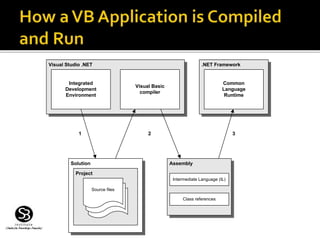
Solution
.NET FrameworkVisual Studio .NET
Project
Common
Language
Runtime
Integrated
Development
Environment
Source files
Visual Basic
compiler
1 2 3
Assembly
Intermediate Language (IL)
Class references
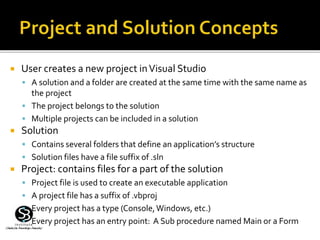
 User creates a new project inVisual Studio
 A solution and a folder are created at the same time with the same name as
the project
 The project belongs to the solution
 Multiple projects can be included in a solution
 Solution
 Contains several folders that define an application’s structure
 Solution files have a file suffix of .sln
 Project: contains files for a part of the solution
 Project file is used to create an executable application
 A project file has a suffix of .vbproj
 Every project has a type (Console,Windows, etc.)
 Every project has an entry point: A Sub procedure named Main or a Form
 Solution folder
 Solution file (.sln)
 Project folder
▪ Project file (.vbproj)
▪ Visual Basic source files (.vb)
▪ My Project folder: contains configuration information
common to all projects
▪ The file AssemblyInfo.vb contains assembly metadata
▪ The References folder contains references to other assemblies
▪ The bin folder contains the executable file produced as a
result of compiling the application
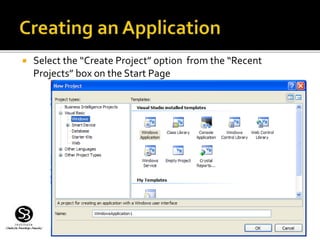
 Select the “Create Project” option from the “Recent
Projects” box on the Start Page
 This is aVisual Basic
GUI object called a form
 Forms are the windows
and dialog boxes that
display when a program
runs.
 A form is an object that
contains other objects
such as buttons, text
boxes, and labels
 Form elements are
objects called controls
 This form has:
 TwoTextBox controls
 Four Label controls
 Two Button controls
 The value displayed by
a control is held in the text property of the control
 Left button text property is Calculate Gross Pay
 Buttons have methods attached to events
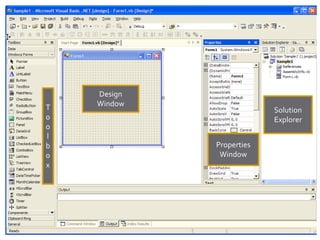
Design
WindowT
o
o
l
b
o
x
Solution
Explorer
Properties
Window
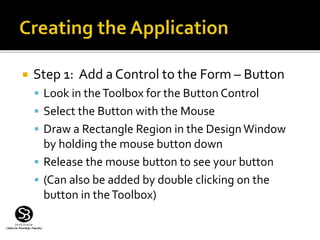
 Step 1: Add a Control to the Form – Button
 Look in theToolbox for the Button Control
 Select the Button with the Mouse
 Draw a Rectangle Region in the DesignWindow
by holding the mouse button down
 Release the mouse button to see your button
 (Can also be added by double clicking on the
button in theToolbox)
 Add a Second Button to the Form
 Put it in the lower right corner
 The project now contains
 a form with 2 button
 controls
 Properties
 All controls have properties
 Each property has a value (or values)
 Determine the Look and Feel (and sometimes
behavior) of a Control
 Set initially through the Properties Window
 Properties Set for this Application
 Name
 Text
 The name property establishes a means for
the program to refer to that control
 Controls are assigned relatively meaningless
names when created
 Change these names to something more
meaningful
 Control names must start with a letter
 Remaining characters may be letters, digits,
or underscore
btnCalcGrossPay btnClose
txtHoursWorked
txtPayRate
lblGrossPay
Label1
Label2
Label3
 The label controls use the default names (Label1, etc.)
 Text boxes, buttons, and the Gross Pay label play an
active role in the program and have been changed
 Should be meaningful
 1st 3 lowercase letters indicate the type of control
 txt… forText Boxes
 lbl… for Labels
 btn… for Buttons
 After that, capitalize the first letter of each word
 txtHoursWorked is clearer than txthoursworked
 Change the name property
 Set the name of button1 to btnWelcome
 Set the name of button2 to btnExit
 Click on the Control in the DesignWindow
 Select the appropriate property in the
PropertiesWindow
 Determines the visible text on the control
 Change the text property
 bntWelcome  set to “SayWelcome”
 btnExit  set to “Exit”
 Do not need to include the “ “ in your text field
 Notice how the buttons now display the new text
 The GUI environment is event-driven
 An event is an action that takes place within a
program
 Clicking a button (a Click event)
 Keying in aTextBox (aTextChanged event)
 Visual Basic controls are capable of detecting
many, many events
 A program can respond to an event if the
programmer writes an event procedure
 An Event Procedure is a block of code that
executes only when particular event occurs
 Writing an Event Procedure
 Create the event procedure stub
▪ Double click on control from DesignWindow – for
default event for that control
OR
▪ Open the Code Editor (F7 orView Menu/Code option)
▪ Select Control & Select Event from drop down windows
in Code Editor
 Add the event code to the event procedure stub
 Select the btnWelcome control from the
Form Controls List Box
 Select the Click event from the list of many
available events
 Buttons have 57 possible events they can
respond to
 Beginning of Procedure is created for you
 If you create stub by double clicking on control it
will create a stub for the most commonly used
event for that control
 Write the code that you want executed when
the user clicks on the btnWelcome button
 Type: MsgBox (“Welcome toVisual Basic”)
 Must be contained within the Event Procedure
Stub
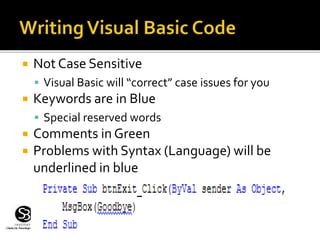
 Not Case Sensitive
 Visual Basic will “correct” case issues for you
 Keywords are in Blue
 Special reserved words
 Comments in Green
 Problems with Syntax (Language) will be
underlined in blue
 Rules
 Use spaces to separate the words and operators
 Indentation and capitalization have no effect
 Recommendations
 Use indentation and extra spaces for alignment
 Use blank lines before and after groups of related
statements
 Code all variable declarations at the start of the
procedure
 Group related declarations
 Usage
 Type an apostrophe ( ' ) followed by the comment
 The compiler ignores everything on the line after ‘
 Used for documentation/readability and to disable
chosen statements during testing
 Recommendations
 Follow apostrophe with a star for readability ( ‘* )
 Use at beginning of program to indicate author,
purpose, date, etc.
 Use for groups of related statements and portions of
code that are difficult to understand
'* ======================================
'* Class: CIS 115-101
'* Author: Paul Overstreet
'* Purpose: Homework 1 –VB Application
'* Date: 11/30/01
'* ======================================
Public Class Form1
Private Sub btnCalculate_Click(ByVal sender As System.Object, ByVal e As System.EventAr…
'*Variable declarations
Dim dOrderTotal As Decimal
Dim dDiscountAmount As Decimal
'*Get total from textbox
dOrderTotal = txtOrderTotal.Text
'*Calculate the proper discount
dDiscountAmount = dOrderTotal * 0.25
' dDiscountAmount = dOrderTotal * 0.25
End Sub
Private Sub Button1_Click(ByVal sender As System.Object, ByVal e As System.EventArgs)…
‘*Code goes here
End Sub
End Class
 Create an Event Procedure for when the
btnExit button is clicked
 Have it display “Goodbye” in a MsgBox
 Then “End” – this will terminate the program
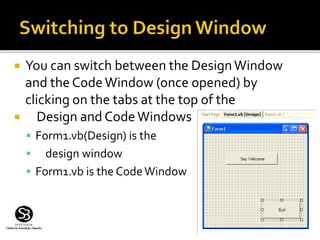
 You can switch between the DesignWindow
and the CodeWindow (once opened) by
clicking on the tabs at the top of the
 Design and CodeWindows
 Form1.vb(Design) is the
 design window
 Form1.vb is the CodeWindow
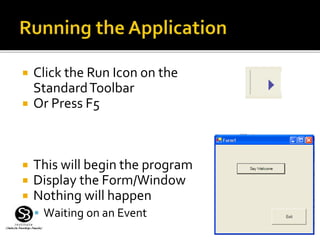
 Click the Run Icon on the
StandardToolbar
 Or Press F5
 This will begin the program
 Display the Form/Window
 Nothing will happen
 Waiting on an Event
 Click on the “SayWelcome” button
 The message box should display
 Click on the “Exit” button
 The message box should display
 The application should terminate
 Make sure to save your work
 SAVE ALL (not Save Form)
 Visual Basic applications are
 made of several files -
 Often even several forms

Visual studio.net

  • 1.
  • 2.
     Visual Studio2005 Professional Edition (Requires Windows XP Pro)  MSDN Library for Visual Studio 2005 Available from MSDNAA
  • 3.
     A platformthat allows the development and deployment of desktop and web applications  Allows user choice of many .NET languages  May program in One of them  May create different parts of application in different languages ▪ Visual Basic ▪ C# (C Sharp) ▪ C++ ▪ J++ ▪ Etc.
  • 4.
     Integrated DevelopmentEnvironment – allows the automation of many of the common programming tasks in one environment  Writing the code  Checking for Syntax (Language) errors  Compiling and Interpreting(Transferring to computer language)  Debugging (Fixing Run-time or Logic Errors)  Running the Application
  • 5.
     4th GenerationProgramming Environment / Development Language  Based on BASIC language  Beginners All-Purpose Symbolic Instructional Code  Most widely used tool for developing Windows Applications  Graphical User Interface (GUI)  Menus, Buttons, Icons to help the user  Full Object-Oriented Programming Language
  • 6.
    Solution .NET FrameworkVisual Studio.NET Project Common Language Runtime Integrated Development Environment Source files Visual Basic compiler 1 2 3 Assembly Intermediate Language (IL) Class references
  • 7.
     User createsa new project inVisual Studio  A solution and a folder are created at the same time with the same name as the project  The project belongs to the solution  Multiple projects can be included in a solution  Solution  Contains several folders that define an application’s structure  Solution files have a file suffix of .sln  Project: contains files for a part of the solution  Project file is used to create an executable application  A project file has a suffix of .vbproj  Every project has a type (Console,Windows, etc.)  Every project has an entry point: A Sub procedure named Main or a Form
  • 8.
     Solution folder Solution file (.sln)  Project folder ▪ Project file (.vbproj) ▪ Visual Basic source files (.vb) ▪ My Project folder: contains configuration information common to all projects ▪ The file AssemblyInfo.vb contains assembly metadata ▪ The References folder contains references to other assemblies ▪ The bin folder contains the executable file produced as a result of compiling the application
  • 10.
     Select the“Create Project” option from the “Recent Projects” box on the Start Page
  • 12.
     This isaVisual Basic GUI object called a form  Forms are the windows and dialog boxes that display when a program runs.  A form is an object that contains other objects such as buttons, text boxes, and labels
  • 13.
     Form elementsare objects called controls  This form has:  TwoTextBox controls  Four Label controls  Two Button controls  The value displayed by a control is held in the text property of the control  Left button text property is Calculate Gross Pay  Buttons have methods attached to events
  • 14.
  • 15.
     Step 1:Add a Control to the Form – Button  Look in theToolbox for the Button Control  Select the Button with the Mouse  Draw a Rectangle Region in the DesignWindow by holding the mouse button down  Release the mouse button to see your button  (Can also be added by double clicking on the button in theToolbox)
  • 17.
     Add aSecond Button to the Form  Put it in the lower right corner  The project now contains  a form with 2 button  controls
  • 18.
     Properties  Allcontrols have properties  Each property has a value (or values)  Determine the Look and Feel (and sometimes behavior) of a Control  Set initially through the Properties Window  Properties Set for this Application  Name  Text
  • 19.
     The nameproperty establishes a means for the program to refer to that control  Controls are assigned relatively meaningless names when created  Change these names to something more meaningful  Control names must start with a letter  Remaining characters may be letters, digits, or underscore
  • 20.
    btnCalcGrossPay btnClose txtHoursWorked txtPayRate lblGrossPay Label1 Label2 Label3  Thelabel controls use the default names (Label1, etc.)  Text boxes, buttons, and the Gross Pay label play an active role in the program and have been changed
  • 21.
     Should bemeaningful  1st 3 lowercase letters indicate the type of control  txt… forText Boxes  lbl… for Labels  btn… for Buttons  After that, capitalize the first letter of each word  txtHoursWorked is clearer than txthoursworked  Change the name property  Set the name of button1 to btnWelcome  Set the name of button2 to btnExit
  • 22.
     Click onthe Control in the DesignWindow  Select the appropriate property in the PropertiesWindow
  • 23.
     Determines thevisible text on the control  Change the text property  bntWelcome  set to “SayWelcome”  btnExit  set to “Exit”  Do not need to include the “ “ in your text field  Notice how the buttons now display the new text
  • 24.
     The GUIenvironment is event-driven  An event is an action that takes place within a program  Clicking a button (a Click event)  Keying in aTextBox (aTextChanged event)  Visual Basic controls are capable of detecting many, many events  A program can respond to an event if the programmer writes an event procedure
  • 25.
     An EventProcedure is a block of code that executes only when particular event occurs  Writing an Event Procedure  Create the event procedure stub ▪ Double click on control from DesignWindow – for default event for that control OR ▪ Open the Code Editor (F7 orView Menu/Code option) ▪ Select Control & Select Event from drop down windows in Code Editor  Add the event code to the event procedure stub
  • 28.
     Select thebtnWelcome control from the Form Controls List Box
  • 29.
     Select theClick event from the list of many available events  Buttons have 57 possible events they can respond to
  • 30.
     Beginning ofProcedure is created for you  If you create stub by double clicking on control it will create a stub for the most commonly used event for that control
  • 31.
     Write thecode that you want executed when the user clicks on the btnWelcome button  Type: MsgBox (“Welcome toVisual Basic”)  Must be contained within the Event Procedure Stub
  • 32.
     Not CaseSensitive  Visual Basic will “correct” case issues for you  Keywords are in Blue  Special reserved words  Comments in Green  Problems with Syntax (Language) will be underlined in blue
  • 33.
     Rules  Usespaces to separate the words and operators  Indentation and capitalization have no effect  Recommendations  Use indentation and extra spaces for alignment  Use blank lines before and after groups of related statements  Code all variable declarations at the start of the procedure  Group related declarations
  • 34.
     Usage  Typean apostrophe ( ' ) followed by the comment  The compiler ignores everything on the line after ‘  Used for documentation/readability and to disable chosen statements during testing  Recommendations  Follow apostrophe with a star for readability ( ‘* )  Use at beginning of program to indicate author, purpose, date, etc.  Use for groups of related statements and portions of code that are difficult to understand
  • 35.
    '* ====================================== '* Class:CIS 115-101 '* Author: Paul Overstreet '* Purpose: Homework 1 –VB Application '* Date: 11/30/01 '* ====================================== Public Class Form1 Private Sub btnCalculate_Click(ByVal sender As System.Object, ByVal e As System.EventAr… '*Variable declarations Dim dOrderTotal As Decimal Dim dDiscountAmount As Decimal '*Get total from textbox dOrderTotal = txtOrderTotal.Text '*Calculate the proper discount dDiscountAmount = dOrderTotal * 0.25 ' dDiscountAmount = dOrderTotal * 0.25 End Sub Private Sub Button1_Click(ByVal sender As System.Object, ByVal e As System.EventArgs)… ‘*Code goes here End Sub End Class
  • 36.
     Create anEvent Procedure for when the btnExit button is clicked  Have it display “Goodbye” in a MsgBox  Then “End” – this will terminate the program
  • 37.
     You canswitch between the DesignWindow and the CodeWindow (once opened) by clicking on the tabs at the top of the  Design and CodeWindows  Form1.vb(Design) is the  design window  Form1.vb is the CodeWindow
  • 38.
     Click theRun Icon on the StandardToolbar  Or Press F5  This will begin the program  Display the Form/Window  Nothing will happen  Waiting on an Event
  • 39.
     Click onthe “SayWelcome” button  The message box should display  Click on the “Exit” button  The message box should display  The application should terminate
  • 40.
     Make sureto save your work  SAVE ALL (not Save Form)  Visual Basic applications are  made of several files -  Often even several forms

Editor's Notes

  • #10 Click on Visual Studio Icon on Desktop Start Page should look something like this. If the start page does not appear, click on the Tools Menu, Select Options, Select Start Page from the “At Start Up” list box The Recent Projects box will allow you to open a new or an existing project
  • #11 Project Type  Visual Basic Project Template  Windows Application Name  Give the project a name Projects will be stored in the default file location as specified in the program options. Visual Basic applications (and all Visual Studio applications) have multiple files. It will create a folder in the location for each project name
  • #12 The default settings (located under Tools  Options) allows you to specify where to save the projects.
  • #15 Visual Basic IDE Title Bar Menu Bar Toolbars  Standard and Layout (others available under View menu) DESIGN Window – this contains the form (window) currently being developed Toolbox – Contains the controls that you can add to the form – the forms with the controls make up the GUI for your application Solution Explorer – Contains a listing of the components of the project / solution. A solution is the large application that contains one or more projects. Most applications will contain one project within one solution If anything is not visible, look under the “View” menu
  • #28 This will open the Code Editor – to write, display, edit your Visual Basic Code
  • #31 DO NOT MODIFY the Windows Form Designer Generated Code
  • #33 This is based on the interpreter. An Interpreter attempts to make the conversion to machine language at the end of every line of code. Any syntax errors are identified by Visual Basic as the line is completed.