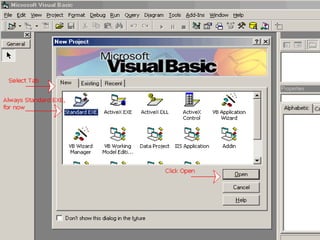
MICROSOFT
VISUAL BASIC
A Brief History of Basic
· Language developed in early 1960's at
   Dartmouth College:
B (eginner's)
A (All-Purpose)
S (Symbolic)
I (Instruction)
C (Code)
· Answer to complicated programming
   languages (FORTRAN, Algol, Cobol ...).
First timeshare language.
A Brief History of Basic
. In the mid-1970's, two college students
   write first Basic for a microcomputer
  (Altair) - cost $350 on cassette tape.
   You may have heard of them:
   Bill Gates and Paul Allen!

· Every Basic since then essentially based
  on that early version. Examples include:
  GW-Basic, QBasic, QuickBasic.

· Visual Basic was introduced in 1991.
Visual Basic versions
Visual Basic 6.0 versus Other Versions of Visual
    Basic
· The original Visual Basic for DOS and Visual Basic
    For Windows were
introduced in 1991.
· Visual Basic 3.0 (a vast improvement over previous
    versions) was released in
1993.

· Visual Basic 4.0 released in late 1995 (added 32 bit
   application support).
·
·
Visual Basic versions
Visual Basic 5.0 released in late 1996. New
   environment, supported creation of
ActiveX controls, deleted 16 bit application support.

· And, now Visual Basic 6.0 - some identified new
  features of Visual Basic 6.0:
Þ Faster compiler
Þ New ActiveX data control object
Þ Allows database integration with wide variety of
  applications
Þ New data report designer
Þ New Package & Deployment Wizard
Þ Additional internet capabilities
What is Visual Basic ?
  • A high level programming language
  • Created by Microsoft
  • Uses a graphic environment called
    Integrated Development Environment
    (IDE)
  • Capable of developing Windows-based
    applications and games
  • Event –driven language
  • Made up of many subprograms , each
    with its own codes that can run
    independently, and at the same time
    can be linked together
DEFINITION OF TERMS
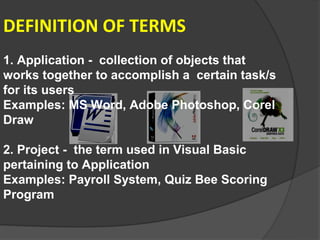
1. Application - collection of objects that
works together to accomplish a certain task/s
for its users
Examples: MS Word, Adobe Photoshop, Corel
Draw

2. Project - the term used in Visual Basic
pertaining to Application
Examples: Payroll System, Quiz Bee Scoring
Program
DEFINITION OF TERMS

3. Object– a piece of software
that has properties and functions
that can be managed or
controlled
Examples: window, dialog box
DEFINITION OF TERMS

4. Property – characteristic of an object
Examples: color, size, background

5. Method – functions of an object that can
be manipulated
Examples: opening, resizing, moving (of a
window)
DEFINITION OF TERMS

6.Object-Oriented Environment – a place
wherein application is created using objects
and combining them to produce an output

7. Event – an action that happens
Examples: clicking of a button, clicking of
a menu, loading of form
DEFINITION OF TERMS
8. Event- Driven – an operation is executed
as the result of some kind of event
9. Form – the first object you will see on
     the screen when you open Visual
Basic
  - it is where all the controls are placed
  - it is also where you will enter data and
    see the results
10. Controls –the object you put on a form
Examples: text box, label, command
DEFINITION OF TERMS
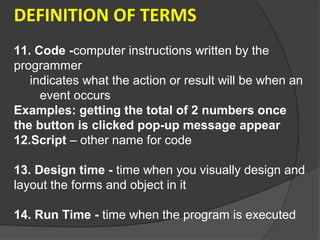
11. Code -computer instructions written by the
programmer
   indicates what the action or result will be when an
     event occurs
Examples: getting the total of 2 numbers once
the button is clicked pop-up message appear
12.Script – other name for code

13. Design time - time when you visually design and
layout the forms and object in it

14. Run Time - time when the program is executed
Why is operation event –driven?
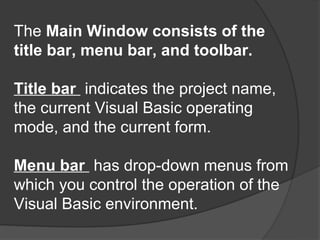
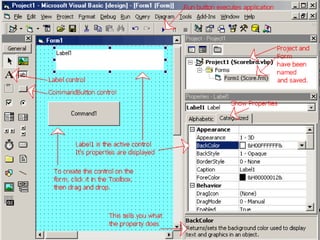
The Main Window consists of the
title bar, menu bar, and toolbar.

Title bar indicates the project name,
the current Visual Basic operating
mode, and the current form.

Menu bar has drop-down menus from
which you control the operation of the
Visual Basic environment.
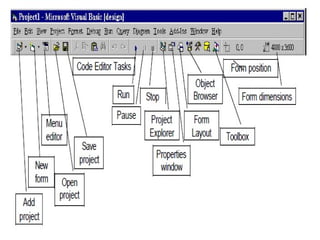
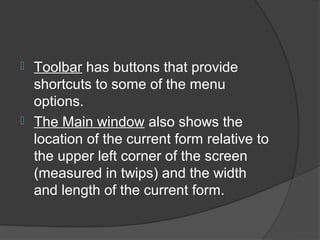
 Toolbar has buttons that provide
  shortcuts to some of the menu
  options.
 The Main window also shows the
  location of the current form relative to
  the upper left corner of the screen
  (measured in twips) and the width
  and length of the current form.
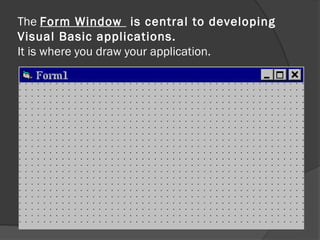
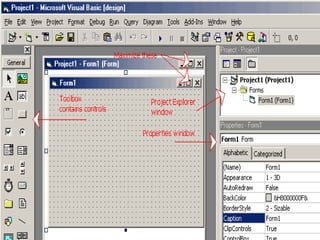
The Form Window is central to developing
Visual Basic applications.
It is where you draw your application.
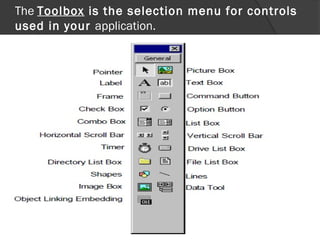
The Toolbox is the selection menu for controls
used in your application.
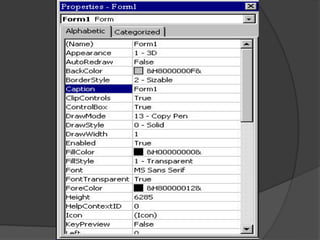
The Properties Window is used
to establish initial property
values for
objects. The drop-down box at the top
of the window lists all objects in the
current form.
Two views are available: Alphabetic
and Categorized. Under this box
are the available properties for the
currently selected object.
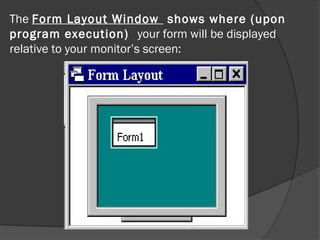
The Form Layout Window shows where (upon
program execution) your form will be displayed
relative to your monitor’s screen:
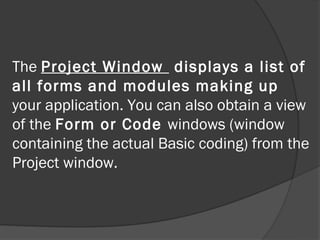
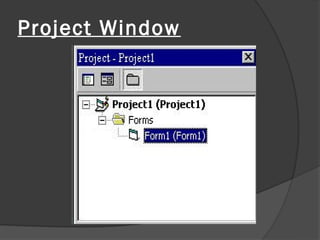
The Project Window displays a list of
all forms and modules making up
your application. You can also obtain a view
of the Form or Code windows (window
containing the actual Basic coding) from the
Project window.
Project Window
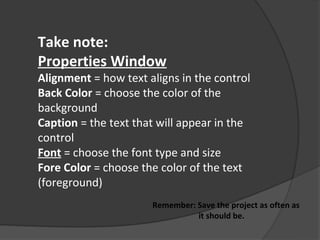
Take note:
Properties Window
Alignment = how text aligns in the control
Back Color = choose the color of the
background
Caption = the text that will appear in the
control
Font = choose the font type and size
Fore Color = choose the color of the text
(foreground)
                      Remember: Save the project as often as
                                it should be.
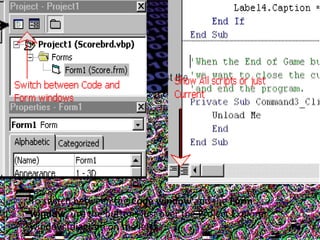
To switch between the Code window and the Form
window, use the buttons just over the Project Explorer
window (diagram on the left).
Tips on Improving your
               application
-write the simplest program that you understand and make it
work - even if it doesn't have color or fancy fonts, test it and then
save it;

-make a copy of your previous working program and code one or
two improvements in the copy

- repeat for every improvement you make, using small steps so
that if something does go wrong its easier to identify the source
of the problem
Avoid repeating code!

The way to correct the application is to take all
the code that repeats and put it into a separate
procedure.

A procedure is identified by the Private Sub ...
End Sub lines.

Call the procedure simply by writing its name.
Writing code
Code Editor
Cut, Copy, Paste, Find, Replace
GOOD HABITS:
1.Use comments
2.Use indents
3.Use standard capitalization
4.Write extra-long statements on 2
lines using the continuation
character _ (space underscore)
VARIABLES
   AND
CONSTANT
    S
Variables and Constants
VARIABLE
 are used by Visual Basic to hold information
  needed by your application
 sign or a name that stands for a particular
  value in a program
 may store a data while the program is running
Naming Conventions
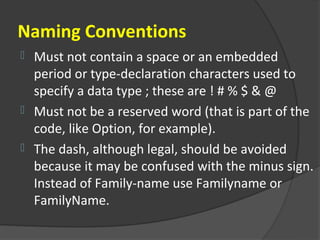
These are the rules to follow when naming
elements in VB - variables, constants, controls,
procedures, and so on:

A name must begin with a letter.

May be as much as 255 characters
Naming Conventions
 Must not contain a space or an embedded
  period or type-declaration characters used to
  specify a data type ; these are ! # % $ & @
 Must not be a reserved word (that is part of the
  code, like Option, for example).
 The dash, although legal, should be avoided
  because it may be confused with the minus sign.
  Instead of Family-name use Familyname or
  FamilyName.
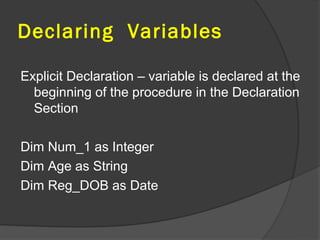
Declaring Variables

Explicit Declaration – variable is declared at the
  beginning of the procedure in the Declaration
  Section

Dim Num_1 as Integer
Dim Age as String
Dim Reg_DOB as Date
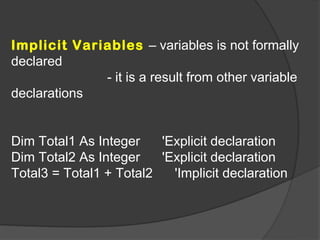
Implicit Variables – variables is not formally
declared
             - it is a result from other variable
declarations


Dim Total1 As Integer    'Explicit declaration
Dim Total2 As Integer    'Explicit declaration
Total3 = Total1 + Total2   'Implicit declaration
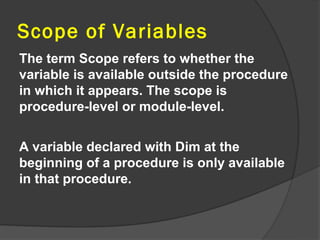
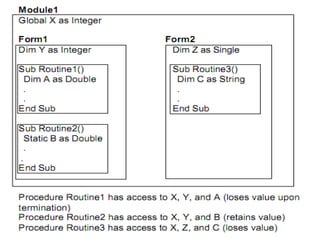
Scope of Variables
The term Scope refers to whether the
variable is available outside the procedure
in which it appears. The scope is
procedure-level or module-level.


A variable declared with Dim at the
beginning of a procedure is only available
in that procedure.
Public Statement
- variable can be used in several forms of the
   project

Private Statement
- variable can only be used in the form it is
  declared
  Module-level – variables declared in the
   declarations section of the module
- available only for the control in the form

  Procedure-level - variables is declared
   inside a procedure is called
- the original value will go back to its default
   value once it is called
Constant
– stores a value that does not change the
  value during the execution of the
  procedure

Types of Constants

Intrinsic Constants – defined by Visual Basic

vbTrue
vbBlack
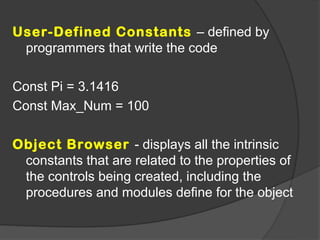
User-Defined Constants – defined by
 programmers that write the code

Const Pi = 3.1416
Const Max_Num = 100

Object Browser - displays all the intrinsic
 constants that are related to the properties of
 the controls being created, including the
 procedures and modules define for the object
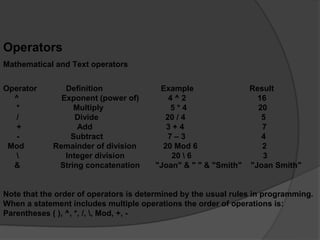
Operators
Mathematical and Text operators


Operator        Definition              Example               Result
  ^            Exponent (power of)        4^2                   16
   *               Multiply                5*4                  20
   /               Divide                20 / 4                  5
   +                Add                   3+4                    7
   -              Subtract                7–3                    4
 Mod         Remainder of division       20 Mod 6                2
               Integer division           20  6                3
  &           String concatenation     "Joan" & " " & "Smith" "Joan Smith"


Note that the order of operators is determined by the usual rules in programming.
When a statement includes multiple operations the order of operations is:
Parentheses ( ), ^, *, /, , Mod, +, -
Logical operators
Operator    Definition          Example             Result
   =        Equal to               9 = 11           False
   >       Greater than            11 > 9            True
   <        Less than               11 < 9          False
   >=      Greater or equal        15 >= 15          True
   <=      Less or equal             9 <= 15         True
   <>       Not equal                9 <> 9          False
  AND       Logical AND       (9 = 9) AND (7 = 6)    False
   OR        Logical OR        (9 = 9) OR (7 = 6)     True
Control Structures

If...Then...Else

If condition1 Then
    statements1
Else
    statements2
End If

If condition1 is True, then statements1 block is executed; Else,
condition1 is not True, therefore statements2 block gets
executed. The structure must be terminated with the End If
statement.

The Else clause is optional. In a simple comparison, statements1
get executed or not.

If condition1 Then
    statements1
End If
Select Case
Can be used as an alternative to the If...Then...Else structure, especially
when many comparisons are involved.

Select Case ShirtSize
   Case 1
      SizeName.Caption = "Small"
   Case 2
      SizeName.Caption = "Medium"
   Case 3
      SizeName.Caption = "Large"
   Case 4
      SizeName.Caption = "Extra Large"
   Case Else
      SizeName.Caption = "Unknown size"
End Select
Do...Loop

Used to execute a block of statements an unspecified number of times.

Do While condition
  statements
Loop

First, the condition is tested; if condition is True, then the statements are
executed. When it gets to the Loop it goes back to the Do and tests
condition again. If condition is False on the first pass, the statements are
never executed.
For...Next


When the number of iterations of the loop is known, it is better to
use the For...Next rather than the Do...Loop.

For counter = start To end
  statements
Next

1) The counter is set to the value of start.
2) Counter is checked to see if it is greater than end; if yes, control
passes to the statement after the Next; if not the statements are
executed.
3)At Next, counter is incremented and goes back to step 2).

Ms vb

  • 1.
  • 2.
    A Brief Historyof Basic · Language developed in early 1960's at Dartmouth College: B (eginner's) A (All-Purpose) S (Symbolic) I (Instruction) C (Code) · Answer to complicated programming languages (FORTRAN, Algol, Cobol ...). First timeshare language.
  • 3.
    A Brief Historyof Basic . In the mid-1970's, two college students write first Basic for a microcomputer (Altair) - cost $350 on cassette tape. You may have heard of them: Bill Gates and Paul Allen! · Every Basic since then essentially based on that early version. Examples include: GW-Basic, QBasic, QuickBasic. · Visual Basic was introduced in 1991.
  • 4.
    Visual Basic versions VisualBasic 6.0 versus Other Versions of Visual Basic · The original Visual Basic for DOS and Visual Basic For Windows were introduced in 1991. · Visual Basic 3.0 (a vast improvement over previous versions) was released in 1993. · Visual Basic 4.0 released in late 1995 (added 32 bit application support). · ·
  • 5.
    Visual Basic versions VisualBasic 5.0 released in late 1996. New environment, supported creation of ActiveX controls, deleted 16 bit application support. · And, now Visual Basic 6.0 - some identified new features of Visual Basic 6.0: Þ Faster compiler Þ New ActiveX data control object Þ Allows database integration with wide variety of applications Þ New data report designer Þ New Package & Deployment Wizard Þ Additional internet capabilities
  • 6.
    What is VisualBasic ? • A high level programming language • Created by Microsoft • Uses a graphic environment called Integrated Development Environment (IDE) • Capable of developing Windows-based applications and games • Event –driven language • Made up of many subprograms , each with its own codes that can run independently, and at the same time can be linked together
  • 7.
    DEFINITION OF TERMS 1.Application - collection of objects that works together to accomplish a certain task/s for its users Examples: MS Word, Adobe Photoshop, Corel Draw 2. Project - the term used in Visual Basic pertaining to Application Examples: Payroll System, Quiz Bee Scoring Program
  • 8.
    DEFINITION OF TERMS 3.Object– a piece of software that has properties and functions that can be managed or controlled Examples: window, dialog box
  • 9.
    DEFINITION OF TERMS 4.Property – characteristic of an object Examples: color, size, background 5. Method – functions of an object that can be manipulated Examples: opening, resizing, moving (of a window)
  • 10.
    DEFINITION OF TERMS 6.Object-OrientedEnvironment – a place wherein application is created using objects and combining them to produce an output 7. Event – an action that happens Examples: clicking of a button, clicking of a menu, loading of form

  • 11.
    DEFINITION OF TERMS 8.Event- Driven – an operation is executed as the result of some kind of event 9. Form – the first object you will see on the screen when you open Visual Basic - it is where all the controls are placed - it is also where you will enter data and see the results 10. Controls –the object you put on a form Examples: text box, label, command


  • 12.
    DEFINITION OF TERMS 11.Code -computer instructions written by the programmer indicates what the action or result will be when an event occurs Examples: getting the total of 2 numbers once the button is clicked pop-up message appear 12.Script – other name for code 13. Design time - time when you visually design and layout the forms and object in it 14. Run Time - time when the program is executed
  • 13.
    Why is operationevent –driven?
  • 14.
    The Main Windowconsists of the title bar, menu bar, and toolbar. Title bar indicates the project name, the current Visual Basic operating mode, and the current form. Menu bar has drop-down menus from which you control the operation of the Visual Basic environment.
  • 16.
     Toolbar hasbuttons that provide shortcuts to some of the menu options.  The Main window also shows the location of the current form relative to the upper left corner of the screen (measured in twips) and the width and length of the current form.
  • 17.
    The Form Windowis central to developing Visual Basic applications. It is where you draw your application.
  • 18.
    The Toolbox isthe selection menu for controls used in your application.
  • 19.
    The Properties Windowis used to establish initial property values for objects. The drop-down box at the top of the window lists all objects in the current form. Two views are available: Alphabetic and Categorized. Under this box are the available properties for the currently selected object.
  • 21.
    The Form LayoutWindow shows where (upon program execution) your form will be displayed relative to your monitor’s screen:
  • 22.
    The Project Windowdisplays a list of all forms and modules making up your application. You can also obtain a view of the Form or Code windows (window containing the actual Basic coding) from the Project window.
  • 23.
  • 27.
    Take note: Properties Window Alignment= how text aligns in the control Back Color = choose the color of the background Caption = the text that will appear in the control Font = choose the font type and size Fore Color = choose the color of the text (foreground) Remember: Save the project as often as it should be.
  • 30.
    To switch betweenthe Code window and the Form window, use the buttons just over the Project Explorer window (diagram on the left).
  • 31.
    Tips on Improvingyour application -write the simplest program that you understand and make it work - even if it doesn't have color or fancy fonts, test it and then save it; -make a copy of your previous working program and code one or two improvements in the copy - repeat for every improvement you make, using small steps so that if something does go wrong its easier to identify the source of the problem
  • 32.
    Avoid repeating code! Theway to correct the application is to take all the code that repeats and put it into a separate procedure. A procedure is identified by the Private Sub ... End Sub lines. Call the procedure simply by writing its name.
  • 33.
    Writing code Code Editor Cut,Copy, Paste, Find, Replace
  • 34.
    GOOD HABITS: 1.Use comments 2.Useindents 3.Use standard capitalization 4.Write extra-long statements on 2 lines using the continuation character _ (space underscore)
  • 38.
    VARIABLES AND CONSTANT S
  • 39.
    Variables and Constants VARIABLE are used by Visual Basic to hold information needed by your application  sign or a name that stands for a particular value in a program  may store a data while the program is running
  • 40.
    Naming Conventions These arethe rules to follow when naming elements in VB - variables, constants, controls, procedures, and so on: A name must begin with a letter. May be as much as 255 characters
  • 41.
    Naming Conventions  Mustnot contain a space or an embedded period or type-declaration characters used to specify a data type ; these are ! # % $ & @  Must not be a reserved word (that is part of the code, like Option, for example).  The dash, although legal, should be avoided because it may be confused with the minus sign. Instead of Family-name use Familyname or FamilyName.
  • 42.
    Declaring Variables Explicit Declaration– variable is declared at the beginning of the procedure in the Declaration Section Dim Num_1 as Integer Dim Age as String Dim Reg_DOB as Date
  • 43.
    Implicit Variables –variables is not formally declared - it is a result from other variable declarations Dim Total1 As Integer 'Explicit declaration Dim Total2 As Integer 'Explicit declaration Total3 = Total1 + Total2 'Implicit declaration
  • 44.
    Scope of Variables Theterm Scope refers to whether the variable is available outside the procedure in which it appears. The scope is procedure-level or module-level. A variable declared with Dim at the beginning of a procedure is only available in that procedure.
  • 45.
    Public Statement - variablecan be used in several forms of the project Private Statement - variable can only be used in the form it is declared
  • 47.
     Module-level– variables declared in the declarations section of the module - available only for the control in the form  Procedure-level - variables is declared inside a procedure is called - the original value will go back to its default value once it is called
  • 48.
    Constant – stores avalue that does not change the value during the execution of the procedure Types of Constants Intrinsic Constants – defined by Visual Basic vbTrue vbBlack
  • 49.
    User-Defined Constants –defined by programmers that write the code Const Pi = 3.1416 Const Max_Num = 100 Object Browser - displays all the intrinsic constants that are related to the properties of the controls being created, including the procedures and modules define for the object
  • 54.
    Operators Mathematical and Textoperators Operator Definition Example Result ^ Exponent (power of) 4^2 16 * Multiply 5*4 20 / Divide 20 / 4 5 + Add 3+4 7 - Subtract 7–3 4 Mod Remainder of division 20 Mod 6 2 Integer division 20 6 3 & String concatenation "Joan" & " " & "Smith" "Joan Smith" Note that the order of operators is determined by the usual rules in programming. When a statement includes multiple operations the order of operations is: Parentheses ( ), ^, *, /, , Mod, +, -
  • 55.
    Logical operators Operator Definition Example Result = Equal to 9 = 11 False > Greater than 11 > 9 True < Less than 11 < 9 False >= Greater or equal 15 >= 15 True <= Less or equal 9 <= 15 True <> Not equal 9 <> 9 False AND Logical AND (9 = 9) AND (7 = 6) False OR Logical OR (9 = 9) OR (7 = 6) True
  • 56.
    Control Structures If...Then...Else If condition1Then statements1 Else statements2 End If If condition1 is True, then statements1 block is executed; Else, condition1 is not True, therefore statements2 block gets executed. The structure must be terminated with the End If statement. The Else clause is optional. In a simple comparison, statements1 get executed or not. If condition1 Then statements1 End If
  • 57.
    Select Case Can beused as an alternative to the If...Then...Else structure, especially when many comparisons are involved. Select Case ShirtSize Case 1 SizeName.Caption = "Small" Case 2 SizeName.Caption = "Medium" Case 3 SizeName.Caption = "Large" Case 4 SizeName.Caption = "Extra Large" Case Else SizeName.Caption = "Unknown size" End Select
  • 58.
    Do...Loop Used to executea block of statements an unspecified number of times. Do While condition statements Loop First, the condition is tested; if condition is True, then the statements are executed. When it gets to the Loop it goes back to the Do and tests condition again. If condition is False on the first pass, the statements are never executed.
  • 59.
    For...Next When the numberof iterations of the loop is known, it is better to use the For...Next rather than the Do...Loop. For counter = start To end statements Next 1) The counter is set to the value of start. 2) Counter is checked to see if it is greater than end; if yes, control passes to the statement after the Next; if not the statements are executed. 3)At Next, counter is incremented and goes back to step 2).