Visual Pathway & Its Lesions
JATIN YADAV
MBBS 2021-2022
Visual pathway starting from retina consists of—
Components:
A. Optic nerve
B. Optic chiasma.
C. Optic tract
D. Lateral geniculate body (of the thalamus).
E. Optic radiations
F. Visual cortex
Optic Nerve
• 2nd cranial nerve.
• 47-50 mm in length.
• Starts from optic disc & extends upto optic chiasma where
the two nerves meet.
• Backward continuation of nerve fibre layer of retina which
consist of axons originating from ganglion cells.
• Contains the afferent fibres of light reflex
• Has 4 parts : 1)intraocular (1mm)
2)intraorbital (30mm)
3)intra canalicular (6-9mm)
4)intracranial (10mm)
Optic chiasma
• Flattened structure,12 mm horizontally & 8mm
anteroposteriorly.
• Ensheathed by pia & surrounded by CSF.
• Lies over diaphragma sellae so visual field
defects seen in patient with pituitary tumor
having suprasellar extension.
• Posteriorly chiasma continuous with the optic
tracts & form the anterior wall of 3rd ventricle.
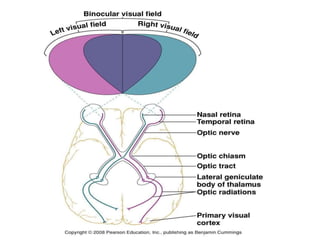
• Nerve fibres arising from nasal half of two retina
decussate at the chiasma.
Optic tract
• Cylindrical bundle of nerve fibres.
• Run outwards & backwards from
posterolateral aspect of optic chiasma.
• Fibres from temporal half of retina of same
eye & nasal half of opposite eye.
• Posteriorly each ends in Lateral Geniculate
Body.
Lateral Geniculate body
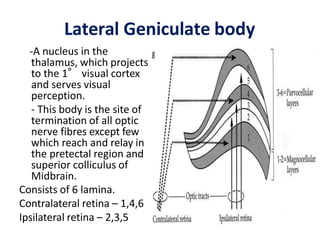
-A nucleus in the
thalamus, which projects
to the 1° visual cortex
and serves visual
perception.
- This body is the site of
termination of all optic
nerve fibres except few
which reach and relay in
the pretectal region and
superior colliculus of
Midbrain.
Consists of 6 lamina.
Contralateral retina – 1,4,6
Ipsilateral retina – 2,3,5
0ptic radiation
• From LGB to the occipital cortex.
• Pass forwards then laterally through the area of wernicke
as optic peduncles.
• Anterior to lateral ventricle ,traversing the retrolenticular
part of internal capsule, medial to auditory tract.
• Its fibres then spread out fanwise to form medullary optic
lamina.
• Inferior fibres subserve upper visual fields & sweep
anteroinferiorly in meyer’s loop & temporal lobe to visual
cortex.
• Superior fibres subserve inferior visual field proceed
posteriorly through parietal lobe to visual cortex.
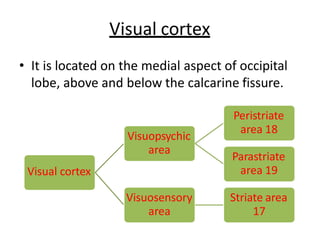
Visual cortex
• It is located on the medial aspect of occipital
lobe, above and below the calcarine fissure.
Visual cortex
Visuopsychic
area
Peristriate
area 18
Parastriate
area 19
Visuosensory
area
Striate area
17
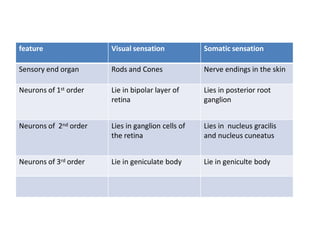
feature Visual sensation Somatic sensation
Sensory end organ Rods and Cones Nerve endings in the skin
Neurons of 1st order Lie in bipolar layer of
retina
Lies in posterior root
ganglion
Neurons of 2nd order Lies in ganglion cells of
the retina
Lies in nucleus gracilis
and nucleus cuneatus
Neurons of 3rd order Lie in geniculate body Lie in geniculte body
Neural pathway for vision
• Ist order sensory neurons –
Arise from the bipolar cells
of the retina.
• II nd order neurons are the
Multipolar neurons whose
axons run along the optic
nerve to the optic chiasma
• Nasal fibres – Cross to
opposite side and terminate
in LGB of opposite side.
• Temporal fibres – Doesn’t
cross and terminates in
ipsilateral LGB.
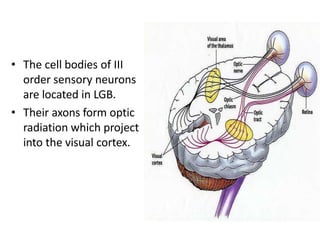
• The cell bodies of III
order sensory neurons
are located in LGB.
• Their axons form optic
radiation which project
into the visual cortex.
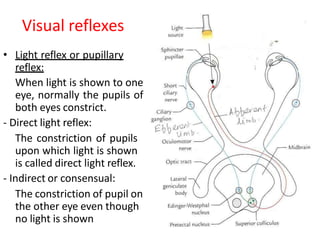
Visual reflexes
• Light reflex or pupillary
reflex:
When light is shown to one
eye, normally the pupils of
both eyes constrict.
- Direct light reflex:
The constriction of pupils
upon which light is shown
is called direct light reflex.
- Indirect or consensual:
The constriction of pupil on
the other eye even though
no light is shown
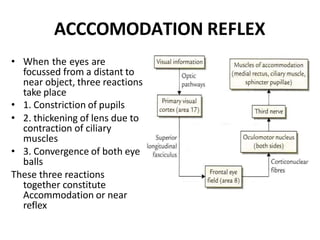
ACCCOMODATION REFLEX
• When the eyes are
focussed from a distant to
near object, three reactions
take place
• 1. Constriction of pupils
• 2. thickening of lens due to
contraction of ciliary
muscles
• 3. Convergence of both eye
balls
These three reactions
together constitute
Accommodation or near
reflex
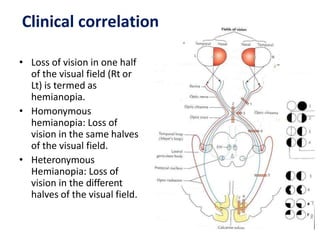
Clinical correlation
• Loss of vision in one half
of the visual field (Rt or
Lt) is termed as
hemianopia.
• Homonymous
hemianopia: Loss of
vision in the same halves
of the visual field.
• Heteronymous
Hemianopia: Loss of
vision in the different
halves of the visual field.
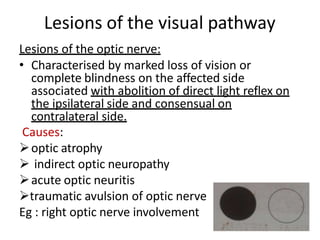
Lesions of the visual pathway
Lesions of the optic nerve:
• Characterised by marked loss of vision or
complete blindness on the affected side
associated with abolition of direct light reflex on
the ipsilateral side and consensual on
contralateral side.
Causes:
optic atrophy
 indirect optic neuropathy
acute optic neuritis
traumatic avulsion of optic nerve
Eg : right optic nerve involvement
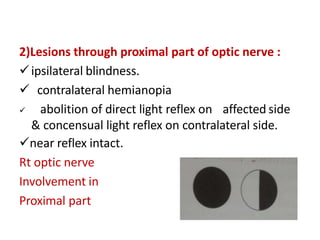
2)Lesions through proximal part of optic nerve :
ipsilateral blindness.
 contralateral hemianopia
 abolition of direct light reflex on affected side
& concensual light reflex on contralateral side.
near reflex intact.
Rt optic nerve
Involvement in
Proximal part
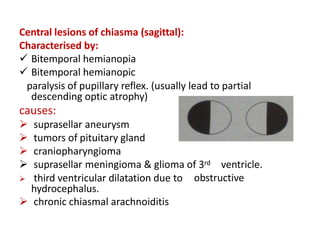
Central lesions of chiasma (sagittal):
Characterised by:
 Bitemporal hemianopia
 Bitemporal hemianopic
paralysis of pupillary reflex. (usually lead to partial
descending optic atrophy)
causes:
 suprasellar aneurysm
 tumors of pituitary gland
 craniopharyngioma
 suprasellar meningioma & glioma of 3rd ventricle.
obstructive
 third ventricular dilatation due to
hydrocephalus.
 chronic chiasmal arachnoiditis
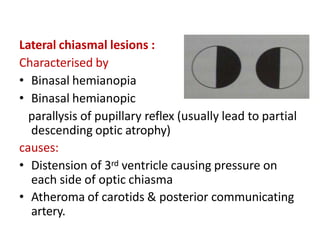
Lateral chiasmal lesions :
Characterised by
• Binasal hemianopia
• Binasal hemianopic
parallysis of pupillary reflex (usually lead to partial
descending optic atrophy)
causes:
• Distension of 3rd ventricle causing pressure on
each side of optic chiasma
• Atheroma of carotids & posterior communicating
artery.
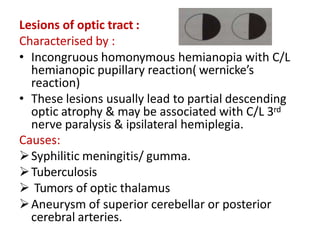
Lesions of optic tract :
Characterised by :
• Incongruous homonymous hemianopia with C/L
hemianopic pupillary reaction( wernicke’s
reaction)
• These lesions usually lead to partial descending
optic atrophy & may be associated with C/L 3rd
nerve paralysis & ipsilateral hemiplegia.
Causes:
Syphilitic meningitis/ gumma.
Tuberculosis
 Tumors of optic thalamus
Aneurysm of superior cerebellar or posterior
cerebral arteries.
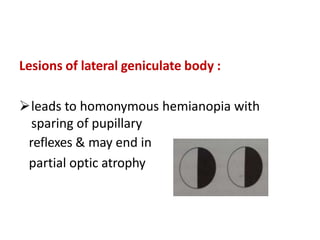
Lesions of lateral geniculate body :
leads to homonymous hemianopia with
sparing of pupillary
reflexes & may end in
partial optic atrophy
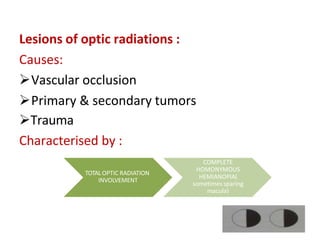
Lesions of optic radiations :
Causes:
Vascular occlusion
Primary & secondary tumors
Trauma
Characterised by :
TOTAL OPTIC RADIATION
INVOLVEMENT
COMPLETE
HOMONYMOUS
HEMIANOPIA(
sometimes sparing
macula)
LESIONS OF PARIETAL LOBE
(involving superior fibres of
optic radiations)
INFERIOR
QUADRANTIC
HEMIANOPIA( PIE
ON THE FLOOR)
LESIONS OF
TEMPORAL LOBE
(involving inferior
fibres of optic
radiations)
SUPERIOR
QUADRANTIC
HEMIANOPIA( PIE
ON THE ROOF)
• Pupillary reactions are normal as fibres of light
reflex leave the optic tracts to synapse in the
superior colliculi.
• Lesions of optic radiations do not produce
optic atrophy as the 1st order neurons (optic
nerve fibres) synapse in LGB.
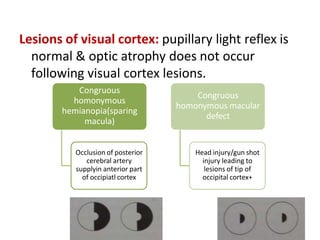
Lesions of visual cortex: pupillary light reflex is
normal & optic atrophy does not occur
following visual cortex lesions.
Congruous
homonymous
hemianopia(sparing
macula)
Occlusion of posterior
cerebral artery
supplyin anterior part
of occipiatl cortex
Congruous
homonymous macular
defect
Head injury/gun shot
injury leading to
lesions of tip of
occipital cortex+

visual pathway & its lesions.pptx

  • 1.
    Visual Pathway &Its Lesions JATIN YADAV MBBS 2021-2022
  • 2.
    Visual pathway startingfrom retina consists of— Components: A. Optic nerve B. Optic chiasma. C. Optic tract D. Lateral geniculate body (of the thalamus). E. Optic radiations F. Visual cortex
  • 4.
    Optic Nerve • 2ndcranial nerve. • 47-50 mm in length. • Starts from optic disc & extends upto optic chiasma where the two nerves meet. • Backward continuation of nerve fibre layer of retina which consist of axons originating from ganglion cells. • Contains the afferent fibres of light reflex • Has 4 parts : 1)intraocular (1mm) 2)intraorbital (30mm) 3)intra canalicular (6-9mm) 4)intracranial (10mm)
  • 5.
    Optic chiasma • Flattenedstructure,12 mm horizontally & 8mm anteroposteriorly. • Ensheathed by pia & surrounded by CSF. • Lies over diaphragma sellae so visual field defects seen in patient with pituitary tumor having suprasellar extension. • Posteriorly chiasma continuous with the optic tracts & form the anterior wall of 3rd ventricle. • Nerve fibres arising from nasal half of two retina decussate at the chiasma.
  • 6.
    Optic tract • Cylindricalbundle of nerve fibres. • Run outwards & backwards from posterolateral aspect of optic chiasma. • Fibres from temporal half of retina of same eye & nasal half of opposite eye. • Posteriorly each ends in Lateral Geniculate Body.
  • 7.
    Lateral Geniculate body -Anucleus in the thalamus, which projects to the 1° visual cortex and serves visual perception. - This body is the site of termination of all optic nerve fibres except few which reach and relay in the pretectal region and superior colliculus of Midbrain. Consists of 6 lamina. Contralateral retina – 1,4,6 Ipsilateral retina – 2,3,5
  • 8.
    0ptic radiation • FromLGB to the occipital cortex. • Pass forwards then laterally through the area of wernicke as optic peduncles. • Anterior to lateral ventricle ,traversing the retrolenticular part of internal capsule, medial to auditory tract. • Its fibres then spread out fanwise to form medullary optic lamina. • Inferior fibres subserve upper visual fields & sweep anteroinferiorly in meyer’s loop & temporal lobe to visual cortex. • Superior fibres subserve inferior visual field proceed posteriorly through parietal lobe to visual cortex.
  • 10.
    Visual cortex • Itis located on the medial aspect of occipital lobe, above and below the calcarine fissure. Visual cortex Visuopsychic area Peristriate area 18 Parastriate area 19 Visuosensory area Striate area 17
  • 11.
    feature Visual sensationSomatic sensation Sensory end organ Rods and Cones Nerve endings in the skin Neurons of 1st order Lie in bipolar layer of retina Lies in posterior root ganglion Neurons of 2nd order Lies in ganglion cells of the retina Lies in nucleus gracilis and nucleus cuneatus Neurons of 3rd order Lie in geniculate body Lie in geniculte body
  • 12.
    Neural pathway forvision • Ist order sensory neurons – Arise from the bipolar cells of the retina. • II nd order neurons are the Multipolar neurons whose axons run along the optic nerve to the optic chiasma • Nasal fibres – Cross to opposite side and terminate in LGB of opposite side. • Temporal fibres – Doesn’t cross and terminates in ipsilateral LGB.
  • 13.
    • The cellbodies of III order sensory neurons are located in LGB. • Their axons form optic radiation which project into the visual cortex.
  • 14.
    Visual reflexes • Lightreflex or pupillary reflex: When light is shown to one eye, normally the pupils of both eyes constrict. - Direct light reflex: The constriction of pupils upon which light is shown is called direct light reflex. - Indirect or consensual: The constriction of pupil on the other eye even though no light is shown
  • 16.
    ACCCOMODATION REFLEX • Whenthe eyes are focussed from a distant to near object, three reactions take place • 1. Constriction of pupils • 2. thickening of lens due to contraction of ciliary muscles • 3. Convergence of both eye balls These three reactions together constitute Accommodation or near reflex
  • 17.
    Clinical correlation • Lossof vision in one half of the visual field (Rt or Lt) is termed as hemianopia. • Homonymous hemianopia: Loss of vision in the same halves of the visual field. • Heteronymous Hemianopia: Loss of vision in the different halves of the visual field.
  • 18.
    Lesions of thevisual pathway Lesions of the optic nerve: • Characterised by marked loss of vision or complete blindness on the affected side associated with abolition of direct light reflex on the ipsilateral side and consensual on contralateral side. Causes: optic atrophy  indirect optic neuropathy acute optic neuritis traumatic avulsion of optic nerve Eg : right optic nerve involvement
  • 19.
    2)Lesions through proximalpart of optic nerve : ipsilateral blindness.  contralateral hemianopia  abolition of direct light reflex on affected side & concensual light reflex on contralateral side. near reflex intact. Rt optic nerve Involvement in Proximal part
  • 20.
    Central lesions ofchiasma (sagittal): Characterised by:  Bitemporal hemianopia  Bitemporal hemianopic paralysis of pupillary reflex. (usually lead to partial descending optic atrophy) causes:  suprasellar aneurysm  tumors of pituitary gland  craniopharyngioma  suprasellar meningioma & glioma of 3rd ventricle. obstructive  third ventricular dilatation due to hydrocephalus.  chronic chiasmal arachnoiditis
  • 21.
    Lateral chiasmal lesions: Characterised by • Binasal hemianopia • Binasal hemianopic parallysis of pupillary reflex (usually lead to partial descending optic atrophy) causes: • Distension of 3rd ventricle causing pressure on each side of optic chiasma • Atheroma of carotids & posterior communicating artery.
  • 22.
    Lesions of optictract : Characterised by : • Incongruous homonymous hemianopia with C/L hemianopic pupillary reaction( wernicke’s reaction) • These lesions usually lead to partial descending optic atrophy & may be associated with C/L 3rd nerve paralysis & ipsilateral hemiplegia. Causes: Syphilitic meningitis/ gumma. Tuberculosis  Tumors of optic thalamus Aneurysm of superior cerebellar or posterior cerebral arteries.
  • 23.
    Lesions of lateralgeniculate body : leads to homonymous hemianopia with sparing of pupillary reflexes & may end in partial optic atrophy
  • 24.
    Lesions of opticradiations : Causes: Vascular occlusion Primary & secondary tumors Trauma Characterised by : TOTAL OPTIC RADIATION INVOLVEMENT COMPLETE HOMONYMOUS HEMIANOPIA( sometimes sparing macula)
  • 25.
    LESIONS OF PARIETALLOBE (involving superior fibres of optic radiations) INFERIOR QUADRANTIC HEMIANOPIA( PIE ON THE FLOOR) LESIONS OF TEMPORAL LOBE (involving inferior fibres of optic radiations) SUPERIOR QUADRANTIC HEMIANOPIA( PIE ON THE ROOF)
  • 26.
    • Pupillary reactionsare normal as fibres of light reflex leave the optic tracts to synapse in the superior colliculi. • Lesions of optic radiations do not produce optic atrophy as the 1st order neurons (optic nerve fibres) synapse in LGB.
  • 27.
    Lesions of visualcortex: pupillary light reflex is normal & optic atrophy does not occur following visual cortex lesions. Congruous homonymous hemianopia(sparing macula) Occlusion of posterior cerebral artery supplyin anterior part of occipiatl cortex Congruous homonymous macular defect Head injury/gun shot injury leading to lesions of tip of occipital cortex+