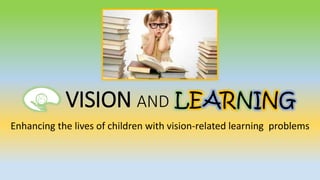






VISION AND LEARNING
Enhancing the lives of children with vision-related learning problems
Let’s Talk About . . .
• Developmental Optometry
• Vision
• Vision Related Problems
• Identifying Vision Problems v. ADHD
• Vision Therapy
We’re going to
talk about some
things you may
recognize in
yourself, a family
member, or a
patient
Please ask
lots of
questions
WHAT IS
OPTOMETRY ?
DEVELOPMENTAL
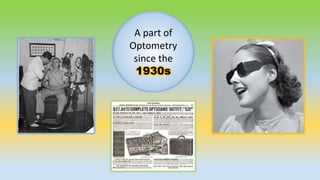
A part of
Optometry
since the
1930s
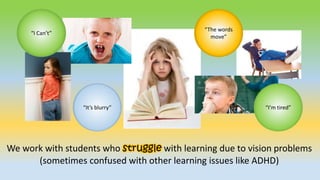
“I Can’t”
“It’s blurry”
“The words
move”
“I’m tired”
We work with students who struggle with learning due to vision problems
(sometimes confused with other learning issues like ADHD)
We also work with developmental disabilities including
Autism, CP, and Downs Syndrome
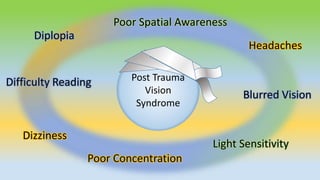
Post Trauma
Vision
Syndrome
Diplopia
Dizziness
Headaches
Light Sensitivity
Difficulty Reading
Blurred Vision
Poor Spatial Awareness
Poor Concentration
WHAT IS
VISION?
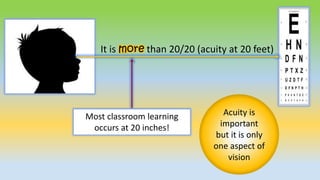
It is more than 20/20 (acuity at 20 feet)
Most classroom learning
occurs at 20 inches!
Acuity is
important
but it is only
one aspect of
vision
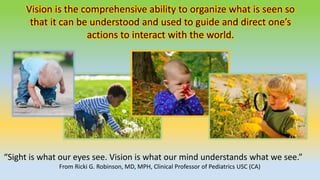
Vision is the comprehensive ability to organize what is seen so
that it can be understood and used to guide and direct one’s
actions to interact with the world.
“Sight is what our eyes see. Vision is what our mind understands what we see.”
From Ricki G. Robinson, MD, MPH, Clinical Professor of Pediatrics USC (CA)
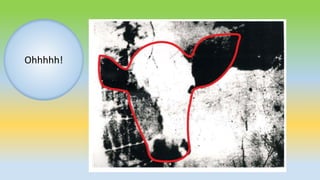
What is it?
Ohhhhh!
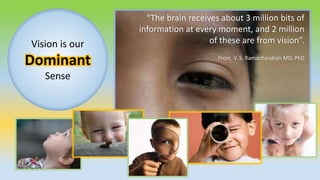
Vision is our
Dominant
Sense
“The brain receives about 3 million bits of
information at every moment, and 2 million
of these are from vision”.
From V. S. Ramachandran MD, PhD
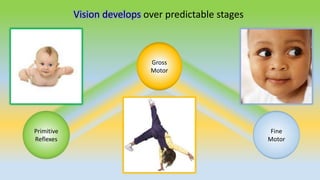
Vision develops over predictable stages
Primitive
Reflexes
Gross
Motor
Fine
Motor
“When we open our eyes each morning,
it is upon a world we have spent a
lifetime learning to see.”
From An Anthropologist on Mars By Oliver Sachs, MD
WHAT ARE
VISION RELATED
PROBLEMS?
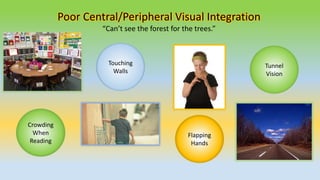
Crowding
When
Reading
Touching
Walls
Flapping
Hands
Tunnel
Vision
Poor Central/Peripheral Visual Integration
“Can’t see the forest for the trees.”
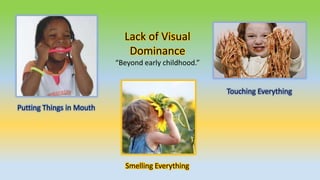
Lack of Visual
Dominance
“Beyond early childhood.”
Putting Things in Mouth
Smelling Everything
Touching Everything
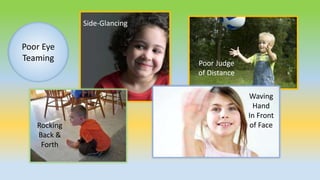
Poor Eye
Teaming
Side-Glancing
Rocking
Back &
Forth
Waving
Hand
In Front
of Face
Poor Judge
of Distance
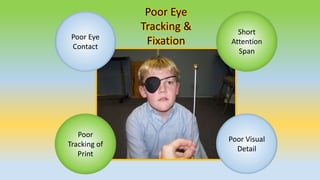
Poor
Tracking of
Print
Poor Eye
Contact
Short
Attention
Span
Poor Visual
Detail
Poor Eye
Tracking &
Fixation
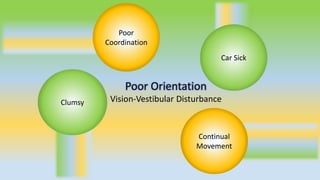
Clumsy
Continual
Movement
Poor Orientation
Vision-Vestibular Disturbance
Car Sick
Poor
Coordination
WHAT CAUSES
VISION
PROBLEMS?
Birth History
Pregnancy/Birth Complications
Birth Weight Under 5 lbs.
Adoption
Prematurity
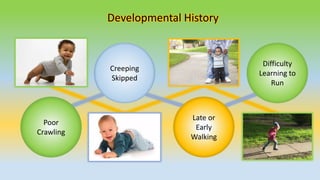
Developmental History
Poor
Crawling
Creeping
Skipped
Late or
Early
Walking
Difficulty
Learning to
Run
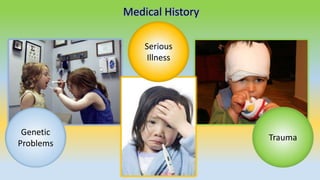
Genetic
Problems
Trauma
Medical History
Serious
Illness
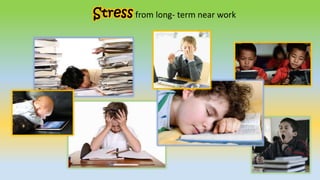
Stress from long- term near work
HOW DO WE
IDENTIFY VISION
PROBLEMS?
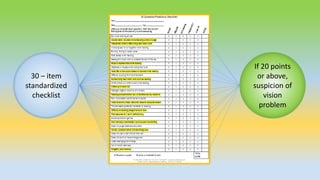
30 – item
standardized
checklist
If 20 points
or above,
suspicion of
vision
problem
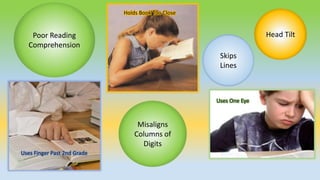
Head Tilt
Skips
Lines
Poor Reading
Comprehension
Misaligns
Columns of
Digits
Uses Finger Past 2nd Grade
Holds Book Too Close
Uses One Eye
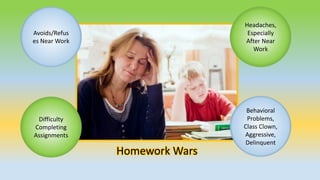
Difficulty
Completing
Assignments
Avoids/Refus
es Near Work
Behavioral
Problems,
Class Clown,
Aggressive,
Delinquent
Headaches,
Especially
After Near
Work
Homework Wars
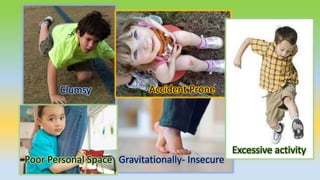
Clumsy
Poor Personal Space
Accident Prone
Excessive activity
Gravitationally- Insecure
WHAT DO WE NEED
TO KNOW ABOUT
VISION
PROBLEMS?
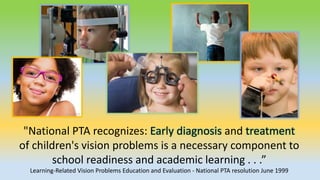
"National PTA recognizes: Early diagnosis and treatment
of children's vision problems is a necessary component to
school readiness and academic learning . . .”
Learning-Related Vision Problems Education and Evaluation - National PTA resolution June 1999
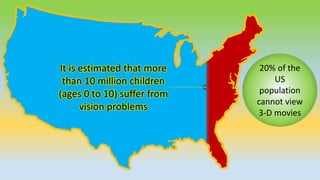
20% of the
US
population
cannot view
3-D movies
It is estimated that more
than 10 million children
(ages 0 to 10) suffer from
vision problems
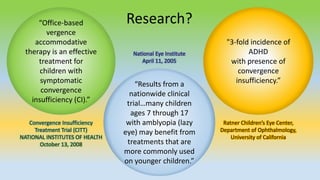
“Results from a
nationwide clinical
trial…many children
ages 7 through 17
with amblyopia (lazy
eye) may benefit from
treatments that are
more commonly used
on younger children.”
"3-fold incidence of
ADHD
with presence of
convergence
insufficiency.”
“Office-based
vergence
accommodative
therapy is an effective
treatment for
children with
symptomatic
convergence
insufficiency (CI).”
Research?
National Eye Institute
April 11, 2005
Ratner Children’s Eye Center,
Department of Ophthalmology,
University of California
Convergence Insufficiency
Treatment Trial (CITT)
NATIONAL INSTITUTES OF HEALTH
October 13, 2008
WHAT CAN WE DO
ABOUT
VISION
PROBLEMS?
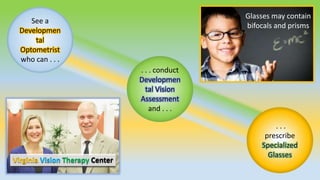
See a
Developmen
tal
Optometrist
who can . . .
Glasses may contain
bifocals and prisms
Virginia Vision Therapy Center
. . .
prescribe
Specialized
Glasses
. . . conduct
Developmen
tal Vision
Assessment
and . . .
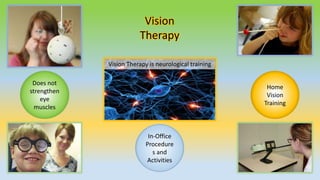
Vision Therapy is neurological training
Does not
strengthen
eye
muscles
In-Office
Procedure
s and
Activities
Home
Vision
Training
Vision
Therapy
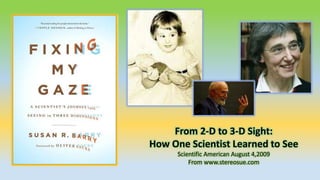
From 2-D to 3-D Sight:
How One Scientist Learned to See
Scientific American August 4,2009
From www.stereosue.com
?
?
? ?
?
?
?
?
?
?
? ?
?
?
?
?
?
?
?
?
?
?
?
?
?
?
?
?
??
Questions?

Vision and Learning