


1 in 20 preschoolers has a vision problem  Undetected and uncorrected vision problems can lead to serious difficulties for a child Children are often unaware of their vision problem 85% of amblyopia cases are not detected until after the preschool years
are required by North Carolina Law detect and prevent serious lifelong and irreversible vision problems
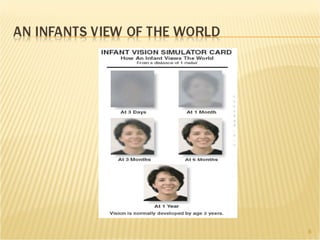
Health professionals typically administer an antibiotic ointment, such as erythromycin, to prevent infection.  Within a short period of time, (s)he will begin to focus on objects less than a foot away, such as mom’s face when nursing.
Two months: Learning to look Normal to not have eyes track together Some tearing normal – drainage ducts open? Activity: moving a child’s arms or legs simultaneously, as parents tend to do naturally, is helpful in fostering appropriate bilateral and binocular development.
4-6 months First optometrist visit Tests for excessive near/far sight, astigmatism, evaluate eye alignment. 8-12 months Use both eyes to judge distances Throw objects with precision
Strabismus (Misalignment of eyes) results from eye muscles not working together may be constant, come and go, or alternate from one eye to the other affects 3-5% of children if uncorrected, strabismus can result in amblyopia (loss of vision)
Amblyopia (Lazy Eye) reduced vision in an eye not adequately used during early childhood is NOT OBSERVABLE; must screen both eyes to find this condition affects 2-5% of general population if untreated by age 6, permanent vision loss is likely treatment involves patching the good eye to re-train the brain to accept images from the affected eye
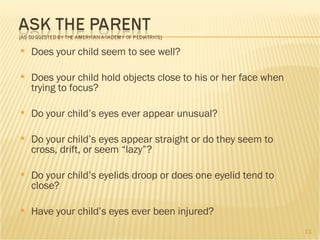
Does your child seem to see well? Does your child hold objects close to his or her face when trying to focus? Do your child’s eyes ever appear unusual? Do your child’s eyes appear straight or do they seem to cross, drift, or seem “lazy”? Do your child’s eyelids droop or does one eyelid tend to close? Have your child’s eyes ever been injured?
A - appearance and structure of the eyes appear normal B - behavior of the child appears normal C - child complains of eye problems
eye redness or discharge swelling of the eyelids eye crossing or misalignment  eyes “jiggle”  protruding eyes drooping eyelids presence of white pupil non-round pupils
constant head tilt or face turn squinting  rubbing eyes excessively closing or covering one eye holding objects close to eyes blinking excessively
headaches blurry vision double vision eyes itch, burn or feel scratchy unusual sensitivity to light
Acuity screenings are the primary measure of visual systems and determine if there is a need for refractive correction  if amblyopia is suspected
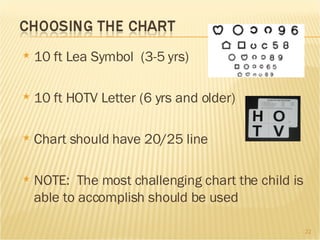
10 ft Lea Symbol  (3-5 yrs) 10 ft HOTV Letter (6 yrs and older) Chart should have 20/25 line NOTE:  The most challenging chart the child is able to accomplish should be used
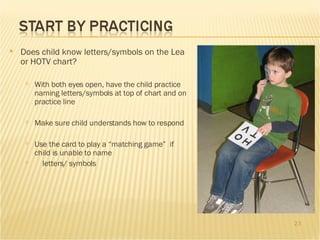
Does child know letters/symbols on the Lea or HOTV chart? With both eyes open, have the child practice naming letters/symbols at top of chart and on practice line Make sure child understands how to respond Use the card to play a “matching game”  if child is unable to name letters/ symbols
Child should occlude one eye and begin reading on practice line Watch for “cheating” such as squinting, tilting the head sideways or “peeking” from behind occluder To pass a line, child must correctly identify one more than half the symbols on that line Record visual acuity as the smallest line the child was able to pass Repeat for other eye
Stereopsis is simultaneous visual perception by the eyes When the brain is able to blend the separate images from each eye into one image, the child perceives three-dimensional space and is said to have good stereopsis Stereopsis screening is recommended for Kindergarten through grade 3 or up to age 9 The child who fails the stereopsis screening is at great risk for amblyopia or loss of vision, in one eye
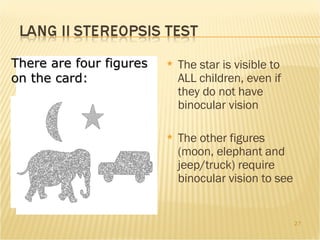
The star is visible to ALL children, even if they do not have binocular vision The other figures (moon, elephant and jeep/truck) require binocular vision to see There are four figures on the card:
Assure the child he/she performed well The parent, if present for the screening, will likely be aware of whether the child passed or not
challenge individuals, communities, and professionals—indeed, all of us—to take specific steps to improve the eye health of people living in the United States through prevention, early detection, timely treatment, and rehabilitation.
We must all sit at the table of the public health community as equal and respected partners for the benefit of future generations.

Back 2 School

  • 3.
    1 in 20preschoolers has a vision problem Undetected and uncorrected vision problems can lead to serious difficulties for a child Children are often unaware of their vision problem 85% of amblyopia cases are not detected until after the preschool years
  • 4.
    are required byNorth Carolina Law detect and prevent serious lifelong and irreversible vision problems
  • 5.
    Health professionals typicallyadminister an antibiotic ointment, such as erythromycin, to prevent infection. Within a short period of time, (s)he will begin to focus on objects less than a foot away, such as mom’s face when nursing.
  • 6.
    Two months: Learningto look Normal to not have eyes track together Some tearing normal – drainage ducts open? Activity: moving a child’s arms or legs simultaneously, as parents tend to do naturally, is helpful in fostering appropriate bilateral and binocular development.
  • 7.
    4-6 months Firstoptometrist visit Tests for excessive near/far sight, astigmatism, evaluate eye alignment. 8-12 months Use both eyes to judge distances Throw objects with precision
  • 9.
    Strabismus (Misalignment ofeyes) results from eye muscles not working together may be constant, come and go, or alternate from one eye to the other affects 3-5% of children if uncorrected, strabismus can result in amblyopia (loss of vision)
  • 10.
    Amblyopia (Lazy Eye)reduced vision in an eye not adequately used during early childhood is NOT OBSERVABLE; must screen both eyes to find this condition affects 2-5% of general population if untreated by age 6, permanent vision loss is likely treatment involves patching the good eye to re-train the brain to accept images from the affected eye
  • 13.
    Does your childseem to see well? Does your child hold objects close to his or her face when trying to focus? Do your child’s eyes ever appear unusual? Do your child’s eyes appear straight or do they seem to cross, drift, or seem “lazy”? Do your child’s eyelids droop or does one eyelid tend to close? Have your child’s eyes ever been injured?
  • 15.
    A - appearanceand structure of the eyes appear normal B - behavior of the child appears normal C - child complains of eye problems
  • 16.
    eye redness ordischarge swelling of the eyelids eye crossing or misalignment eyes “jiggle” protruding eyes drooping eyelids presence of white pupil non-round pupils
  • 17.
    constant head tiltor face turn squinting rubbing eyes excessively closing or covering one eye holding objects close to eyes blinking excessively
  • 18.
    headaches blurry visiondouble vision eyes itch, burn or feel scratchy unusual sensitivity to light
  • 21.
    Acuity screenings arethe primary measure of visual systems and determine if there is a need for refractive correction if amblyopia is suspected
  • 22.
    10 ft LeaSymbol (3-5 yrs) 10 ft HOTV Letter (6 yrs and older) Chart should have 20/25 line NOTE: The most challenging chart the child is able to accomplish should be used
  • 23.
    Does child knowletters/symbols on the Lea or HOTV chart? With both eyes open, have the child practice naming letters/symbols at top of chart and on practice line Make sure child understands how to respond Use the card to play a “matching game” if child is unable to name letters/ symbols
  • 24.
    Child should occludeone eye and begin reading on practice line Watch for “cheating” such as squinting, tilting the head sideways or “peeking” from behind occluder To pass a line, child must correctly identify one more than half the symbols on that line Record visual acuity as the smallest line the child was able to pass Repeat for other eye
  • 26.
    Stereopsis is simultaneousvisual perception by the eyes When the brain is able to blend the separate images from each eye into one image, the child perceives three-dimensional space and is said to have good stereopsis Stereopsis screening is recommended for Kindergarten through grade 3 or up to age 9 The child who fails the stereopsis screening is at great risk for amblyopia or loss of vision, in one eye
  • 27.
    The star isvisible to ALL children, even if they do not have binocular vision The other figures (moon, elephant and jeep/truck) require binocular vision to see There are four figures on the card:
  • 30.
    Assure the childhe/she performed well The parent, if present for the screening, will likely be aware of whether the child passed or not
  • 31.
    challenge individuals, communities,and professionals—indeed, all of us—to take specific steps to improve the eye health of people living in the United States through prevention, early detection, timely treatment, and rehabilitation.
  • 32.
    We must allsit at the table of the public health community as equal and respected partners for the benefit of future generations.