I CARE FOR EYE
CARE
Dr Ajay Dudani
COMMON EYE
PROBLEMS IN
CHILDREN
Dr Ajay Dudani
Good vision is key to a child’s physical
development, success in school and overall
well-being. If a young child’s eyes cannot
send clear images to the brain, his or her
vision may become limited in ways that
cannot be corrected later in life.
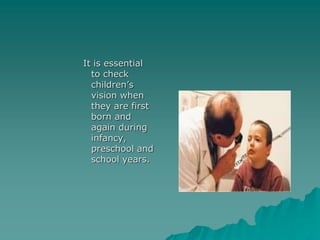
It is essential
to check
children’s
vision when
they are first
born and
again during
infancy,
preschool and
school years.
The American Academy of Ophthalmology and the American Association for
Pediatric Ophthalmology and Strabismus recommend the following exams:
 Newborn. An ophthalmologist ,pediatrician, family doctor or
other trained health professional should examine a newborn
baby’s eyes and perform a comprehensive exam if the baby is
premature or at high risk for medical problems for other reasons,
has signs of abnormalities, or has a family history of serious vision
disorders in childhood.
 Infant. A second screening for eye health should be done by an
ophthalmologist, pediatrician, family doctor between six months
and the first birthday.
 Preschooler. Between the ages of 3 and 3½, a child’s vision and
eye alignment should be assessed by a pediatrician, family doctor
or ophthalmologist.
Warning Signs
 Baby does not focus or follow objects or
do not make eye contact by 3yrs of age.
 Eyes are constantly watering and are light
sensitive
 Involuntary to and fro movements of the
eyes.
 Redness of eyes for a few days.
 Child tilts his head or his eyes seem to be
intermittently or constantly turned
in/out/up/down.
 Eyelids tend to droop
 Child constantly rubs his eyes
 White colour in the centre of the
iris(dark coloured area) of the eye
 Child complains of headache or
feeling of tiredness while reading.
 Child holds the book too close or
cannot see the words on the board in
school.
Refractive Errors
 Refractive errors are problems in the
way the crystalline lens and the
cornea focus light on the retina. In
order for the eye to send a clear,
sharp image to the brain, light rays
need to be brought to a point
(focused) directly on the retina, and
particularly on the center of the
retina.
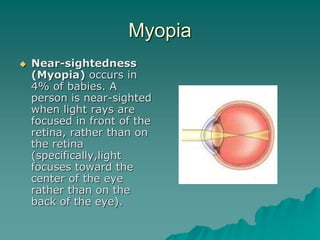
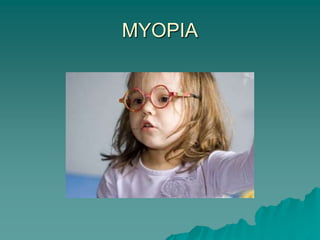
Myopia
 Near-sightedness
(Myopia) occurs in
4% of babies. A
person is near-sighted
when light rays are
focused in front of the
retina, rather than on
the retina
(specifically,light
focuses toward the
center of the eye
rather than on the
back of the eye).
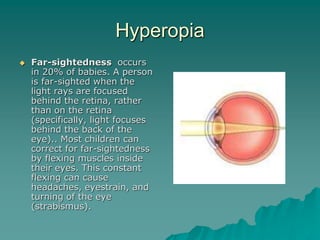
Hyperopia
 Far-sightedness occurs
in 20% of babies. A person
is far-sighted when the
light rays are focused
behind the retina, rather
than on the retina
(specifically, light focuses
behind the back of the
eye).. Most children can
correct for far-sightedness
by flexing muscles inside
their eyes. This constant
flexing can cause
headaches, eyestrain, and
turning of the eye
(strabismus).
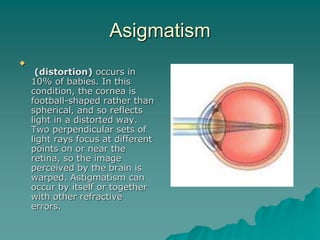
Asigmatism

(distortion) occurs in
10% of babies. In this
condition, the cornea is
football-shaped rather than
spherical, and so reflects
light in a distorted way.
Two perpendicular sets of
light rays focus at different
points on or near the
retina, so the image
perceived by the brain is
warped. Astigmatism can
occur by itself or together
with other refractive
errors.
Amblyopia
 Amblyopia, also known as "lazy eye," occurs in 2% to 3%
of babies.In this condition, poor vision in one or both eyes
may result in the eyes not pointing in the same direction
(misalignment) or in the eyes becoming crossed
(strabismus).
 Amblyopia may be inherited or caused by
uncorrected.Refractive error.
 Amblyopia results when there is a difference in the quality
of the images recorded by each eye and sent to the brain.
The brain picks the better of the two images sent to it and
disregards the blurry or cloudy image. When the brain
disregards this image, the visual system develops more
slowly for the eye that sent the discarded image than for
the eye that sent the good image.
 Parents usually cannot recognize a lazy eye
merely by looking at it, because the problem is in
the brain as well as the eye. The brain blocks
vision from the lazy eye because the brain is
unable to use both eyes together. An infant with
normal vision learns to use both eyes together
(binocular vision), and the pictures from the left
and right eye are then combined (fused) into one
picture by the brain. Because binocular vision
permits us to tell how far away an object is in
relation to other objects (depth perception),
children with amblyopia have poor depth
perception.
Warning signs of amblyopia
Most babies with amblyopia show no
obvious signs of the condition, which
must be diagnosed by an eye doctor.
In some infants, however:
 The weak eye turns
 The weak eye tends to close.
 The child squints.
 The child constantly rubs one eye.
Treatment
 Patch therapy: A patch is worn over the good eye so the
weak eye will be used and will develop. In this situation,
the BabyEyesT DVD can help to stimulate and strengthen
vision in the weak eye.
 Glasses, which help correct poor vision in one or both
eyes.
 Eye surgery may be required in rare cases in which the
child is born with a clouded crystalline lens (a congenital
cataract), or if amblyopia is combined with strabismus.
 If amblyopia is not treated before 4 years of age, it can
become permanent and untreatable. This is one reason why
a visit to the eye doctor before 14 months of age is so
important!
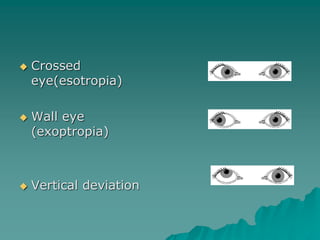
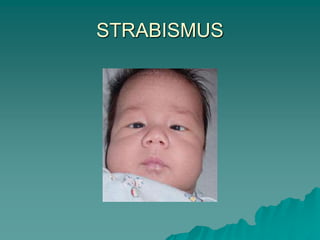
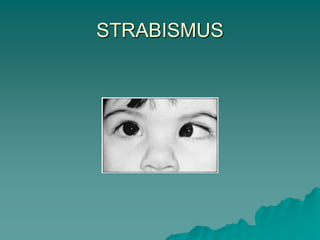
Strabismus
 Strabismus is the medical term for
"crossed" or "turned" eye. This
condition occurs in 2% to 4% of
children.
 Crossed
eye(esotropia)
 Wall eye
(exoptropia)
 Vertical deviation
Blocked tear duct
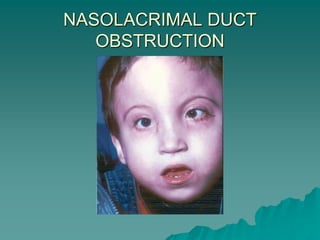
 Babies often develop a blocked tear
duct (nasolacrimal duct obstruction).
In this condition, the delicate
drainage tube that leads from the
eye to the nose is clogged, or the
membrane that covers this tube's
entryway does not open (as it
normally would after birth).
Signs :
 Too much tearing (tears may even run down the
cheeks).
 Watery or cloudy liquid draining from the eyes.
 Crusty eyelashes upon awakening.
 Constant rubbing of the eyes.
Treatments for blocked tear duct
 Mild pressure is applied to the area between the eye and
the nose and this area is gently massaged.
 Antibiotic drops or ointments are applied.
 Corrective surgery is done if the above
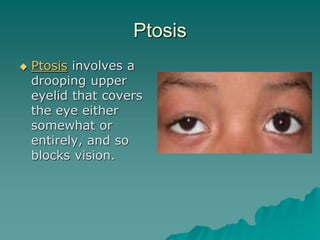
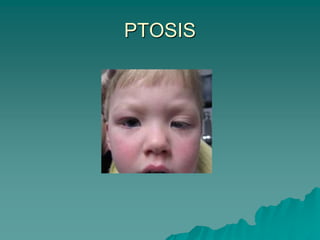
Ptosis
 Ptosis involves a
drooping upper
eyelid that covers
the eye either
somewhat or
entirely, and so
blocks vision.
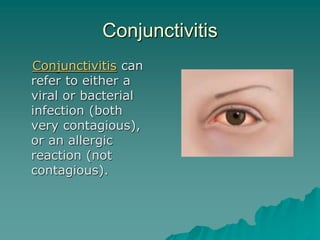
Conjunctivitis
Conjunctivitis can
refer to either a
viral or bacterial
infection (both
very contagious),
or an allergic
reaction (not
contagious).
 The eye appears red or pink due to
inflammation of the conjunctiva, the thin,
filmy membrane that covers the inside of
eyelids and white part of eye.
 The eye tears and/or has discharge, and is
usually itchy and uncomfortable.
 When a viral infection is the cause, the
child may also have a fever, sore throat
and runny nose.
Causes
 Reusing handkerchiefs and towels
when wiping your face and eyes;
 forgetting to wash hands often;
 frequently touching eyes;
 using old cosmetics, and/or sharing
them with other people; and
 not cleaning contact lenses properly.
 What to do: If the child has (or may
have) contagious pink eye, he or she
needs to stay home from school or
return home to avoid infecting
others. Contagious pink eye usually
resolves in three to seven days.
When the tearing and discharge from
the eyes has stopped the child may
return to school
Other infections of the eye
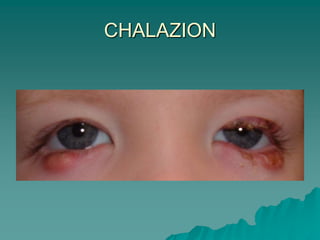
 Chalazion: looks like a small lump on the eyelid, and may occur
when a meibomian gland (an oil-secreting gland in the eyelid)
becomes clogged. It is not caused by infection.
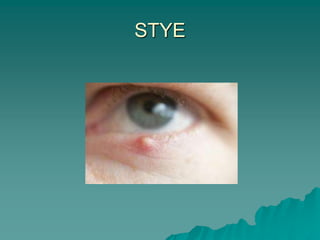
 Stye:looks like a red, sore lump near the edge of the eyelid; it is
caused by an infected eyelash follicle.
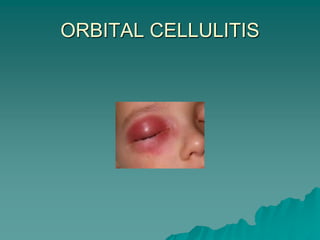
 Preseptal or Orbital Cellulitis: is an infection related to trauma,
an upper respiratory infection or an eyelid infection.
 What to look for: The tissues around the eye appear red and
painfully swollen.The child may have a fever. More serious
preseptal or orbital cellulitis infections can cause decreased vision,
an inability to move the eye, and the appearance of the eye being
pushed forward.
 What to do: Both forms of cellulitis are serious conditions that
require urgent medical attention. Take the child to a primary care
doctor or other qualified health professional who will co-manage
the child's treatment with an ophthalmologist.
Computer vision syndrome
 The National Institute for Occupational Safety and Health
(NIOSH) defines computer vision syndrome (CVS) as
"eyestrain associated with prolonged computer use."
 On an average,children between 11-18 yr spend about 1.5
hrs texting.
 Children between 8-18yrs spend 7.5 hrs consuming
electornic media.
 Working at a computer requires a number of visual skills. When
you are viewing a computer screen, your eyes must easily
converge so they point to the exact same spot on the screen. As
you read the screen, your eyes must move quickly and accurately
for sustained periods. And while maintaining a converged position
and moving quickly and accurately across the screen, your eyes
must maintain the proper amount of focusing.m
 Studies also show that people don't blink frequently enough when
using a computer. Most people normally blink 16 to 20 times per
minute. But during computer use, blink rates can drop to only 5
to 7 times per minute. Infrequent and incomplete blinking when
using a computer can cause eyes to become dry, red, and
irritated. It can also lead to eyestrain and blurred vision.
 In addition to the stress it causes on our eyes, prolonged
computer use involves sitting in one position for long periods of
time.Many (if not most) people have poor posture when working
at a computer. This may be due to the physical setup of the
workstation itself or because the user feels the need to lean closer
to the screen over time to see it more clearly. The longer a person
works at a computer, the more likely they are to experience
stiffness, headaches, neck and shoulder discomfort, backaches,
and arm and wrist pain from poor posture or overuse of certain
muscles.
How computer vision syndrome is
treated
 The first step in relieving computer vision syndrome is to
have a complete eye exam. If you use a computer on a
routine basis, you should have an annual eye exam.
 Tell your eye doctor that you use a computer, and explain
what type of computer-related symptoms you are
experiencing. Let your doctor know as much as you can
about your work environment, including the distance from
your eyes to your computer screen. Also, let them know
whether you typically wear eyeglasses or contact lenses
when using a computer.
 Most people who use a computer for prolonged periods can
benefit from eyeglasses prescribed specifically for computer
use. These eyeglasses will help your eyes maintain proper
focus on your computer screen with less eye fatigue.
PAEDIATRIC
OPHTHALMIC
DISORDERS
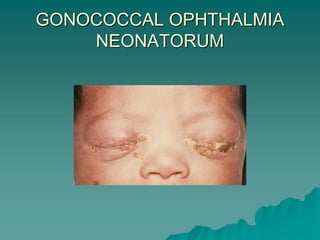
GONOCOCCAL OPHTHALMIA
NEONATORUM
NASOLACRIMAL DUCT
OBSTRUCTION
CHALAZION
STYE
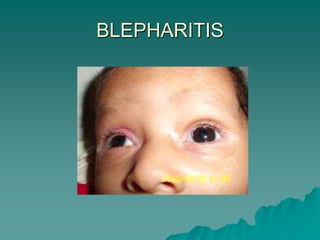
BLEPHARITIS
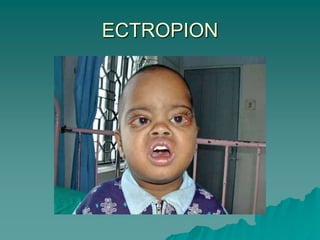
ECTROPION
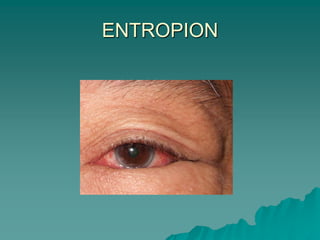
ENTROPION
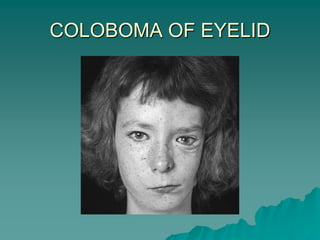
COLOBOMA OF EYELID
PTOSIS
ORBITAL CELLULITIS
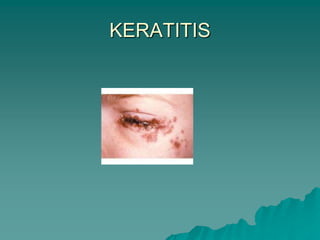
KERATITIS
HERPES SIMPLEX VIRAL
KERATITIS
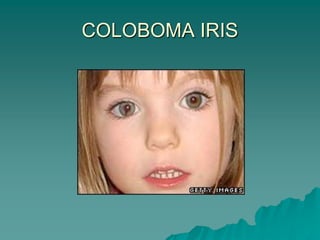
COLOBOMA IRIS
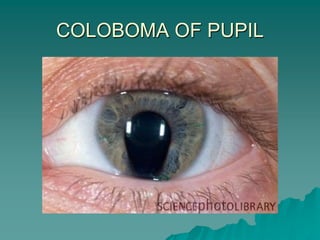
COLOBOMA OF PUPIL
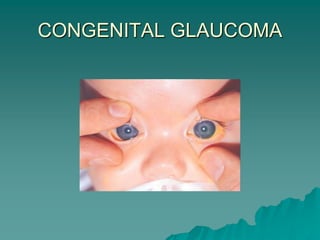
CONGENITAL GLAUCOMA
BULLOUS KERATOPATHY
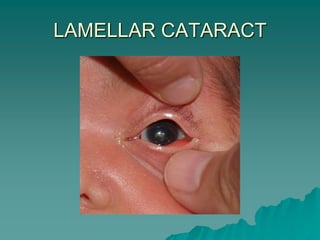
LAMELLAR CATARACT
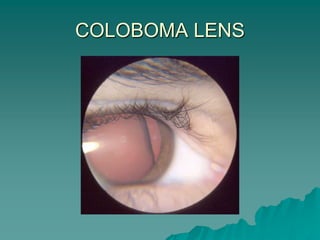
COLOBOMA LENS
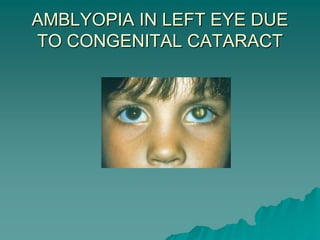
AMBLYOPIA IN LEFT EYE DUE
TO CONGENITAL CATARACT
STRABISMUS
STRABISMUS
MYOPIA
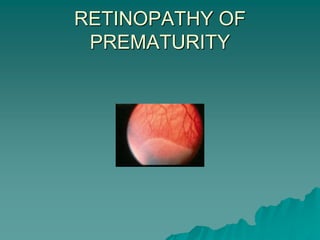
RETINOPATHY OF
PREMATURITY
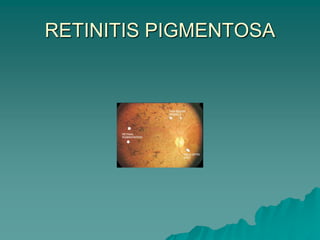
RETINITIS PIGMENTOSA
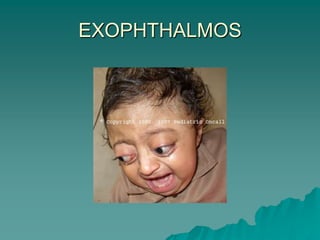
EXOPHTHALMOS
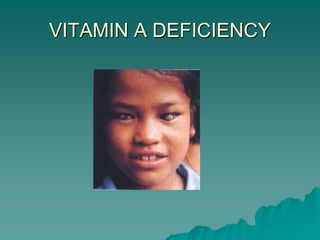
VITAMIN A DEFICIENCY
BILATERAL
CRYPTOPHTHALMOUS WITH
EXPOSURE KERATOPATHY
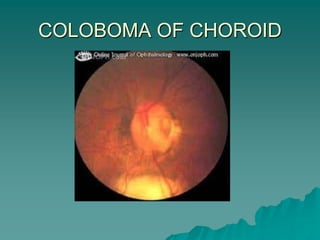
COLOBOMA OF CHOROID
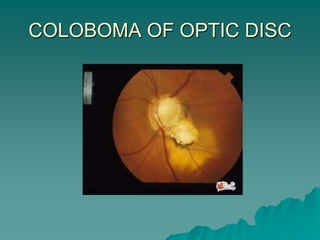
COLOBOMA OF OPTIC DISC
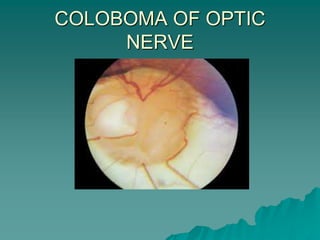
COLOBOMA OF OPTIC
NERVE
Common+eye+problems+in+children AJAY DUDANI

Common+eye+problems+in+children AJAY DUDANI

  • 1.
    I CARE FOREYE CARE Dr Ajay Dudani
  • 2.
  • 3.
    Good vision iskey to a child’s physical development, success in school and overall well-being. If a young child’s eyes cannot send clear images to the brain, his or her vision may become limited in ways that cannot be corrected later in life.
  • 4.
    It is essential tocheck children’s vision when they are first born and again during infancy, preschool and school years.
  • 5.
    The American Academyof Ophthalmology and the American Association for Pediatric Ophthalmology and Strabismus recommend the following exams:  Newborn. An ophthalmologist ,pediatrician, family doctor or other trained health professional should examine a newborn baby’s eyes and perform a comprehensive exam if the baby is premature or at high risk for medical problems for other reasons, has signs of abnormalities, or has a family history of serious vision disorders in childhood.  Infant. A second screening for eye health should be done by an ophthalmologist, pediatrician, family doctor between six months and the first birthday.  Preschooler. Between the ages of 3 and 3½, a child’s vision and eye alignment should be assessed by a pediatrician, family doctor or ophthalmologist.
  • 6.
    Warning Signs  Babydoes not focus or follow objects or do not make eye contact by 3yrs of age.  Eyes are constantly watering and are light sensitive  Involuntary to and fro movements of the eyes.  Redness of eyes for a few days.  Child tilts his head or his eyes seem to be intermittently or constantly turned in/out/up/down.
  • 7.
     Eyelids tendto droop  Child constantly rubs his eyes  White colour in the centre of the iris(dark coloured area) of the eye  Child complains of headache or feeling of tiredness while reading.  Child holds the book too close or cannot see the words on the board in school.
  • 8.
    Refractive Errors  Refractiveerrors are problems in the way the crystalline lens and the cornea focus light on the retina. In order for the eye to send a clear, sharp image to the brain, light rays need to be brought to a point (focused) directly on the retina, and particularly on the center of the retina.
  • 9.
    Myopia  Near-sightedness (Myopia) occursin 4% of babies. A person is near-sighted when light rays are focused in front of the retina, rather than on the retina (specifically,light focuses toward the center of the eye rather than on the back of the eye).
  • 10.
    Hyperopia  Far-sightedness occurs in20% of babies. A person is far-sighted when the light rays are focused behind the retina, rather than on the retina (specifically, light focuses behind the back of the eye).. Most children can correct for far-sightedness by flexing muscles inside their eyes. This constant flexing can cause headaches, eyestrain, and turning of the eye (strabismus).
  • 11.
    Asigmatism  (distortion) occurs in 10%of babies. In this condition, the cornea is football-shaped rather than spherical, and so reflects light in a distorted way. Two perpendicular sets of light rays focus at different points on or near the retina, so the image perceived by the brain is warped. Astigmatism can occur by itself or together with other refractive errors.
  • 12.
    Amblyopia  Amblyopia, alsoknown as "lazy eye," occurs in 2% to 3% of babies.In this condition, poor vision in one or both eyes may result in the eyes not pointing in the same direction (misalignment) or in the eyes becoming crossed (strabismus).  Amblyopia may be inherited or caused by uncorrected.Refractive error.  Amblyopia results when there is a difference in the quality of the images recorded by each eye and sent to the brain. The brain picks the better of the two images sent to it and disregards the blurry or cloudy image. When the brain disregards this image, the visual system develops more slowly for the eye that sent the discarded image than for the eye that sent the good image.
  • 13.
     Parents usuallycannot recognize a lazy eye merely by looking at it, because the problem is in the brain as well as the eye. The brain blocks vision from the lazy eye because the brain is unable to use both eyes together. An infant with normal vision learns to use both eyes together (binocular vision), and the pictures from the left and right eye are then combined (fused) into one picture by the brain. Because binocular vision permits us to tell how far away an object is in relation to other objects (depth perception), children with amblyopia have poor depth perception.
  • 14.
    Warning signs ofamblyopia Most babies with amblyopia show no obvious signs of the condition, which must be diagnosed by an eye doctor. In some infants, however:  The weak eye turns  The weak eye tends to close.  The child squints.  The child constantly rubs one eye.
  • 15.
    Treatment  Patch therapy:A patch is worn over the good eye so the weak eye will be used and will develop. In this situation, the BabyEyesT DVD can help to stimulate and strengthen vision in the weak eye.  Glasses, which help correct poor vision in one or both eyes.  Eye surgery may be required in rare cases in which the child is born with a clouded crystalline lens (a congenital cataract), or if amblyopia is combined with strabismus.  If amblyopia is not treated before 4 years of age, it can become permanent and untreatable. This is one reason why a visit to the eye doctor before 14 months of age is so important!
  • 16.
    Strabismus  Strabismus isthe medical term for "crossed" or "turned" eye. This condition occurs in 2% to 4% of children.
  • 17.
     Crossed eye(esotropia)  Walleye (exoptropia)  Vertical deviation
  • 18.
    Blocked tear duct Babies often develop a blocked tear duct (nasolacrimal duct obstruction). In this condition, the delicate drainage tube that leads from the eye to the nose is clogged, or the membrane that covers this tube's entryway does not open (as it normally would after birth).
  • 19.
    Signs :  Toomuch tearing (tears may even run down the cheeks).  Watery or cloudy liquid draining from the eyes.  Crusty eyelashes upon awakening.  Constant rubbing of the eyes. Treatments for blocked tear duct  Mild pressure is applied to the area between the eye and the nose and this area is gently massaged.  Antibiotic drops or ointments are applied.  Corrective surgery is done if the above
  • 20.
    Ptosis  Ptosis involvesa drooping upper eyelid that covers the eye either somewhat or entirely, and so blocks vision.
  • 21.
    Conjunctivitis Conjunctivitis can refer toeither a viral or bacterial infection (both very contagious), or an allergic reaction (not contagious).
  • 22.
     The eyeappears red or pink due to inflammation of the conjunctiva, the thin, filmy membrane that covers the inside of eyelids and white part of eye.  The eye tears and/or has discharge, and is usually itchy and uncomfortable.  When a viral infection is the cause, the child may also have a fever, sore throat and runny nose.
  • 23.
    Causes  Reusing handkerchiefsand towels when wiping your face and eyes;  forgetting to wash hands often;  frequently touching eyes;  using old cosmetics, and/or sharing them with other people; and  not cleaning contact lenses properly.
  • 24.
     What todo: If the child has (or may have) contagious pink eye, he or she needs to stay home from school or return home to avoid infecting others. Contagious pink eye usually resolves in three to seven days. When the tearing and discharge from the eyes has stopped the child may return to school
  • 25.
    Other infections ofthe eye  Chalazion: looks like a small lump on the eyelid, and may occur when a meibomian gland (an oil-secreting gland in the eyelid) becomes clogged. It is not caused by infection.  Stye:looks like a red, sore lump near the edge of the eyelid; it is caused by an infected eyelash follicle.  Preseptal or Orbital Cellulitis: is an infection related to trauma, an upper respiratory infection or an eyelid infection.  What to look for: The tissues around the eye appear red and painfully swollen.The child may have a fever. More serious preseptal or orbital cellulitis infections can cause decreased vision, an inability to move the eye, and the appearance of the eye being pushed forward.  What to do: Both forms of cellulitis are serious conditions that require urgent medical attention. Take the child to a primary care doctor or other qualified health professional who will co-manage the child's treatment with an ophthalmologist.
  • 26.
    Computer vision syndrome The National Institute for Occupational Safety and Health (NIOSH) defines computer vision syndrome (CVS) as "eyestrain associated with prolonged computer use."  On an average,children between 11-18 yr spend about 1.5 hrs texting.  Children between 8-18yrs spend 7.5 hrs consuming electornic media.  Working at a computer requires a number of visual skills. When you are viewing a computer screen, your eyes must easily converge so they point to the exact same spot on the screen. As you read the screen, your eyes must move quickly and accurately for sustained periods. And while maintaining a converged position and moving quickly and accurately across the screen, your eyes must maintain the proper amount of focusing.m
  • 27.
     Studies alsoshow that people don't blink frequently enough when using a computer. Most people normally blink 16 to 20 times per minute. But during computer use, blink rates can drop to only 5 to 7 times per minute. Infrequent and incomplete blinking when using a computer can cause eyes to become dry, red, and irritated. It can also lead to eyestrain and blurred vision.  In addition to the stress it causes on our eyes, prolonged computer use involves sitting in one position for long periods of time.Many (if not most) people have poor posture when working at a computer. This may be due to the physical setup of the workstation itself or because the user feels the need to lean closer to the screen over time to see it more clearly. The longer a person works at a computer, the more likely they are to experience stiffness, headaches, neck and shoulder discomfort, backaches, and arm and wrist pain from poor posture or overuse of certain muscles.
  • 28.
    How computer visionsyndrome is treated  The first step in relieving computer vision syndrome is to have a complete eye exam. If you use a computer on a routine basis, you should have an annual eye exam.  Tell your eye doctor that you use a computer, and explain what type of computer-related symptoms you are experiencing. Let your doctor know as much as you can about your work environment, including the distance from your eyes to your computer screen. Also, let them know whether you typically wear eyeglasses or contact lenses when using a computer.  Most people who use a computer for prolonged periods can benefit from eyeglasses prescribed specifically for computer use. These eyeglasses will help your eyes maintain proper focus on your computer screen with less eye fatigue.
  • 29.
  • 30.
  • 31.
  • 32.
  • 33.
  • 34.
  • 35.
  • 36.
  • 37.
  • 38.
  • 39.
  • 40.
  • 41.
  • 42.
  • 43.
  • 44.
  • 45.
  • 46.
  • 47.
  • 48.
    AMBLYOPIA IN LEFTEYE DUE TO CONGENITAL CATARACT
  • 49.
  • 50.
  • 51.
  • 52.
  • 53.
  • 54.
  • 55.
  • 56.
  • 57.
  • 58.
  • 59.