Design of an Electronic Instrumentation
Virtual Laboratory based on Free-Open
Resources
Gustavo Meneses
Ing. Eléctrico UNALMED
Esp. Automatización Industrial UdeA
Msc. en Ingeniería UdeA
Universidad de San Buenaventura
Motivations
Over the last decade a complete plethora of free-open
hardware and software resources have been
developed for use in engineering and other fields
[4], more recently significant advances have been
achieved in the field of microcontrollers [5] and
data acquisition and analysis [6]
Motivations

Virtual laboratories have become an extended tool used for teachers and students around the world in all
stages of education, ranging from elementary school to higher education[1]. The virtualization of
laboratory practicals has shown to be an effective mean to extend learning scenarios beyond the
classroom or laboratory at campus site.
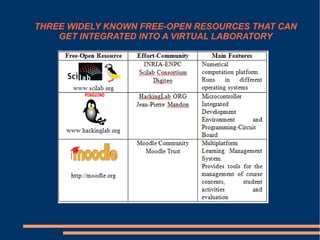
THREE WIDELY KNOWN FREE-OPEN RESOURCES THAT CAN
GET INTEGRATED INTO A VIRTUAL LABORATORY
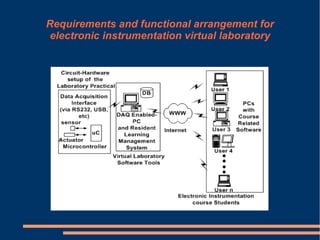
Requirements and functional arrangement for
electronic instrumentation virtual laboratory
Project's Goal


The main goal is to design and implement a set of practicals belonging to the Electronic
Instrumentation course for the Electronic Engineering undergraduate program.



Laboratory practicals on temperature sensing, error estimation, data acquisition, remote monitoring
and sound analysis have been designed to be integrated to course virtual activities
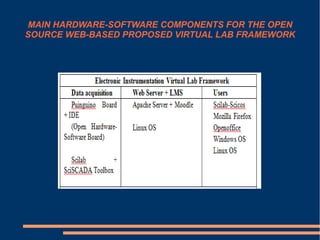
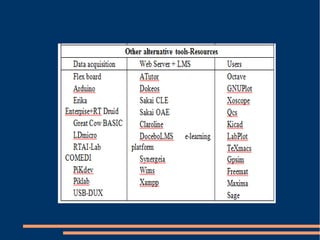
MAIN HARDWARE-SOFTWARE COMPONENTS FOR THE OPEN
SOURCE WEB-BASED PROPOSED VIRTUAL LAB FRAMEWORK
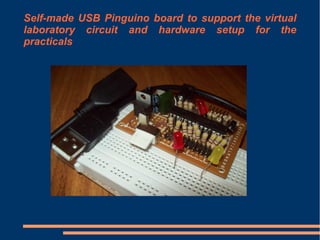
Self-made USB Pinguino board to support the virtual
laboratory circuit and hardware setup for the
practicals
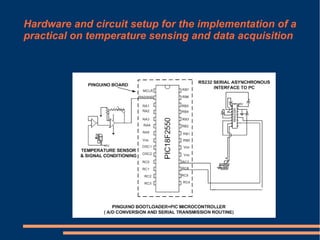
Hardware and circuit setup for the implementation of a
practical on temperature sensing and data acquisition
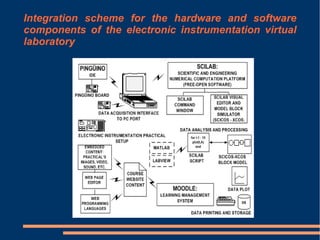
Integration scheme for the hardware and software
components of the electronic instrumentation virtual
laboratory
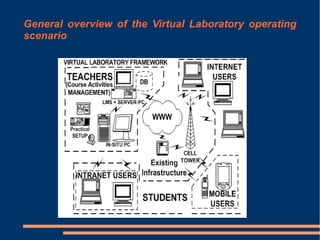
General overview of the Virtual Laboratory operating
scenario
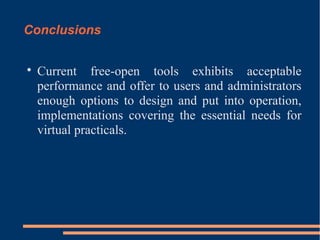
Conclusions


Current free-open tools exhibits acceptable
performance and offer to users and administrators
enough options to design and put into operation,
implementations covering the essential needs for
virtual practicals.
Conclusions


Virtual laboratories and similar e-learning tools
improve and complement traditional “atclassroom” education instead of abolishing it.
Conclusions


The solution based in open-free resources has
flexible features that enhance time sustainability.
The less dependent design on hardware-software
elements, allows a wider spectrum of operating
variants, including the adoption of teaching
approaches or models dynamically, as time passes
according to academic results.
References
[1] M. Cabrera, R. Bragós, M. Pérez, J. Mariño, J. Rius, O. Gomis, M. Casany and X.
Gironella, “GILABVIR: Virtual Laboratories and Remote Laboratories in Engineering,”in
Proc. Of IEEE EDUCON 2010-The Future of Global Learning in Engineering Education,
Madrid, 2010, pp. 1403-1408
[4] J. Rodríguez, P. Russo and A. Sulé, “A Virtual Exhibition of Open Source Software for
Libraries,” presented at the 16th BOBCATSSS Symposium, Zadar (Croatia), Jan. 28-30,
2008
[5] M. Smolnikar and M. Mohoric, “A Framework for Developing a Microhip PIC
Microcontroller Based Applications,” WSEAS Trans. Advances in Engineering Education,
vol 5, Issue 2, pp.83-91, Feb. 2008.
[6] Z. Peng and L. Ma, “The Realization of SCADA based on Scilab,” In Proc. Of the
International Workshop on Open Source Software SCILAB and its Engineering
Applications OSSS-EA, Hangzhou, China, 2006, pp. 175-185
[7] G. Meneses, M. Correa, B. Mendoza and Y. Ocampo, “Laboratorio virtual para la
enseñanza de instrumentación electrónica,” Revista Ingenierías Usbmed, vol 1, Issue 1, pp.
70-77, Dec. 2010.

Electronic Instrumentation Virtual Laboratory

  • 1.
    Design of anElectronic Instrumentation Virtual Laboratory based on Free-Open Resources Gustavo Meneses Ing. Eléctrico UNALMED Esp. Automatización Industrial UdeA Msc. en Ingeniería UdeA Universidad de San Buenaventura
  • 2.
    Motivations Over the lastdecade a complete plethora of free-open hardware and software resources have been developed for use in engineering and other fields [4], more recently significant advances have been achieved in the field of microcontrollers [5] and data acquisition and analysis [6]
  • 3.
    Motivations Virtual laboratories havebecome an extended tool used for teachers and students around the world in all stages of education, ranging from elementary school to higher education[1]. The virtualization of laboratory practicals has shown to be an effective mean to extend learning scenarios beyond the classroom or laboratory at campus site.
  • 4.
    THREE WIDELY KNOWNFREE-OPEN RESOURCES THAT CAN GET INTEGRATED INTO A VIRTUAL LABORATORY
  • 5.
    Requirements and functionalarrangement for electronic instrumentation virtual laboratory
  • 6.
    Project's Goal  The maingoal is to design and implement a set of practicals belonging to the Electronic Instrumentation course for the Electronic Engineering undergraduate program.  Laboratory practicals on temperature sensing, error estimation, data acquisition, remote monitoring and sound analysis have been designed to be integrated to course virtual activities
  • 7.
    MAIN HARDWARE-SOFTWARE COMPONENTSFOR THE OPEN SOURCE WEB-BASED PROPOSED VIRTUAL LAB FRAMEWORK
  • 9.
    Self-made USB Pinguinoboard to support the virtual laboratory circuit and hardware setup for the practicals
  • 10.
    Hardware and circuitsetup for the implementation of a practical on temperature sensing and data acquisition
  • 11.
    Integration scheme forthe hardware and software components of the electronic instrumentation virtual laboratory
  • 12.
    General overview ofthe Virtual Laboratory operating scenario
  • 15.
    Conclusions  Current free-open toolsexhibits acceptable performance and offer to users and administrators enough options to design and put into operation, implementations covering the essential needs for virtual practicals.
  • 16.
    Conclusions  Virtual laboratories andsimilar e-learning tools improve and complement traditional “atclassroom” education instead of abolishing it.
  • 17.
    Conclusions  The solution basedin open-free resources has flexible features that enhance time sustainability. The less dependent design on hardware-software elements, allows a wider spectrum of operating variants, including the adoption of teaching approaches or models dynamically, as time passes according to academic results.
  • 18.
    References [1] M. Cabrera,R. Bragós, M. Pérez, J. Mariño, J. Rius, O. Gomis, M. Casany and X. Gironella, “GILABVIR: Virtual Laboratories and Remote Laboratories in Engineering,”in Proc. Of IEEE EDUCON 2010-The Future of Global Learning in Engineering Education, Madrid, 2010, pp. 1403-1408 [4] J. Rodríguez, P. Russo and A. Sulé, “A Virtual Exhibition of Open Source Software for Libraries,” presented at the 16th BOBCATSSS Symposium, Zadar (Croatia), Jan. 28-30, 2008 [5] M. Smolnikar and M. Mohoric, “A Framework for Developing a Microhip PIC Microcontroller Based Applications,” WSEAS Trans. Advances in Engineering Education, vol 5, Issue 2, pp.83-91, Feb. 2008. [6] Z. Peng and L. Ma, “The Realization of SCADA based on Scilab,” In Proc. Of the International Workshop on Open Source Software SCILAB and its Engineering Applications OSSS-EA, Hangzhou, China, 2006, pp. 175-185 [7] G. Meneses, M. Correa, B. Mendoza and Y. Ocampo, “Laboratorio virtual para la enseñanza de instrumentación electrónica,” Revista Ingenierías Usbmed, vol 1, Issue 1, pp. 70-77, Dec. 2010.