An Initiative of
Ministry of Human Resource & Development (MHRD)
under the aegis of
The National Mission on Education through ICT (NMEICT)
 Huge number of Technical Institutions.
 Huge production of engineers per year.
 Competence level of Engineers.
 Practical Knowledge.
 Collaboration with Industry / Research Institutions.
 Geographical location.
 Quality education for all.
 Equal opportunity to all.
Salient Features
 Anytime anywhere lab.
 Virtual Labs are free to use.
 Accessible through Internet on any PC/Laptop.
 Surprisingly even on your smartphone/Tablet.
 Developed in self-learning mode.
 Innovative experimentations.
 Over 100 Virtual Labs have already been developed.
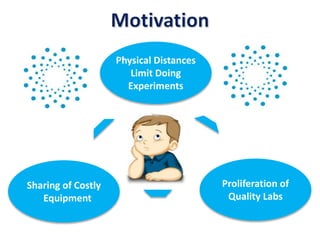
Physical Distances
Limit Doing
Experiments
Sharing of Costly
Equipment
Proliferation of
Quality Labs
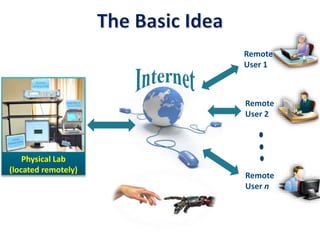
Physical Lab
(located remotely)
Remote
User 1
Remote
User 2
Remote
User n
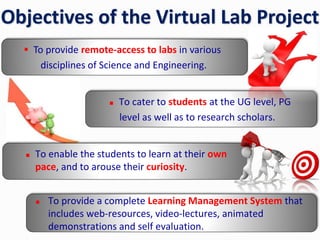
Objectives of the Virtual Lab Project
 To provide remote-access to labs in various
disciplines of Science and Engineering.
 To cater to students at the UG level, PG
level as well as to research scholars.
 To enable the students to learn at their own
pace, and to arouse their curiosity.
 To provide a complete Learning Management System that
includes web-resources, video-lectures, animated
demonstrations and self evaluation.
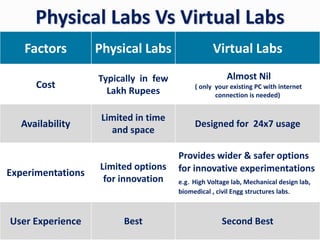
Physical Labs Vs Virtual Labs
Factors Physical Labs Virtual Labs
Cost
Typically in few
Lakh Rupees
Almost Nil
( only your existing PC with internet
connection is needed)
Availability
Limited in time
and space
Designed for 24x7 usage
Experimentations
Limited options
for innovation
Provides wider & safer options
for innovative experimentations
e.g. High Voltage lab, Mechanical design lab,
biomedical , civil Engg structures labs.
User Experience Best Second Best
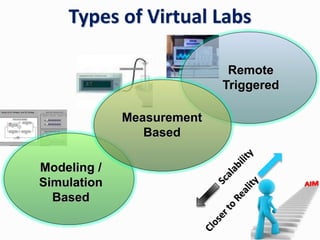
Types of Virtual Labs
Modeling /
Simulation
Based
Remote
Triggered
Measurement
Based
Intended Users
 College Students who do not have access to good lab-
facilities.
 High-school students whose inquisitiveness will be
triggered, possibly motivating them to take up higher-
studies.
 Different engineering colleges who can benefit from
the content and related teaching resources.
 Researchers in different institutes who can share
collaborate equipment and resources.
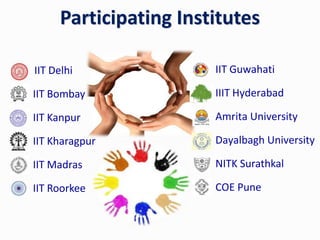
 IIT Delhi
 IIT Bombay
 IIT Kanpur
 IIT Kharagpur
 IIT Madras
 IIT Roorkee
Participating Institutes
IIT Guwahati
IIIT Hyderabad
Amrita University
Dayalbagh University
NITK Surathkal
COE Pune
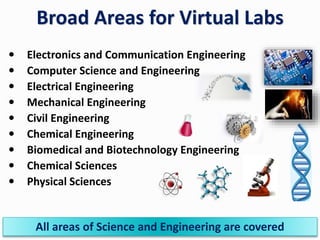
Broad Areas for Virtual Labs
 Electronics and Communication Engineering
 Computer Science and Engineering
 Electrical Engineering
 Mechanical Engineering
 Civil Engineering
 Chemical Engineering
 Biomedical and Biotechnology Engineering
 Chemical Sciences
 Physical Sciences
All areas of Science and Engineering are covered
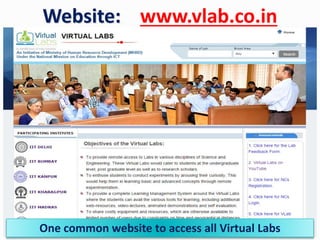
Website: www.vlab.co.in
One common website to access all Virtual Labs
Value Add in a Nutshell
On-demand Labs
[learn at own pace]
Integrated Learning
[contents at one place]
Self - Evaluation
[pre /post lab quiz]
Animation/Video Tut
[better insight]
Freedom to make mistakes
[can experiment with experiments]
Virtual Labs - A Complete Learning Management System
Impact of the Project
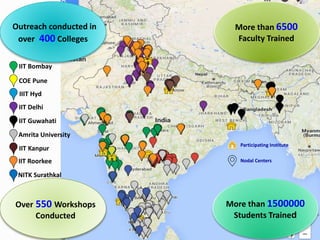
Outreach conducted in
over 400 Colleges
More than 6500
Faculty Trained
Over 550 Workshops
Conducted
More than 1500000
Students Trained
Participating Institute
Nodal Centers
IIT Bombay
IIIT Hyd
COE Pune
IIT Delhi
IIT Guwahati
Amrita University
IIT Kanpur
IIT Roorkee
NITK Surathkal
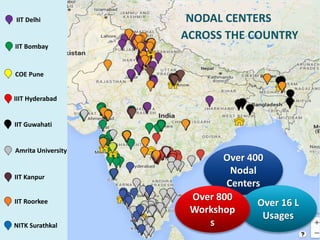
Over 400
Nodal
Centers
Over 16 L
Usages
Over 800
Workshop
s
NODAL CENTERS
ACROSS THE COUNTRY
IIT Bombay
IIIT Hyderabad
IIT Delhi
IIT Guwahati
Amrita University
IIT Kanpur
COE Pune
NITK Surathkal
IIT Roorkee
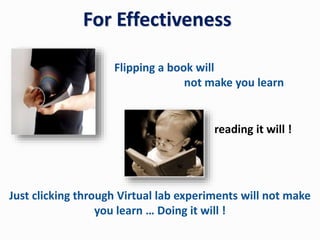
For Effectiveness
Flipping a book will
not make you learn
reading it will !
Just clicking through Virtual lab experiments will not make
you learn … Doing it will !
Want Something to Share !
: support@vlab.co.in
: +91-11-64674687
: +91-11-26597244
A Journey From Concept To Reality !
Thank You

generalpptofvirtuallabs-170505052054.pdf

  • 1.
    An Initiative of Ministryof Human Resource & Development (MHRD) under the aegis of The National Mission on Education through ICT (NMEICT)
  • 2.
     Huge numberof Technical Institutions.  Huge production of engineers per year.  Competence level of Engineers.  Practical Knowledge.  Collaboration with Industry / Research Institutions.  Geographical location.  Quality education for all.  Equal opportunity to all.
  • 3.
    Salient Features  Anytimeanywhere lab.  Virtual Labs are free to use.  Accessible through Internet on any PC/Laptop.  Surprisingly even on your smartphone/Tablet.  Developed in self-learning mode.  Innovative experimentations.  Over 100 Virtual Labs have already been developed.
  • 4.
    Physical Distances Limit Doing Experiments Sharingof Costly Equipment Proliferation of Quality Labs
  • 5.
    Physical Lab (located remotely) Remote User1 Remote User 2 Remote User n
  • 6.
    Objectives of theVirtual Lab Project  To provide remote-access to labs in various disciplines of Science and Engineering.  To cater to students at the UG level, PG level as well as to research scholars.  To enable the students to learn at their own pace, and to arouse their curiosity.  To provide a complete Learning Management System that includes web-resources, video-lectures, animated demonstrations and self evaluation.
  • 7.
    Physical Labs VsVirtual Labs Factors Physical Labs Virtual Labs Cost Typically in few Lakh Rupees Almost Nil ( only your existing PC with internet connection is needed) Availability Limited in time and space Designed for 24x7 usage Experimentations Limited options for innovation Provides wider & safer options for innovative experimentations e.g. High Voltage lab, Mechanical design lab, biomedical , civil Engg structures labs. User Experience Best Second Best
  • 8.
    Types of VirtualLabs Modeling / Simulation Based Remote Triggered Measurement Based
  • 9.
    Intended Users  CollegeStudents who do not have access to good lab- facilities.  High-school students whose inquisitiveness will be triggered, possibly motivating them to take up higher- studies.  Different engineering colleges who can benefit from the content and related teaching resources.  Researchers in different institutes who can share collaborate equipment and resources.
  • 10.
     IIT Delhi IIT Bombay  IIT Kanpur  IIT Kharagpur  IIT Madras  IIT Roorkee Participating Institutes IIT Guwahati IIIT Hyderabad Amrita University Dayalbagh University NITK Surathkal COE Pune
  • 11.
    Broad Areas forVirtual Labs  Electronics and Communication Engineering  Computer Science and Engineering  Electrical Engineering  Mechanical Engineering  Civil Engineering  Chemical Engineering  Biomedical and Biotechnology Engineering  Chemical Sciences  Physical Sciences All areas of Science and Engineering are covered
  • 12.
    Website: www.vlab.co.in One commonwebsite to access all Virtual Labs
  • 13.
    Value Add ina Nutshell On-demand Labs [learn at own pace] Integrated Learning [contents at one place] Self - Evaluation [pre /post lab quiz] Animation/Video Tut [better insight] Freedom to make mistakes [can experiment with experiments] Virtual Labs - A Complete Learning Management System
  • 14.
  • 15.
    Outreach conducted in over400 Colleges More than 6500 Faculty Trained Over 550 Workshops Conducted More than 1500000 Students Trained Participating Institute Nodal Centers IIT Bombay IIIT Hyd COE Pune IIT Delhi IIT Guwahati Amrita University IIT Kanpur IIT Roorkee NITK Surathkal
  • 16.
    Over 400 Nodal Centers Over 16L Usages Over 800 Workshop s NODAL CENTERS ACROSS THE COUNTRY IIT Bombay IIIT Hyderabad IIT Delhi IIT Guwahati Amrita University IIT Kanpur COE Pune NITK Surathkal IIT Roorkee
  • 17.
    For Effectiveness Flipping abook will not make you learn reading it will ! Just clicking through Virtual lab experiments will not make you learn … Doing it will !
  • 18.
    Want Something toShare ! : support@vlab.co.in : +91-11-64674687 : +91-11-26597244
  • 19.
    A Journey FromConcept To Reality ! Thank You