introduction to the


           Making knowledge
           accessible to people living
           in poverty.


               EDUCATION EDITION
Problem: Education in Rural Areas
Limited resources
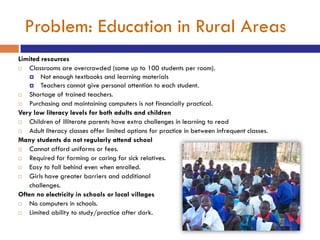
   Classrooms are overcrowded (some up to 100 students per room).
     Not enough textbooks and learning materials
     Teachers cannot give personal attention to each student.
   Shortage of trained teachers.
   Purchasing and maintaining computers is not financially practical.
Very low literacy levels for both adults and children
   Children of illiterate parents have extra challenges in learning to read
   Adult literacy classes offer limited options for practice in between infrequent classes.
Many students do not regularly attend school
   Cannot afford uniforms or fees.
   Required for farming or caring for sick relatives.
   Easy to fall behind even when enrolled.
   Girls have greater barriers and additional
    challenges.
Often no electricity in schools or local villages
   No computers in schools.
   Limited ability to study/practice after dark.
Solution: The Talking Book
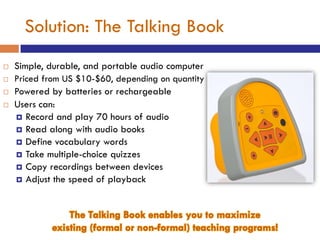
   Simple, durable, and portable audio computer
   Priced from US $10-$60, depending on quantity
   Powered by batteries or rechargeable
   Users can:
     Record and play 70 hours of audio
     Read along with audio books
     Define vocabulary words
     Take multiple-choice quizzes
     Copy recordings between devices
     Adjust the speed of playback
How Is the Talking Book Being Used?
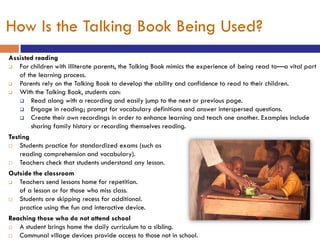
Assisted reading
  For children with illiterate parents, the Talking Book mimics the experience of being read to—a vital part
   of the learning process.
  Parents rely on the Talking Book to develop the ability and confidence to read to their children.
  With the Talking Book, students can:
    Read along with a recording and easily jump to the next or previous page.
    Engage in reading; prompt for vocabulary definitions and answer interspersed questions.
    Create their own recordings in order to enhance learning and teach one another. Examples include
       sharing family history or recording themselves reading.
Testing
   Students practice for standardized exams (such as
    reading comprehension and vocabulary).
   Teachers check that students understand any lesson.
Outside the classroom
  Teachers send lessons home for repetition.
   of a lesson or for those who miss class.
  Students are skipping recess for additional.
   practice using the fun and interactive device.
Reaching those who do not attend school
  A student brings home the daily curriculum to a sibling.
  Communal village devices provide access to those not in school.
Program Overview

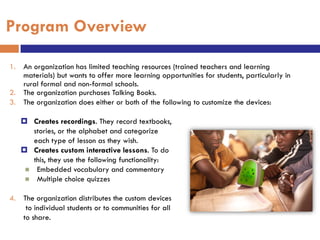
1. An organization has limited teaching resources (trained teachers and learning
   materials) but wants to offer more learning opportunities for students, particularly in
   rural formal and non-formal schools.
2. The organization purchases Talking Books.
3. The organization does either or both of the following to customize the devices:

    Creates recordings. They record textbooks,
      stories, or the alphabet and categorize
      each type of lesson as they wish.
    Creates custom interactive lessons. To do
      this, they use the following functionality:
     Embedded vocabulary and commentary
     Multiple choice quizzes


4. The organization distributes the custom devices
    to individual students or to communities for all
   to share.
Logic Model
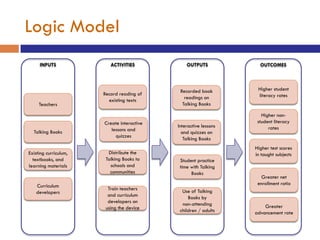
     INPUTS               ACTIVITIES            OUTPUTS             OUTCOMES


                                             Recorded book         Higher student
                       Record reading of                           literacy rates
                                               readings on
                         existing texts
     Teachers                                 Talking Books

                                                                     Higher non-
                       Create interactive                          student literacy
                                            Interactive lessons         rates
  Talking Books           lessons and
                                              and quizzes on
                            quizzes
                                               Talking Books
                                                                  Higher test scores
Existing curriculum,     Distribute the                           in taught subjects
  textbooks, and        Talking Books to     Student practice
learning materials        schools and        time with Talking
                          communities             Books
                                                                     Greater net
   Curriculum                                                      enrollment ratio
                         Train teachers       Use of Talking
   developers
                         and curriculum          Books by
                         developers on        non-attending
                        using the device                              Greater
                                             children / adults    advancement rate
Who Creates the Content?
Governments and local organizations both play
  important roles in this program.
Governments
   The curriculum development office customizes Talking Books to accompany
    national curriculum (textbooks, workbooks, and so on).
   They use computers to easily create a set of interactive lessons on the
    Talking Books.
   By complementing standard materials with Talking Books, they help ensure
    children understand and retain the knowledge.
Local schools and NGOs
   Teachers complement the national curriculum at the local level.
   They create lessons and quizzes on a Talking Book and copy them to the
    other devices.
   By creating recordings to complement a specific exercise, teachers are able
    to best meet the needs of their students.
Summary
The Talking Book allows you to increase:
   Efficiency
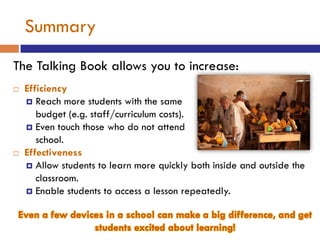
     Reach more students with the same
       budget (e.g. staff/curriculum costs).
     Even touch those who do not attend
       school.
   Effectiveness
     Allow students to learn more quickly both inside and outside the
       classroom.
     Enable students to access a lesson repeatedly.
Interested?


To learn more about how
Talking Books can increase
your impact, see
http://literacybridge.org
to learn more or email
info@literacybridge.org.

Talking Book For Education

  • 1.
    introduction to the Making knowledge accessible to people living in poverty. EDUCATION EDITION
  • 2.
    Problem: Education inRural Areas Limited resources  Classrooms are overcrowded (some up to 100 students per room).  Not enough textbooks and learning materials  Teachers cannot give personal attention to each student.  Shortage of trained teachers.  Purchasing and maintaining computers is not financially practical. Very low literacy levels for both adults and children  Children of illiterate parents have extra challenges in learning to read  Adult literacy classes offer limited options for practice in between infrequent classes. Many students do not regularly attend school  Cannot afford uniforms or fees.  Required for farming or caring for sick relatives.  Easy to fall behind even when enrolled.  Girls have greater barriers and additional challenges. Often no electricity in schools or local villages  No computers in schools.  Limited ability to study/practice after dark.
  • 3.
    Solution: The TalkingBook  Simple, durable, and portable audio computer  Priced from US $10-$60, depending on quantity  Powered by batteries or rechargeable  Users can:  Record and play 70 hours of audio  Read along with audio books  Define vocabulary words  Take multiple-choice quizzes  Copy recordings between devices  Adjust the speed of playback
  • 4.
    How Is theTalking Book Being Used? Assisted reading  For children with illiterate parents, the Talking Book mimics the experience of being read to—a vital part of the learning process.  Parents rely on the Talking Book to develop the ability and confidence to read to their children.  With the Talking Book, students can:  Read along with a recording and easily jump to the next or previous page.  Engage in reading; prompt for vocabulary definitions and answer interspersed questions.  Create their own recordings in order to enhance learning and teach one another. Examples include sharing family history or recording themselves reading. Testing  Students practice for standardized exams (such as reading comprehension and vocabulary).  Teachers check that students understand any lesson. Outside the classroom  Teachers send lessons home for repetition. of a lesson or for those who miss class.  Students are skipping recess for additional. practice using the fun and interactive device. Reaching those who do not attend school  A student brings home the daily curriculum to a sibling.  Communal village devices provide access to those not in school.
  • 5.
    Program Overview 1. Anorganization has limited teaching resources (trained teachers and learning materials) but wants to offer more learning opportunities for students, particularly in rural formal and non-formal schools. 2. The organization purchases Talking Books. 3. The organization does either or both of the following to customize the devices:  Creates recordings. They record textbooks, stories, or the alphabet and categorize each type of lesson as they wish.  Creates custom interactive lessons. To do this, they use the following functionality:  Embedded vocabulary and commentary  Multiple choice quizzes 4. The organization distributes the custom devices to individual students or to communities for all to share.
  • 6.
    Logic Model INPUTS ACTIVITIES OUTPUTS OUTCOMES Recorded book Higher student Record reading of literacy rates readings on existing texts Teachers Talking Books Higher non- Create interactive student literacy Interactive lessons rates Talking Books lessons and and quizzes on quizzes Talking Books Higher test scores Existing curriculum, Distribute the in taught subjects textbooks, and Talking Books to Student practice learning materials schools and time with Talking communities Books Greater net Curriculum enrollment ratio Train teachers Use of Talking developers and curriculum Books by developers on non-attending using the device Greater children / adults advancement rate
  • 7.
    Who Creates theContent? Governments and local organizations both play important roles in this program. Governments  The curriculum development office customizes Talking Books to accompany national curriculum (textbooks, workbooks, and so on).  They use computers to easily create a set of interactive lessons on the Talking Books.  By complementing standard materials with Talking Books, they help ensure children understand and retain the knowledge. Local schools and NGOs  Teachers complement the national curriculum at the local level.  They create lessons and quizzes on a Talking Book and copy them to the other devices.  By creating recordings to complement a specific exercise, teachers are able to best meet the needs of their students.
  • 8.
    Summary The Talking Bookallows you to increase:  Efficiency  Reach more students with the same budget (e.g. staff/curriculum costs).  Even touch those who do not attend school.  Effectiveness  Allow students to learn more quickly both inside and outside the classroom.  Enable students to access a lesson repeatedly.
  • 9.
    Interested? To learn moreabout how Talking Books can increase your impact, see http://literacybridge.org to learn more or email info@literacybridge.org.