Virtual labs-An Extension of Science
Centre

K. Madangopal
VITM
Virtual labs

An Extension of Science Centre
Abstract
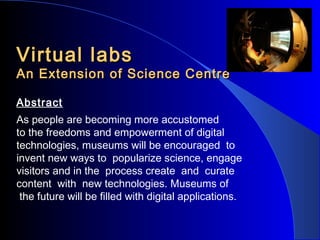
As people are becoming more accustomed
to the freedoms and empowerment of digital
technologies, museums will be encouraged to
invent new ways to popularize science, engage
visitors and in the process create and curate
content with new technologies. Museums of
the future will be filled with digital applications.
Virtual labs

An Extension of Science Centre
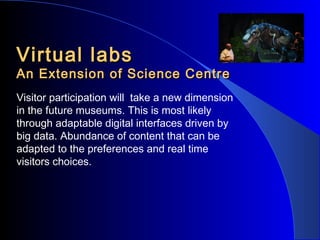
Visitor participation will take a new dimension
in the future museums. This is most likely
through adaptable digital interfaces driven by
big data. Abundance of content that can be
adapted to the preferences and real time
visitors choices.
Why Virtual labs
We have grown up interacting with
Physical objects around us. The serene
nature, accessibility to natural vegetation,
organisms, insects etc had provided us natures
lab open for 24X7 with the opportunity to explore
interact and experiment. But slowly with the growing
population, urbanization, Industrial revolution, and
paucity of open spaces in rapidly expanding cities the
Natures lab spaces/workspaces are dwindling. It is
expected that by the next decade more than 50 percent
of the population in the country will be city dwellers.
Cities & Towns need
for Virtual Labs
Situation in cities is interesting. High
competition for spaces, education, congestion,
traffic jams, are on one side whereas revolution
in communication, mobile accessibility, Television,
high speed Data and voice communication, Internet,
social websites, satellite accessibility etc have opened
up new opportunities.
Limitations of
traditional labs






Time
Money
Equipment availability
Instructor time/ resources/ knowledge
Safety concerns

Virtual laboratory exercises can remedy
nearly all of these concerns!
Need for
Virtual Labs
With the non affordability of lab equipment,
ban on using live specimens for experimentation,
Virtual lab simulations are the alternative and
most effective mode of experimentation for
Education.
Virtual Laboratories






Familiarize with equipment.
Learn the Scientific Method – Problem
statement- Hypothesis – experiment – observation
study the results – verify the hypothesis
Understand theoretical concepts in a better way.
Learn standard practices and procedures
Advantages of
Virtual Labs





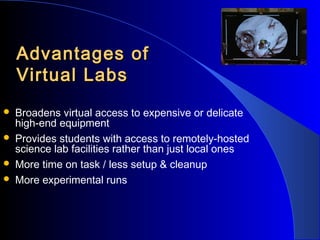
Broadens virtual access to expensive or delicate
high-end equipment
Provides students with access to remotely-hosted
science lab facilities rather than just local ones
More time on task / less setup & cleanup
More experimental runs
Advantages of
Virtual labs





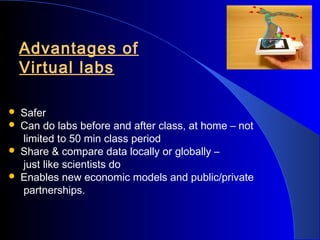
Safer
Can do labs before and after class, at home – not
limited to 50 min class period
Share & compare data locally or globally –
just like scientists do
Enables new economic models and public/private
partnerships.
From Lab to
‘ Virtual lab’







Traditional labs use expensive apparatus.
There are restrictions to conduct work on live
biological specimen.
Labs restricted to research institutions or places of
higher learning or other educational institutions,
unreachable to laymen.
Remote and simulated laboratories reduce
overall costs and enrich educational experience
Virtual laboratories








Virtual laboratories use technology to
enhance learning experience.
They can supplement real laboratories for
education.
Use pictures, animations and interactive simulations.
Free choice learning
No restriction on the education level/age etc of the user.
Digital Age –

Inspiration for Virtual labs
As we continue to push the boundaries
of the digital frontier, we are also redefining
the scope and range of our mission as public
learning facilities. By implementing the latest
advances in digital technologies with wisdom and
vision, the students as well as common people can
team up in a unique way for understanding new
scientific advancements.
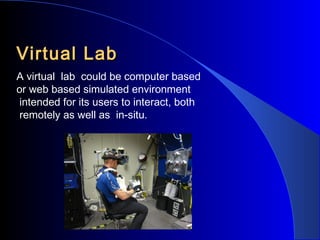
Virtual Lab
A virtual lab could be computer based
or web based simulated environment
intended for its users to interact, both
remotely as well as in-situ.
Museums & Virtual labs
Virtual labs are the extensions to science
Museums due to the following common
interests namely:







Both are free choice learning
environments.
No restriction of education level/ age etc.
Self-learning without any evaluation
during the process
Repeatability
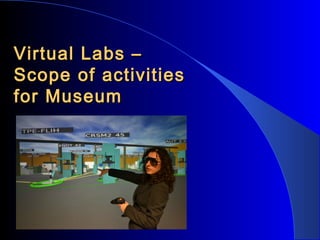
Virtual Labs –
Scope of activities
for Museum
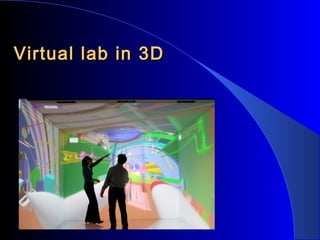
Virtual lab in 3D
Virtual lab on
Mobile
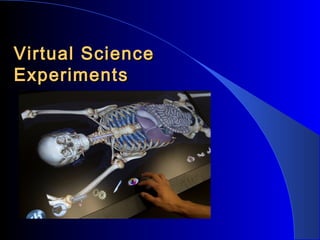
Virtual Science
Experiments
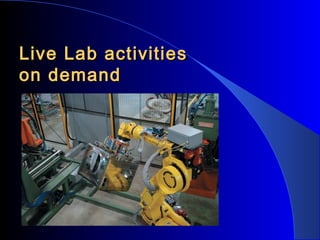
Live Lab activities
on demand
Guided Lab
Activities on demand
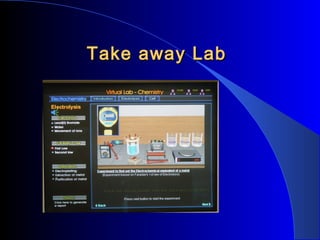
Take away Lab
Virtual tour of
/
Museum Galleries
In the age of broadband connectivity,
science communication through internet is
going to be a major area of operation of science
museums/science centres. Such communication
will not be time bound and it will not require
physical presence of the visitor.
Virtual tour of
Museum Galleries
A virtual tour of museum galleries through
online payment mode will be the modern mode
to discover museum exhibits. It will be powered
by high speed internet and the digital world of
virtual reality.
Virtual tour of
Museum Galleries
The digital technology coupled with
automation will provide a way for museums to
deliver highly compelling, individually- curated
experiences, where exhibits, with light, sound and
space interacting with digital media will create a
seamless environment.
Virtual Museum
Tour on Mobile
Mobile users in India who are science
enthusiasts can opt to take a short tour of a
specific exhibit/exhibition in a museum during
their free time during shopping / marketing / while
waiting to catch a delayed flight/ train /bus or
while they are on move.
Virtual Science
Experiments
The innovation lab with student innovators
also has the scope to begin with startup
Science experimentation for students, before they
embark on working with their ideas.
Virtual Science
Experiments
The activities at the innovation lab can
be virtually accessed live through satellites
on Television. In addition multimedia
resources, virtual experiments on different
topics, in soft format can be made available
through dedicated servers/ cloud. This can be
similar to the pay channels now available on
Television.
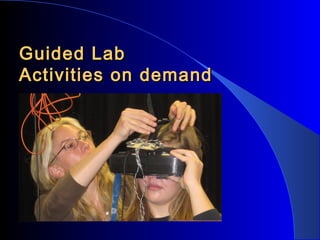
Guided Lab
Activities on demand

Multimedia demonstration of ideas / activities in the
innovation lab including curriculum based experiments
can be uploaded on internet which can be
made available on demand on payment mode.
Lab Experiments
Virtual lab experiments with on screen
instructions for remote access and
Interaction to give a real life experience can
be developed and made available on shared
servers/cloud with access facilities through
different media like tablets/ mobiles and other
communication devices.
Live Virtual Lab
Virtual labs can also have fixed time
Mentors interaction with remote students
to help them perform a experiment or discuss an
idea/ discuss on a scientific topic. This can be
a two way communication.
Live Virtual Lab
Live chat programs / blogs can also be
a part of virtual access with fixed time
availability of mentors drawn from different
scientific institutions.
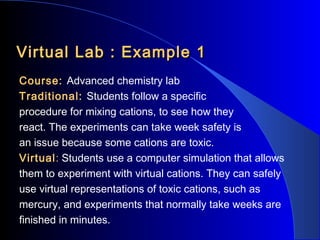
Virtual Lab : Example 1
Course: Advanced chemistry lab
Traditional: Students follow a specific
procedure for mixing cations, to see how they
react. The experiments can take week safety is

an issue because some cations are toxic.
Virtual: Students use a computer simulation that allows
them to experiment with virtual cations. They can safely
use virtual representations of toxic cations, such as
mercury, and experiments that normally take weeks are
finished in minutes.
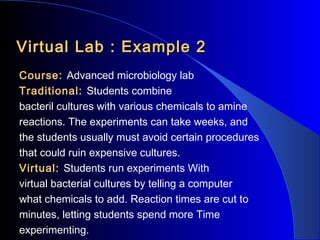
Virtual Lab : Example 2
Course: Advanced microbiology lab
Traditional: Students combine
bacteril cultures with various chemicals to amine
reactions. The experiments can take weeks, and
the students usually must avoid certain procedures
that could ruin expensive cultures.
Virtual: Students run experiments With
virtual bacterial cultures by telling a computer
what chemicals to add. Reaction times are cut to
minutes, letting students spend more Time
experimenting.
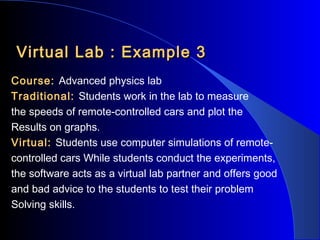
Virtual Lab : Example 3
Course: Advanced physics lab
Traditional: Students work in the lab to measure
the speeds of remote-controlled cars and plot the
Results on graphs.
Virtual: Students use computer simulations of remotecontrolled cars While students conduct the experiments,
the software acts as a virtual lab partner and offers good
and bad advice to the students to test their problem
Solving skills.
Thank you!

Virtual labs presentation by k madangopal

  • 1.
    Virtual labs-An Extensionof Science Centre K. Madangopal VITM
  • 2.
    Virtual labs An Extensionof Science Centre Abstract As people are becoming more accustomed to the freedoms and empowerment of digital technologies, museums will be encouraged to invent new ways to popularize science, engage visitors and in the process create and curate content with new technologies. Museums of the future will be filled with digital applications.
  • 3.
    Virtual labs An Extensionof Science Centre Visitor participation will take a new dimension in the future museums. This is most likely through adaptable digital interfaces driven by big data. Abundance of content that can be adapted to the preferences and real time visitors choices.
  • 4.
    Why Virtual labs Wehave grown up interacting with Physical objects around us. The serene nature, accessibility to natural vegetation, organisms, insects etc had provided us natures lab open for 24X7 with the opportunity to explore interact and experiment. But slowly with the growing population, urbanization, Industrial revolution, and paucity of open spaces in rapidly expanding cities the Natures lab spaces/workspaces are dwindling. It is expected that by the next decade more than 50 percent of the population in the country will be city dwellers.
  • 5.
    Cities & Townsneed for Virtual Labs Situation in cities is interesting. High competition for spaces, education, congestion, traffic jams, are on one side whereas revolution in communication, mobile accessibility, Television, high speed Data and voice communication, Internet, social websites, satellite accessibility etc have opened up new opportunities.
  • 6.
    Limitations of traditional labs      Time Money Equipmentavailability Instructor time/ resources/ knowledge Safety concerns Virtual laboratory exercises can remedy nearly all of these concerns!
  • 7.
    Need for Virtual Labs Withthe non affordability of lab equipment, ban on using live specimens for experimentation, Virtual lab simulations are the alternative and most effective mode of experimentation for Education.
  • 8.
    Virtual Laboratories     Familiarize withequipment. Learn the Scientific Method – Problem statement- Hypothesis – experiment – observation study the results – verify the hypothesis Understand theoretical concepts in a better way. Learn standard practices and procedures
  • 9.
    Advantages of Virtual Labs     Broadensvirtual access to expensive or delicate high-end equipment Provides students with access to remotely-hosted science lab facilities rather than just local ones More time on task / less setup & cleanup More experimental runs
  • 10.
    Advantages of Virtual labs     Safer Cando labs before and after class, at home – not limited to 50 min class period Share & compare data locally or globally – just like scientists do Enables new economic models and public/private partnerships.
  • 11.
    From Lab to ‘Virtual lab’     Traditional labs use expensive apparatus. There are restrictions to conduct work on live biological specimen. Labs restricted to research institutions or places of higher learning or other educational institutions, unreachable to laymen. Remote and simulated laboratories reduce overall costs and enrich educational experience
  • 12.
    Virtual laboratories      Virtual laboratoriesuse technology to enhance learning experience. They can supplement real laboratories for education. Use pictures, animations and interactive simulations. Free choice learning No restriction on the education level/age etc of the user.
  • 13.
    Digital Age – Inspirationfor Virtual labs As we continue to push the boundaries of the digital frontier, we are also redefining the scope and range of our mission as public learning facilities. By implementing the latest advances in digital technologies with wisdom and vision, the students as well as common people can team up in a unique way for understanding new scientific advancements.
  • 14.
    Virtual Lab A virtuallab could be computer based or web based simulated environment intended for its users to interact, both remotely as well as in-situ.
  • 15.
    Museums & Virtuallabs Virtual labs are the extensions to science Museums due to the following common interests namely:     Both are free choice learning environments. No restriction of education level/ age etc. Self-learning without any evaluation during the process Repeatability
  • 16.
    Virtual Labs – Scopeof activities for Museum
  • 17.
  • 18.
  • 19.
  • 20.
  • 21.
  • 22.
  • 23.
    Virtual tour of / MuseumGalleries In the age of broadband connectivity, science communication through internet is going to be a major area of operation of science museums/science centres. Such communication will not be time bound and it will not require physical presence of the visitor.
  • 24.
    Virtual tour of MuseumGalleries A virtual tour of museum galleries through online payment mode will be the modern mode to discover museum exhibits. It will be powered by high speed internet and the digital world of virtual reality.
  • 25.
    Virtual tour of MuseumGalleries The digital technology coupled with automation will provide a way for museums to deliver highly compelling, individually- curated experiences, where exhibits, with light, sound and space interacting with digital media will create a seamless environment.
  • 26.
    Virtual Museum Tour onMobile Mobile users in India who are science enthusiasts can opt to take a short tour of a specific exhibit/exhibition in a museum during their free time during shopping / marketing / while waiting to catch a delayed flight/ train /bus or while they are on move.
  • 27.
    Virtual Science Experiments The innovationlab with student innovators also has the scope to begin with startup Science experimentation for students, before they embark on working with their ideas.
  • 28.
    Virtual Science Experiments The activitiesat the innovation lab can be virtually accessed live through satellites on Television. In addition multimedia resources, virtual experiments on different topics, in soft format can be made available through dedicated servers/ cloud. This can be similar to the pay channels now available on Television.
  • 29.
    Guided Lab Activities ondemand Multimedia demonstration of ideas / activities in the innovation lab including curriculum based experiments can be uploaded on internet which can be made available on demand on payment mode.
  • 30.
    Lab Experiments Virtual labexperiments with on screen instructions for remote access and Interaction to give a real life experience can be developed and made available on shared servers/cloud with access facilities through different media like tablets/ mobiles and other communication devices.
  • 31.
    Live Virtual Lab Virtuallabs can also have fixed time Mentors interaction with remote students to help them perform a experiment or discuss an idea/ discuss on a scientific topic. This can be a two way communication.
  • 32.
    Live Virtual Lab Livechat programs / blogs can also be a part of virtual access with fixed time availability of mentors drawn from different scientific institutions.
  • 33.
    Virtual Lab :Example 1 Course: Advanced chemistry lab Traditional: Students follow a specific procedure for mixing cations, to see how they react. The experiments can take week safety is an issue because some cations are toxic. Virtual: Students use a computer simulation that allows them to experiment with virtual cations. They can safely use virtual representations of toxic cations, such as mercury, and experiments that normally take weeks are finished in minutes.
  • 34.
    Virtual Lab :Example 2 Course: Advanced microbiology lab Traditional: Students combine bacteril cultures with various chemicals to amine reactions. The experiments can take weeks, and the students usually must avoid certain procedures that could ruin expensive cultures. Virtual: Students run experiments With virtual bacterial cultures by telling a computer what chemicals to add. Reaction times are cut to minutes, letting students spend more Time experimenting.
  • 35.
    Virtual Lab :Example 3 Course: Advanced physics lab Traditional: Students work in the lab to measure the speeds of remote-controlled cars and plot the Results on graphs. Virtual: Students use computer simulations of remotecontrolled cars While students conduct the experiments, the software acts as a virtual lab partner and offers good and bad advice to the students to test their problem Solving skills.
  • 36.