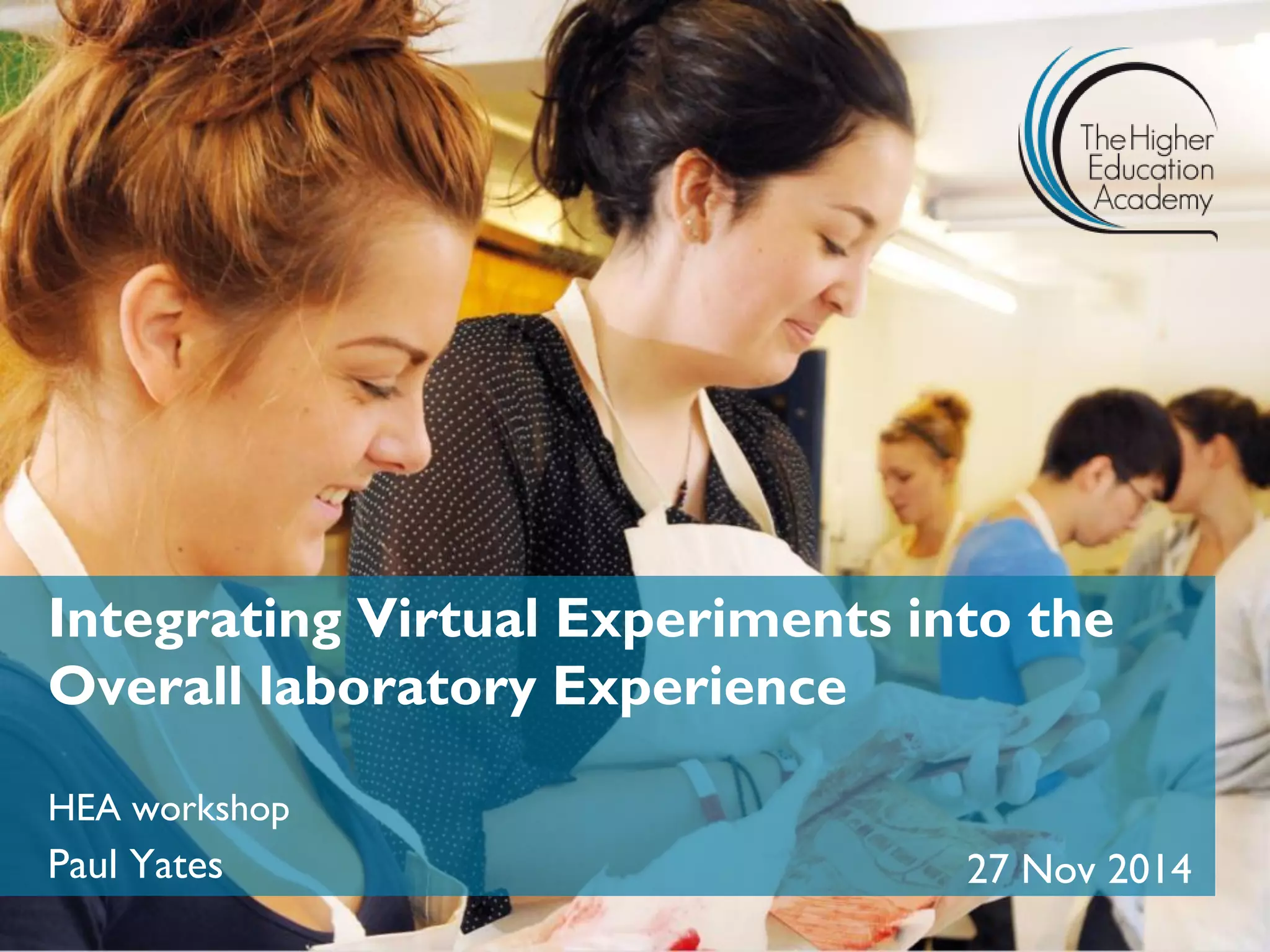
Integrating Virtual Experiments into the Overall laboratory Experience 
HEA workshop 
Paul Yates 
27 Nov 2014
What is a virtual experiment? 
Examples 
Advantages and limitations 
Research work 
Role in the overall laboratory 
Launch of project report 
Workshop outline
3 
What is a virtual experiment?
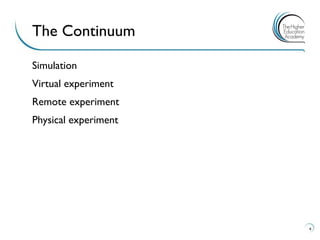
Simulation 
Virtual experiment 
Remote experiment 
Physical experiment 
4 
The Continuum
Examples of virtual experiments 
5
The Open Science Laboratory 
Earthquake 
Plant Cells
Explore the nature of science 
Develop team work 
Cultivating interest in science 
Promote conceptual understanding 
Develop inquiry skills 
Laboratory Teaching
Develop practical skills 
Experience troubleshooting 
Set up equipment 
Observation over long time span 
Develop conceptual knowledge via tactile information 
Authentic delays between experiments 
Deal with unanticipated events 
Measurement uncertainties 
8 
Physical laboratories
Simplify learning 
Highlight salient information 
Remove confusing details 
Modify time scale 
Unobservable phenomena 
Link to symbolic equations 
Gather more information 
Student prompts 
Instructional data 
9 
Virtual laboratories
Change magnetic field of the earth 
Vary accumulation of greenhouse gases 
Extreme heart rate and blood pressure 
10 
Unobservable phenomena
Research work 
11
These new technologies do not replace educators but replace the educators’ role by pushing them from the position of information source to creative managers and facilitators in learning experiences. 
In order to be successful in such a change, the educators need to adapt themselves in new technologies and knowhow to get benefits from these technologies in their classroom environments; 
12 
Kara et al.
One practice observed in VRL applications is to design GUIs which are replicas of laboratory equipment of particular brands. A drawback of this approach is the difficulty of modifying the GUI and its functionality when the underlying equipment needs to be replaced by different brand or model. Designing GUIs that incorporate generic instrument panels and equipment illustrations eliminates this weakness while satisfying the users desire to use, to some extent, actual GUIs. 
13
14 
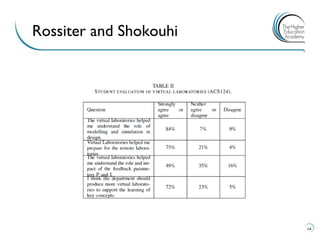
Rossiter and Shokouhi
15
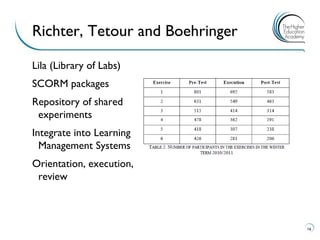
Lila (Library of Labs) 
SCORM packages 
Repository of shared experiments 
Integrate into Learning Management Systems 
Orientation, execution, review 
16 
Richter, Tetour and Boehringer
Some conventional laboratories must remain in the curriculum. for labs that involve a kinesthetic element and require the development of specific motor skills to ensure success. 
Universities’ teaching times often coincide, meaning that only a small number of institutions can use a given remote experiment as part of their undergraduate course. 
17 
Coble et al.
18 
In remote experiments, students are usually required to follow strict procedures in order to complete an experiment safely and on time. Virtual experiments have few constraints with regard to time and safety, and are well suited to an exploratory style of learning, which teaches fundamental concepts and improves theoretical understanding.
Potential benefits: 
•students would feel more relaxed and comfortable in the laboratory; 
•less laboratory time would be wasted looking for items of apparatus; 
•students would be more likely to assemble and use apparatus in the correct way leading to more meaningful experimental results; 
•greater familiarity with laboratory procedures may improve safety; and 
•students could devote more of their attention to the concepts involved in the experiments because they would already be familiar with the procedural aspects of the task. 
19 
Dalgarno, Bishop and Bedgood
20 
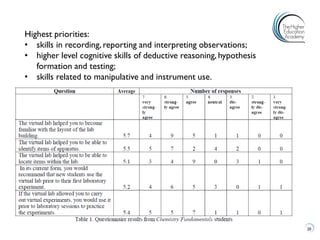
Highest priorities: 
•skills in recording, reporting and interpreting observations; 
•higher level cognitive skills of deductive reasoning, hypothesis formation and testing; 
•skills related to manipulative and instrument use.
Studies showing no difference in conceptual understanding: 
Wiesner and Lan (chemical engineering) 
Zacharia and Constantinou (heat and temperature) 
21 
Physical vs virtual laboratories
Only a requirement for the development of conceptual knowledge or inquiry skills where students have no previous relevant physical experience with the phenomenon or concept under study. 
22 
Tactile information
Students investigating simulated electric circuits showing moving electrons acquired more conceptual knowledge than those using physical materials. 
23 
Finkelstein et al.
Students using virtual optics materials displaying light rays outperformed those using physical materials. 
24 
Olympiou and Zacharia
Virtual laboratory offered students more time to experience experiment and to concentrate on concepts. Allowed faster manipulation of materials. 
Students conducting a virtual and a physical laboratory outperformed students performing only the physical laboratory on conceptual understanding of heat and temperature. 
25 
Zacharia
A group of microbiology students who performed physical laboratories were less successful on a conceptual test than a group where a simulation was substituted for one laboratory session. 
26 
Huppert et al.
Students who used a simulation of distillation preceding the physical laboratory had an advantage over students who did not. 
27 
Climent-Bellido et al.
No significant difference between starting with the virtual laboratory followed by a physical laboratory compared to the reverse order (DNA gel electrophoresis). 
28 
Toth et al.
No difference between virtual-physical and physical-virtual sequence in conceptual understanding of pulleys. 
29 
Chini et al.
Draw a graphical representation of how a virtual experiment could be related to other aspects of the laboratory: 
Pre-laboratory work 
Hands on experiments 
Report writing 
Data analysis 
Design 
Planning 
30 
The overall laboratory
31
32
Exploit the advantages of each method 
Design combinations carefully for greatest benefit 
Provide appropriate student guidance 
33 
Summary

Integrating virtual experiments into the overall laboratory experience - Paul Yates

  • 1.
    Integrating Virtual Experimentsinto the Overall laboratory Experience HEA workshop Paul Yates 27 Nov 2014
  • 2.
    What is avirtual experiment? Examples Advantages and limitations Research work Role in the overall laboratory Launch of project report Workshop outline
  • 3.
    3 What isa virtual experiment?
  • 4.
    Simulation Virtual experiment Remote experiment Physical experiment 4 The Continuum
  • 5.
    Examples of virtualexperiments 5
  • 6.
    The Open ScienceLaboratory Earthquake Plant Cells
  • 7.
    Explore the natureof science Develop team work Cultivating interest in science Promote conceptual understanding Develop inquiry skills Laboratory Teaching
  • 8.
    Develop practical skills Experience troubleshooting Set up equipment Observation over long time span Develop conceptual knowledge via tactile information Authentic delays between experiments Deal with unanticipated events Measurement uncertainties 8 Physical laboratories
  • 9.
    Simplify learning Highlightsalient information Remove confusing details Modify time scale Unobservable phenomena Link to symbolic equations Gather more information Student prompts Instructional data 9 Virtual laboratories
  • 10.
    Change magnetic fieldof the earth Vary accumulation of greenhouse gases Extreme heart rate and blood pressure 10 Unobservable phenomena
  • 11.
  • 12.
    These new technologiesdo not replace educators but replace the educators’ role by pushing them from the position of information source to creative managers and facilitators in learning experiences. In order to be successful in such a change, the educators need to adapt themselves in new technologies and knowhow to get benefits from these technologies in their classroom environments; 12 Kara et al.
  • 13.
    One practice observedin VRL applications is to design GUIs which are replicas of laboratory equipment of particular brands. A drawback of this approach is the difficulty of modifying the GUI and its functionality when the underlying equipment needs to be replaced by different brand or model. Designing GUIs that incorporate generic instrument panels and equipment illustrations eliminates this weakness while satisfying the users desire to use, to some extent, actual GUIs. 13
  • 14.
  • 15.
  • 16.
    Lila (Library ofLabs) SCORM packages Repository of shared experiments Integrate into Learning Management Systems Orientation, execution, review 16 Richter, Tetour and Boehringer
  • 17.
    Some conventional laboratoriesmust remain in the curriculum. for labs that involve a kinesthetic element and require the development of specific motor skills to ensure success. Universities’ teaching times often coincide, meaning that only a small number of institutions can use a given remote experiment as part of their undergraduate course. 17 Coble et al.
  • 18.
    18 In remoteexperiments, students are usually required to follow strict procedures in order to complete an experiment safely and on time. Virtual experiments have few constraints with regard to time and safety, and are well suited to an exploratory style of learning, which teaches fundamental concepts and improves theoretical understanding.
  • 19.
    Potential benefits: •studentswould feel more relaxed and comfortable in the laboratory; •less laboratory time would be wasted looking for items of apparatus; •students would be more likely to assemble and use apparatus in the correct way leading to more meaningful experimental results; •greater familiarity with laboratory procedures may improve safety; and •students could devote more of their attention to the concepts involved in the experiments because they would already be familiar with the procedural aspects of the task. 19 Dalgarno, Bishop and Bedgood
  • 20.
    20 Highest priorities: •skills in recording, reporting and interpreting observations; •higher level cognitive skills of deductive reasoning, hypothesis formation and testing; •skills related to manipulative and instrument use.
  • 21.
    Studies showing nodifference in conceptual understanding: Wiesner and Lan (chemical engineering) Zacharia and Constantinou (heat and temperature) 21 Physical vs virtual laboratories
  • 22.
    Only a requirementfor the development of conceptual knowledge or inquiry skills where students have no previous relevant physical experience with the phenomenon or concept under study. 22 Tactile information
  • 23.
    Students investigating simulatedelectric circuits showing moving electrons acquired more conceptual knowledge than those using physical materials. 23 Finkelstein et al.
  • 24.
    Students using virtualoptics materials displaying light rays outperformed those using physical materials. 24 Olympiou and Zacharia
  • 25.
    Virtual laboratory offeredstudents more time to experience experiment and to concentrate on concepts. Allowed faster manipulation of materials. Students conducting a virtual and a physical laboratory outperformed students performing only the physical laboratory on conceptual understanding of heat and temperature. 25 Zacharia
  • 26.
    A group ofmicrobiology students who performed physical laboratories were less successful on a conceptual test than a group where a simulation was substituted for one laboratory session. 26 Huppert et al.
  • 27.
    Students who useda simulation of distillation preceding the physical laboratory had an advantage over students who did not. 27 Climent-Bellido et al.
  • 28.
    No significant differencebetween starting with the virtual laboratory followed by a physical laboratory compared to the reverse order (DNA gel electrophoresis). 28 Toth et al.
  • 29.
    No difference betweenvirtual-physical and physical-virtual sequence in conceptual understanding of pulleys. 29 Chini et al.
  • 30.
    Draw a graphicalrepresentation of how a virtual experiment could be related to other aspects of the laboratory: Pre-laboratory work Hands on experiments Report writing Data analysis Design Planning 30 The overall laboratory
  • 31.
  • 32.
  • 33.
    Exploit the advantagesof each method Design combinations carefully for greatest benefit Provide appropriate student guidance 33 Summary