VIRTUAL LABORATORY
Computer Organisation and Architecture
Virtual Laboratory [VLS - 12]
IIT KHARAGPUR
People Involved
 Principal Investigator:
Prof. Chittaranjan Mandal
Department of Computer Science and Engineering
Email Id: chitta@iitkgp.ac.in
 Developers:
Gargi Roy, JPA
Devleena Ghosh, JPA
 Presenters:
N. Aditya Kameswara Rao, SRF, Email # akraonandula@gmail.com
Sanhati Mallik, SPA, Email # sanhati.mallik@gmail.com
Department of Mechanical Engineering Department
OBJECTIVES OF THE
VIRTUAL LABS
Web-based learning plays a vital role in the modern education system,
where different technologies are being emerged to enhance this E-
learning process.
Objectives of the Virtual Labs:-
 To enthuse students to conduct experiments by the arousing their
curiosity. This would help them in learning basic and advanced
concepts through remote experimentation.
 To provide a Learning Management System around the Virtual
Labs where the students can avail the various tools for learning,
including additional web-resources, animated demonstrations and
self evaluation.
INTRODUCTION
 The Objective is to Expose the students to the various key
aspects of Digital Logic and Computer Organization by enabling
them to perform FPGA based prototyping of experiments with
support of a virtual environment.
 Computer Organization and Architecture is a core course in most
of the Undergraduate Curricula of the entire Electrical Sciences
Discipline(Computer Science / Engg., Electronics, Electrical) etc.
 This virtual laboratory is based upon FOSS
(Free and open-source software ).
 With this, we can acquire data accurately from instruments in
time with reality.
 A virtual laboratory is build to achieve an integrated
environment for measurement and instrumentation.
 A virtual lab is designed to enhance the efficiency of the
learners.
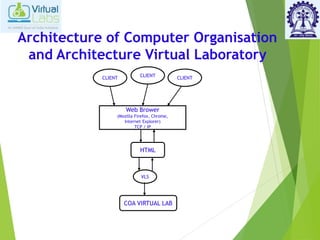
Architecture of Computer Organisation
and Architecture Virtual Laboratory
Web Brower
(Mozilla Firefox, Chrome,
Internet Explorer)
TCP / IP
CLIENT CLIENT CLIENT
HTML
VLS
COA VIRTUAL LAB
PROCEDURE
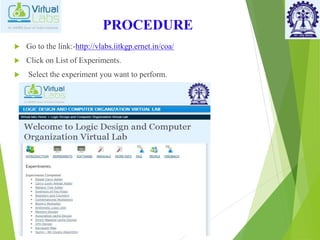
 Go to the link:-http://vlabs.iitkgp.ernet.in/coa/
 Click on List of Experiments.
 Select the experiment you want to perform.
Continued…
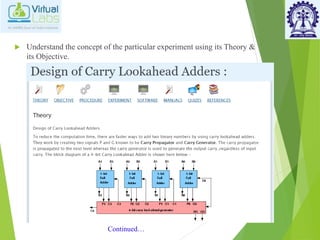
 Understand the concept of the particular experiment using its Theory &
its Objective.
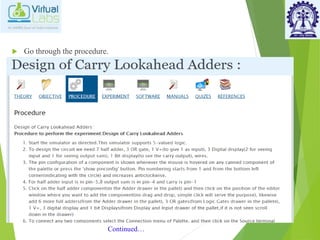
 Go through the procedure.
Continued…
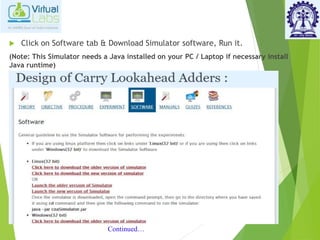
 Click on Software tab & Download Simulator software, Run it.
(Note: This Simulator needs a Java installed on your PC / Laptop if necessary install
Java runtime)
Continued…
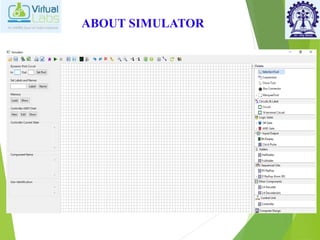
ABOUT SIMULATOR
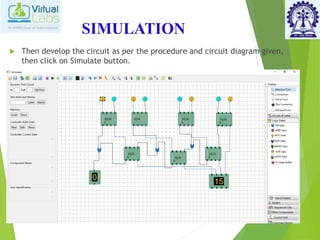
SIMULATION
 Then develop the circuit as per the procedure and circuit diagram given,
then click on Simulate button.
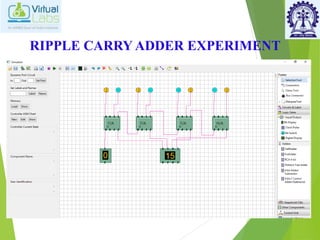
RIPPLE CARRY ADDER EXPERIMENT
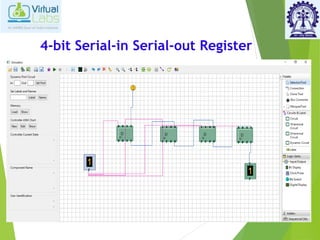
4-bit Serial-in Serial-out Register
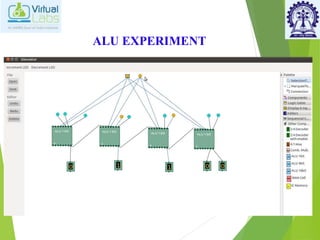
ALU EXPERIMENT
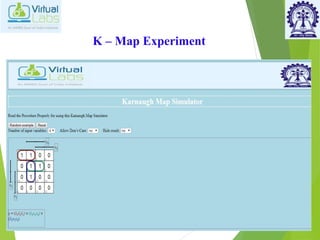
K – Map Experiment
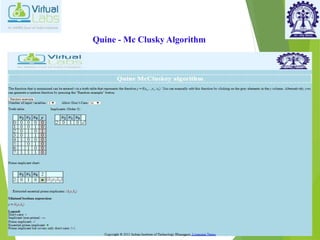
Quine - Mc Clusky Algorithm
BENEFITS
 Virtual lab Reduces work and time.
 Virtual lab provides User friendly screens to enter the data.
 Virtual lab is web enabled portable and flexible for further enhancement.
coa.ppt
coa.ppt

coa.ppt

  • 1.
    VIRTUAL LABORATORY Computer Organisationand Architecture Virtual Laboratory [VLS - 12] IIT KHARAGPUR
  • 2.
    People Involved  PrincipalInvestigator: Prof. Chittaranjan Mandal Department of Computer Science and Engineering Email Id: chitta@iitkgp.ac.in  Developers: Gargi Roy, JPA Devleena Ghosh, JPA  Presenters: N. Aditya Kameswara Rao, SRF, Email # akraonandula@gmail.com Sanhati Mallik, SPA, Email # sanhati.mallik@gmail.com Department of Mechanical Engineering Department
  • 3.
    OBJECTIVES OF THE VIRTUALLABS Web-based learning plays a vital role in the modern education system, where different technologies are being emerged to enhance this E- learning process. Objectives of the Virtual Labs:-  To enthuse students to conduct experiments by the arousing their curiosity. This would help them in learning basic and advanced concepts through remote experimentation.  To provide a Learning Management System around the Virtual Labs where the students can avail the various tools for learning, including additional web-resources, animated demonstrations and self evaluation.
  • 4.
    INTRODUCTION  The Objectiveis to Expose the students to the various key aspects of Digital Logic and Computer Organization by enabling them to perform FPGA based prototyping of experiments with support of a virtual environment.  Computer Organization and Architecture is a core course in most of the Undergraduate Curricula of the entire Electrical Sciences Discipline(Computer Science / Engg., Electronics, Electrical) etc.  This virtual laboratory is based upon FOSS (Free and open-source software ).  With this, we can acquire data accurately from instruments in time with reality.  A virtual laboratory is build to achieve an integrated environment for measurement and instrumentation.  A virtual lab is designed to enhance the efficiency of the learners.
  • 5.
    Architecture of ComputerOrganisation and Architecture Virtual Laboratory Web Brower (Mozilla Firefox, Chrome, Internet Explorer) TCP / IP CLIENT CLIENT CLIENT HTML VLS COA VIRTUAL LAB
  • 6.
    PROCEDURE  Go tothe link:-http://vlabs.iitkgp.ernet.in/coa/  Click on List of Experiments.  Select the experiment you want to perform.
  • 7.
    Continued…  Understand theconcept of the particular experiment using its Theory & its Objective.
  • 8.
     Go throughthe procedure. Continued…
  • 9.
     Click onSoftware tab & Download Simulator software, Run it. (Note: This Simulator needs a Java installed on your PC / Laptop if necessary install Java runtime) Continued…
  • 10.
  • 11.
    SIMULATION  Then developthe circuit as per the procedure and circuit diagram given, then click on Simulate button.
  • 12.
  • 13.
  • 14.
  • 15.
    K – MapExperiment
  • 16.
    Quine - McClusky Algorithm
  • 17.
    BENEFITS  Virtual labReduces work and time.  Virtual lab provides User friendly screens to enter the data.  Virtual lab is web enabled portable and flexible for further enhancement.