Putting Fundamentals of Electronic
Circuits Practices Online


Mohamed Tawfik, Elio San Cristóbal, Alberto Pesquera, Rosario Gil, Sergio
Martin, Gabriel Diaz, Juan Peire, Manuel Castro
Electrical & Computer Engineering Department
Spanish University for Distance Education (UNED)

Pablo Orduña
DeustoTech – Deusto Institute of Technology
University of Deusto

Javier García-Zubia
Faculty of Engineering
University of Deusto
The implementation of practical sessions in engineering education:

• Paves the way for students to be familiar with the instruments and thus,
  with the industrial real-world.
• Augment the learning outcomes by strengthening the understanding of
  scientific concepts and theories.
Unfortunately, there exist a wide gap between the engineering
educational curricula and the industrial real-world owing to:

    • The lack of experimentation availability.
    • The high cost of equipment and administration burdens.
• Remote laboratories addresses these needs providing on-line ubiquitous
  workbenches unconstrained by neither temporal nor geographical
  considerations.
• Recently, hundreds of remote laboratories for industrial electronics
  applications have been developed at many universities.
Remote laboratories are those laboratories that can be controlled and
administrated online. They differ from the virtual simulated
laboratories as they are interacting with physical instruments.
Fundamentals of electronic circuits’ practices have a central role in all
the electrical engineering education disciplines. They teach the student
the basics of electronic circuit’s components and the adjustment of
electrical instruments, and allow him to wire and build circuits in order
to realize and monitor measurements
In this contribution we present several solutions for putting
fundamentals of electronic circuit’s practices online
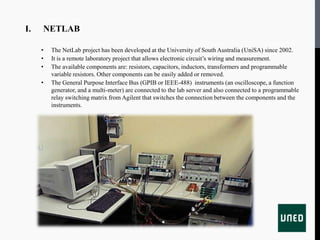
I.   NETLAB

     •   The NetLab project has been developed at the University of South Australia (UniSA) since 2002.
     •   It is a remote laboratory project that allows electronic circuit’s wiring and measurement.
     •   The available components are: resistors, capacitors, inductors, transformers and programmable
         variable resistors. Other components can be easily added or removed.
     •   The General Purpose Interface Bus (GPIB or IEEE-488) instruments (an oscilloscope, a function
         generator, and a multi-meter) are connected to the lab server and also connected to a programmable
         relay switching matrix from Agilent that switches the connection between the components and the
         instruments.
I.   NETLAB

     •   The software application is written in JAVA.
     •   A Web-Cam is included, which has its own web server and is fully controllable by the user.
     •   A Chat window is provided within the software application for communication and collaboration
         during the online lab sessions; it displays the names of all logged-on users, including
         administrators.
     •   A booking system is also provided within the software application.
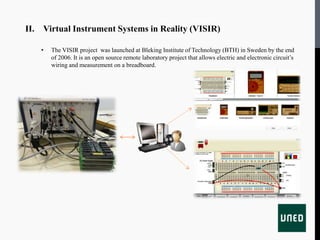
II. Virtual Instrument Systems in Reality (VISIR)

    •   The VISIR project was launched at Bleking Institute of Technology (BTH) in Sweden by the end
        of 2006. It is an open source remote laboratory project that allows electric and electronic circuit’s
        wiring and measurement on a breadboard.
II. Virtual Instrument Systems in Reality (VISIR)

    •   The PCI eXtensions for Instrumentation (PXI) instruments (an oscilloscope, a power supply, a
        function generator and a multi-meter), from National Instruments are connected to a relay
        switching matrix and altogether are connected to the lab server.
II. Virtual Instrument Systems in Reality (VISIR)

    •   The relay switching matrix is a stack of PCI/104 sized boards, fabricated at BTH, which acts as a
        circuit-wiring robot.
II. Virtual Instrument Systems in Reality (VISIR)

    •   The lab server software is written in LabVIEW.
    •   An additional measurement server (written in Visual C++) is added to verify the circuit parameters
        before being passed to the lab server and thus, to prevent hazard connections.
    •   The website is written in PHP/MySQL and includes a booking system and different account types,
        e.g., administrator account, teacher account, student account, and guest account.
    •   The GUI is written in Adobe Flash, where the entire workbench is simulated and the wiring is done
        on a virtual breadboard.
II. Virtual Instrument Systems in Reality (VISIR)

    •   So far, six universities have already implemented VISIR after Blekinge Institute of Technology
        (BTH): Carinthia University of Applied Sciences and FH Campus Wien University of Applied
        Sciences, both in Austria; Polytechnic Institute of Porto (ISEP) in Portugal; University of Deusto
        and Spanish University for Distance Education (UNED), both in Spain; and Indian Institute of
        Technology Madras (IIT-M) in India.
II. Virtual Instrument Systems in Reality (VISIR)

    •   Among these universities, VISIR has been applied in the undergraduate engineering practices, with
        pleasant results, to carry out different types of experiments online such as half-wave Rectifier with
        and without filter, regulator with zener diode, inverter and non-inverter operational amplifier,
        Common emitter BJT, and Common collector BJT.
III. Remote Laboratories based on NI ELVIS

   •   NI ELVIS is a versatile design and prototyping educational integrated platform released by
       National Instruments.
   •   It is suited for remote control and integrated with 12 of the most commonly used laboratory
       instruments (oscilloscope, DMM, function generator, power supply, dynamic signal analyzer, a
       bode analyzer, 2- and 3-wire current-voltage analyzer, arbitrary waveform generator, digital
       reader/writer, and impedance analyze).
III. Remote Laboratories based on NI ELVIS

   •   It has a variety of experiment plug-in boards and kits from National Instruments and from other
       third-party companies for teaching concepts in control, telecommunication, fiber optics, embedded
       design, bioinstrumentation, digital electronics, and Field-Programmable Gate Arrays (FPGAs).
   •   Unlimited number of applications and experiments can be mounted on the plug-in boards.
III. Remote Laboratories based on NI ELVIS

   •   RemotElectLab is a remote laboratory based on NI ELVIS (the older version) and developed by
       Polytechnic Institute of Porto (ISEP).
   •   Mounting circuits on the plug-in boards of NI ELVIS must be done by hands. Therefore, a relay
       switching matrix has been developed to allow instruments to measure voltage or currents at
       different nodes of the circuit remotely,
IV. Other Approaches

           •   Remote laboratories for could be simply built by selecting appropriate lab server software such as
               Matlab, LabVIEW or other software written from scratch by a high-level programming language,
               with connection to a Data Acquisition Cards (DAQ) that retrieves and send digital and analog
               signals between the lab server and the measured circuit.
           •   There are several modular types of instrumentation platforms, such as PXI, LXI, and GPIB, that
               could be connected to the lab server in order to change the circuit’s parameters values remotely.
               This combination has allowed the development of a wide range of remote Digital Signal Processing
               (DSP) applications, among them electronic circuits’ measurements.


                              Web Server               Lab Server             DAQ                Electronic Circuit

Students
Research on Technologies for Engineering Education

                            http://ohm.ieec.uned.es/


For more information about remote laboratories, we invite you to access to
the web page of the Electrical & Computer Engineering department of the
UNED.
Thanks for your Attention!

                    Rosario Gil

Electrical & Computer Engineering Department (DIEEC)
   Spanish University for Distance Education (UNED)

TAEE2012-Putting Fundmentals of Electronic Circuits Practices online

  • 1.
    Putting Fundamentals ofElectronic Circuits Practices Online Mohamed Tawfik, Elio San Cristóbal, Alberto Pesquera, Rosario Gil, Sergio Martin, Gabriel Diaz, Juan Peire, Manuel Castro Electrical & Computer Engineering Department Spanish University for Distance Education (UNED) Pablo Orduña DeustoTech – Deusto Institute of Technology University of Deusto Javier García-Zubia Faculty of Engineering University of Deusto
  • 2.
    The implementation ofpractical sessions in engineering education: • Paves the way for students to be familiar with the instruments and thus, with the industrial real-world. • Augment the learning outcomes by strengthening the understanding of scientific concepts and theories.
  • 3.
    Unfortunately, there exista wide gap between the engineering educational curricula and the industrial real-world owing to: • The lack of experimentation availability. • The high cost of equipment and administration burdens.
  • 4.
    • Remote laboratoriesaddresses these needs providing on-line ubiquitous workbenches unconstrained by neither temporal nor geographical considerations. • Recently, hundreds of remote laboratories for industrial electronics applications have been developed at many universities.
  • 5.
    Remote laboratories arethose laboratories that can be controlled and administrated online. They differ from the virtual simulated laboratories as they are interacting with physical instruments.
  • 6.
    Fundamentals of electroniccircuits’ practices have a central role in all the electrical engineering education disciplines. They teach the student the basics of electronic circuit’s components and the adjustment of electrical instruments, and allow him to wire and build circuits in order to realize and monitor measurements
  • 7.
    In this contributionwe present several solutions for putting fundamentals of electronic circuit’s practices online
  • 8.
    I. NETLAB • The NetLab project has been developed at the University of South Australia (UniSA) since 2002. • It is a remote laboratory project that allows electronic circuit’s wiring and measurement. • The available components are: resistors, capacitors, inductors, transformers and programmable variable resistors. Other components can be easily added or removed. • The General Purpose Interface Bus (GPIB or IEEE-488) instruments (an oscilloscope, a function generator, and a multi-meter) are connected to the lab server and also connected to a programmable relay switching matrix from Agilent that switches the connection between the components and the instruments.
  • 9.
    I. NETLAB • The software application is written in JAVA. • A Web-Cam is included, which has its own web server and is fully controllable by the user. • A Chat window is provided within the software application for communication and collaboration during the online lab sessions; it displays the names of all logged-on users, including administrators. • A booking system is also provided within the software application.
  • 10.
    II. Virtual InstrumentSystems in Reality (VISIR) • The VISIR project was launched at Bleking Institute of Technology (BTH) in Sweden by the end of 2006. It is an open source remote laboratory project that allows electric and electronic circuit’s wiring and measurement on a breadboard.
  • 11.
    II. Virtual InstrumentSystems in Reality (VISIR) • The PCI eXtensions for Instrumentation (PXI) instruments (an oscilloscope, a power supply, a function generator and a multi-meter), from National Instruments are connected to a relay switching matrix and altogether are connected to the lab server.
  • 12.
    II. Virtual InstrumentSystems in Reality (VISIR) • The relay switching matrix is a stack of PCI/104 sized boards, fabricated at BTH, which acts as a circuit-wiring robot.
  • 13.
    II. Virtual InstrumentSystems in Reality (VISIR) • The lab server software is written in LabVIEW. • An additional measurement server (written in Visual C++) is added to verify the circuit parameters before being passed to the lab server and thus, to prevent hazard connections. • The website is written in PHP/MySQL and includes a booking system and different account types, e.g., administrator account, teacher account, student account, and guest account. • The GUI is written in Adobe Flash, where the entire workbench is simulated and the wiring is done on a virtual breadboard.
  • 14.
    II. Virtual InstrumentSystems in Reality (VISIR) • So far, six universities have already implemented VISIR after Blekinge Institute of Technology (BTH): Carinthia University of Applied Sciences and FH Campus Wien University of Applied Sciences, both in Austria; Polytechnic Institute of Porto (ISEP) in Portugal; University of Deusto and Spanish University for Distance Education (UNED), both in Spain; and Indian Institute of Technology Madras (IIT-M) in India.
  • 15.
    II. Virtual InstrumentSystems in Reality (VISIR) • Among these universities, VISIR has been applied in the undergraduate engineering practices, with pleasant results, to carry out different types of experiments online such as half-wave Rectifier with and without filter, regulator with zener diode, inverter and non-inverter operational amplifier, Common emitter BJT, and Common collector BJT.
  • 16.
    III. Remote Laboratoriesbased on NI ELVIS • NI ELVIS is a versatile design and prototyping educational integrated platform released by National Instruments. • It is suited for remote control and integrated with 12 of the most commonly used laboratory instruments (oscilloscope, DMM, function generator, power supply, dynamic signal analyzer, a bode analyzer, 2- and 3-wire current-voltage analyzer, arbitrary waveform generator, digital reader/writer, and impedance analyze).
  • 17.
    III. Remote Laboratoriesbased on NI ELVIS • It has a variety of experiment plug-in boards and kits from National Instruments and from other third-party companies for teaching concepts in control, telecommunication, fiber optics, embedded design, bioinstrumentation, digital electronics, and Field-Programmable Gate Arrays (FPGAs). • Unlimited number of applications and experiments can be mounted on the plug-in boards.
  • 18.
    III. Remote Laboratoriesbased on NI ELVIS • RemotElectLab is a remote laboratory based on NI ELVIS (the older version) and developed by Polytechnic Institute of Porto (ISEP). • Mounting circuits on the plug-in boards of NI ELVIS must be done by hands. Therefore, a relay switching matrix has been developed to allow instruments to measure voltage or currents at different nodes of the circuit remotely,
  • 19.
    IV. Other Approaches • Remote laboratories for could be simply built by selecting appropriate lab server software such as Matlab, LabVIEW or other software written from scratch by a high-level programming language, with connection to a Data Acquisition Cards (DAQ) that retrieves and send digital and analog signals between the lab server and the measured circuit. • There are several modular types of instrumentation platforms, such as PXI, LXI, and GPIB, that could be connected to the lab server in order to change the circuit’s parameters values remotely. This combination has allowed the development of a wide range of remote Digital Signal Processing (DSP) applications, among them electronic circuits’ measurements. Web Server Lab Server DAQ Electronic Circuit Students
  • 20.
    Research on Technologiesfor Engineering Education http://ohm.ieec.uned.es/ For more information about remote laboratories, we invite you to access to the web page of the Electrical & Computer Engineering department of the UNED.
  • 21.
    Thanks for yourAttention! Rosario Gil Electrical & Computer Engineering Department (DIEEC) Spanish University for Distance Education (UNED)