TOR NETWORK 
A Presentation by 
Nishanth Samuel Fenn 
Roll No. 57 
S7, CS-B. 
Under the Guidance of 
Mr. Pramod Pavithran
2
Contents 
• Why do we need anonymity? 
• Introducing the Tor Network 
• How does the Tor Network work? 
• Hidden Services 
• Weaknesses
Why do we need anonymity? 
• To hide user identity from target web site 
• To hide browsing pattern from employer or ISP 
• To conceal our internet usage from hackers 
• To circumvent censorship
Introducing the Tor Network 
• Tor aims to conceal its users' identities and their online activity from surveillance 
and traffic analysis by separating identification and routing. 
• This is done by passing the data through a circuit of at least three different routers. 
• The data that passes through the network is encrypted, but at the beginning and 
end node, there is no encryption.
R1 
R2 
R3 
R4 
srvr1 
srvr2 
R5 
R6 
one minute later
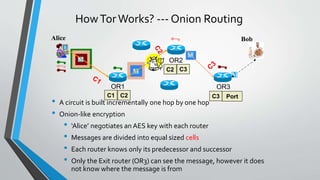
How Tor Works? --- Onion Routing 
Alice Bob 
OR2 
OR1 
• A circuit is built incrementally one hop by one hop 
• Onion-like encryption 
• ‘Alice’ negotiates an AES key with each router 
• Messages are divided into equal sized cells 
• Each router knows only its predecessor and successor 
• Only the Exit router (OR3) can see the message, however it does 
not know where the message is from 
M 
M√ 
M 
OR3 
M 
C1 C2 
C2 C3 
C3 Port
Cells 
• All data is sent in fixed size (bytes) cells 
• Control cell commands: 
• Padding, create, destroy 
• Relay cell commands: 
• Begin, data, connected, teardown, ...
How Tor Works? --- Node to Node Connection 
• Tor implements Perfect Forward Secrecy (PFC) by using AES encryption 
• In AES (Advanced Encryption Standard), a private key is generated and shared 
between the two users, and from this key, session keys are generated 
• Original keypairs are only used for signatures (i.e. to verify the authenticity of 
messages)
How Tor Works? --- Integrity Checking 
• Only done at the edges of a stream 
• SHA-1 digest of data sent and received 
• First 4 bytes of digest are sent with each message for verification
Commands in Use
Hidden Services 
• Location-hidden services allow a server to offer a TCP service without revealing its IP 
address. 
• Tor accommodates receiver anonymity by allowing location hidden services 
• Design goals for location hidden services 
• Access Control: filtering incoming requests 
• Robustness: maintain a long-term pseudonymous identity 
• Smear-resistance: against socially disapproved acts 
• Application transparency 
• Location hidden service leverage rendezvous points
Weaknesses 
• Autonomous System (AS) eavesdropping 
• Exit node eavesdropping 
• Traffic-analysis attack 
• Tor exit node block 
• Bad Apple attack 
• Sniper attack 
• Heartbleed bug
Autonomous System (AS) eavesdropping 
If an Autonomous System (AS) exists on both path segments from a client to entry 
relay and from exit relay to destination, such an AS can statistically correlate traffic on 
the entry and exit segments of the path and potentially infer the destination with 
which the client communicated. In 2012, LASTor proposed a method to predict a set 
of potential ASes on these two segments and then avoid choosing this path during 
path selection algorithm on client side. In this paper, they also improve latency by 
choosing shorter geographical paths between client and destination.
Exit node eavesdropping 
As Tor does not, and by design cannot, encrypt the traffic between an exit node and 
the target server, any exit node is in a position to capture any traffic passing through 
it that does not use end-to-end encryption such as SSL orTLS. While this may not 
inherently breach the anonymity of the source, traffic intercepted in this way by self-selected 
third parties can expose information about the source in either or both of 
payload and protocol data
Exit node eavesdropping (Contd.) 
• In October 2011, a research team from ESIEA claimed to have discovered a way to 
compromise the Tor network by decrypting communication passing over it. The 
technique they describe requires creating a map of Tor network nodes, controlling 
one third of them, and then acquiring their encryption keys and algorithm seeds. 
Then, using these known keys and seeds, they claim the ability to decrypt two 
encryption layers out of three. They claim to break the third key by a statistical-based 
attack. In order to redirect Tor traffic to the nodes they controlled, they used 
a denial-of-service attack.
Bad Apple attack 
• This attack against Tor consists of two parts: (a) exploiting an insecure 
application to reveal the source IP address of, or trace, a Tor user and (b) 
exploiting Tor to associate the use of a secure application with the IP address of 
a user (revealed by the insecure application). As it is not a goal of Tor to protect 
against application-level attacks, Tor cannot be held responsible for the first 
part of this attack. However, because Tor's design makes it possible to 
associate streams originating from secure application with traced users, the 
second part of this attack is indeed an attack against Tor. The second part of 
this attack is called the bad apple attack. (The name of this attack refers to the 
saying 'one bad apple spoils the bunch.' This wording is used to illustrate that 
one insecure application on Tor may allow to trace other applications.)
Heartbleed bug 
• Heartbleed is a security bug in the OpenSSL cryptography library, which is a widely 
used implementation of theTransport Layer Security(TLS) protocol. The 
vulnerability is classified as a buffer over-read, a situation where software allows 
more data to be read than should be allowed. 
• The Tor Project recommended that Tor relay operators and hidden service 
operators revoke and generate fresh keys after patching OpenSSL, but noted that 
Tor relays use two sets of keys and that Tor's multi-hop design minimizes the 
impact of exploiting a single relay.
Licit and illicit uses 
• Tor is increasingly in common use by victims of domestic violence and the social 
workers and agencies which assist them 
• A growing list of news organizations are using the SecureDrop software platform 
to accept material for publication in a manner intended to protect the anonymity 
of sources. 
• It is endorsed by civil liberties groups as a method for whistleblowers and human 
rights workers to communicate with journalists
Licit and illicit uses (Contd.) 
• Tor is used for matters that are, or may be, illegal in some countries, e.g., to gain 
access to censored information, to organize political activities, or to circumvent 
laws against criticism of heads of state. 
• Tor can be used for anonymous defamation, unauthorized leaks of sensitive 
information and copyright infringement, distribution of illegal sexual 
content, selling controlled substances, money laundering, credit card fraud, 
and identity theft. 
• Ironically, Tor has been used by criminal enterprises, hacktivism groups, and law 
enforcement agencies at cross purposes, sometimes simultaneously
Dangers of using Tor Network 
• "The more you hide the more somebody wants to know why.“ 
• While the inter-relay communications might be secure, the entry and exit nodes 
are vulnerable to packet sniffing and 
• The exit node decrypts the packet it received from its sibling on the chain of nodes 
and receives your full plaintext request. This can be easily seen by the operator of 
the exit node. 
• Running an exit node is dangerous as all exit traffic, legal and illegal, will be traced 
to your IP 
• Anyone using TOR network is on the NSA watch list under the Xkeyscore program.
References 
• https://www.torproject.org/ 
• https://en.wikipedia.org/wiki/Tor_(anonymity_network) 
• McCoy, Damon; Bauer, Kevin; Grunwald, Dirk; Kohno, Tadayoshi; Sicker, Douglas (2008)."Shining Light in 
Dark Places: Understanding the Tor Network". Proceedings of the 8th International Symposium on Privacy 
Enhancing Technologies. 8th International Symposium on Privacy Enhancing Technologies. Berlin, Germany: 
Springer-Verlag. pp. 63–76. 
• "Tor Project Form 990 2008". Tor Project. Tor Project. 2009. Retrieved 30 August 2014. 
• "Tor Project Form 990 2007". Tor Project. Tor Project. 2008. Retrieved 30 August 2014. 
• "Tor Project Form 990 2009". Tor Project. Tor Project. 2010. Retrieved 30 August 2014. 
• Samson, Ted (5 August 2013). "Tor Browser Bundle for Windows users susceptible to info-stealing 
attack". InfoWorld. 
• Dingledine, Roger (7 April 2014). "OpenSSL bug CVE-2014-0160". Tor Project. 
• Le Blond, Stevens; Manils, Pere; Chaabane, Abdelberi; Ali Kaafar, Mohamed; Castelluccia, Claude; Legout, 
Arnaud; Dabbous, Walid (March 2011). "One Bad Apple Spoils the Bunch: Exploiting P2P Applications to 
Trace and Profile Tor Users". 4th USENIX Workshop on Large-Scale Exploits and Emergent Threats (LEET 
'11). National Institute for Research in Computer Science and Control.
Q&A
ThankYou

TOR NETWORK

  • 1.
    TOR NETWORK APresentation by Nishanth Samuel Fenn Roll No. 57 S7, CS-B. Under the Guidance of Mr. Pramod Pavithran
  • 2.
  • 3.
    Contents • Whydo we need anonymity? • Introducing the Tor Network • How does the Tor Network work? • Hidden Services • Weaknesses
  • 4.
    Why do weneed anonymity? • To hide user identity from target web site • To hide browsing pattern from employer or ISP • To conceal our internet usage from hackers • To circumvent censorship
  • 5.
    Introducing the TorNetwork • Tor aims to conceal its users' identities and their online activity from surveillance and traffic analysis by separating identification and routing. • This is done by passing the data through a circuit of at least three different routers. • The data that passes through the network is encrypted, but at the beginning and end node, there is no encryption.
  • 6.
    R1 R2 R3 R4 srvr1 srvr2 R5 R6 one minute later
  • 7.
    How Tor Works?--- Onion Routing Alice Bob OR2 OR1 • A circuit is built incrementally one hop by one hop • Onion-like encryption • ‘Alice’ negotiates an AES key with each router • Messages are divided into equal sized cells • Each router knows only its predecessor and successor • Only the Exit router (OR3) can see the message, however it does not know where the message is from M M√ M OR3 M C1 C2 C2 C3 C3 Port
  • 8.
    Cells • Alldata is sent in fixed size (bytes) cells • Control cell commands: • Padding, create, destroy • Relay cell commands: • Begin, data, connected, teardown, ...
  • 9.
    How Tor Works?--- Node to Node Connection • Tor implements Perfect Forward Secrecy (PFC) by using AES encryption • In AES (Advanced Encryption Standard), a private key is generated and shared between the two users, and from this key, session keys are generated • Original keypairs are only used for signatures (i.e. to verify the authenticity of messages)
  • 10.
    How Tor Works?--- Integrity Checking • Only done at the edges of a stream • SHA-1 digest of data sent and received • First 4 bytes of digest are sent with each message for verification
  • 11.
  • 12.
    Hidden Services •Location-hidden services allow a server to offer a TCP service without revealing its IP address. • Tor accommodates receiver anonymity by allowing location hidden services • Design goals for location hidden services • Access Control: filtering incoming requests • Robustness: maintain a long-term pseudonymous identity • Smear-resistance: against socially disapproved acts • Application transparency • Location hidden service leverage rendezvous points
  • 13.
    Weaknesses • AutonomousSystem (AS) eavesdropping • Exit node eavesdropping • Traffic-analysis attack • Tor exit node block • Bad Apple attack • Sniper attack • Heartbleed bug
  • 14.
    Autonomous System (AS)eavesdropping If an Autonomous System (AS) exists on both path segments from a client to entry relay and from exit relay to destination, such an AS can statistically correlate traffic on the entry and exit segments of the path and potentially infer the destination with which the client communicated. In 2012, LASTor proposed a method to predict a set of potential ASes on these two segments and then avoid choosing this path during path selection algorithm on client side. In this paper, they also improve latency by choosing shorter geographical paths between client and destination.
  • 15.
    Exit node eavesdropping As Tor does not, and by design cannot, encrypt the traffic between an exit node and the target server, any exit node is in a position to capture any traffic passing through it that does not use end-to-end encryption such as SSL orTLS. While this may not inherently breach the anonymity of the source, traffic intercepted in this way by self-selected third parties can expose information about the source in either or both of payload and protocol data
  • 16.
    Exit node eavesdropping(Contd.) • In October 2011, a research team from ESIEA claimed to have discovered a way to compromise the Tor network by decrypting communication passing over it. The technique they describe requires creating a map of Tor network nodes, controlling one third of them, and then acquiring their encryption keys and algorithm seeds. Then, using these known keys and seeds, they claim the ability to decrypt two encryption layers out of three. They claim to break the third key by a statistical-based attack. In order to redirect Tor traffic to the nodes they controlled, they used a denial-of-service attack.
  • 17.
    Bad Apple attack • This attack against Tor consists of two parts: (a) exploiting an insecure application to reveal the source IP address of, or trace, a Tor user and (b) exploiting Tor to associate the use of a secure application with the IP address of a user (revealed by the insecure application). As it is not a goal of Tor to protect against application-level attacks, Tor cannot be held responsible for the first part of this attack. However, because Tor's design makes it possible to associate streams originating from secure application with traced users, the second part of this attack is indeed an attack against Tor. The second part of this attack is called the bad apple attack. (The name of this attack refers to the saying 'one bad apple spoils the bunch.' This wording is used to illustrate that one insecure application on Tor may allow to trace other applications.)
  • 18.
    Heartbleed bug •Heartbleed is a security bug in the OpenSSL cryptography library, which is a widely used implementation of theTransport Layer Security(TLS) protocol. The vulnerability is classified as a buffer over-read, a situation where software allows more data to be read than should be allowed. • The Tor Project recommended that Tor relay operators and hidden service operators revoke and generate fresh keys after patching OpenSSL, but noted that Tor relays use two sets of keys and that Tor's multi-hop design minimizes the impact of exploiting a single relay.
  • 19.
    Licit and illicituses • Tor is increasingly in common use by victims of domestic violence and the social workers and agencies which assist them • A growing list of news organizations are using the SecureDrop software platform to accept material for publication in a manner intended to protect the anonymity of sources. • It is endorsed by civil liberties groups as a method for whistleblowers and human rights workers to communicate with journalists
  • 20.
    Licit and illicituses (Contd.) • Tor is used for matters that are, or may be, illegal in some countries, e.g., to gain access to censored information, to organize political activities, or to circumvent laws against criticism of heads of state. • Tor can be used for anonymous defamation, unauthorized leaks of sensitive information and copyright infringement, distribution of illegal sexual content, selling controlled substances, money laundering, credit card fraud, and identity theft. • Ironically, Tor has been used by criminal enterprises, hacktivism groups, and law enforcement agencies at cross purposes, sometimes simultaneously
  • 21.
    Dangers of usingTor Network • "The more you hide the more somebody wants to know why.“ • While the inter-relay communications might be secure, the entry and exit nodes are vulnerable to packet sniffing and • The exit node decrypts the packet it received from its sibling on the chain of nodes and receives your full plaintext request. This can be easily seen by the operator of the exit node. • Running an exit node is dangerous as all exit traffic, legal and illegal, will be traced to your IP • Anyone using TOR network is on the NSA watch list under the Xkeyscore program.
  • 22.
    References • https://www.torproject.org/ • https://en.wikipedia.org/wiki/Tor_(anonymity_network) • McCoy, Damon; Bauer, Kevin; Grunwald, Dirk; Kohno, Tadayoshi; Sicker, Douglas (2008)."Shining Light in Dark Places: Understanding the Tor Network". Proceedings of the 8th International Symposium on Privacy Enhancing Technologies. 8th International Symposium on Privacy Enhancing Technologies. Berlin, Germany: Springer-Verlag. pp. 63–76. • "Tor Project Form 990 2008". Tor Project. Tor Project. 2009. Retrieved 30 August 2014. • "Tor Project Form 990 2007". Tor Project. Tor Project. 2008. Retrieved 30 August 2014. • "Tor Project Form 990 2009". Tor Project. Tor Project. 2010. Retrieved 30 August 2014. • Samson, Ted (5 August 2013). "Tor Browser Bundle for Windows users susceptible to info-stealing attack". InfoWorld. • Dingledine, Roger (7 April 2014). "OpenSSL bug CVE-2014-0160". Tor Project. • Le Blond, Stevens; Manils, Pere; Chaabane, Abdelberi; Ali Kaafar, Mohamed; Castelluccia, Claude; Legout, Arnaud; Dabbous, Walid (March 2011). "One Bad Apple Spoils the Bunch: Exploiting P2P Applications to Trace and Profile Tor Users". 4th USENIX Workshop on Large-Scale Exploits and Emergent Threats (LEET '11). National Institute for Research in Computer Science and Control.
  • 23.
  • 24.