Touch Screen Sensor

     Quanling zheng
How Does a Touchscreen Work?
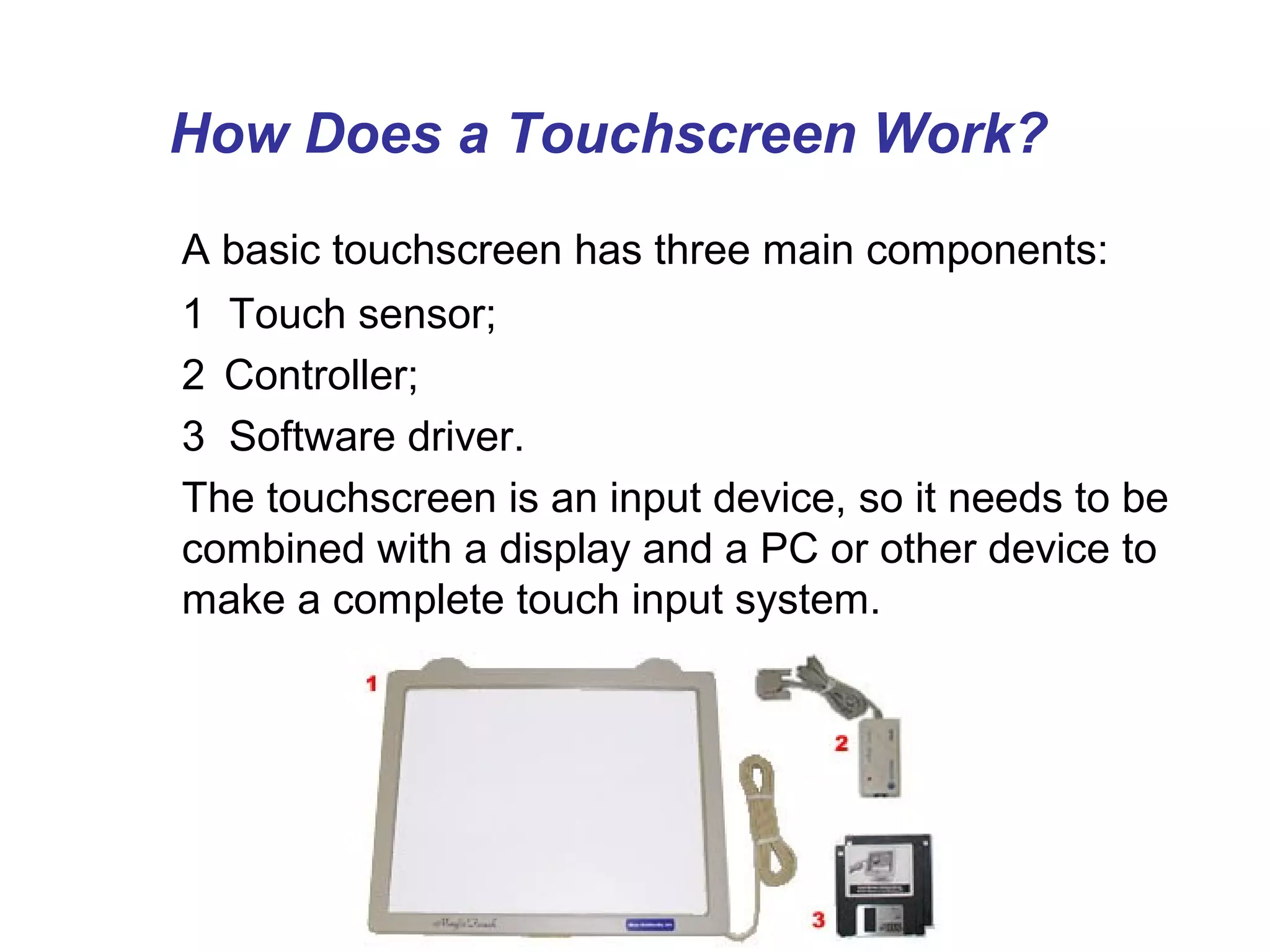
A basic touchscreen has three main components:
1 Touch sensor;
2 Controller;
3 Software driver.
The touchscreen is an input device, so it needs to be
combined with a display and a PC or other device to
make a complete touch input system.
Touch Sensor

• A touch screen sensor is a clear glass panel with a touch
  responsive surface. The touch sensor/panel is placed
  over a display screen so that the responsive area of the
  panel covers the viewable area of the video screen.
  There are several different touch sensor technologies on
  the market today, each using a different method to
  detect touch input. The sensor generally has an
  electrical current or signal going through it and touching
  the screen can cause a voltage or signal change. This
  change is used to determine the location of the touch to
  the screen.
Controller

• The controller connects between the touch sensor and
  the PC. It takes information from the touch sensor and
  translates it into information that PC can understand.
  The controller determines what type of
  interface/connection you will need on the PC. Controllers
  are available that can connect to a Serial/COM port (PC)
  or to a USB port. Specialized controllers are also
  available that work with DVD players and other devices.
Software Driver

• The driver allows the touchscreen and computer to work
  together. It tells the computer's operating system how to
  interpret the touch event information that is sent from the
  controller. Most touch screen drivers today are a mouse-
  emulation type driver. This makes touching the screen
  as same as clicking your mouse at the same location on
  the screen. This allows the touchscreen to work with
  existing software and allows new applications to be
  developed without the need for touchscreen specific
  programming.
Touchscreen Technology

• Resistive touchscreen
• Capacitive touchscreen
• Infrared touchscreen
• Surface acoustic wave (SAW)
  touchscreen
• Strain gauge touchscreen
• Optical imaging touchscreen
• Dispersive signal technology touchscreen
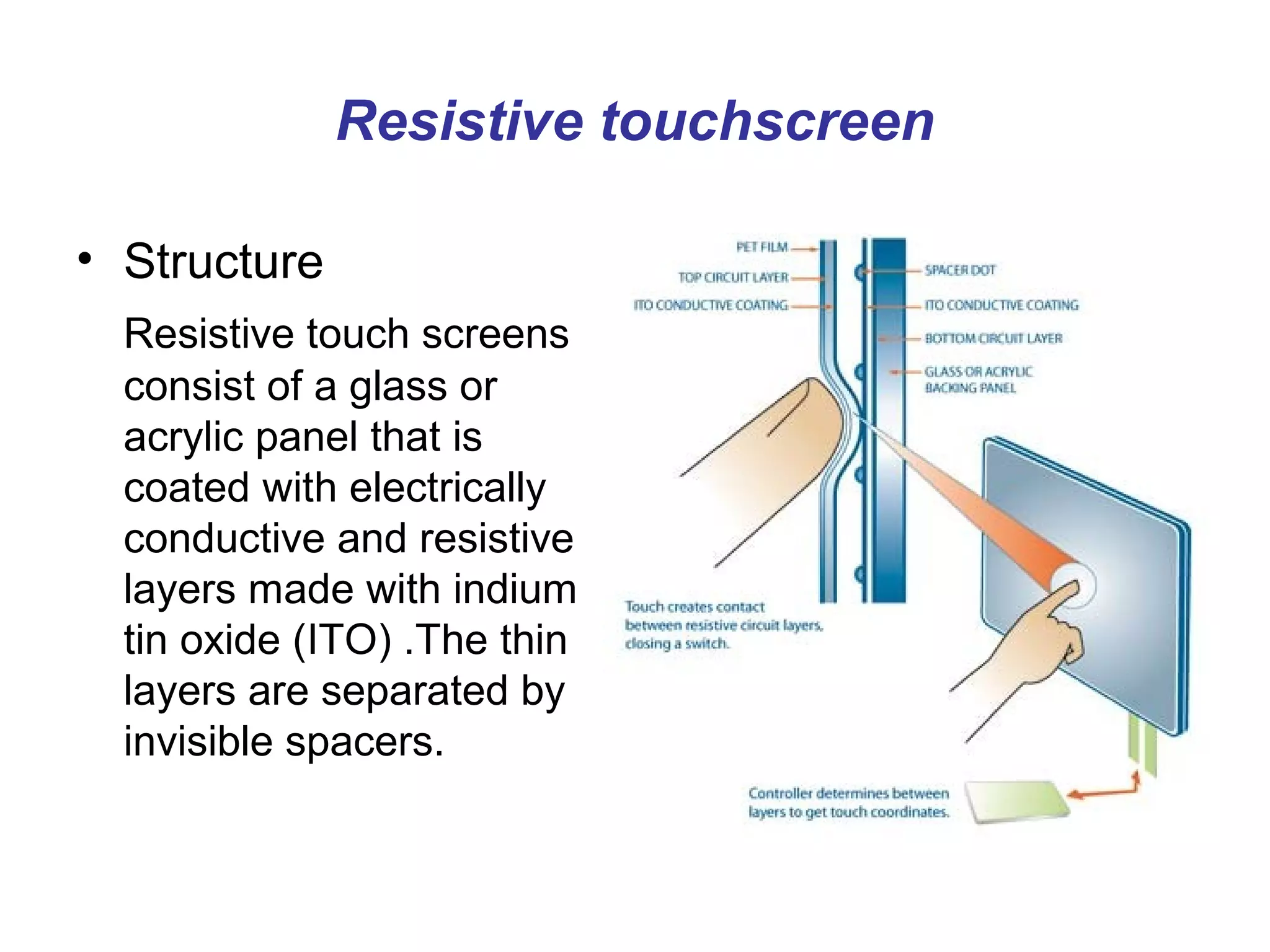
Resistive touchscreen

• Structure
  Resistive touch screens
  consist of a glass or
  acrylic panel that is
  coated with electrically
  conductive and resistive
  layers made with indium
  tin oxide (ITO) .The thin
  layers are separated by
  invisible spacers.
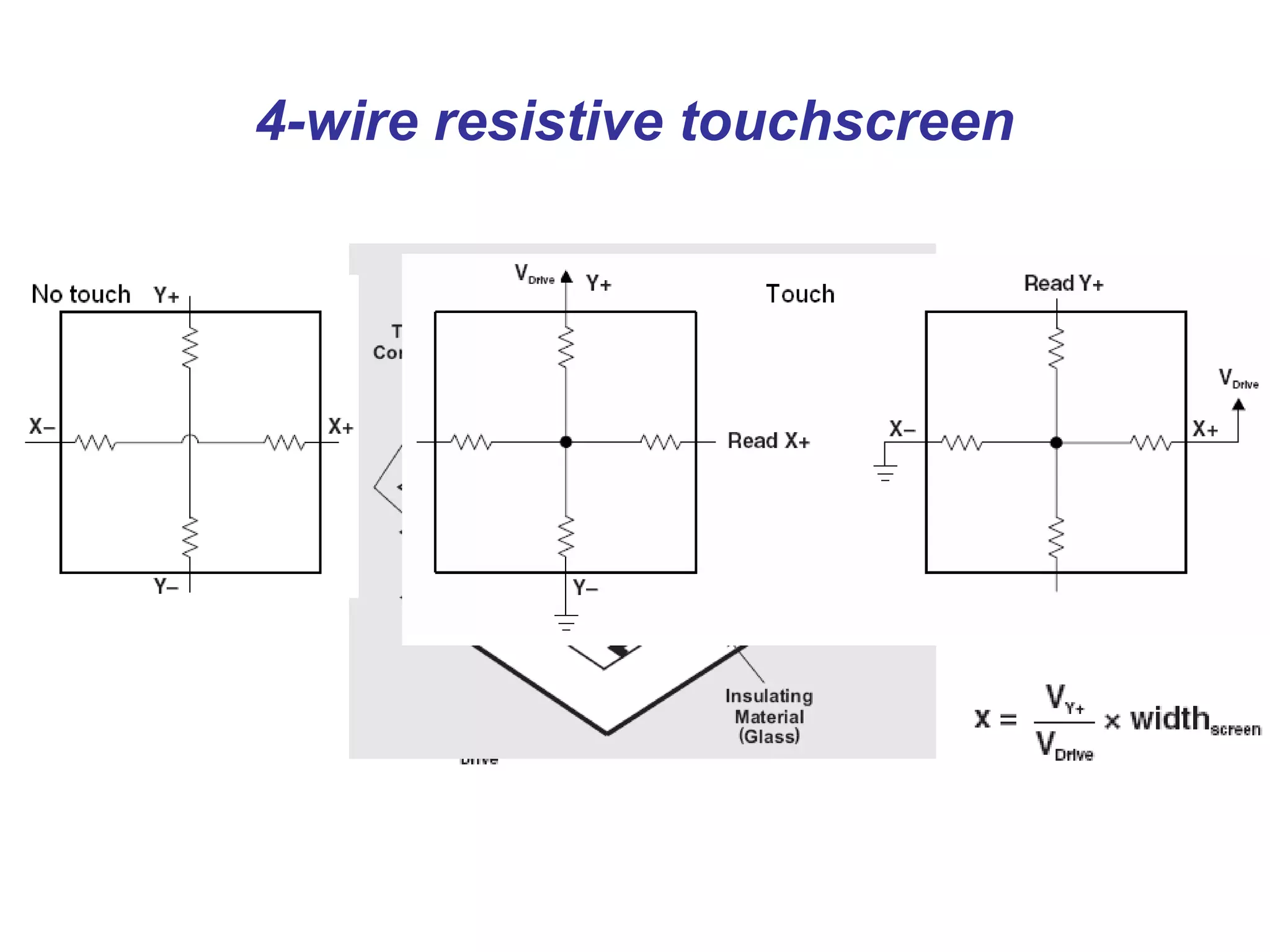
4-wire resistive touchscreen
5-wire resistive touchscreen

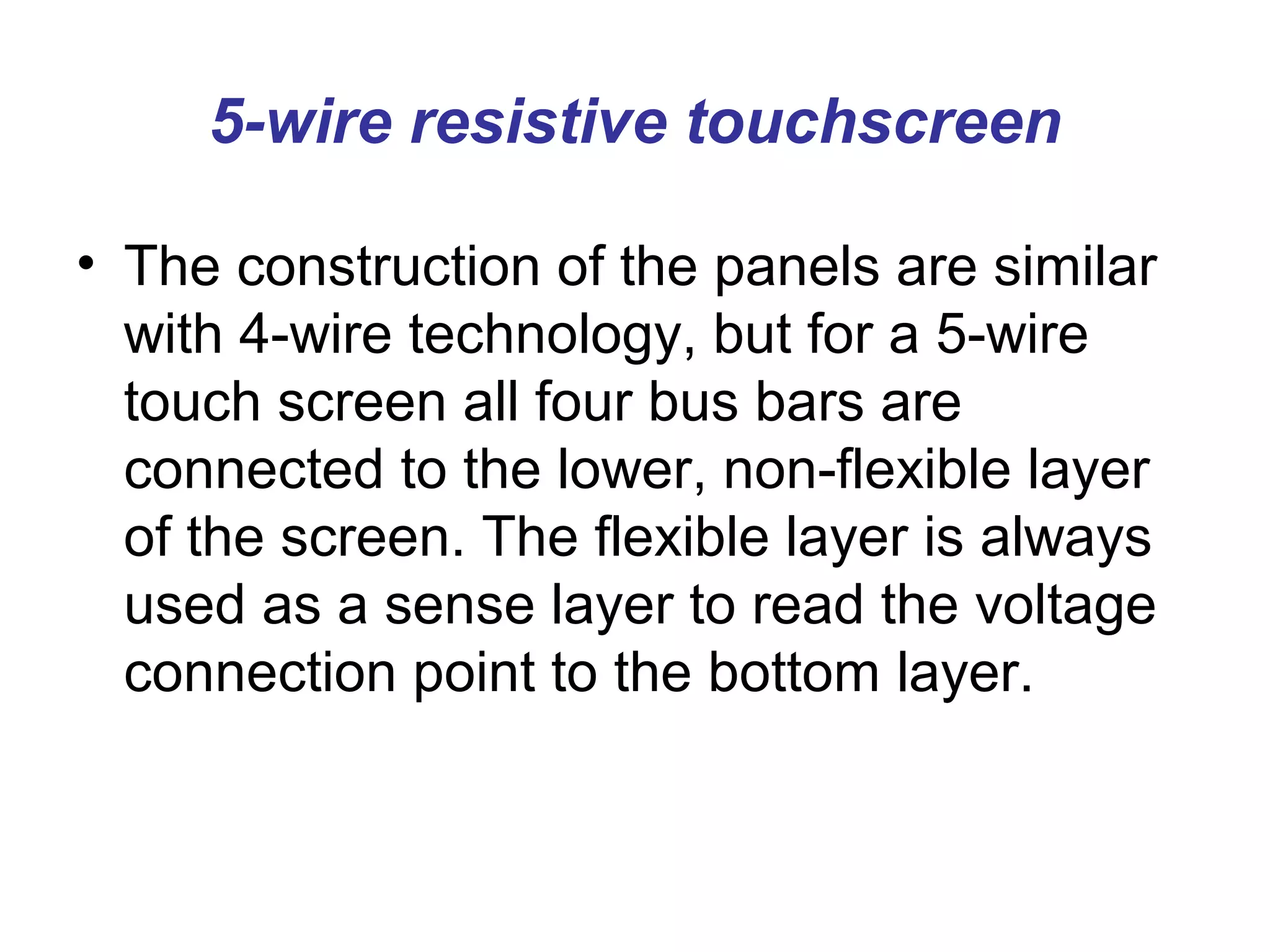
• The construction of the panels are similar
  with 4-wire technology, but for a 5-wire
  touch screen all four bus bars are
  connected to the lower, non-flexible layer
  of the screen. The flexible layer is always
  used as a sense layer to read the voltage
  connection point to the bottom layer.
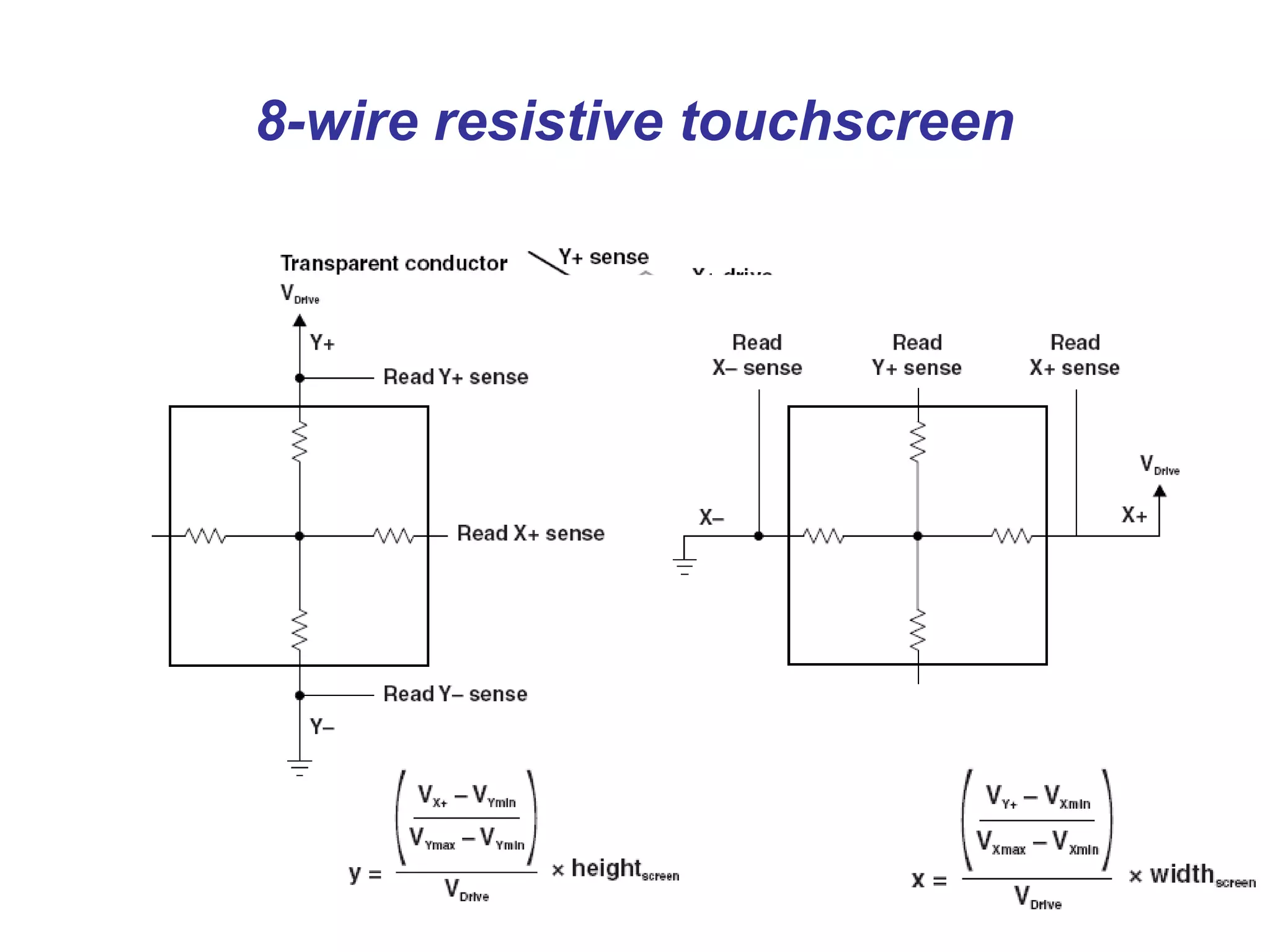
8-wire resistive touchscreen
Resistive touchscreen

•    Characters:
1.   Cost effective solutions
2.   Activated by a stylus, a finger or gloved hand
3.   Not affected by dirt, dust, water, or light
4.   75%~85% clarify
5.   resistive layers can be damaged by a very sharp object
Projected-capacitive touchscreen

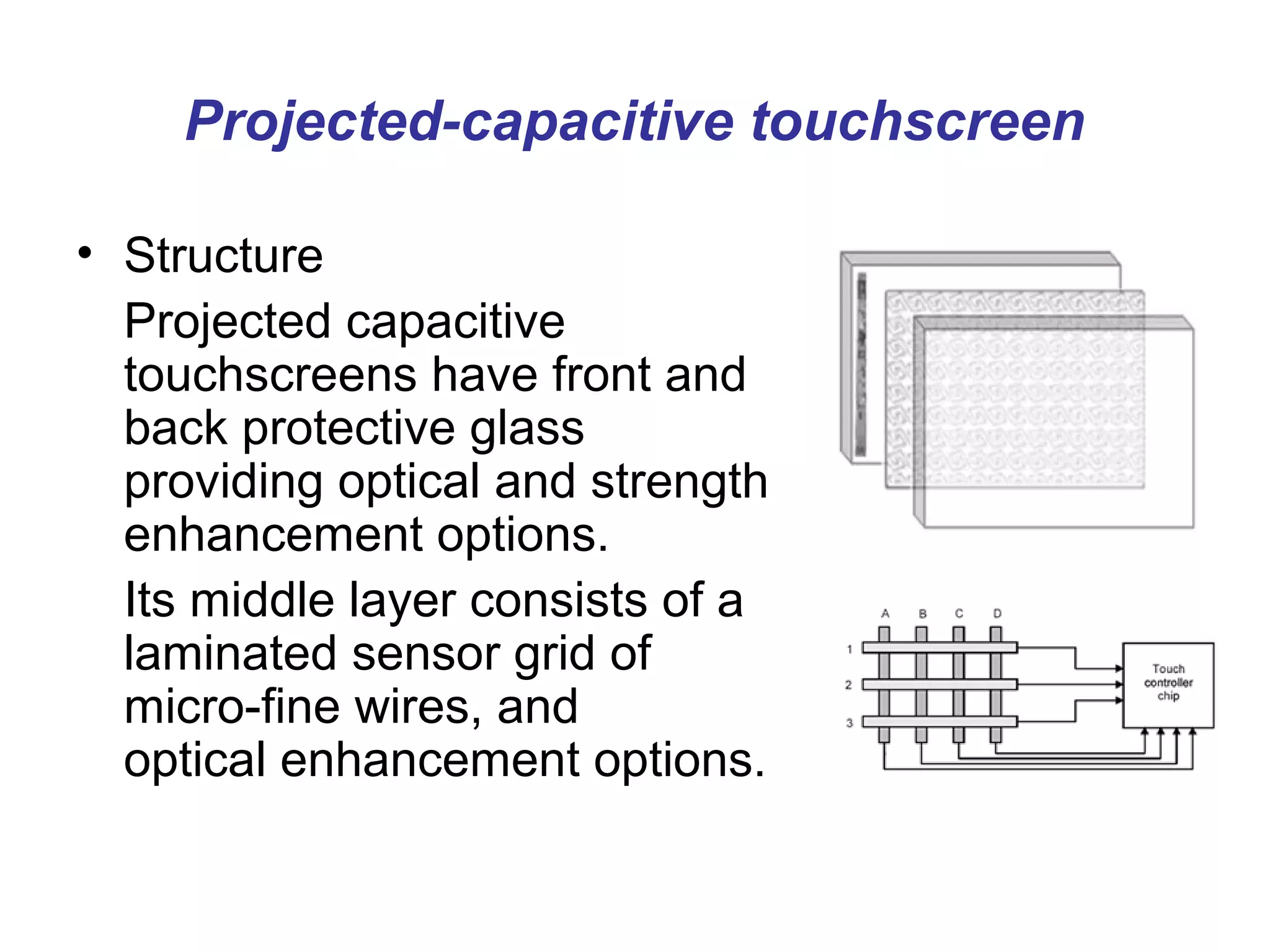
• Structure
  Projected capacitive
  touchscreens have front and
  back protective glass
  providing optical and strength
  enhancement options.
  Its middle layer consists of a
  laminated sensor grid of
  micro-fine wires, and
  optical enhancement options.
Projected-capacitive touchscreen


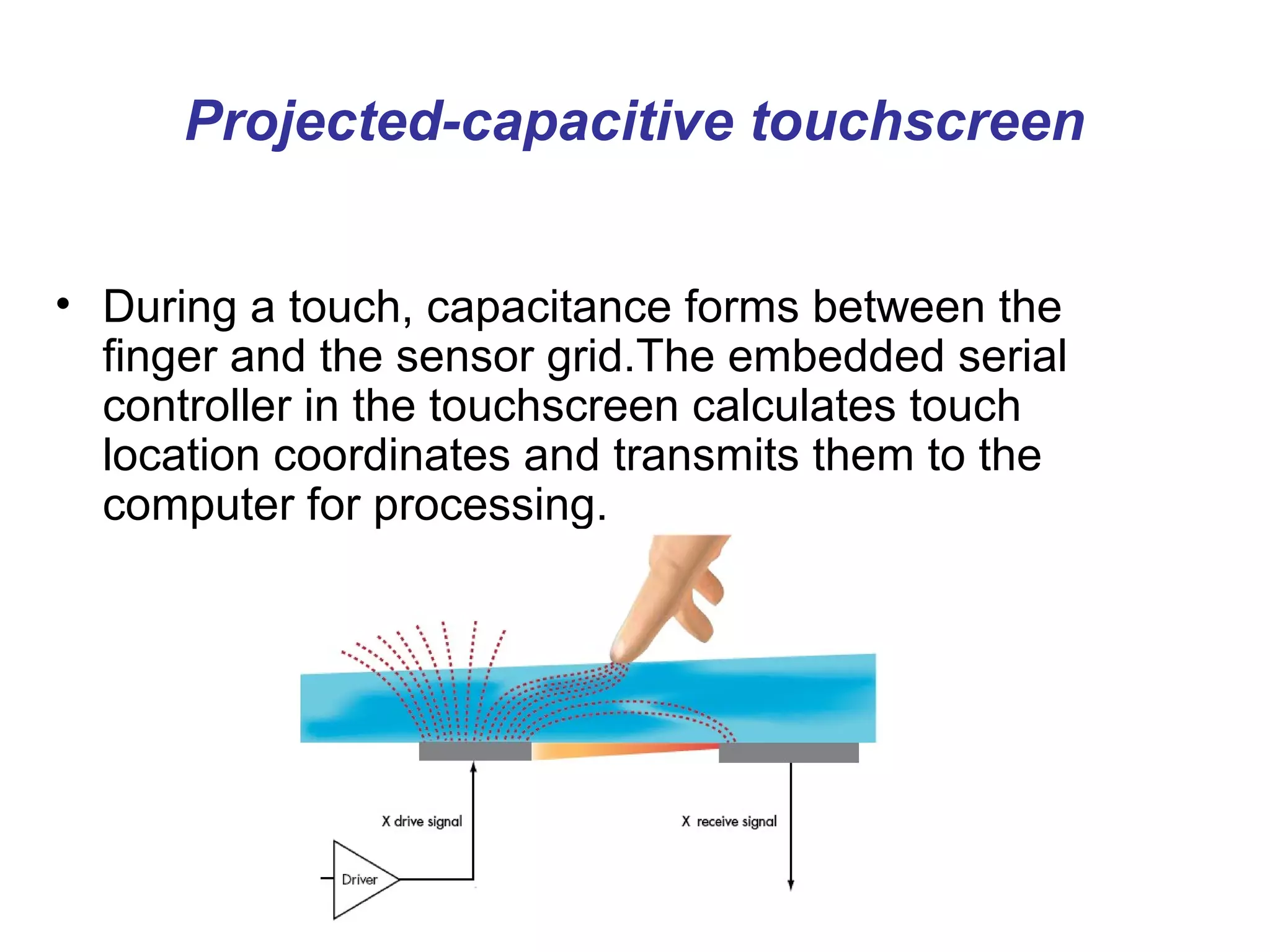
• During a touch, capacitance forms between the
  finger and the sensor grid.The embedded serial
  controller in the touchscreen calculates touch
  location coordinates and transmits them to the
  computer for processing.
Surface-capacitive touchscreen

• Structure
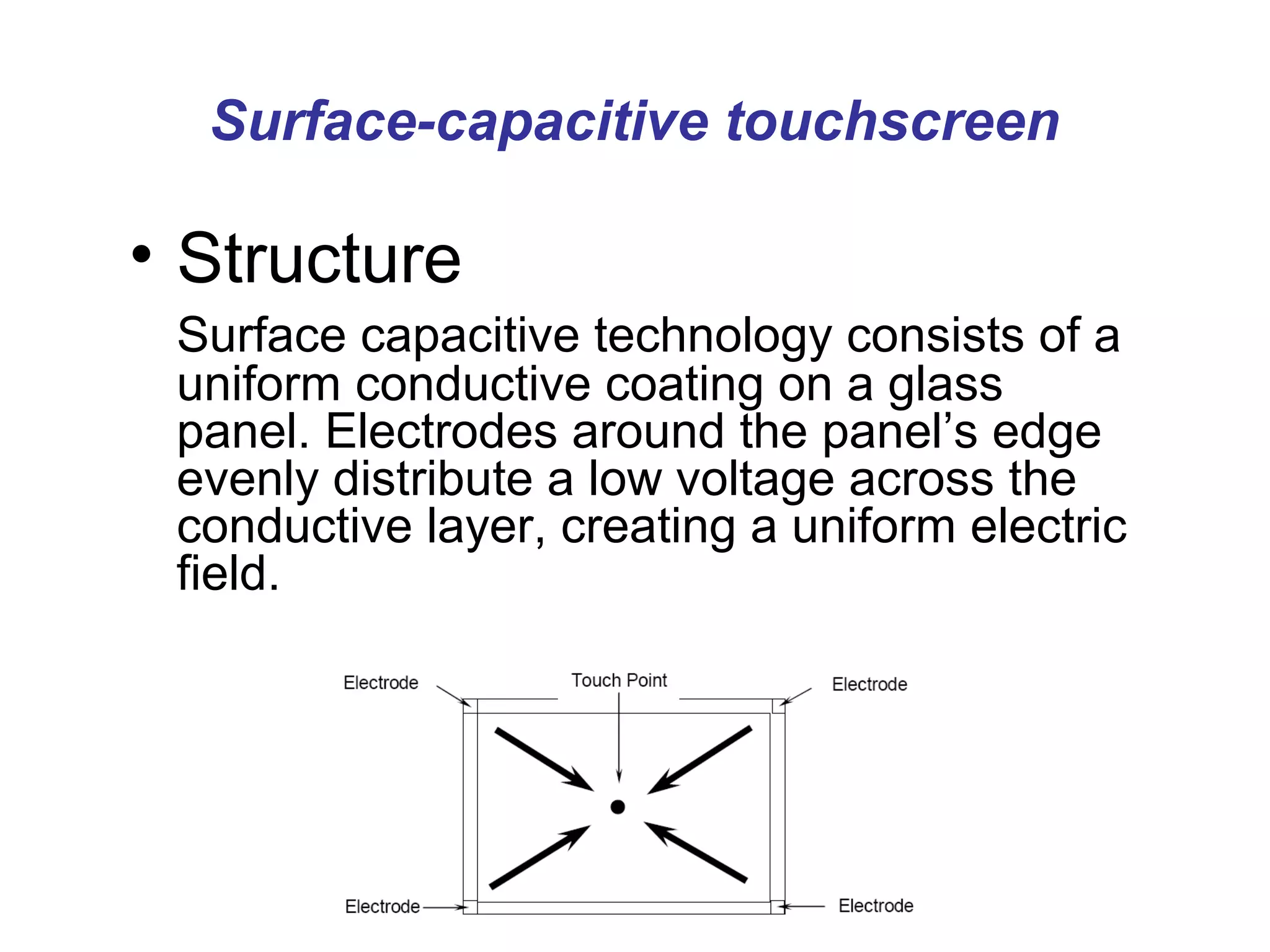
 Surface capacitive technology consists of a
 uniform conductive coating on a glass
 panel. Electrodes around the panel’s edge
 evenly distribute a low voltage across the
 conductive layer, creating a uniform electric
 field.
Surface-capacitive touchscreen
• Working principle
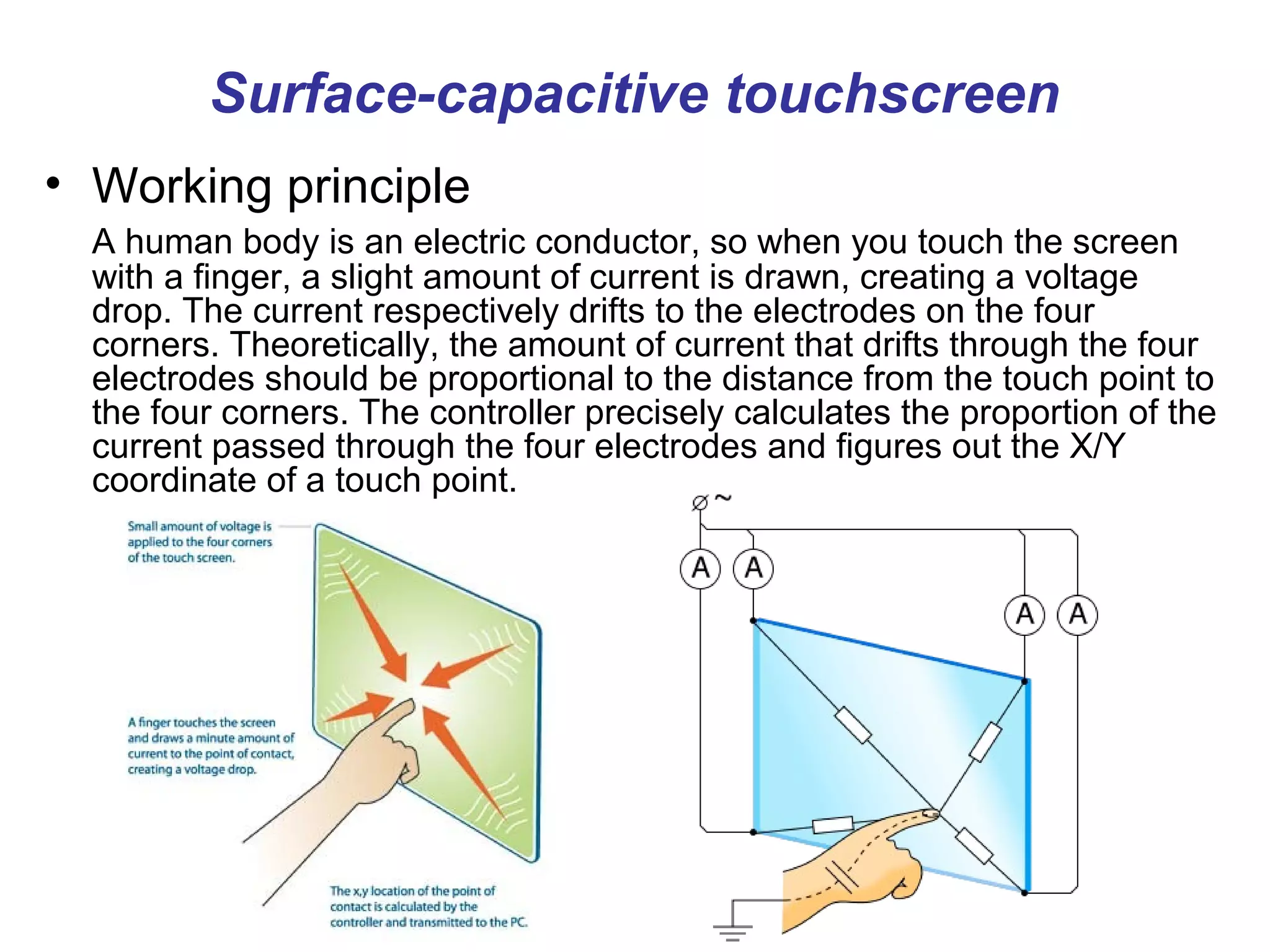
  A human body is an electric conductor, so when you touch the screen
  with a finger, a slight amount of current is drawn, creating a voltage
  drop. The current respectively drifts to the electrodes on the four
  corners. Theoretically, the amount of current that drifts through the four
  electrodes should be proportional to the distance from the touch point to
  the four corners. The controller precisely calculates the proportion of the
  current passed through the four electrodes and figures out the X/Y
  coordinate of a touch point.
Capacitive touchscreen

•   Characters:
1. Durable and resistant to scratches for
   demanding applications
2. Faster and more responsive
3. Immune to surface contaminants
4. Superior optical clarity, brighter display and
   less surface reflection
5. Must be touched by finger, will not work with
   any non-conductive input
Infrared touchscreen

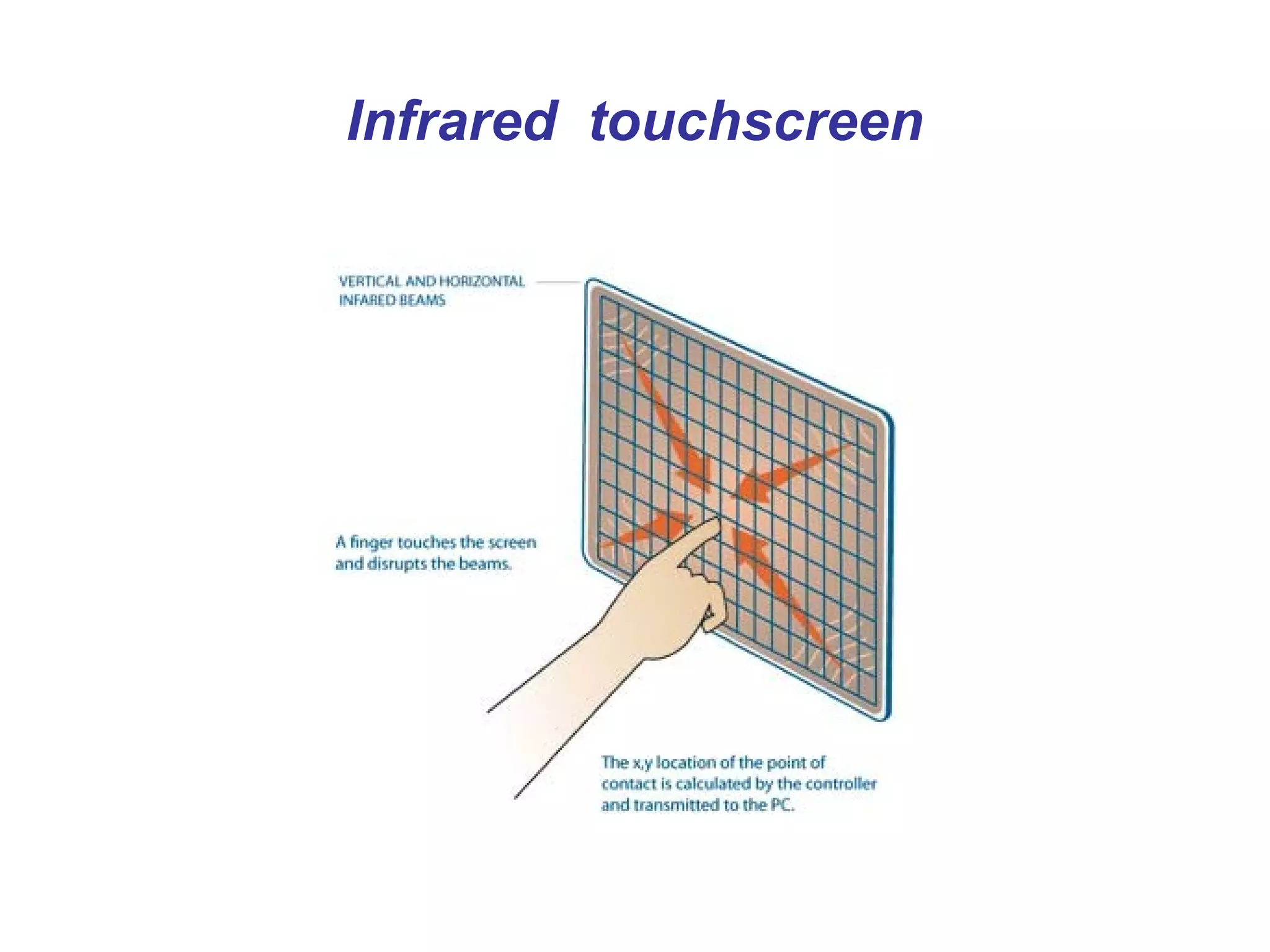
• Infrared (IR) technology relies on the interruption of an
  IR light grid in front of the display screen. The touch
  frame contains a row of IR-light emitting diode (LEDs)
  and photo transistors, each mounted on two opposite
  sides to create a grid of invisible infrared light.
  The IR controller sequentially pulses the LEDs to create
  a grid of IR light beams. When a stylus, such as a finger,
  enters the grid, it obstructs the beams. One or more
  photo transistors from each axis detect the absence of
  light and transmit signals that identifies the x and y
  coordinates.
Infrared touchscreen

•  Characters:
1. Clear as glass, improves reading ability
2. Most durable surface
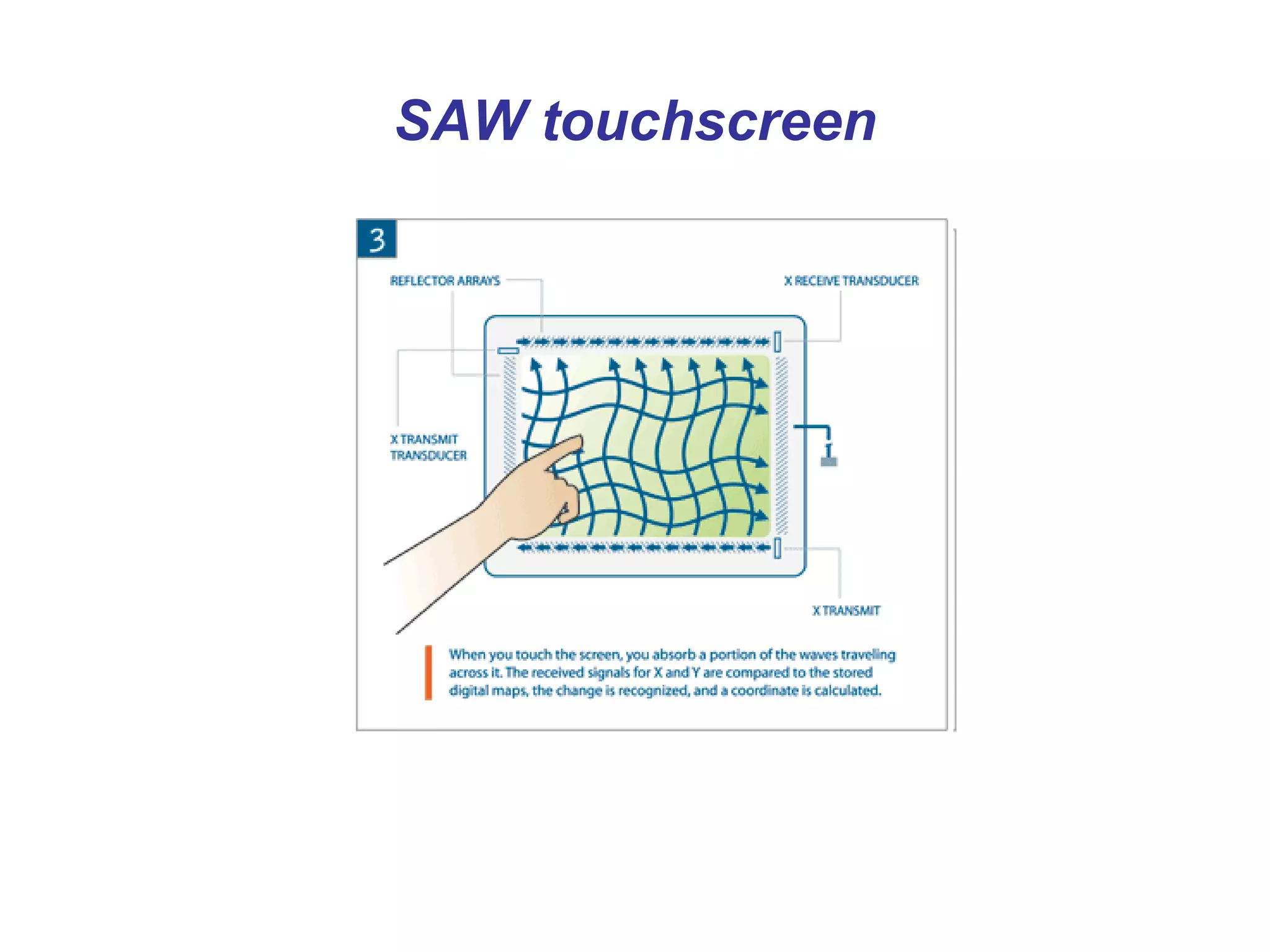
SAW touchscreen
• Principle
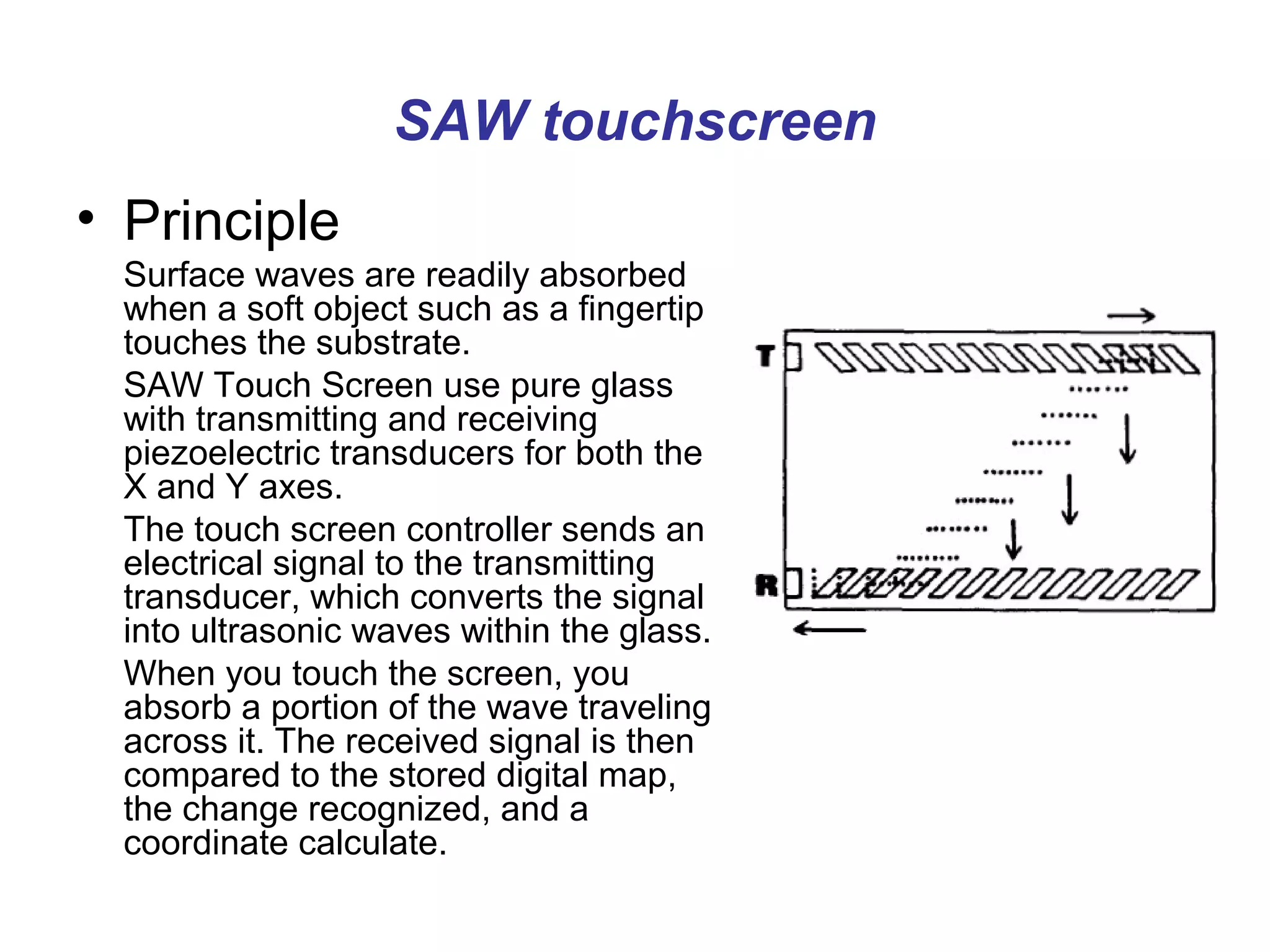
 Surface waves are readily absorbed
 when a soft object such as a fingertip
 touches the substrate.
 SAW Touch Screen use pure glass
 with transmitting and receiving
 piezoelectric transducers for both the
 X and Y axes.
 The touch screen controller sends an
 electrical signal to the transmitting
 transducer, which converts the signal
 into ultrasonic waves within the glass.
 When you touch the screen, you
 absorb a portion of the wave traveling
 across it. The received signal is then
 compared to the stored digital map,
 the change recognized, and a
 coordinate calculate.
SAW touchscreen
SAW touchscreen

•    Characters:
1.   Durable glass construction
2.   High optical clarity
3.   Activated by a finger, gloved hand or soft
     tip
4.   Not completely sealable, can be affected
     by large amounts of dirt, dust, and / or
     water in the environment
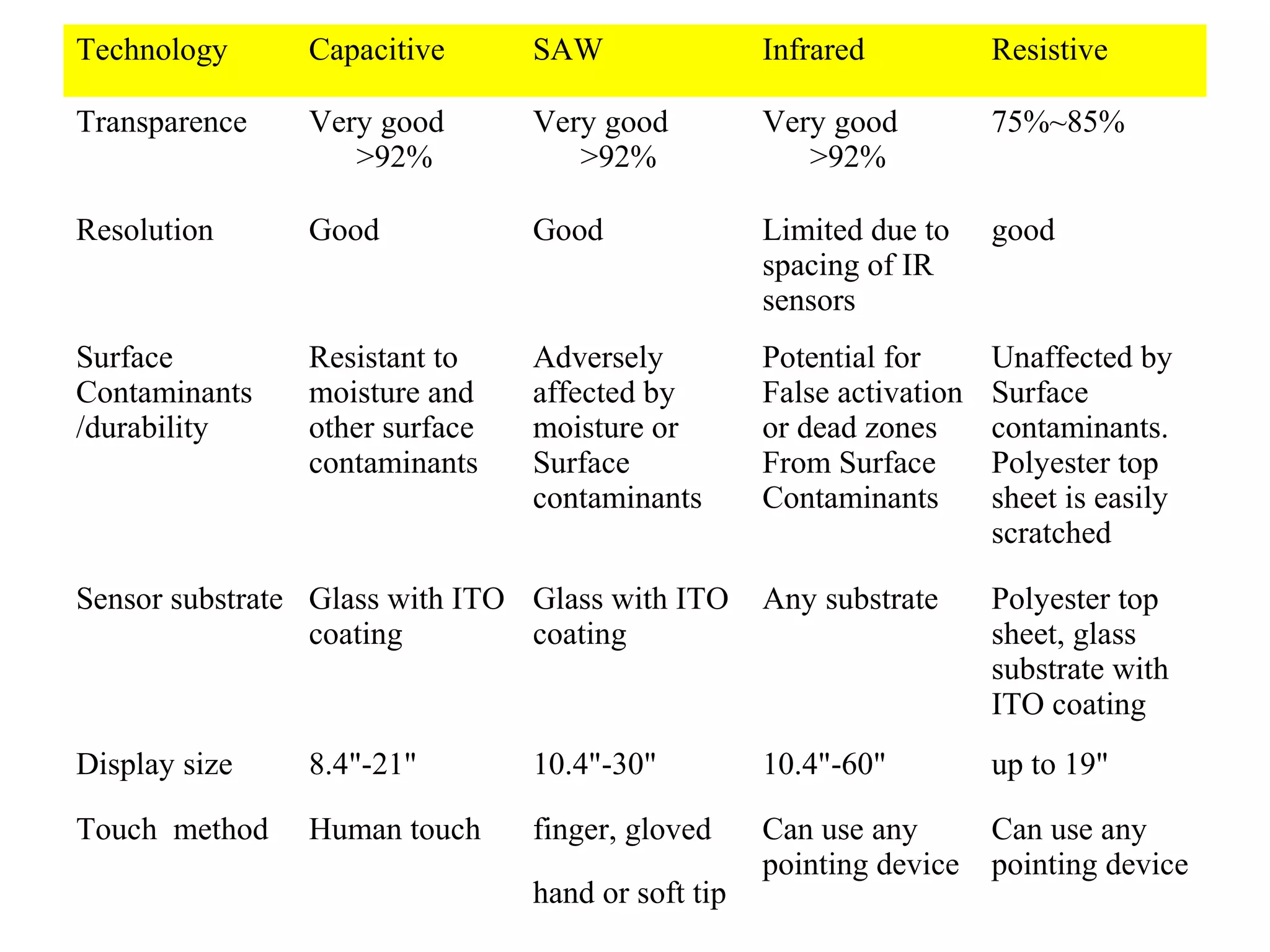
Technology      Capacitive      SAW                Infrared           Resistive

Transparence    Very good       Very good          Very good          75%~85%
                   >92%            >92%               >92%

Resolution      Good            Good               Limited due to     good
                                                   spacing of IR
                                                   sensors
Surface         Resistant to    Adversely          Potential for      Unaffected by
Contaminants    moisture and    affected by        False activation   Surface
/durability     other surface   moisture or        or dead zones      contaminants.
                contaminants    Surface            From Surface       Polyester top
                                contaminants       Contaminants       sheet is easily
                                                                      scratched

Sensor substrate Glass with ITO Glass with ITO     Any substrate      Polyester top
                 coating        coating                               sheet, glass
                                                                      substrate with
                                                                      ITO coating
Display size    8.4"-21"        10.4"-30"          10.4"-60"          up to 19"

Touch method    Human touch     finger, gloved     Can use any        Can use any
                                                   pointing device    pointing device
                                hand or soft tip
Multi-touch technology

• Multi-touch denotes a set of interaction
  techniques which allow computer users to
  control graphical applications with several
  fingers.
• Products:
• Apple iPhone, iPod touch, MacBook Air,
  and MacBook Pro
• Microsoft Surface
• ……

Touch screen sensor

  • 1.
    Touch Screen Sensor Quanling zheng
  • 2.
    How Does aTouchscreen Work? A basic touchscreen has three main components: 1 Touch sensor; 2 Controller; 3 Software driver. The touchscreen is an input device, so it needs to be combined with a display and a PC or other device to make a complete touch input system.
  • 3.
    Touch Sensor • Atouch screen sensor is a clear glass panel with a touch responsive surface. The touch sensor/panel is placed over a display screen so that the responsive area of the panel covers the viewable area of the video screen. There are several different touch sensor technologies on the market today, each using a different method to detect touch input. The sensor generally has an electrical current or signal going through it and touching the screen can cause a voltage or signal change. This change is used to determine the location of the touch to the screen.
  • 4.
    Controller • The controllerconnects between the touch sensor and the PC. It takes information from the touch sensor and translates it into information that PC can understand. The controller determines what type of interface/connection you will need on the PC. Controllers are available that can connect to a Serial/COM port (PC) or to a USB port. Specialized controllers are also available that work with DVD players and other devices.
  • 5.
    Software Driver • Thedriver allows the touchscreen and computer to work together. It tells the computer's operating system how to interpret the touch event information that is sent from the controller. Most touch screen drivers today are a mouse- emulation type driver. This makes touching the screen as same as clicking your mouse at the same location on the screen. This allows the touchscreen to work with existing software and allows new applications to be developed without the need for touchscreen specific programming.
  • 6.
    Touchscreen Technology • Resistivetouchscreen • Capacitive touchscreen • Infrared touchscreen • Surface acoustic wave (SAW) touchscreen • Strain gauge touchscreen • Optical imaging touchscreen • Dispersive signal technology touchscreen
  • 7.
    Resistive touchscreen • Structure Resistive touch screens consist of a glass or acrylic panel that is coated with electrically conductive and resistive layers made with indium tin oxide (ITO) .The thin layers are separated by invisible spacers.
  • 8.
  • 9.
    5-wire resistive touchscreen •The construction of the panels are similar with 4-wire technology, but for a 5-wire touch screen all four bus bars are connected to the lower, non-flexible layer of the screen. The flexible layer is always used as a sense layer to read the voltage connection point to the bottom layer.
  • 10.
  • 11.
    Resistive touchscreen • Characters: 1. Cost effective solutions 2. Activated by a stylus, a finger or gloved hand 3. Not affected by dirt, dust, water, or light 4. 75%~85% clarify 5. resistive layers can be damaged by a very sharp object
  • 12.
    Projected-capacitive touchscreen • Structure Projected capacitive touchscreens have front and back protective glass providing optical and strength enhancement options. Its middle layer consists of a laminated sensor grid of micro-fine wires, and optical enhancement options.
  • 13.
    Projected-capacitive touchscreen • Duringa touch, capacitance forms between the finger and the sensor grid.The embedded serial controller in the touchscreen calculates touch location coordinates and transmits them to the computer for processing.
  • 14.
    Surface-capacitive touchscreen • Structure Surface capacitive technology consists of a uniform conductive coating on a glass panel. Electrodes around the panel’s edge evenly distribute a low voltage across the conductive layer, creating a uniform electric field.
  • 15.
    Surface-capacitive touchscreen • Workingprinciple A human body is an electric conductor, so when you touch the screen with a finger, a slight amount of current is drawn, creating a voltage drop. The current respectively drifts to the electrodes on the four corners. Theoretically, the amount of current that drifts through the four electrodes should be proportional to the distance from the touch point to the four corners. The controller precisely calculates the proportion of the current passed through the four electrodes and figures out the X/Y coordinate of a touch point.
  • 16.
    Capacitive touchscreen • Characters: 1. Durable and resistant to scratches for demanding applications 2. Faster and more responsive 3. Immune to surface contaminants 4. Superior optical clarity, brighter display and less surface reflection 5. Must be touched by finger, will not work with any non-conductive input
  • 17.
    Infrared touchscreen • Infrared(IR) technology relies on the interruption of an IR light grid in front of the display screen. The touch frame contains a row of IR-light emitting diode (LEDs) and photo transistors, each mounted on two opposite sides to create a grid of invisible infrared light. The IR controller sequentially pulses the LEDs to create a grid of IR light beams. When a stylus, such as a finger, enters the grid, it obstructs the beams. One or more photo transistors from each axis detect the absence of light and transmit signals that identifies the x and y coordinates.
  • 18.
  • 19.
    Infrared touchscreen • Characters: 1. Clear as glass, improves reading ability 2. Most durable surface
  • 20.
    SAW touchscreen • Principle Surface waves are readily absorbed when a soft object such as a fingertip touches the substrate. SAW Touch Screen use pure glass with transmitting and receiving piezoelectric transducers for both the X and Y axes. The touch screen controller sends an electrical signal to the transmitting transducer, which converts the signal into ultrasonic waves within the glass. When you touch the screen, you absorb a portion of the wave traveling across it. The received signal is then compared to the stored digital map, the change recognized, and a coordinate calculate.
  • 21.
  • 22.
    SAW touchscreen • Characters: 1. Durable glass construction 2. High optical clarity 3. Activated by a finger, gloved hand or soft tip 4. Not completely sealable, can be affected by large amounts of dirt, dust, and / or water in the environment
  • 23.
    Technology Capacitive SAW Infrared Resistive Transparence Very good Very good Very good 75%~85% >92% >92% >92% Resolution Good Good Limited due to good spacing of IR sensors Surface Resistant to Adversely Potential for Unaffected by Contaminants moisture and affected by False activation Surface /durability other surface moisture or or dead zones contaminants. contaminants Surface From Surface Polyester top contaminants Contaminants sheet is easily scratched Sensor substrate Glass with ITO Glass with ITO Any substrate Polyester top coating coating sheet, glass substrate with ITO coating Display size 8.4"-21" 10.4"-30" 10.4"-60" up to 19" Touch method Human touch finger, gloved Can use any Can use any pointing device pointing device hand or soft tip
  • 24.
    Multi-touch technology • Multi-touchdenotes a set of interaction techniques which allow computer users to control graphical applications with several fingers. • Products: • Apple iPhone, iPod touch, MacBook Air, and MacBook Pro • Microsoft Surface • ……