Oncovirus
Cancer causing viruses
What is Cancer?
• Cancer begins when genetic changes interfere with this orderly process.
• Cells start to grow uncontrollably. These cells may form a mass called a
tumor.
• A tumor can be malignant or benign.
• A cancerous tumor is malignant, meaning it can grow and spread to other
parts of the body. A benign tumor means the tumor can grow but will not
spread.
• Some types of cancer do not form a tumor. These include leukemias, most
types of lymphoma, and myeloma.
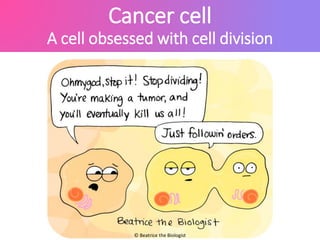
Cancer cell
A cell obsessed with cell division
© Beatrice the Biologist
Are you familiar with these terms?
Tumor suppressor gene
Proto-oncogenes
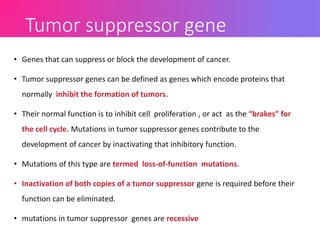
• Genes that can suppress or block the development of cancer.
• Tumor suppressor genes can be defined as genes which encode proteins that
normally inhibit the formation of tumors.
• Their normal function is to inhibit cell proliferation , or act as the “brakes” for
the cell cycle. Mutations in tumor suppressor genes contribute to the
development of cancer by inactivating that inhibitory function.
• Mutations of this type are termed loss-of-function mutations.
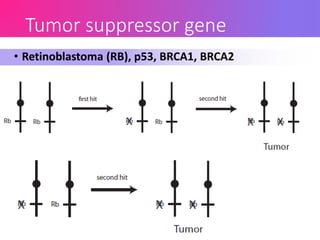
• Inactivation of both copies of a tumor suppressor gene is required before their
function can be eliminated.
• mutations in tumor suppressor genes are recessive
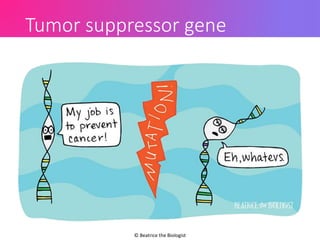
Tumor suppressor gene
© Beatrice the Biologist
• Retinoblastoma (RB), p53, BRCA1, BRCA2
Tumor suppressor gene
• genes that are involved in regulating cell proliferation can be mutated to forms that
promote uncontrolled cell proliferation.
• The normal forms of these genes are called proto-oncogenes, while the mutated,
cancer-causing forms are called oncogenes.
• oncogenes actively promote proliferation (analogous to the gas petal of the cell
cycle). Eg: Cyclin D, Myc, Bcl-2
• Mutations that convert proto-oncogenes to oncogenes typically increase the
activity of the encoded protein or increase the expression of the normal gene.
• mutations are dominant or gain-of-function mutations.
• only one copy of the gene needs to be mutated in order to promote cancer.
Proto-oncogenes
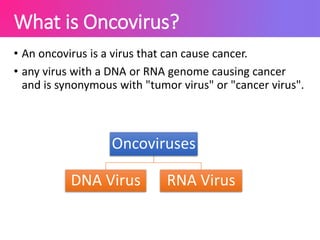
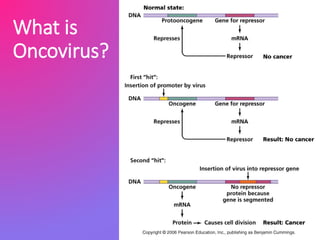
What is Oncovirus?
• An oncovirus is a virus that can cause cancer.
• any virus with a DNA or RNA genome causing cancer
and is synonymous with "tumor virus" or "cancer virus".
Oncoviruses
DNA Virus RNA Virus
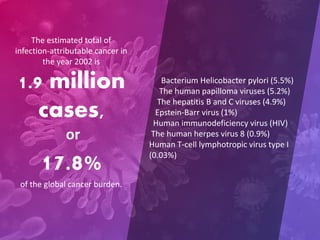
Bacterium Helicobacter pylori (5.5%)
The human papilloma viruses (5.2%)
The hepatitis B and C viruses (4.9%)
Epstein-Barr virus (1%)
Human immunodeficiency virus (HIV)
The human herpes virus 8 (0.9%)
Human T-cell lymphotropic virus type I
(0.03%)
The estimated total of
infection-attributable cancer in
the year 2002 is
1.9 million
cases,
or
17.8%
of the global cancer burden.
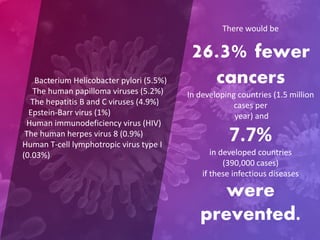
There would be
26.3% fewer
cancers
In developing countries (1.5 million
cases per
year) and
7.7%
in developed countries
(390,000 cases)
if these infectious diseases
were
prevented.
Bacterium Helicobacter pylori (5.5%)
The human papilloma viruses (5.2%)
The hepatitis B and C viruses (4.9%)
Epstein-Barr virus (1%)
Human immunodeficiency virus (HIV)
The human herpes virus 8 (0.9%)
Human T-cell lymphotropic virus type I
(0.03%)
How viruses cause cancer?
Mechanism of Carcinogenesis
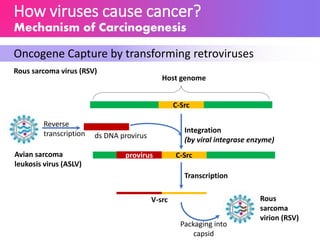
Oncogene Capture by transforming retroviruses
• A cellular protooncogene is captured by insertion into the viral genome during viral
replication.
• Causes genetic changes in the protooncogene, resulting in an oncogene
• The same process usually also results in a replication-defective virus that requires a
helper virus for its replication.
• The helper virus provides viral proteins to form the virion in which the RNA of the
defective virus is packaged. These mixed particles are called pseudotypes.
How viruses cause cancer?
Mechanism of Carcinogenesis
Oncogene Capture by transforming retroviruses
Rous sarcoma virus (RSV)
C-Src
Host genome
C-Srcprovirus
ds DNA provirus
Integration
(by viral integrase enzyme)
Transcription
V-src
Packaging into
capsid
Reverse
transcription
Rous
sarcoma
virion (RSV)
Avian sarcoma
leukosis virus (ASLV)
How viruses cause cancer?
Mechanism of Carcinogenesis
Insertional Activation
• A cellular protooncogene is captured by insertion into the viral genome during viral
replication.
• Causes genetic changes in the protooncogene, resulting in an oncogene
• The same process usually also results in a replication-defective virus that requires a
helper virus for its replication.
• The helper virus provides viral proteins to form the virion in which the RNA of the
defective virus is packaged. These mixed particles are called pseudotypes.
What is
Oncovirus?

Oncovirus

  • 1.
  • 2.
    What is Cancer? •Cancer begins when genetic changes interfere with this orderly process. • Cells start to grow uncontrollably. These cells may form a mass called a tumor. • A tumor can be malignant or benign. • A cancerous tumor is malignant, meaning it can grow and spread to other parts of the body. A benign tumor means the tumor can grow but will not spread. • Some types of cancer do not form a tumor. These include leukemias, most types of lymphoma, and myeloma.
  • 3.
    Cancer cell A cellobsessed with cell division © Beatrice the Biologist
  • 4.
    Are you familiarwith these terms? Tumor suppressor gene Proto-oncogenes
  • 5.
    • Genes thatcan suppress or block the development of cancer. • Tumor suppressor genes can be defined as genes which encode proteins that normally inhibit the formation of tumors. • Their normal function is to inhibit cell proliferation , or act as the “brakes” for the cell cycle. Mutations in tumor suppressor genes contribute to the development of cancer by inactivating that inhibitory function. • Mutations of this type are termed loss-of-function mutations. • Inactivation of both copies of a tumor suppressor gene is required before their function can be eliminated. • mutations in tumor suppressor genes are recessive Tumor suppressor gene
  • 6.
    Tumor suppressor gene ©Beatrice the Biologist
  • 7.
    • Retinoblastoma (RB),p53, BRCA1, BRCA2 Tumor suppressor gene
  • 8.
    • genes thatare involved in regulating cell proliferation can be mutated to forms that promote uncontrolled cell proliferation. • The normal forms of these genes are called proto-oncogenes, while the mutated, cancer-causing forms are called oncogenes. • oncogenes actively promote proliferation (analogous to the gas petal of the cell cycle). Eg: Cyclin D, Myc, Bcl-2 • Mutations that convert proto-oncogenes to oncogenes typically increase the activity of the encoded protein or increase the expression of the normal gene. • mutations are dominant or gain-of-function mutations. • only one copy of the gene needs to be mutated in order to promote cancer. Proto-oncogenes
  • 9.
    What is Oncovirus? •An oncovirus is a virus that can cause cancer. • any virus with a DNA or RNA genome causing cancer and is synonymous with "tumor virus" or "cancer virus". Oncoviruses DNA Virus RNA Virus
  • 10.
    Bacterium Helicobacter pylori(5.5%) The human papilloma viruses (5.2%) The hepatitis B and C viruses (4.9%) Epstein-Barr virus (1%) Human immunodeficiency virus (HIV) The human herpes virus 8 (0.9%) Human T-cell lymphotropic virus type I (0.03%) The estimated total of infection-attributable cancer in the year 2002 is 1.9 million cases, or 17.8% of the global cancer burden.
  • 11.
    There would be 26.3%fewer cancers In developing countries (1.5 million cases per year) and 7.7% in developed countries (390,000 cases) if these infectious diseases were prevented. Bacterium Helicobacter pylori (5.5%) The human papilloma viruses (5.2%) The hepatitis B and C viruses (4.9%) Epstein-Barr virus (1%) Human immunodeficiency virus (HIV) The human herpes virus 8 (0.9%) Human T-cell lymphotropic virus type I (0.03%)
  • 12.
    How viruses causecancer? Mechanism of Carcinogenesis Oncogene Capture by transforming retroviruses • A cellular protooncogene is captured by insertion into the viral genome during viral replication. • Causes genetic changes in the protooncogene, resulting in an oncogene • The same process usually also results in a replication-defective virus that requires a helper virus for its replication. • The helper virus provides viral proteins to form the virion in which the RNA of the defective virus is packaged. These mixed particles are called pseudotypes.
  • 13.
    How viruses causecancer? Mechanism of Carcinogenesis Oncogene Capture by transforming retroviruses Rous sarcoma virus (RSV) C-Src Host genome C-Srcprovirus ds DNA provirus Integration (by viral integrase enzyme) Transcription V-src Packaging into capsid Reverse transcription Rous sarcoma virion (RSV) Avian sarcoma leukosis virus (ASLV)
  • 14.
    How viruses causecancer? Mechanism of Carcinogenesis Insertional Activation • A cellular protooncogene is captured by insertion into the viral genome during viral replication. • Causes genetic changes in the protooncogene, resulting in an oncogene • The same process usually also results in a replication-defective virus that requires a helper virus for its replication. • The helper virus provides viral proteins to form the virion in which the RNA of the defective virus is packaged. These mixed particles are called pseudotypes.
  • 15.