1
HEAT SHOCK
RESPONSE
IN BACTERIAL
CELL
HEAT SHOCK
RESPONSE
IN BACTERIAL
CELL
PRESENTED BY
SHALINI SAINI
M.Sc.2ND
SEM
ROLL NO.1810
2
CONTENTSCONTENTS
• Gneral stress for bacteria
• Strategies to fight from the stress
• Examples of stress in bacteria
1. Specific stress responses
2. General stress responses
• Regulation principle of heat shock response in E.coli
• Outline of heat shock reponse
• rpoH mRNA as thermometer
• Heat shock response in E.coli
• The Hsps of E.coli
• Modulation of heat shock response
• Role of σ32,DnaJ/DnaK, and RNAP
• At the level of adaptation
• Regulation
• References
3
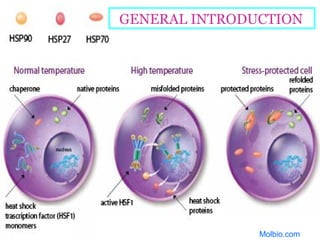
Molbio.com
GENERAL INTRODUCTION
4
1.Physiolochemical and chemical parameters
Pressure, temperature, turgor pressure, irradiation, pH,osmolite/salt
Concentration , oxygen, redox-state.
2.Nutritional Deprivation
Stravation of nutients (carbon, phosphate, nitrogen, amino acids,and
water)
3.Toxic compounds
Toxins, antibiotics, heavy metals, mutagens
4.Interaction with other cells
Hosts cells during infections, high cell density
STRESS FOR BACTERIASTRESS FOR BACTERIA
5
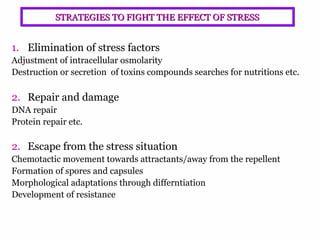
STRATEGIES TO FIGHT THE EFFECT OF STRESSSTRATEGIES TO FIGHT THE EFFECT OF STRESS
1. Elimination of stress factors
Adjustment of intracellular osmolarity
Destruction or secretion of toxins compounds searches for nutritions etc.
2. Repair and damage
DNA repair
Protein repair etc.
2. Escape from the stress situation
Chemotactic movement towards attractants/away from the repellent
Formation of spores and capsules
Morphological adaptations through differntiation
Development of resistance
6
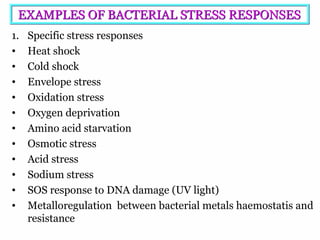
EXAMPLES OF BACTERIAL STRESS RESPONSESEXAMPLES OF BACTERIAL STRESS RESPONSES
1. Specific stress responses
• Heat shock
• Cold shock
• Envelope stress
• Oxidation stress
• Oxygen deprivation
• Amino acid starvation
• Osmotic stress
• Acid stress
• Sodium stress
• SOS response to DNA damage (UV light)
• Metalloregulation between bacterial metals haemostatis and
resistance
7
•Adaptive mutation
•Sporulation
•Long term survival in the stationary phase
General stress ResponsesGeneral stress Responses
8
REGULATION PRINCIPLE OF THE
HEAT SHOCK RESPONSE IN E.coli
REGULATION PRINCIPLE OF THE
HEAT SHOCK RESPONSE IN E.coli
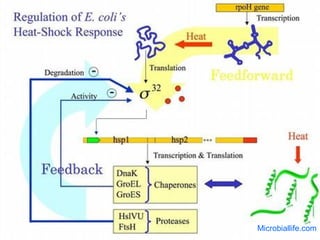
Alternate sigma factor :Sigma 32
Levels of regulation:
Transcription
Translation
Protein activity
Protein stability
9
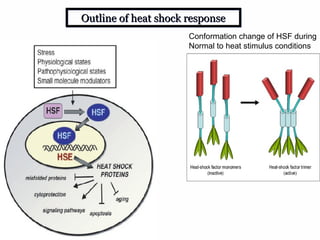
Outline of heat shock responseOutline of heat shock response
Pics-sciencedaily.com
Conformation change of HSF during
Normal to heat stimulus conditions
10Bakau-heat
Shock response
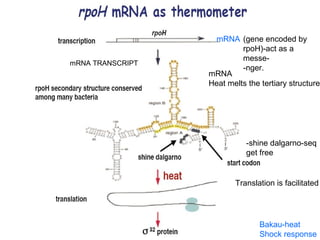
mRNA
Heat melts the tertiary structure
-shine dalgarno-seq
get free
Translation is facilitated
(gene encoded by
rpoH)-act as a
messe-
-nger.
mRNA TRANSCRIPT
mRNA
11
HEAT SHOCK RESPONSE
IN E.coli
HEAT SHOCK RESPONSE
IN E.coli
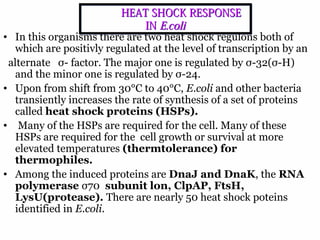
• In this organisms there are two heat shock regulons both of
which are positivly regulated at the level of transcription by an
alternate σ- factor. The major one is regulated by σ-32(σ-H)
and the minor one is regulated by σ-24.
• Upon from shift from 30°C to 40°C, E.coli and other bacteria
transiently increases the rate of synthesis of a set of proteins
called heat shock proteins (HSPs).
• Many of the HSPs are required for the cell. Many of these
HSPs are required for the cell growth or survival at more
elevated temperatures (thermtolerance) for
thermophiles.
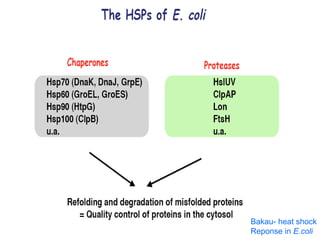
• Among the induced proteins are DnaJ and DnaK, the RNA
polymerase σ70 subunit lon, ClpAP, FtsH,
LysU(protease). There are nearly 50 heat shock poteins
identified in E.coli.
12
Bakau- heat shock
Reponse in E.coli
13
• The σH regulon provides protection against cytoplasmic
thermal stress. The E.coli rpoH locus encodes a 32kD σ factor,
alternativly called σ H or σ32 , which redirects promotor
specificity of RNA polymerase(RNAP). The σ32 protein
regulates the expression of 34 heat shock genes.
• The simple explanation for how heat shock increases
expression of the σ32 regulon ,is that heat shock first cause in
elevation in σ32 levels, which in turn increases expression of
the σ32 target genes.
14
MODULATION OF HEAT
SHOCK RESPONSE
IN E.coli
MODULATION OF HEAT
SHOCK RESPONSE
IN E.coli
15
Sigma-70
rpoH
42°C
Sigma-32
DnaJ
GrpE
Dnak
Sigma-32
GrpEDnaK DnaJ
30°C
Inactive, unstable,degraded
FtsH,HsIUV,ClpAP,Protease
mRNA
Translation
Sigma-32
βα
βα
Sigma-32
HEAT SHOCK
GENES
30°C
Dnak DnaJ LysU
GroE GrpE etc.
CHAPRONINE
FUNCTIONS
Native
protein
UV
pH
H2O2
Dnak DnaJ
GrpE
COMPLEX
Unfolded
protein
42°C
Flow chart
From
Moat and
froaster
House-
Keeping
σ factor
16
•First temperature upshift from 30°C to 42°C results in
the increased translation of rpoH message.
•Cis- acting mRNA sites within the 5′ region of rpoH
message form temperature -sensitive secondary structures
that sequester the ribosomes binding site.
•At high temperature these secondary structures melt,
thereby enabling more efficient translation of the rpoH
message.
17
• In addition to the increased translation of rpoH message, the
σ32 protein itself become more stable, at least transiently. The
mechanism regulating proteolysis centers on wether σ32
associates with RNA polymerase.
• During growth at 30°C,σ32 can be degraded by several
proteases including FtsH,HsIVU, and ClpAP. However , if σ32
is bound to RNAP, σ32 is protected from degradation.
18
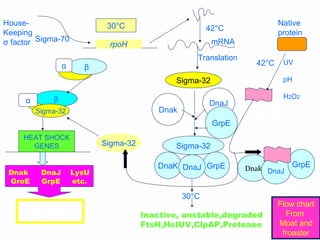
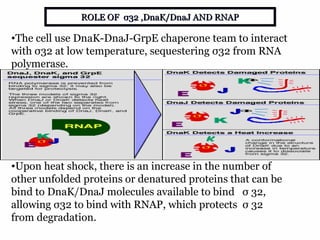
•The cell use DnaK-DnaJ-GrpE chaperone team to interact
with σ32 at low temperature, sequestering σ32 from RNA
polymerase.
•Upon heat shock, there is an increase in the number of
other unfolded proteins or denatured proteins that can be
bind to DnaK/DnaJ molecules available to bind σ 32,
allowing σ32 to bind with RNAP, which protects σ 32
from degradation.
ROLE OF σ32 ,DnaK/DnaJ AND RNAPROLE OF σ32 ,DnaK/DnaJ AND RNAP
Pic-sciencedirect.com
19
AT THE LEVEL OF THE ADAPTATIONAT THE LEVEL OF THE ADAPTATION
• As the cell reaches the adaptation phase following heat shock,
the level of the DnaK and DnaJ rise and can again bind σ32,
redirecting it toward degradation.
• Nevertheless, even through σ 32 degradation resumes,
translation of rpoH remains high at the evaluated temperature
and σ32 continues to accumulate, although at a slower rate.
• In addition of translational and protelytic controls, production
of σ 32 in regulated at the transcriptional level via a feedback
mechanism.
• There are four promoters driving rpoH expression, three of
which are dependent on σ 70, the housekeeping σ factor.
20
• They seemly diverse stresses activate rpoH that appears
responsible is the accumulation of denatured or incomplete
peptides.
• There is a potential alarmone that has been implicated in
signaling exepressions of this global network.
• The σE regulon provide protection against extracytoplasmic
stress.
• The hallmark of the gram- Negative cell is the existence of two
membrane-bound subcellular compartments:the cytoplasm and
the periplasm conditions in each of these compartments differs
makedly.
21
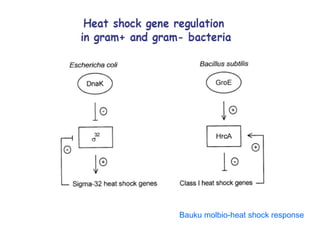
Bauku molbio-heat shock response
22Microbiallife.com
23
Regulatory mechanismRegulatory mechanism
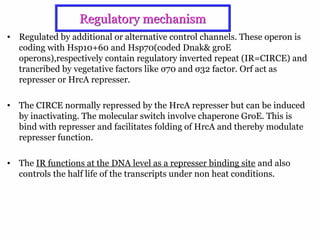
• Regulated by additional or alternative control channels. These operon is
coding with Hsp10+60 and Hsp70(coded Dnak& groE
operons),respectively contain regulatory inverted repeat (IR=CIRCE) and
trancribed by vegetative factors like σ70 and σ32 factor. Orf act as
represser or HrcA represser.
• The CIRCE normally repressed by the HrcA represser but can be induced
by inactivating. The molecular switch involve chaperone GroE. This is
bind with represser and facilitates folding of HrcA and thereby modulate
represser function.
• The IR functions at the DNA level as a represser binding site and also
controls the half life of the transcripts under non heat conditions.
24
References
• Research article -Buakau, B.1993.regulation in E.coli heat shock
response.Mol. Microbial.
• Albert G. Moat, Jhon W. Foster ,Michael P. Spector ,fourth edition
2004 ,Microbial physiology page no. 597,598,599,600,601.
• Sciencedirect.com
• Sciencedaily.com
• Molbio.com
• Microbiallife.com
• Research papers---
• Research paper-heat shock proteins molecular chaperones,and the stress
reponse-Martin E. feeder dept of organism biology and community on
evolutionary biology, University of Chicago.
• Regulation of heat shock response in bacteria-Gil Segal and Elora Z. Ron
dept. of molecular biology and biotechnology,Tel Aviv University Israel.
25

Heat shock response major seminar

  • 1.
    1 HEAT SHOCK RESPONSE IN BACTERIAL CELL HEATSHOCK RESPONSE IN BACTERIAL CELL PRESENTED BY SHALINI SAINI M.Sc.2ND SEM ROLL NO.1810
  • 2.
    2 CONTENTSCONTENTS • Gneral stressfor bacteria • Strategies to fight from the stress • Examples of stress in bacteria 1. Specific stress responses 2. General stress responses • Regulation principle of heat shock response in E.coli • Outline of heat shock reponse • rpoH mRNA as thermometer • Heat shock response in E.coli • The Hsps of E.coli • Modulation of heat shock response • Role of σ32,DnaJ/DnaK, and RNAP • At the level of adaptation • Regulation • References
  • 3.
  • 4.
    4 1.Physiolochemical and chemicalparameters Pressure, temperature, turgor pressure, irradiation, pH,osmolite/salt Concentration , oxygen, redox-state. 2.Nutritional Deprivation Stravation of nutients (carbon, phosphate, nitrogen, amino acids,and water) 3.Toxic compounds Toxins, antibiotics, heavy metals, mutagens 4.Interaction with other cells Hosts cells during infections, high cell density STRESS FOR BACTERIASTRESS FOR BACTERIA
  • 5.
    5 STRATEGIES TO FIGHTTHE EFFECT OF STRESSSTRATEGIES TO FIGHT THE EFFECT OF STRESS 1. Elimination of stress factors Adjustment of intracellular osmolarity Destruction or secretion of toxins compounds searches for nutritions etc. 2. Repair and damage DNA repair Protein repair etc. 2. Escape from the stress situation Chemotactic movement towards attractants/away from the repellent Formation of spores and capsules Morphological adaptations through differntiation Development of resistance
  • 6.
    6 EXAMPLES OF BACTERIALSTRESS RESPONSESEXAMPLES OF BACTERIAL STRESS RESPONSES 1. Specific stress responses • Heat shock • Cold shock • Envelope stress • Oxidation stress • Oxygen deprivation • Amino acid starvation • Osmotic stress • Acid stress • Sodium stress • SOS response to DNA damage (UV light) • Metalloregulation between bacterial metals haemostatis and resistance
  • 7.
    7 •Adaptive mutation •Sporulation •Long termsurvival in the stationary phase General stress ResponsesGeneral stress Responses
  • 8.
    8 REGULATION PRINCIPLE OFTHE HEAT SHOCK RESPONSE IN E.coli REGULATION PRINCIPLE OF THE HEAT SHOCK RESPONSE IN E.coli Alternate sigma factor :Sigma 32 Levels of regulation: Transcription Translation Protein activity Protein stability
  • 9.
    9 Outline of heatshock responseOutline of heat shock response Pics-sciencedaily.com Conformation change of HSF during Normal to heat stimulus conditions
  • 10.
    10Bakau-heat Shock response mRNA Heat meltsthe tertiary structure -shine dalgarno-seq get free Translation is facilitated (gene encoded by rpoH)-act as a messe- -nger. mRNA TRANSCRIPT mRNA
  • 11.
    11 HEAT SHOCK RESPONSE INE.coli HEAT SHOCK RESPONSE IN E.coli • In this organisms there are two heat shock regulons both of which are positivly regulated at the level of transcription by an alternate σ- factor. The major one is regulated by σ-32(σ-H) and the minor one is regulated by σ-24. • Upon from shift from 30°C to 40°C, E.coli and other bacteria transiently increases the rate of synthesis of a set of proteins called heat shock proteins (HSPs). • Many of the HSPs are required for the cell. Many of these HSPs are required for the cell growth or survival at more elevated temperatures (thermtolerance) for thermophiles. • Among the induced proteins are DnaJ and DnaK, the RNA polymerase σ70 subunit lon, ClpAP, FtsH, LysU(protease). There are nearly 50 heat shock poteins identified in E.coli.
  • 12.
  • 13.
    13 • The σHregulon provides protection against cytoplasmic thermal stress. The E.coli rpoH locus encodes a 32kD σ factor, alternativly called σ H or σ32 , which redirects promotor specificity of RNA polymerase(RNAP). The σ32 protein regulates the expression of 34 heat shock genes. • The simple explanation for how heat shock increases expression of the σ32 regulon ,is that heat shock first cause in elevation in σ32 levels, which in turn increases expression of the σ32 target genes.
  • 14.
    14 MODULATION OF HEAT SHOCKRESPONSE IN E.coli MODULATION OF HEAT SHOCK RESPONSE IN E.coli
  • 15.
    15 Sigma-70 rpoH 42°C Sigma-32 DnaJ GrpE Dnak Sigma-32 GrpEDnaK DnaJ 30°C Inactive, unstable,degraded FtsH,HsIUV,ClpAP,Protease mRNA Translation Sigma-32 βα βα Sigma-32 HEATSHOCK GENES 30°C Dnak DnaJ LysU GroE GrpE etc. CHAPRONINE FUNCTIONS Native protein UV pH H2O2 Dnak DnaJ GrpE COMPLEX Unfolded protein 42°C Flow chart From Moat and froaster House- Keeping σ factor
  • 16.
    16 •First temperature upshiftfrom 30°C to 42°C results in the increased translation of rpoH message. •Cis- acting mRNA sites within the 5′ region of rpoH message form temperature -sensitive secondary structures that sequester the ribosomes binding site. •At high temperature these secondary structures melt, thereby enabling more efficient translation of the rpoH message.
  • 17.
    17 • In additionto the increased translation of rpoH message, the σ32 protein itself become more stable, at least transiently. The mechanism regulating proteolysis centers on wether σ32 associates with RNA polymerase. • During growth at 30°C,σ32 can be degraded by several proteases including FtsH,HsIVU, and ClpAP. However , if σ32 is bound to RNAP, σ32 is protected from degradation.
  • 18.
    18 •The cell useDnaK-DnaJ-GrpE chaperone team to interact with σ32 at low temperature, sequestering σ32 from RNA polymerase. •Upon heat shock, there is an increase in the number of other unfolded proteins or denatured proteins that can be bind to DnaK/DnaJ molecules available to bind σ 32, allowing σ32 to bind with RNAP, which protects σ 32 from degradation. ROLE OF σ32 ,DnaK/DnaJ AND RNAPROLE OF σ32 ,DnaK/DnaJ AND RNAP Pic-sciencedirect.com
  • 19.
    19 AT THE LEVELOF THE ADAPTATIONAT THE LEVEL OF THE ADAPTATION • As the cell reaches the adaptation phase following heat shock, the level of the DnaK and DnaJ rise and can again bind σ32, redirecting it toward degradation. • Nevertheless, even through σ 32 degradation resumes, translation of rpoH remains high at the evaluated temperature and σ32 continues to accumulate, although at a slower rate. • In addition of translational and protelytic controls, production of σ 32 in regulated at the transcriptional level via a feedback mechanism. • There are four promoters driving rpoH expression, three of which are dependent on σ 70, the housekeeping σ factor.
  • 20.
    20 • They seemlydiverse stresses activate rpoH that appears responsible is the accumulation of denatured or incomplete peptides. • There is a potential alarmone that has been implicated in signaling exepressions of this global network. • The σE regulon provide protection against extracytoplasmic stress. • The hallmark of the gram- Negative cell is the existence of two membrane-bound subcellular compartments:the cytoplasm and the periplasm conditions in each of these compartments differs makedly.
  • 21.
  • 22.
  • 23.
    23 Regulatory mechanismRegulatory mechanism •Regulated by additional or alternative control channels. These operon is coding with Hsp10+60 and Hsp70(coded Dnak& groE operons),respectively contain regulatory inverted repeat (IR=CIRCE) and trancribed by vegetative factors like σ70 and σ32 factor. Orf act as represser or HrcA represser. • The CIRCE normally repressed by the HrcA represser but can be induced by inactivating. The molecular switch involve chaperone GroE. This is bind with represser and facilitates folding of HrcA and thereby modulate represser function. • The IR functions at the DNA level as a represser binding site and also controls the half life of the transcripts under non heat conditions.
  • 24.
    24 References • Research article-Buakau, B.1993.regulation in E.coli heat shock response.Mol. Microbial. • Albert G. Moat, Jhon W. Foster ,Michael P. Spector ,fourth edition 2004 ,Microbial physiology page no. 597,598,599,600,601. • Sciencedirect.com • Sciencedaily.com • Molbio.com • Microbiallife.com • Research papers--- • Research paper-heat shock proteins molecular chaperones,and the stress reponse-Martin E. feeder dept of organism biology and community on evolutionary biology, University of Chicago. • Regulation of heat shock response in bacteria-Gil Segal and Elora Z. Ron dept. of molecular biology and biotechnology,Tel Aviv University Israel.
  • 25.