NUR HANISAH BINTI ZAINOREN
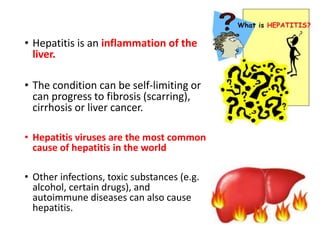
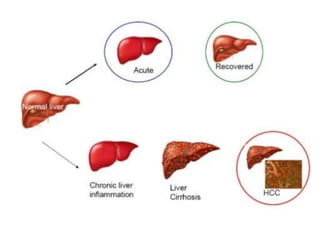
• Hepatitis is an inflammation of the
liver.
• The condition can be self-limiting or
can progress to fibrosis (scarring),
cirrhosis or liver cancer.
• Hepatitis viruses are the most common
cause of hepatitis in the world
• Other infections, toxic substances (e.g.
alcohol, certain drugs), and
autoimmune diseases can also cause
hepatitis.
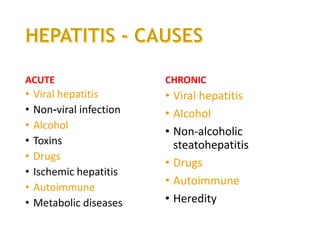
ACUTE
• Viral hepatitis
• Non-viral infection
• Alcohol
• Toxins
• Drugs
• Ischemic hepatitis
• Autoimmune
• Metabolic diseases
CHRONIC
• Viral hepatitis
• Alcohol
• Non-alcoholic
steatohepatitis
• Drugs
• Autoimmune
• Heredity
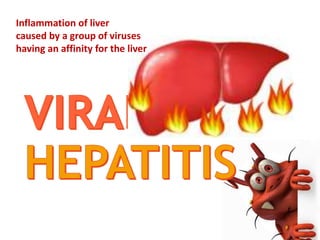
Inflammation of liver
caused by a group of viruses
having an affinity for the liver
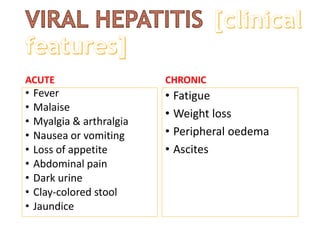
ACUTE
• Fever
• Malaise
• Myalgia & arthralgia
• Nausea or vomiting
• Loss of appetite
• Abdominal pain
• Dark urine
• Clay-colored stool
• Jaundice
CHRONIC
• Fatigue
• Weight loss
• Peripheral oedema
• Ascites
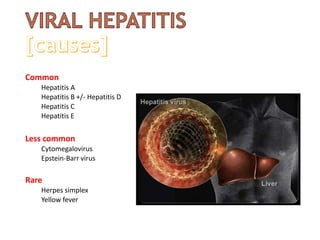
Common
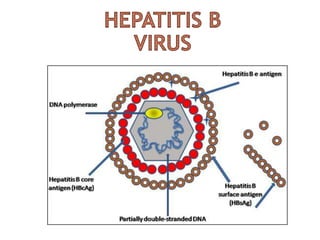
Hepatitis A
Hepatitis B +/- Hepatitis D
Hepatitis C
Hepatitis E
Less common
Cytomegalovirus
Epstein-Barr virus
Rare
Herpes simplex
Yellow fever
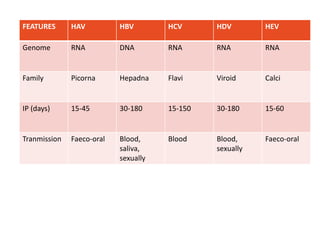
FEATURES HAV HBV HCV HDV HEV
Genome RNA DNA RNA RNA RNA
Family Picorna Hepadna Flavi Viroid Calci
IP (days) 15-45 30-180 15-150 30-180 15-60
Tranmission Faeco-oral Blood,
saliva,
sexually
Blood Blood,
sexually
Faeco-oral
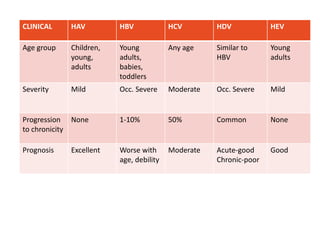
CLINICAL HAV HBV HCV HDV HEV
Age group Children,
young,
adults
Young
adults,
babies,
toddlers
Any age Similar to
HBV
Young
adults
Severity Mild Occ. Severe Moderate Occ. Severe Mild
Progression
to chronicity
None 1-10% 50% Common None
Prognosis Excellent Worse with
age, debility
Moderate Acute-good
Chronic-poor
Good
• ALT, AST
[N: <40 units]
• ALP
[N: 30-120 IU/L]
• Plasma bilirubin
>2.5 mg/dL up to 20 mg/dL
• Prolong PT
[N: 11.5-12.5 seconds]
• Hypoglycemia
• Serological tests
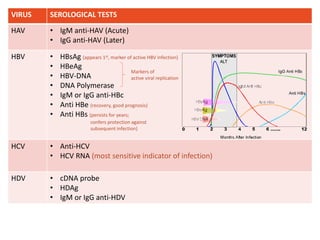
VIRUS SEROLOGICAL TESTS
HAV • IgM anti-HAV (Acute)
• IgG anti-HAV (Later)
HBV • HBsAg (appears 1st, marker of active HBV infection)
• HBeAg
• HBV-DNA
• DNA Polymerase
• IgM or IgG anti-HBc
• Anti HBe (recovery, good prognosis)
• Anti HBs (persists for years;
confers protection against
subsequent infection)
HCV • Anti-HCV
• HCV RNA (most sensitive indicator of infection)
HDV • cDNA probe
• HDAg
• IgM or IgG anti-HDV
Markers of
active viral replication
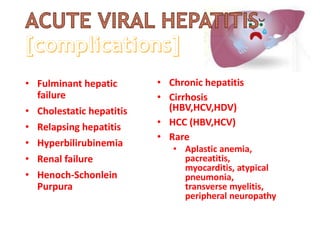
• Fulminant hepatic
failure
• Cholestatic hepatitis
• Relapsing hepatitis
• Hyperbilirubinemia
• Renal failure
• Henoch-Schonlein
Purpura
• Chronic hepatitis
• Cirrhosis
(HBV,HCV,HDV)
• HCC (HBV,HCV)
• Rare
• Aplastic anemia,
pacreatitis,
myocarditis, atypical
pneumonia,
transverse myelitis,
peripheral neuropathy
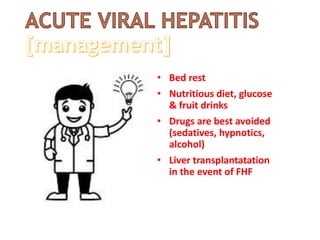
• Bed rest
• Nutritious diet, glucose
& fruit drinks
• Drugs are best avoided
(sedatives, hypnotics,
alcohol)
• Liver transplantatation
in the event of FHF
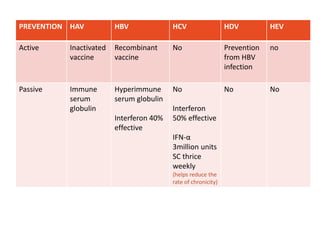
PREVENTION HAV HBV HCV HDV HEV
Active Inactivated
vaccine
Recombinant
vaccine
No Prevention
from HBV
infection
no
Passive Immune
serum
globulin
Hyperimmune
serum globulin
Interferon 40%
effective
No
Interferon
50% effective
IFN-α
3million units
SC thrice
weekly
(helps reduce the
rate of chronicity)
No No
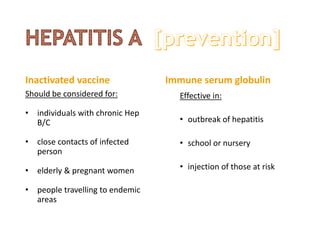
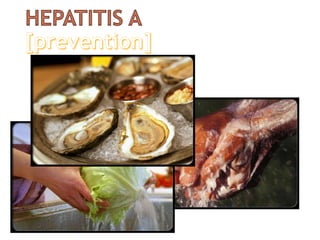
Inactivated vaccine
Should be considered for:
• individuals with chronic Hep
B/C
• close contacts of infected
person
• elderly & pregnant women
• people travelling to endemic
areas
Immune serum globulin
Effective in:
• outbreak of hepatitis
• school or nursery
• injection of those at risk
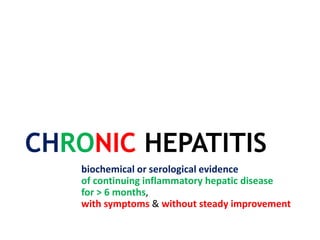
CHRONIC HEPATITIS
biochemical or serological evidence
of continuing inflammatory hepatic disease
for > 6 months,
with symptoms & without steady improvement
CHRONIC HEPATITIS B
[management]
2 drugs are used
• Direct acting nucleoside/nucleotide analogues
• Lamivudine 100mg daily orally
• Adefovir 10mg daily orally
• Entecavir 0.5mg orally
• Pegylated interferon-α
• IFN- α 2a&2b: SC 10 million units thrice weekly
or 5 million units daily
• IFN- α 2a: 180 mcg weekly
• IFN- α 2b: 100 mcg weekly
Liver transplantation
• Indicated FHF and ESLD
• Combined nucleoside analogue + hep B Ig therapy
For 48 weeks
For 6 months
For 48 weeks
CHRONIC HEPATITIS C
[management]
GROUP I GROUP II GROUP III GROUP IV
Anti-HCV + + + -
HCV RNA - + + +
ALT NI NI Raised NI
Management No treatment Under follow-
up
IFN + Ribavirin Liver biopsy
CHRONIC HEPATITIS C
[management]
GROUP I GROUP II GROUP III GROUP IV
Anti-HCV + + + -
HCV RNA - + + +
ALT NI NI Raised NI
Management No treatment Under follow-
up
IFN + Ribavirin Liver biopsy
Peg IFN-α 2a 180mcg SC weekly
or Peg IFN-α 2b 1.5mcg/kg SC
weekly
+
Ribavirin 1000-1200 mg/day
orally for 48 weeks
CHRONIC HEPATITIS C
[management]
GROUP I GROUP II GROUP III GROUP IV
Anti-HCV + + + -
HCV RNA - + + +
ALT NI NI Raised NI
Management No treatment Under follow-
up
IFN + Ribavirin Liver biopsy
Peg IFN-α 2a 180mcg SC weekly
or Peg IFN-α 2b 1.5mcg/kg SC
weekly
+
Ribavirin 1000-1200 mg/day
orally for 48 weeks
Peg IFN-α 2a 180mcg SC weekly
or Peg IFN-α 2b 1.5mcg/kg SC
weekly
+
Ribavirin 800 mg/day orally for
24 weeks
MNEMONICS
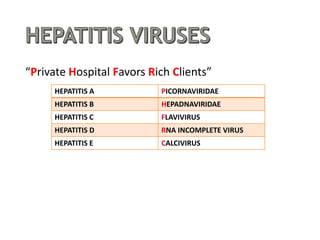
“Private Hospital Favors Rich Clients”
HEPATITIS A PICORNAVIRIDAE
HEPATITIS B HEPADNAVIRIDAE
HEPATITIS C FLAVIVIRUS
HEPATITIS D RNA INCOMPLETE VIRUS
HEPATITIS E CALCIVIRUS
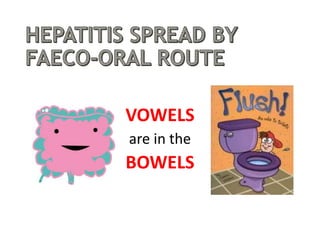
VOWELS
are in the
BOWELS
BLOOD
BLOODC
VIRAL HEPATITIS

VIRAL HEPATITIS

  • 1.
  • 2.
    • Hepatitis isan inflammation of the liver. • The condition can be self-limiting or can progress to fibrosis (scarring), cirrhosis or liver cancer. • Hepatitis viruses are the most common cause of hepatitis in the world • Other infections, toxic substances (e.g. alcohol, certain drugs), and autoimmune diseases can also cause hepatitis.
  • 3.
    ACUTE • Viral hepatitis •Non-viral infection • Alcohol • Toxins • Drugs • Ischemic hepatitis • Autoimmune • Metabolic diseases CHRONIC • Viral hepatitis • Alcohol • Non-alcoholic steatohepatitis • Drugs • Autoimmune • Heredity
  • 4.
    Inflammation of liver causedby a group of viruses having an affinity for the liver
  • 6.
    ACUTE • Fever • Malaise •Myalgia & arthralgia • Nausea or vomiting • Loss of appetite • Abdominal pain • Dark urine • Clay-colored stool • Jaundice CHRONIC • Fatigue • Weight loss • Peripheral oedema • Ascites
  • 7.
    Common Hepatitis A Hepatitis B+/- Hepatitis D Hepatitis C Hepatitis E Less common Cytomegalovirus Epstein-Barr virus Rare Herpes simplex Yellow fever
  • 8.
    FEATURES HAV HBVHCV HDV HEV Genome RNA DNA RNA RNA RNA Family Picorna Hepadna Flavi Viroid Calci IP (days) 15-45 30-180 15-150 30-180 15-60 Tranmission Faeco-oral Blood, saliva, sexually Blood Blood, sexually Faeco-oral
  • 9.
    CLINICAL HAV HBVHCV HDV HEV Age group Children, young, adults Young adults, babies, toddlers Any age Similar to HBV Young adults Severity Mild Occ. Severe Moderate Occ. Severe Mild Progression to chronicity None 1-10% 50% Common None Prognosis Excellent Worse with age, debility Moderate Acute-good Chronic-poor Good
  • 10.
    • ALT, AST [N:<40 units] • ALP [N: 30-120 IU/L] • Plasma bilirubin >2.5 mg/dL up to 20 mg/dL • Prolong PT [N: 11.5-12.5 seconds] • Hypoglycemia • Serological tests
  • 12.
    VIRUS SEROLOGICAL TESTS HAV• IgM anti-HAV (Acute) • IgG anti-HAV (Later) HBV • HBsAg (appears 1st, marker of active HBV infection) • HBeAg • HBV-DNA • DNA Polymerase • IgM or IgG anti-HBc • Anti HBe (recovery, good prognosis) • Anti HBs (persists for years; confers protection against subsequent infection) HCV • Anti-HCV • HCV RNA (most sensitive indicator of infection) HDV • cDNA probe • HDAg • IgM or IgG anti-HDV Markers of active viral replication
  • 13.
    • Fulminant hepatic failure •Cholestatic hepatitis • Relapsing hepatitis • Hyperbilirubinemia • Renal failure • Henoch-Schonlein Purpura • Chronic hepatitis • Cirrhosis (HBV,HCV,HDV) • HCC (HBV,HCV) • Rare • Aplastic anemia, pacreatitis, myocarditis, atypical pneumonia, transverse myelitis, peripheral neuropathy
  • 14.
    • Bed rest •Nutritious diet, glucose & fruit drinks • Drugs are best avoided (sedatives, hypnotics, alcohol) • Liver transplantatation in the event of FHF
  • 15.
    PREVENTION HAV HBVHCV HDV HEV Active Inactivated vaccine Recombinant vaccine No Prevention from HBV infection no Passive Immune serum globulin Hyperimmune serum globulin Interferon 40% effective No Interferon 50% effective IFN-α 3million units SC thrice weekly (helps reduce the rate of chronicity) No No
  • 16.
    Inactivated vaccine Should beconsidered for: • individuals with chronic Hep B/C • close contacts of infected person • elderly & pregnant women • people travelling to endemic areas Immune serum globulin Effective in: • outbreak of hepatitis • school or nursery • injection of those at risk
  • 18.
    CHRONIC HEPATITIS biochemical orserological evidence of continuing inflammatory hepatic disease for > 6 months, with symptoms & without steady improvement
  • 19.
    CHRONIC HEPATITIS B [management] 2drugs are used • Direct acting nucleoside/nucleotide analogues • Lamivudine 100mg daily orally • Adefovir 10mg daily orally • Entecavir 0.5mg orally • Pegylated interferon-α • IFN- α 2a&2b: SC 10 million units thrice weekly or 5 million units daily • IFN- α 2a: 180 mcg weekly • IFN- α 2b: 100 mcg weekly Liver transplantation • Indicated FHF and ESLD • Combined nucleoside analogue + hep B Ig therapy For 48 weeks For 6 months For 48 weeks
  • 20.
    CHRONIC HEPATITIS C [management] GROUPI GROUP II GROUP III GROUP IV Anti-HCV + + + - HCV RNA - + + + ALT NI NI Raised NI Management No treatment Under follow- up IFN + Ribavirin Liver biopsy
  • 21.
    CHRONIC HEPATITIS C [management] GROUPI GROUP II GROUP III GROUP IV Anti-HCV + + + - HCV RNA - + + + ALT NI NI Raised NI Management No treatment Under follow- up IFN + Ribavirin Liver biopsy Peg IFN-α 2a 180mcg SC weekly or Peg IFN-α 2b 1.5mcg/kg SC weekly + Ribavirin 1000-1200 mg/day orally for 48 weeks
  • 22.
    CHRONIC HEPATITIS C [management] GROUPI GROUP II GROUP III GROUP IV Anti-HCV + + + - HCV RNA - + + + ALT NI NI Raised NI Management No treatment Under follow- up IFN + Ribavirin Liver biopsy Peg IFN-α 2a 180mcg SC weekly or Peg IFN-α 2b 1.5mcg/kg SC weekly + Ribavirin 1000-1200 mg/day orally for 48 weeks Peg IFN-α 2a 180mcg SC weekly or Peg IFN-α 2b 1.5mcg/kg SC weekly + Ribavirin 800 mg/day orally for 24 weeks
  • 23.
  • 24.
    “Private Hospital FavorsRich Clients” HEPATITIS A PICORNAVIRIDAE HEPATITIS B HEPADNAVIRIDAE HEPATITIS C FLAVIVIRUS HEPATITIS D RNA INCOMPLETE VIRUS HEPATITIS E CALCIVIRUS
  • 25.
  • 26.
  • 27.

Editor's Notes

  • #14  vasculitis occurs with a viral illness, such as hepatitis B or C, HIV (the virus that causes AIDS), cytomegalovirus, Epstein-Barr virus, or parvovirus B19.