Liver Failure/ Hepatic Failure
By,
Ms. Ekta S Patel
Assistant Professor
LIVER FAILURE
Liver failure is an uncommon condition
in which rapid deterioration of liver
function results in coagulopathy and
alteration in the mental status(
encephalopathy ).
Liver failure indicates that liver has
sustained injury.
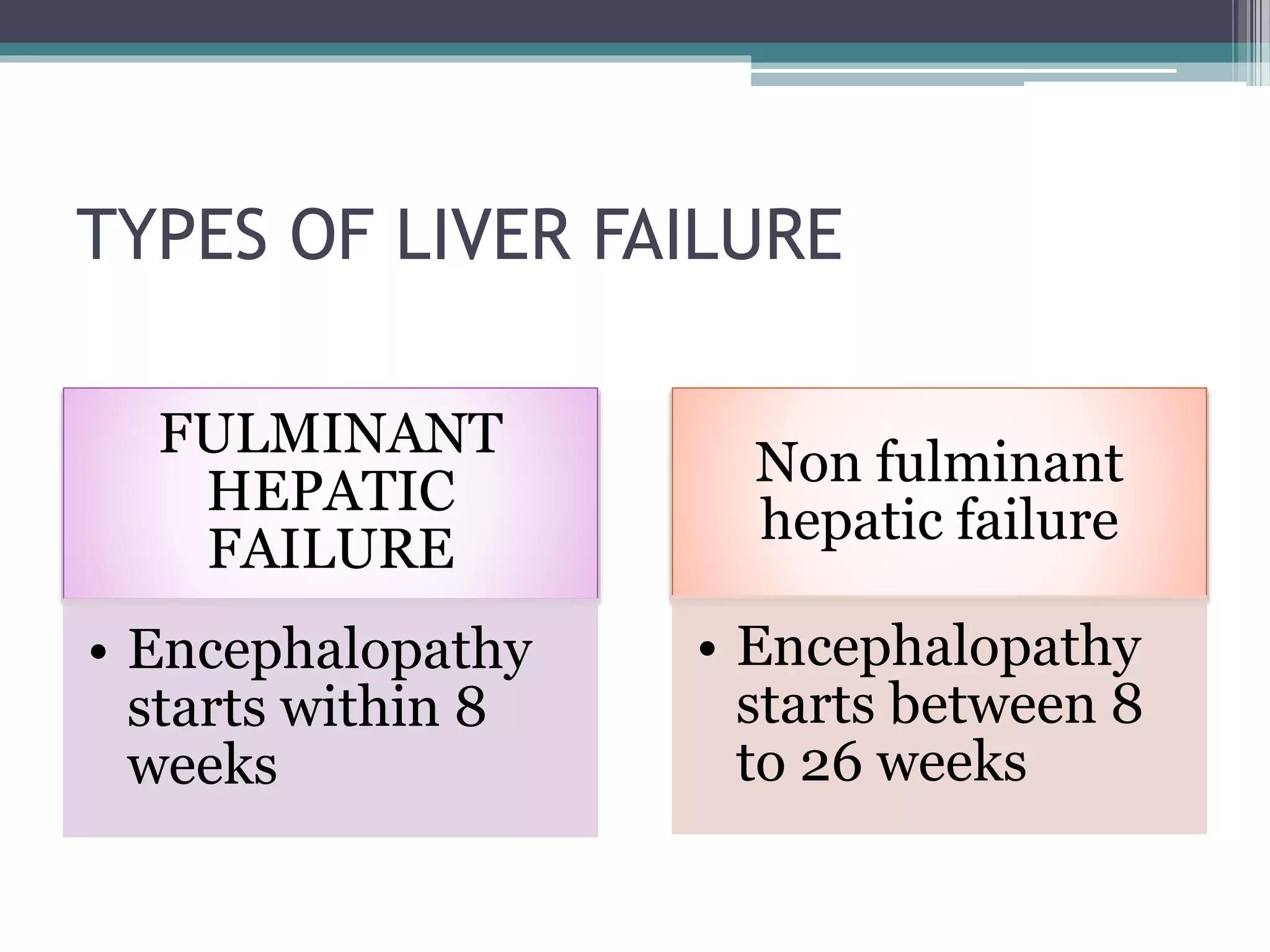
TYPES OF LIVER FAILURE
FULMINANT
HEPATIC
FAILURE
• Encephalopathy
starts within 8
weeks
Non fulminant
hepatic failure
• Encephalopathy
starts between 8
to 26 weeks
ACUTE LIVER FAILURE
Acute liver failure (ALF) is
a rare condition
characterized by the abrupt
onset of severe liver injury.
ALF
• Acute liver failure is loss of liver function
that occurs rapidly — in days or weeks —
usually in a person who has no pre-
existing liver disease .
• It's a medical emergency that requires
hospitalization .
INCIDENCE
• In developed country incidence is 10
cases per million people per year.
• it accounts for 6% of all deaths due to
liver disease.
• It is more common in women than in men,
and more common in white people than in
other races.
ETIOLOGY OF ALF
•
VIRAL
HEPATITIS
DRUG
INDUCED
HEPATOTOX
ICITY
TOXIN
RELATED
HEPATOTOX
ICITY
VASCULAR
CAUSES
METABOLIC
CAUSES
VIRAL HEPATITIS
Virus hepatitis may lead to hepatic failure.
Hepatitis A and B Accounts for most of the
cases.
Atypical causes of viral hepatitis and
fulminant hepatic failure include the following:
Cytomegalovirus, Herpes simplex virus,
paramyxovirus, Epstein-Barr virus
DRUG INDUCED HEPATOTOXICITY
• Acetaminophen is the main drug for these type
of hepatotoxicity.
• Acetaminophen (also known as paracetamol )
may lead to liver failure as a result of intentional
or accidental overdose.
• Some kind of antibiotics, antidepressants,
anaesthetic agents, Salicylates are also
associated with hepatotoxicity.
TOXIN RELATED HEAPTOTOXICITY
Amanita phalloides,
mushroom toxin.
Cyanobacteria toxin .
Organic solvents (eg, carbon tetrachloride).
Yellow phosphorus.
AMNITA PHALLOIDES
VASCULAR CAUSES• Liver injury caused by
insufficient blood flow
Ischemic
hepatitis./ Shock
liver
• Occlusion of hepatic
veins that drains liver
Budd chairi
syndrome .
• Blockage or narrowing
of the portal vein.
Portal vein
thrombosis.
METABOLIC CAUSES
Alpha1-antitrypsin . (shape and blockage )
Fructose intolerance. (Def. of aldolase B which
results in inability to convert fructose 1 phosphate
into dihydroxyacetone and glyceraldehyde. )
Galactosemia (Decreased liver enzyme to break
down )
Reye syndrome. (fatty liver+ encephalopathy )
Wilson disease. (copper accumulation )
MALIGNANCIES
• primary liver tumour (hepatocellular
carcinoma).
• Secondary tumour includes hepatic
metastasis or breast, lung cancer .
C/M OF ALF
 Hepatic encephalopathy (mental confusion,
difficulty concentrating and disorientation)
 Sudden jaundice .
 Pain and tenderness in the upper right side of
the stomach.
 Nausea.
 Vomiting.
 Melena.
• Ascites (accumulation of fluid in the
stomach)
• Ankle Edema (accumulation of fluid in the
legs, ankles and feet)
• Feeling ill (Malaise).
• Drowsiness.
• Muscle tremors.
• Bleeding easily
• Cerebral oedema
• Coma
• Brain herniation.
• Hypotension.
• Tachycardia.
• Hematemesis.
DIAGNOSTIC EVALUATION
• History collection.
• Physical examination.
• CBC.
• Prothrombin time (PT) . (9.5-13.5 Seconds )
• SGOT , SGPT.
• Serum billirubin level, Serum ammonia level.
• ABG.
• Serum Creatinine level,
• Serum free copper
• Ceruloplasmin level. (20-38mg/dl)(wilson diases)
• Blood cultures: For patients with
suspected infection.
• Viral serology: hepatitis A virus
immunoglobulin M (IgM), hepatitis B
surface antigen (HBsAg).
• Drug screening.
• Electroencephalography(EEG)
• Intracranial pressure monitoring.
• Percutaneous (contraindicated in
presence of coagulopathy) or transjugular
liver biopsy.
• Autoimmune markers: Autoimmune
markers (for autoimmune hepatitis
diagnosis):
A. Antinuclear antibody (ANA).
B. Anti-smooth muscle antibody (ASMA).
MANAGEMENT OF ALF
Treatment of acute liver failure consists
of Drugs and liver transplantation.
Pharmacological management
includes certain antidotes to reverse
the effects of ALF and various
medications to reduce ICP.
Antidotes neutralize toxic agents or
counteract any form of poisoning.
PHARAMACOLOGICAL INTERVENTION
Penicillin G.
Activated charcoal.
N-Acetylcysteine.
Osmotic diuretics.
Barbiturate.
Benzodiazepine.
Anaesthetic agents.
PENICILLIN G
• Intravenous Penicillin G is the drug of
choice for the treatment of Mushroom
Poisoning from Amanita Phalloides.
ACTIVATED CHARCOL
• Patients who have recently ingested A.
Phalloides activated charcoal may bind
the toxin and prevent absorption.
ACTIVATED CHARCOAL
EFFECT OF ACTIVATED CHARCOAL
N-Acectylcycteine
• It is the drug of choice in acetaminophen
overdose.
•
OSMOTIC DIUERETICS
• Intracranial hypertension in acute liver
failure managed by osmotic diuretics such
as Mannitol.
• Mannitol decreases cerebral Edema.
BARBITURATE
• Pentobarbital are used when severe
intracranial hypertension does not respond
to any measures.
BENZODIAZEPENE
• Midazolam is used for sedation in
mechanically ventilated patients.
ANEASTHATIC AGENTS
• Propofol is a sedative hypnotic used to
reduce cerebral blood flow.
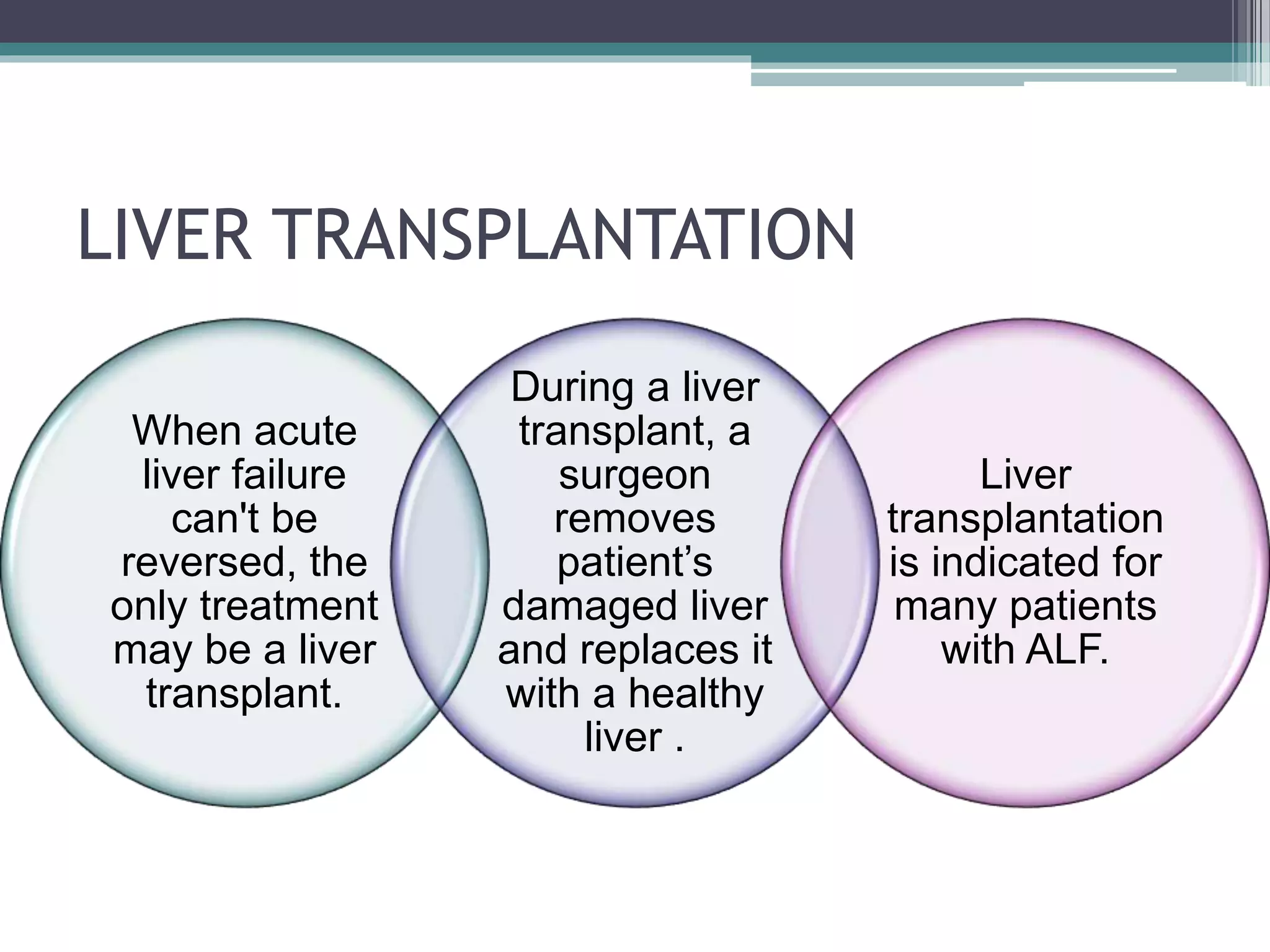
LIVER TRANSPLANTATION
When acute
liver failure
can't be
reversed, the
only treatment
may be a liver
transplant.
During a liver
transplant, a
surgeon
removes
patient’s
damaged liver
and replaces it
with a healthy
liver .
Liver
transplantation
is indicated for
many patients
with ALF.
COMPLICATIONS
Kidney
failure.
Cerebral
Edema.
Bleeding
disorders.
Infections.
OTHER INTERVENTIONS
For coagulopathy/ GIT bleeding vitamin K can
be given to treat abnormal PT.
Hypotension should be treated with fluids.
Pulmonary complications mechanical
ventilation may be required.
Head of the patient should be elevated to 30
degree .
Neurological status should be monitored
regularly.
NURSING DIAGNOSIS
• Increased risk of dehydration, electrolytes
and metabolic disturbances related to liver
damage.
• Increased risk of secondary infections due
to impaired immune state , related to liver
dysfunction.
• Increased risk of haematological
complications related to liver dysfunction.
contd
• Changes in neurological state(
Encephalopathy) due to liver insufficiency.
• Increased risk of haematological
complications related to liver dysfunction.
• Anxiety related to the symptoms of
disease and fear of the unknown.
NURSING INTERVENTIONS
• Assess, report and record signs and
symptoms and reactions to the treatment.
• Monitor fluids input and output closely,
observe signs of dehydration, secondary
infections, neurological disturbances, Edema
and jaundice.
• Provide adequate diet with high proteins,
carbohydrates and vitamins ( carefully in
encephalopathy) .
Contd.
• Administer antibiotics, antiemetic, vitamins
and other medications as prescribed, monitor
for side effects.
• Monitor for signs of possible bleeding.
• Provide prescribed diet, rest and comfort
measures.
• Provide emotional support to client and his
family , explain all procedure to decrease
anxiety and to obtain cooperation.
PREVENTIVE MEASURES
• Tell doctor about all medicines. Over the
counter and herbal medicines interfere
with the drugs.
• Limit the amount of alcohol.
• Do not have wild mushrooms.
• Get vaccinated for hepatitis.
• Avoid contact with other people blood or
body fluids.

Hepatic failure

  • 1.
    Liver Failure/ HepaticFailure By, Ms. Ekta S Patel Assistant Professor
  • 2.
    LIVER FAILURE Liver failureis an uncommon condition in which rapid deterioration of liver function results in coagulopathy and alteration in the mental status( encephalopathy ). Liver failure indicates that liver has sustained injury.
  • 3.
    TYPES OF LIVERFAILURE FULMINANT HEPATIC FAILURE • Encephalopathy starts within 8 weeks Non fulminant hepatic failure • Encephalopathy starts between 8 to 26 weeks
  • 4.
    ACUTE LIVER FAILURE Acuteliver failure (ALF) is a rare condition characterized by the abrupt onset of severe liver injury.
  • 5.
    ALF • Acute liverfailure is loss of liver function that occurs rapidly — in days or weeks — usually in a person who has no pre- existing liver disease . • It's a medical emergency that requires hospitalization .
  • 6.
    INCIDENCE • In developedcountry incidence is 10 cases per million people per year. • it accounts for 6% of all deaths due to liver disease. • It is more common in women than in men, and more common in white people than in other races.
  • 7.
  • 8.
    VIRAL HEPATITIS Virus hepatitismay lead to hepatic failure. Hepatitis A and B Accounts for most of the cases. Atypical causes of viral hepatitis and fulminant hepatic failure include the following: Cytomegalovirus, Herpes simplex virus, paramyxovirus, Epstein-Barr virus
  • 9.
    DRUG INDUCED HEPATOTOXICITY •Acetaminophen is the main drug for these type of hepatotoxicity. • Acetaminophen (also known as paracetamol ) may lead to liver failure as a result of intentional or accidental overdose. • Some kind of antibiotics, antidepressants, anaesthetic agents, Salicylates are also associated with hepatotoxicity.
  • 10.
    TOXIN RELATED HEAPTOTOXICITY Amanitaphalloides, mushroom toxin. Cyanobacteria toxin . Organic solvents (eg, carbon tetrachloride). Yellow phosphorus.
  • 11.
  • 12.
    VASCULAR CAUSES• Liverinjury caused by insufficient blood flow Ischemic hepatitis./ Shock liver • Occlusion of hepatic veins that drains liver Budd chairi syndrome . • Blockage or narrowing of the portal vein. Portal vein thrombosis.
  • 13.
    METABOLIC CAUSES Alpha1-antitrypsin .(shape and blockage ) Fructose intolerance. (Def. of aldolase B which results in inability to convert fructose 1 phosphate into dihydroxyacetone and glyceraldehyde. ) Galactosemia (Decreased liver enzyme to break down ) Reye syndrome. (fatty liver+ encephalopathy ) Wilson disease. (copper accumulation )
  • 14.
    MALIGNANCIES • primary livertumour (hepatocellular carcinoma). • Secondary tumour includes hepatic metastasis or breast, lung cancer .
  • 15.
    C/M OF ALF Hepatic encephalopathy (mental confusion, difficulty concentrating and disorientation)  Sudden jaundice .  Pain and tenderness in the upper right side of the stomach.  Nausea.  Vomiting.  Melena.
  • 16.
    • Ascites (accumulationof fluid in the stomach) • Ankle Edema (accumulation of fluid in the legs, ankles and feet) • Feeling ill (Malaise). • Drowsiness. • Muscle tremors.
  • 17.
    • Bleeding easily •Cerebral oedema • Coma • Brain herniation. • Hypotension. • Tachycardia. • Hematemesis.
  • 18.
    DIAGNOSTIC EVALUATION • Historycollection. • Physical examination. • CBC. • Prothrombin time (PT) . (9.5-13.5 Seconds ) • SGOT , SGPT. • Serum billirubin level, Serum ammonia level. • ABG. • Serum Creatinine level, • Serum free copper • Ceruloplasmin level. (20-38mg/dl)(wilson diases)
  • 19.
    • Blood cultures:For patients with suspected infection. • Viral serology: hepatitis A virus immunoglobulin M (IgM), hepatitis B surface antigen (HBsAg). • Drug screening. • Electroencephalography(EEG) • Intracranial pressure monitoring. • Percutaneous (contraindicated in presence of coagulopathy) or transjugular liver biopsy.
  • 20.
    • Autoimmune markers:Autoimmune markers (for autoimmune hepatitis diagnosis): A. Antinuclear antibody (ANA). B. Anti-smooth muscle antibody (ASMA).
  • 21.
    MANAGEMENT OF ALF Treatmentof acute liver failure consists of Drugs and liver transplantation. Pharmacological management includes certain antidotes to reverse the effects of ALF and various medications to reduce ICP. Antidotes neutralize toxic agents or counteract any form of poisoning.
  • 22.
    PHARAMACOLOGICAL INTERVENTION Penicillin G. Activatedcharcoal. N-Acetylcysteine. Osmotic diuretics. Barbiturate. Benzodiazepine. Anaesthetic agents.
  • 23.
    PENICILLIN G • IntravenousPenicillin G is the drug of choice for the treatment of Mushroom Poisoning from Amanita Phalloides.
  • 24.
    ACTIVATED CHARCOL • Patientswho have recently ingested A. Phalloides activated charcoal may bind the toxin and prevent absorption.
  • 25.
  • 26.
  • 27.
    N-Acectylcycteine • It isthe drug of choice in acetaminophen overdose. •
  • 28.
    OSMOTIC DIUERETICS • Intracranialhypertension in acute liver failure managed by osmotic diuretics such as Mannitol. • Mannitol decreases cerebral Edema.
  • 29.
    BARBITURATE • Pentobarbital areused when severe intracranial hypertension does not respond to any measures.
  • 30.
    BENZODIAZEPENE • Midazolam isused for sedation in mechanically ventilated patients.
  • 31.
    ANEASTHATIC AGENTS • Propofolis a sedative hypnotic used to reduce cerebral blood flow.
  • 32.
    LIVER TRANSPLANTATION When acute liverfailure can't be reversed, the only treatment may be a liver transplant. During a liver transplant, a surgeon removes patient’s damaged liver and replaces it with a healthy liver . Liver transplantation is indicated for many patients with ALF.
  • 33.
  • 34.
    OTHER INTERVENTIONS For coagulopathy/GIT bleeding vitamin K can be given to treat abnormal PT. Hypotension should be treated with fluids. Pulmonary complications mechanical ventilation may be required. Head of the patient should be elevated to 30 degree . Neurological status should be monitored regularly.
  • 35.
    NURSING DIAGNOSIS • Increasedrisk of dehydration, electrolytes and metabolic disturbances related to liver damage. • Increased risk of secondary infections due to impaired immune state , related to liver dysfunction. • Increased risk of haematological complications related to liver dysfunction.
  • 36.
    contd • Changes inneurological state( Encephalopathy) due to liver insufficiency. • Increased risk of haematological complications related to liver dysfunction. • Anxiety related to the symptoms of disease and fear of the unknown.
  • 37.
    NURSING INTERVENTIONS • Assess,report and record signs and symptoms and reactions to the treatment. • Monitor fluids input and output closely, observe signs of dehydration, secondary infections, neurological disturbances, Edema and jaundice. • Provide adequate diet with high proteins, carbohydrates and vitamins ( carefully in encephalopathy) .
  • 38.
    Contd. • Administer antibiotics,antiemetic, vitamins and other medications as prescribed, monitor for side effects. • Monitor for signs of possible bleeding. • Provide prescribed diet, rest and comfort measures. • Provide emotional support to client and his family , explain all procedure to decrease anxiety and to obtain cooperation.
  • 39.
    PREVENTIVE MEASURES • Telldoctor about all medicines. Over the counter and herbal medicines interfere with the drugs. • Limit the amount of alcohol. • Do not have wild mushrooms. • Get vaccinated for hepatitis. • Avoid contact with other people blood or body fluids.