► Catastrophic situation in which the normal pattern of life or ecosystem

has been disrupted and extraordinary emergency interventions are
required to save and preserve lives and or the environment (Ministry of
Home Affairs 2012).
► The occurrence of sudden or major misfortune which disrupts the basic

fabric and normal functioning of the society or community (United
Nations).
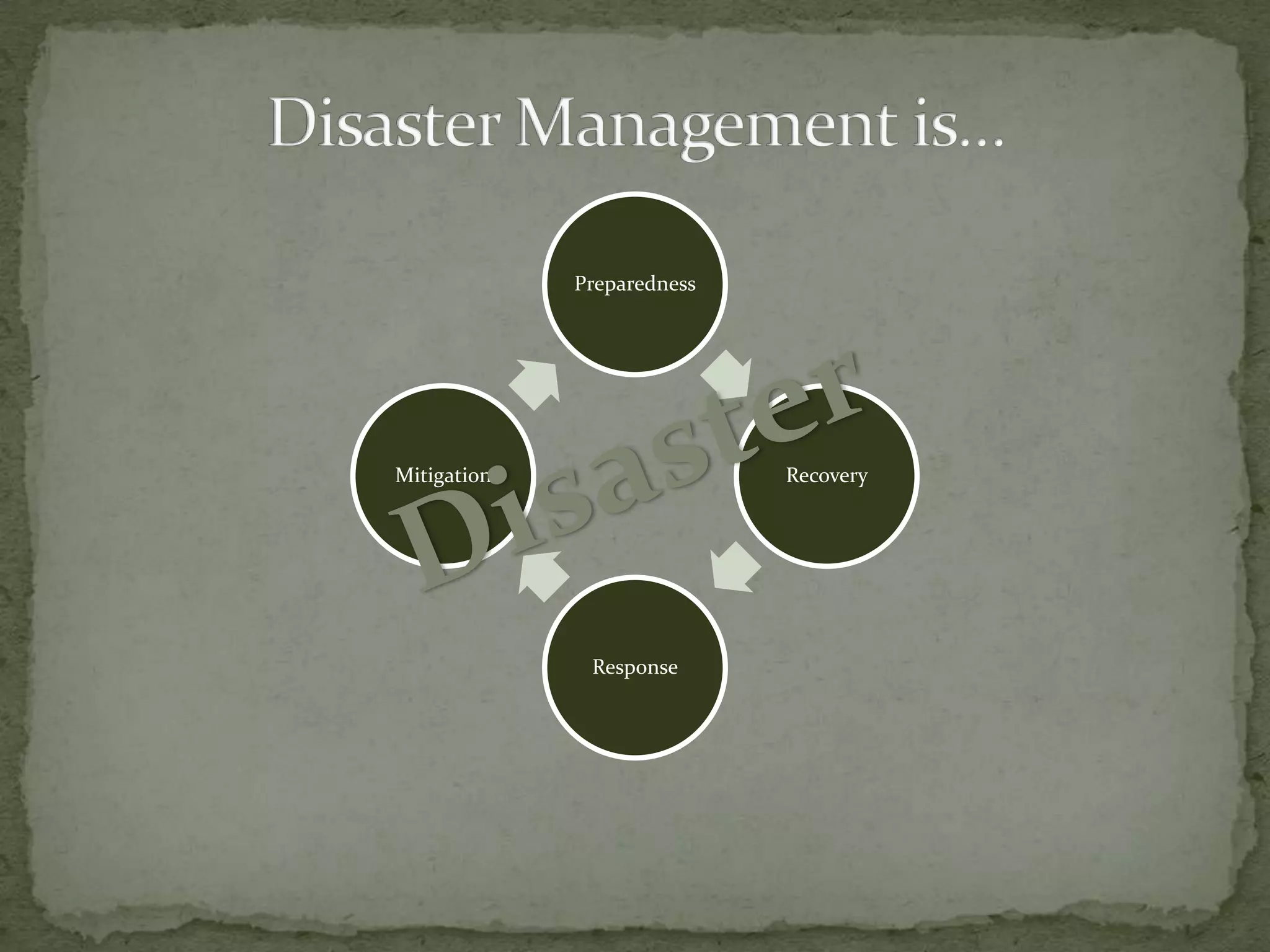
Preparedness

Mitigation

Recovery

Response
► Preparedness: activities prior to a disaster (long-term; all-hazard, culturally

sensitive and specific; multi-sectoral; part of a larger risk reduction program;
comprehensive application of sustainable development
►

For Instance- preparedness plan; emergency exercise/ training; warning
systems.

► Response: activities during a disaster
►

For Instance- public warning systems; emergency operations; search
and rescue.

► Recovery: activities following a disaster
►

For Instance- temporary housing; claims processing and grants; longterms medical care and counseling

► Mitigation: activities that reduces the effects of disasters.
►

For Instance- building codes and zoning; vulnerability analysis; public
education.
► Community Based

Organization’s (catalysts in their communities and
intermediaries between all stakeholders; the most advantageous and
appropriate position to provide and deliver necessities and services to
communities affected by disaster; sensitivity to and Awareness of Cultural and
Local Contexts )

► Donors (Primary role lies in the provision of funds and resources to carry out

relief, recovery and rehabilitation efforts)
► Local Community (all immediate life-saving actions and initial emergency

support in the first few days are provided by local people, often assisted by the
wider public and national institutions)
► Local Governments
► Media
► Others (International aid agencies, private and public foundations)
Water and climate related disasters
(Floods, Cyclones, Cloudburst, Drought, Tsunami, Hurricanes etc.)
Geological related disasters (Landslides and mudflows; Earthquakes; Dam
failures/ Dam bursts; Minor fires)
Chemical, industrial and nuclear related disasters (Chemical and industrial
disasters; Nuclear disasters, industrial accidents)
Accident related disasters (Forest fires, Urban fires, Mine flooding, Oil
spills, Major building collapse, Serial bomb blasts etc.)
Biological related disasters (Biological disasters and epidemics, Pest
attacks, Cattle epidemics, Food poisoning).
(Source: High Powered Committee Report-1999)
► India is one of the most disaster prone countries in the world
► India’s Vulnerability Profile
►

60% of India’s landmass is susceptible to earthquakes; over 8% prone to
floods

►

68% of the area is susceptible to drought

►

Over 70% prone to cyclones

►

70% of the land under cultivation is prone to drought

►

2.25% of the Gross Domestic Product has been eroded by disasters

► The need to consider disaster risk as a developmental issue was emphasised for

the first time in our Tenth Five Year Plan which covered the period 2002 to 2007.
► Economic loss is accounted for 2% of the GDP due to disasters as per the study of

the World Bank.
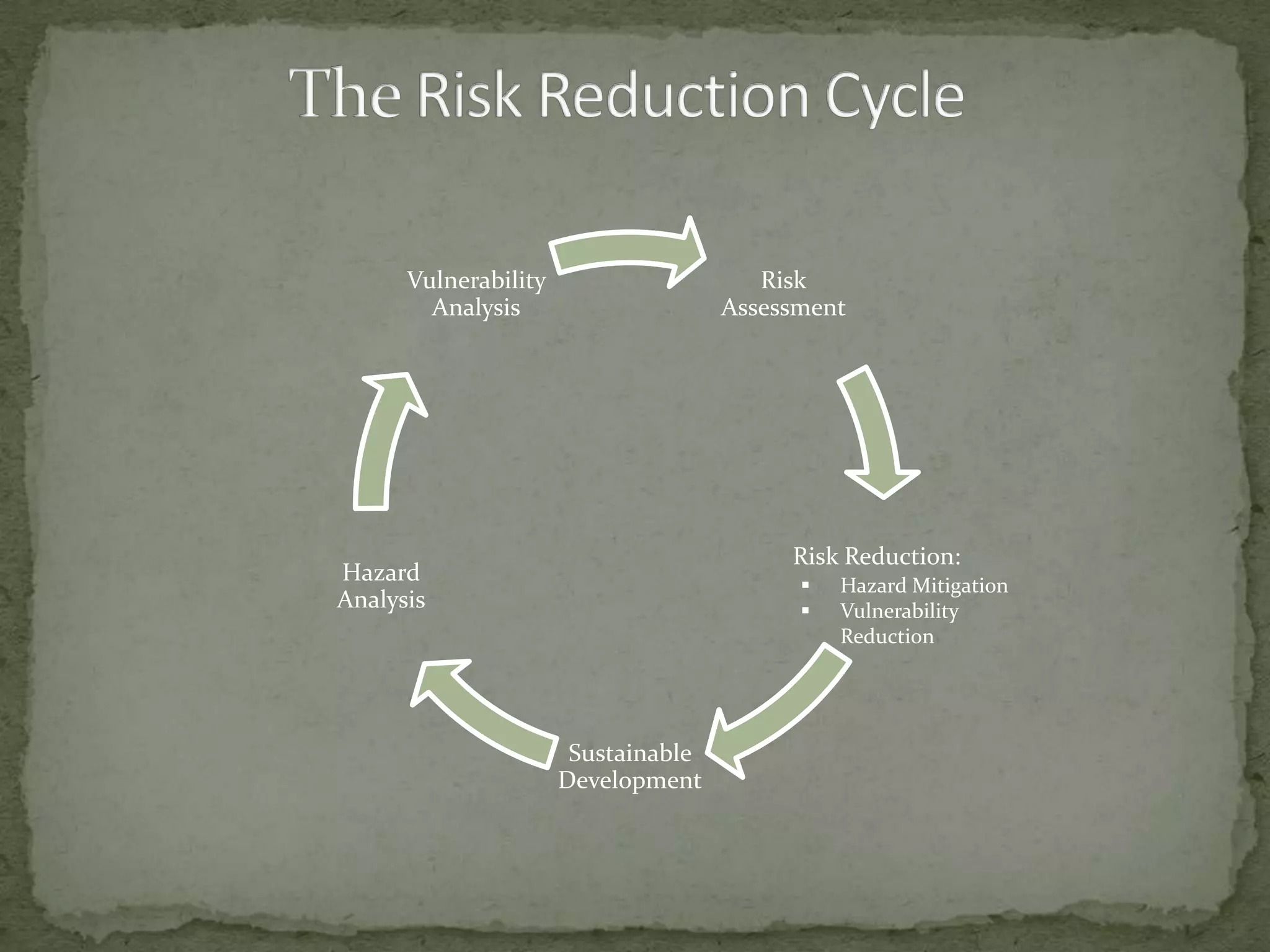
Vulnerability
Analysis

Risk
Assessment

Risk Reduction:

Hazard
Analysis




Sustainable
Development

Hazard Mitigation
Vulnerability
Reduction
► Mainstreaming of Disaster Risk Reduction in Developmental Strategy –

DRR should be seen as an integral part of environment and development.
► Analysis- The impending risk analysis should be done in the light of disasters

and possible threat of high intensity disasters.
► Plan formulation- Accordingly, mitigation and adaptation programmes

should be developed.
► Mitigation Plan -The mitigation plan should address the issues of structural

and non-structural interventions along with the fiscal and monetary tools (for
DRR & adaptation) for pre and post disaster planning.
► Sustainable

Development- If this is main streamed, sustainable
development can be attained and miseries of the people could be minimised.

► Linkages- The top down and bottom up institutional linkages for policy

formulation and programme execution would be interdependent with each
other.
► In sum, development cannot be sustainable without mitigation being built

into the developmental process.
► Lack of Online Inventory of Emergency Resources- early warning system

network and its close monitoring
► Lack of Database- Lack of integrated efforts to collect and compile

data, information and local knowledge on disaster history and traditional
response patterns.
► Cross-sectoral linkages- lacking mechanisms for integrating the

►
►
►
►

scientific, technological and administrative agencies for effective disaster
management
Vulnerability of critical infrastructures- power supply, communication, water
supply, transport, health , sanitation etc)
Strategy- Absence of a National Disaster Management Plan, and State level and
district level disaster management plans.
Geographical Planning- Preparedness and Mitigation very often ignored.
Institutional capacity

► Inadequate emergency medicine, critical care medicine, triage, first aid
► Disaster management is not the priority.
► No clear disaster-management policy
► Disaster Management Cell- neither well-equipped nor has the resources to

combat any untoward situations.
► Economy is considered more important than ecology. But in reality, the

economy depends on the health of the ecology.
► Lessons learnt:
►

Prevent mushrooming of new development
settlements in environmentally sensitive areas

projects

and

►

Be Prepared : Preparedness and Mitigation is bound to yield
more effective returns than distributing relief after a
disaster.

►

Create a Culture of Preparedness and Prevention.

►

Evolve a code of conduct for all stake-holders
► Shifting Paradigm
► Funding Priorities-Primacy of relief as disaster response.
► Participatory

Approaches-

Prioritize

Programs

with

True

Community

Involvement.
► Invest in Assessment- Investments in Preparedness and Prevention (Mitigation)

will yield sustainable results, rather than spending money on relief after a
disaster.
► Increased Capacity building - leads to faster vulnerability reduction.

► Mobilize Local Informants and Resource Persons and to refine strategies

accordingly.
► Encourage Sustainability and Independence – Moving Beyond Monetary Benefits
► Utilize and Respect Local Systems- Programs and interventions should not

disturb the local social, political, cultural and economic setup of the affected
area.
► Set-up

reliable information and communication network- Terrestrial
communication links which collapse in the event of a rapid onset disaster.

► Access and Measure data- Need for standardized efforts in compiling and

interpreting geo-spatial data, satellite imagery and early warning signals.
► Sustainability of efforts - Coordinated efforts among stakeholders (different

central ministries, state governments, the corporate sector, academic
institutions, civil societies and citizens at large.)
► Mobilize and train disaster volunteers: NSS, NCC, Scouts and Guides, Civil

Defence, Homeguards.
► Anticipatory Governance: Simulation exercises, Mock drills and Scenario
Analysis.
► Knowledge Management: Documentation and dissemination of good practices;
encourage information and knowledge sharing.
► Advocacy and Lobbying- Continuing efforts towards advocacy and lobbying
with the government and the media.
► Support local initiatives
► Flexibility is critical
► Seek local knowledge and assessment

► Invest towards long-term social needs of affected communities
► Information and Communication Technologies (Internet, GIS, Remote

Sensing, Satellite communication etc.)
► Adopt conservation and development in an eco sensitive manner
► Increasing the coping capacities of the communities at large and making them

resilient to the impacts of disasters
► Every stakeholder involved needs to contribute his bit in order to ensure that

the increasing hazards, risks & associated vulnerabilities get addressed in a
planned and systematic manner
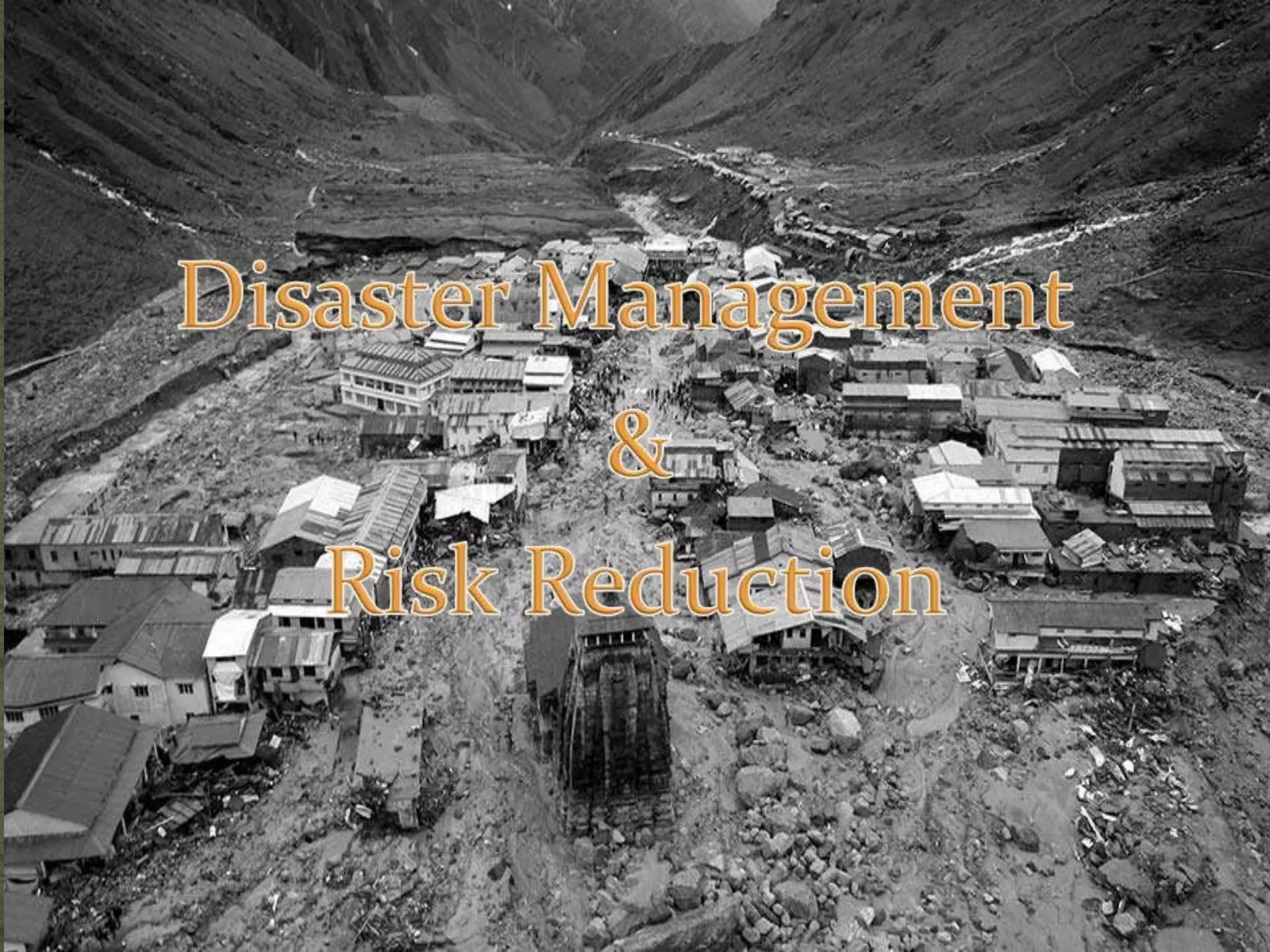
Disaster management & Risk Reduction

Disaster management & Risk Reduction

  • 3.
    ► Catastrophic situationin which the normal pattern of life or ecosystem has been disrupted and extraordinary emergency interventions are required to save and preserve lives and or the environment (Ministry of Home Affairs 2012). ► The occurrence of sudden or major misfortune which disrupts the basic fabric and normal functioning of the society or community (United Nations).
  • 4.
  • 5.
    ► Preparedness: activitiesprior to a disaster (long-term; all-hazard, culturally sensitive and specific; multi-sectoral; part of a larger risk reduction program; comprehensive application of sustainable development ► For Instance- preparedness plan; emergency exercise/ training; warning systems. ► Response: activities during a disaster ► For Instance- public warning systems; emergency operations; search and rescue. ► Recovery: activities following a disaster ► For Instance- temporary housing; claims processing and grants; longterms medical care and counseling ► Mitigation: activities that reduces the effects of disasters. ► For Instance- building codes and zoning; vulnerability analysis; public education.
  • 6.
    ► Community Based Organization’s(catalysts in their communities and intermediaries between all stakeholders; the most advantageous and appropriate position to provide and deliver necessities and services to communities affected by disaster; sensitivity to and Awareness of Cultural and Local Contexts ) ► Donors (Primary role lies in the provision of funds and resources to carry out relief, recovery and rehabilitation efforts) ► Local Community (all immediate life-saving actions and initial emergency support in the first few days are provided by local people, often assisted by the wider public and national institutions) ► Local Governments ► Media ► Others (International aid agencies, private and public foundations)
  • 7.
    Water and climaterelated disasters (Floods, Cyclones, Cloudburst, Drought, Tsunami, Hurricanes etc.) Geological related disasters (Landslides and mudflows; Earthquakes; Dam failures/ Dam bursts; Minor fires) Chemical, industrial and nuclear related disasters (Chemical and industrial disasters; Nuclear disasters, industrial accidents) Accident related disasters (Forest fires, Urban fires, Mine flooding, Oil spills, Major building collapse, Serial bomb blasts etc.) Biological related disasters (Biological disasters and epidemics, Pest attacks, Cattle epidemics, Food poisoning). (Source: High Powered Committee Report-1999)
  • 8.
    ► India isone of the most disaster prone countries in the world ► India’s Vulnerability Profile ► 60% of India’s landmass is susceptible to earthquakes; over 8% prone to floods ► 68% of the area is susceptible to drought ► Over 70% prone to cyclones ► 70% of the land under cultivation is prone to drought ► 2.25% of the Gross Domestic Product has been eroded by disasters ► The need to consider disaster risk as a developmental issue was emphasised for the first time in our Tenth Five Year Plan which covered the period 2002 to 2007. ► Economic loss is accounted for 2% of the GDP due to disasters as per the study of the World Bank.
  • 10.
  • 11.
    ► Mainstreaming ofDisaster Risk Reduction in Developmental Strategy – DRR should be seen as an integral part of environment and development. ► Analysis- The impending risk analysis should be done in the light of disasters and possible threat of high intensity disasters. ► Plan formulation- Accordingly, mitigation and adaptation programmes should be developed. ► Mitigation Plan -The mitigation plan should address the issues of structural and non-structural interventions along with the fiscal and monetary tools (for DRR & adaptation) for pre and post disaster planning. ► Sustainable Development- If this is main streamed, sustainable development can be attained and miseries of the people could be minimised. ► Linkages- The top down and bottom up institutional linkages for policy formulation and programme execution would be interdependent with each other. ► In sum, development cannot be sustainable without mitigation being built into the developmental process.
  • 12.
    ► Lack ofOnline Inventory of Emergency Resources- early warning system network and its close monitoring ► Lack of Database- Lack of integrated efforts to collect and compile data, information and local knowledge on disaster history and traditional response patterns. ► Cross-sectoral linkages- lacking mechanisms for integrating the ► ► ► ► scientific, technological and administrative agencies for effective disaster management Vulnerability of critical infrastructures- power supply, communication, water supply, transport, health , sanitation etc) Strategy- Absence of a National Disaster Management Plan, and State level and district level disaster management plans. Geographical Planning- Preparedness and Mitigation very often ignored. Institutional capacity ► Inadequate emergency medicine, critical care medicine, triage, first aid
  • 13.
    ► Disaster managementis not the priority. ► No clear disaster-management policy ► Disaster Management Cell- neither well-equipped nor has the resources to combat any untoward situations. ► Economy is considered more important than ecology. But in reality, the economy depends on the health of the ecology. ► Lessons learnt: ► Prevent mushrooming of new development settlements in environmentally sensitive areas projects and ► Be Prepared : Preparedness and Mitigation is bound to yield more effective returns than distributing relief after a disaster. ► Create a Culture of Preparedness and Prevention. ► Evolve a code of conduct for all stake-holders
  • 14.
    ► Shifting Paradigm ►Funding Priorities-Primacy of relief as disaster response. ► Participatory Approaches- Prioritize Programs with True Community Involvement. ► Invest in Assessment- Investments in Preparedness and Prevention (Mitigation) will yield sustainable results, rather than spending money on relief after a disaster. ► Increased Capacity building - leads to faster vulnerability reduction. ► Mobilize Local Informants and Resource Persons and to refine strategies accordingly. ► Encourage Sustainability and Independence – Moving Beyond Monetary Benefits ► Utilize and Respect Local Systems- Programs and interventions should not disturb the local social, political, cultural and economic setup of the affected area.
  • 15.
    ► Set-up reliable informationand communication network- Terrestrial communication links which collapse in the event of a rapid onset disaster. ► Access and Measure data- Need for standardized efforts in compiling and interpreting geo-spatial data, satellite imagery and early warning signals. ► Sustainability of efforts - Coordinated efforts among stakeholders (different central ministries, state governments, the corporate sector, academic institutions, civil societies and citizens at large.) ► Mobilize and train disaster volunteers: NSS, NCC, Scouts and Guides, Civil Defence, Homeguards. ► Anticipatory Governance: Simulation exercises, Mock drills and Scenario Analysis. ► Knowledge Management: Documentation and dissemination of good practices; encourage information and knowledge sharing. ► Advocacy and Lobbying- Continuing efforts towards advocacy and lobbying with the government and the media.
  • 16.
    ► Support localinitiatives ► Flexibility is critical ► Seek local knowledge and assessment ► Invest towards long-term social needs of affected communities ► Information and Communication Technologies (Internet, GIS, Remote Sensing, Satellite communication etc.) ► Adopt conservation and development in an eco sensitive manner ► Increasing the coping capacities of the communities at large and making them resilient to the impacts of disasters ► Every stakeholder involved needs to contribute his bit in order to ensure that the increasing hazards, risks & associated vulnerabilities get addressed in a planned and systematic manner