Vertical integration
                  When does
outsourcing/ownership matter?
What is vertical integration?
   Vertical (or horizontal) integration means that
    the assets that were previously held by two
    firms are combined into a single firm.
   The result is either joint ownership or the sale
    of one firm’s assets to the other.
Market Imperfections
   Upstream and downstream firm
   Downstream firm
       Monopolist with no costs
       Sets price to its market (mark-up over marginal
        costs)
   Upstream firm
       Monopolist
       Sets input price to downstream firm anticipating
        impact on demand
Vertical Integration
   Suppose upstream and downstream firms are
    commonly owned
   Best internal transfer price is based on
    upstream marginal cost, c.
   Market price set so that MR = c.
   Maximises joint profits
Impact on Profits
  $


  PS
  PI
       Downstream
         Profit
 c+t                                        Downstream Marginal
        Upstream                            Cost
         Profit
  c
                                            Joint Marginal
                                            Cost
                              Marginal   Demand
                              Revenue
                    QS   QI
Double Marginalisation
   With outsourcing
       Both firms charge a mark-up
       Higher prices, low overall profits, lower consumer
        welfare (not very competitive if there is another
        vertical chain)
   Solved by:
       Vertical integration
       Two-part tariffs
       More downstream or upstream competition
Can vertical integration
matter?
   The Coase Theorem tells us that asset ownership
    does not matter for efficiency.
       Assumes complete contracting
   When contracts are incomplete there exist residual
    rights of control (unspecified actions). According to
    Grossman & Hart:
        “To the extent that there are benefits of control, there will
          always be potential costs associated with removing control
          (i.e., ownership) from those who manage productive
          activities.”
GM-Fisher Body
   1920s: General Motors purchased car bodies from
    independent firm (Fisher Body)
   Technology change: wooden to metal
   GM built a new assembly plant that required reliable
    supply
       wanted Fisher Body to build a new car body plant next to it
       no need for shipping docks etc.
Fisher Refused
   Fisher Body refused to make this investment.
   Feared that a plant so closely tailored to
    GM’s needs would be vulnerable to GM’s
    demands (hold-up)
   Eventually resolved this issue by vertical
    integration -- could not find a contractual
    solution
Merger Benefits & Costs
   Benefits to GM:
       Could make more demands of Fisher Body
       More investment or extra supply
   Costs to GM:
       Diminished managerial incentives
       If costs are lowered in the body plant, GM is better able to
        appropriate these at expense of managers.
       Harder to keep those costs down.
Bottling Pepsi
   PepsiCo has two types of bottlers:
       Independent: owns assets of bottling operation
        and exclusive rights to franchise territory. Can
        determine how these are used - when to restock
        stores etc.
       Company owned: decisions can be made higher
        up; Pepsi can choose to delegate local marketing
        to its subsiduary
Pepsi’s Control
   Pepsi cannot control how an independent bottler
    operates in a territory
       If it wants a national marketing strategy (such as the Pepsi
        Challenge), it can’t compel the bottler to cooperate
   By acquiring a bottler, Pepsi has ultimate control.
       If the subsidiary managers refused to participate in the
        national campaign, they could be sacked and replaced.
Motivating Example Again
   Service requires a truck (the asset) for production
   Also, enhancing value are:
     a shipper, S (who wants to ship goods)
           there are also other shippers except that they have goods to ship that
            are $100 less in value created
       a trucker, T (does this): can take care or no care in maintaining
        truck;
           there are many truckers who can take no care but this particular
            trucker is the only one that can take care
   Effort in care is relationship-specific and is now assumed to be
    non-contractible
   Also assume that care is a skill that is developed (through habits
    etc.). Therefore, it becomes embedded in the trucker’s human
    capital.
Effort and Value
   Benefit from extended truck life
       No Care: truck’s value is $50
       Care: truck’s value is $200
   Trucker’s effort cost of care
       Minimal care: cost of $0
       High care: cost of $100
   Marginal Benefit = $150 > $100 = Marginal Cost
       Efficient to take care
What happens under different ownership structures for
                     the asset?
Non-contractible Investment
   Suppose bargaining took place after effort choice is
    made
   There are four cases to evaluate.
       Minimal care and alternative shipper
       Minimal care and S
       High care and alternative shipper
       High care and S
   S is no longer essential and so their added value is
    less than the T if they do not own the asset.
Will trucker take care?
              Ex Post Added Values: How to Share $200
Ownership         Shipper’s      Trucker’s     3rd Party’s
 Structure       Added Value    Added Value   Added Value
                  (Expected      (Expected     (Expected
                   Surplus)       Surplus       Surplus)
 Backward            $200           $150            $0
Integration         ($125)          ($75)          ($0)
 Forward             $100           $200            $0
Integration          ($50)         ($150)          ($0)
Cooperative          $200           $200            $0
                    ($100)         ($100)          ($0)
  Vertical           $100           $150          $200
 Separation        ($16.66)       ($66.66)      ($116.66)
Incentives and Ownership
   Trucker can be easily replaced if does not take care.
    However, under BI and 3rd party ownership (vertical
    separation), does not expect to earn enough to
    cover costs of $100.
   Will take care under FI: needs to have control rights
    (i.e., right to exclude use of asset) in order to gain
    sufficient surplus ex post.
       That is, under FI, by taking care, T gets $50 (=$150-$100)
        but only $25 if it does not take care.
       Under Cooperative, taking care gives T $0 but not taking
        care gives them $25.
   General principle: give control rights to agents
    making important investments.
Efficient Integration Level
   As they encourage the trucker to take care,
    forward integration is the only efficient
    organisational form
   Do we expect asset ownership to track
    efficiency?
Shipper Interests
   Shipper might choose to have a back haul. A
    back haul adds value of $100 (independent of
    level of care).
   Suppose that trucker – if they own the truck –
    can find alternative customers for the back
    haul. If expend cost of $10 will find alternative
    customer adding value of $50.
Forward Integration
   Shipper’s added value ex post:
       $250 if trucker searches for alternative customer
       $300 if trucker does not search
   Trucker’s added value ex post
       $300 regardless of whether searches
       Searching improves trucker’s expected surplus
        from $150 to $175; therefore, worth the $10
        expense.
   If search very costly, BI may become efficient
    again.
Optimal Firm Boundaries
   Ownership provides maximal incentives to
    take non-contractible actions
   Optimal firm boundary depends upon:
       whose actions are hardest to encourage
       whose actions are most important for value
   Never vest ownership with someone who
    does not provide a non-contractible action
    (I.e., 3rd party)
What Happens in Trucking?
   Suppose that you could put on-board
    computers on truckers to monitor drivers.
   Theory: easier to monitor driver’s care and
    reflect it in explicit performance payments or
    fines – therefore, less need for trucker
    ownership.
   Baker & Hubbard (2000): use of OBCs has
    increased non-trucker ownership especially
    on routes that may be more subject to trucker
    rent seeking.
Shipper vs. Carrier ownership
   What determines whether shippers use internal (captive) fleets or
    for-hire carriers for a haul?
     Determines who owns control rights associated with dispatch
       (truck scheduling)
   Shippers use internal fleets when want high service levels from
    truck drivers
   Truck utilisation higher in for-hire fleets – ability to line up a
    sequence of hauls for a truck – tight coordination (requires
    dispatcher effort)
   Need for flexibility conflicts with search for back hauls
   Harder to motivate truck drivers when looking for high service
    levels.
   Empirically: OBCs lead to more shipper ownership
Case: Insurance Industry
   Insurance industries
       In-house sales force: whole life
       Independent brokers: fire and casualty
   Choice determines ownership of client list
Effect of ownership
   Agent owns list
       cannot be solicited without permission
       agent looks for clients most likely to renew
       motivate agents by using renewal commission
       agent can hold-up company; threaten not to introduce new
        products to clients
   Company owns list
       company can hold-up agent; threaten to increase
        premiums that reduce renewal commission
Applying Grossman & Hart
   Choice between independent and in-house agents
    should turn on relative importance of investments in
    developing long-term clients by the agent and list-
    building activities of the insurance firm
       Whole life: customer less likely to switch so searching for
        long-term customers less important -- in-house
       Fire & casualty: searching for long-term customers is
        important -- independent
Dynamic Issues
     How does outsourcing and
integration performance change
                     over time?
T5 at Heathrow
   Project management handled internally
   Contractors on cost-plus contracts (not fixed
    price as is usually the case)
   British Airports Authority wanted to keep
    options open to change design specifications
    throughout the life of the project
   Happy to engage in on-going managerial
    attention
Fixed vs Cost Plus
   Fixed contracts
     Costs aren’t passed through
     High powered incentives to keep costs down
     Anticipate cost savings that might be achieved when tendering
     But contracts incomplete: so subject to renegotiation (also
       anticipated in tender)
   Cost plus contracts
     Costs are passed through
     Low powered incentives
     No difficult renegotiations – easier to change designs during
       project
   For complex projects that require lots of coordination, may be
    better to use cost plus contracts
Car Manufacturing
   Varied patterns of outsourcing
       Some companies integrated (GM)
       Some outsource almost everything (Volvo)
   Novak-Stern case studies suggest that...
       External sourcing allows firms to access state-of-the-art
        technology but leaves them open to hold-up and low effort supply
        after the initial terms of the contract are satisfied
       Internal development is associated with inferior technology
        development and high costs for an initial model-year, but there
        are much greater opportunities for improvements over time
Performance Over time

                             Vertical Integration              External Sourcing

                          Deep vehicle- specific          Global supply opportunities
       Ex Ante           knowledge base                     Opportunity for well-
                          Less knowledge of               defined performance
      Contracting
                         system-specific technology        contracts
     Opportunities        Difficult to enforce specific
                         performance criterion
                          Continuing authority             Hard to enforce contracts
       Ex Post           relationship allows for           after key requirements have
Renegotiation Outcomes   redirection                       been met
                          Potential for learning           Fewer continuing
                                                           relationships
Empirical Findings
Performance
(Consumer Reports)

                       Internal Sourcing


                       Outsourcing


                         Model Year
Summary
   No black and white choice in outsourcing
   Capabilities can improve over time
       Ability to coordinate internal or external teams
       Ability to improve internal performance
       Handling contractual disputes
   No ‘one size fits all’
       Complexity – design and parts
Principles of Efficient
Ownership
     Simple example
       Asset: luxury yacht
       Service: gourmet seafare
       Workers: chef and skipper
       Customer: tycoon
     Value created
       Tycoon value = $240 (no other customers)
       Substitutes for skipper’s skills (no added value)
       Chef: asset-specific action (no other yachts) for cost of $100;
         necessary to provide service for Tycoon
     Time-line
       Date 0: chef chooses whether to take action
       Date 1: negotiate over division of $240
Ownership Outcomes

  Owner      Skipper        Tycoon              Chef


 Division
             240/3 each   0, 240/2, 240/2   0, 240/2, 240/2
 (S, T, C)

  Invest        No             Yes               Yes
Skipper Value
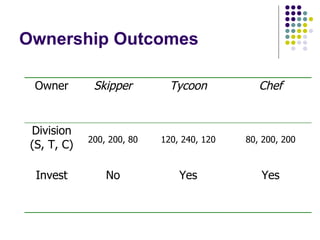
   Now suppose, skipper has a non-contractible
    (date 0) action
       for cost of $100 can increase value of service to
        tycoon by another $240 (total now $480)
       for example, increases knowledge of local islands
Ownership Outcomes

  Owner       Skipper         Tycoon           Chef


 Division
             200, 200, 80   120, 240, 120   80, 200, 200
 (S, T, C)

  Invest         No             Yes            Yes
Complementary Assets

     Now suppose there are other customers
      who can use the yacht
     But tycoon can choose a non-contractible
      action (e.g., plan entertainment schedule
      for the year). Gives additional value of
      $240.
     Yacht can be split in two: galley and hull
Divided Ownership
   Is it ever optimal for chef to own galley and
    skipper to own hull?
       Division of value is: chef ($320), skipper ($320)
        and tycoon ($240/3)
       Tycoon has to reach agreement with both while
        skipper and chef only require their joint
        agreement
   Better to give entire yacht to skipper or chef.
    Tycoon’s incentive rises ($240/2)
Principles
   Never give ownership to dispensable
    individuals
   Give ownership to indispensable agents
    (even though may not make an investment)
   Vest ownership of complementary assets
    with a single individual
Qualification

   Does asset ownership really improve incentives for
    specific investments?
       Those investments create value
       But may reduce the asset’s value outside of the
        relationship: it is specialised to the other agent
       Without ownership, do not care about this reduction
       Hence, it is possible that incentives could be reduced by
        ownership
Summary
   Value of ownership
       Increased bargaining position (added value)
   Incentives to take non-contractible actions
       Ownership improves this by allowing agent to capture a
        greater share of the rewards
       But diminishes the incentives of non-owners
   Who should own an asset?
       Agents taking non-contractible actions
       Important agents

Vertical integration

  • 1.
    Vertical integration When does outsourcing/ownership matter?
  • 2.
    What is verticalintegration?  Vertical (or horizontal) integration means that the assets that were previously held by two firms are combined into a single firm.  The result is either joint ownership or the sale of one firm’s assets to the other.
  • 3.
    Market Imperfections  Upstream and downstream firm  Downstream firm  Monopolist with no costs  Sets price to its market (mark-up over marginal costs)  Upstream firm  Monopolist  Sets input price to downstream firm anticipating impact on demand
  • 4.
    Vertical Integration  Suppose upstream and downstream firms are commonly owned  Best internal transfer price is based on upstream marginal cost, c.  Market price set so that MR = c.  Maximises joint profits
  • 5.
    Impact on Profits $ PS PI Downstream Profit c+t Downstream Marginal Upstream Cost Profit c Joint Marginal Cost Marginal Demand Revenue QS QI
  • 6.
    Double Marginalisation  With outsourcing  Both firms charge a mark-up  Higher prices, low overall profits, lower consumer welfare (not very competitive if there is another vertical chain)  Solved by:  Vertical integration  Two-part tariffs  More downstream or upstream competition
  • 7.
    Can vertical integration matter?  The Coase Theorem tells us that asset ownership does not matter for efficiency.  Assumes complete contracting  When contracts are incomplete there exist residual rights of control (unspecified actions). According to Grossman & Hart: “To the extent that there are benefits of control, there will always be potential costs associated with removing control (i.e., ownership) from those who manage productive activities.”
  • 8.
    GM-Fisher Body  1920s: General Motors purchased car bodies from independent firm (Fisher Body)  Technology change: wooden to metal  GM built a new assembly plant that required reliable supply  wanted Fisher Body to build a new car body plant next to it  no need for shipping docks etc.
  • 9.
    Fisher Refused  Fisher Body refused to make this investment.  Feared that a plant so closely tailored to GM’s needs would be vulnerable to GM’s demands (hold-up)  Eventually resolved this issue by vertical integration -- could not find a contractual solution
  • 10.
    Merger Benefits &Costs  Benefits to GM:  Could make more demands of Fisher Body  More investment or extra supply  Costs to GM:  Diminished managerial incentives  If costs are lowered in the body plant, GM is better able to appropriate these at expense of managers.  Harder to keep those costs down.
  • 11.
    Bottling Pepsi  PepsiCo has two types of bottlers:  Independent: owns assets of bottling operation and exclusive rights to franchise territory. Can determine how these are used - when to restock stores etc.  Company owned: decisions can be made higher up; Pepsi can choose to delegate local marketing to its subsiduary
  • 12.
    Pepsi’s Control  Pepsi cannot control how an independent bottler operates in a territory  If it wants a national marketing strategy (such as the Pepsi Challenge), it can’t compel the bottler to cooperate  By acquiring a bottler, Pepsi has ultimate control.  If the subsidiary managers refused to participate in the national campaign, they could be sacked and replaced.
  • 13.
    Motivating Example Again  Service requires a truck (the asset) for production  Also, enhancing value are:  a shipper, S (who wants to ship goods)  there are also other shippers except that they have goods to ship that are $100 less in value created  a trucker, T (does this): can take care or no care in maintaining truck;  there are many truckers who can take no care but this particular trucker is the only one that can take care  Effort in care is relationship-specific and is now assumed to be non-contractible  Also assume that care is a skill that is developed (through habits etc.). Therefore, it becomes embedded in the trucker’s human capital.
  • 14.
    Effort and Value  Benefit from extended truck life  No Care: truck’s value is $50  Care: truck’s value is $200  Trucker’s effort cost of care  Minimal care: cost of $0  High care: cost of $100  Marginal Benefit = $150 > $100 = Marginal Cost  Efficient to take care What happens under different ownership structures for the asset?
  • 15.
    Non-contractible Investment  Suppose bargaining took place after effort choice is made  There are four cases to evaluate.  Minimal care and alternative shipper  Minimal care and S  High care and alternative shipper  High care and S  S is no longer essential and so their added value is less than the T if they do not own the asset.
  • 16.
    Will trucker takecare? Ex Post Added Values: How to Share $200 Ownership Shipper’s Trucker’s 3rd Party’s Structure Added Value Added Value Added Value (Expected (Expected (Expected Surplus) Surplus Surplus) Backward $200 $150 $0 Integration ($125) ($75) ($0) Forward $100 $200 $0 Integration ($50) ($150) ($0) Cooperative $200 $200 $0 ($100) ($100) ($0) Vertical $100 $150 $200 Separation ($16.66) ($66.66) ($116.66)
  • 17.
    Incentives and Ownership  Trucker can be easily replaced if does not take care. However, under BI and 3rd party ownership (vertical separation), does not expect to earn enough to cover costs of $100.  Will take care under FI: needs to have control rights (i.e., right to exclude use of asset) in order to gain sufficient surplus ex post.  That is, under FI, by taking care, T gets $50 (=$150-$100) but only $25 if it does not take care.  Under Cooperative, taking care gives T $0 but not taking care gives them $25.  General principle: give control rights to agents making important investments.
  • 18.
    Efficient Integration Level  As they encourage the trucker to take care, forward integration is the only efficient organisational form  Do we expect asset ownership to track efficiency?
  • 19.
    Shipper Interests  Shipper might choose to have a back haul. A back haul adds value of $100 (independent of level of care).  Suppose that trucker – if they own the truck – can find alternative customers for the back haul. If expend cost of $10 will find alternative customer adding value of $50.
  • 20.
    Forward Integration  Shipper’s added value ex post:  $250 if trucker searches for alternative customer  $300 if trucker does not search  Trucker’s added value ex post  $300 regardless of whether searches  Searching improves trucker’s expected surplus from $150 to $175; therefore, worth the $10 expense.  If search very costly, BI may become efficient again.
  • 21.
    Optimal Firm Boundaries  Ownership provides maximal incentives to take non-contractible actions  Optimal firm boundary depends upon:  whose actions are hardest to encourage  whose actions are most important for value  Never vest ownership with someone who does not provide a non-contractible action (I.e., 3rd party)
  • 22.
    What Happens inTrucking?  Suppose that you could put on-board computers on truckers to monitor drivers.  Theory: easier to monitor driver’s care and reflect it in explicit performance payments or fines – therefore, less need for trucker ownership.  Baker & Hubbard (2000): use of OBCs has increased non-trucker ownership especially on routes that may be more subject to trucker rent seeking.
  • 23.
    Shipper vs. Carrierownership  What determines whether shippers use internal (captive) fleets or for-hire carriers for a haul?  Determines who owns control rights associated with dispatch (truck scheduling)  Shippers use internal fleets when want high service levels from truck drivers  Truck utilisation higher in for-hire fleets – ability to line up a sequence of hauls for a truck – tight coordination (requires dispatcher effort)  Need for flexibility conflicts with search for back hauls  Harder to motivate truck drivers when looking for high service levels.  Empirically: OBCs lead to more shipper ownership
  • 24.
    Case: Insurance Industry  Insurance industries  In-house sales force: whole life  Independent brokers: fire and casualty  Choice determines ownership of client list
  • 25.
    Effect of ownership  Agent owns list  cannot be solicited without permission  agent looks for clients most likely to renew  motivate agents by using renewal commission  agent can hold-up company; threaten not to introduce new products to clients  Company owns list  company can hold-up agent; threaten to increase premiums that reduce renewal commission
  • 26.
    Applying Grossman &Hart  Choice between independent and in-house agents should turn on relative importance of investments in developing long-term clients by the agent and list- building activities of the insurance firm  Whole life: customer less likely to switch so searching for long-term customers less important -- in-house  Fire & casualty: searching for long-term customers is important -- independent
  • 27.
    Dynamic Issues How does outsourcing and integration performance change over time?
  • 28.
    T5 at Heathrow  Project management handled internally  Contractors on cost-plus contracts (not fixed price as is usually the case)  British Airports Authority wanted to keep options open to change design specifications throughout the life of the project  Happy to engage in on-going managerial attention
  • 29.
    Fixed vs CostPlus  Fixed contracts  Costs aren’t passed through  High powered incentives to keep costs down  Anticipate cost savings that might be achieved when tendering  But contracts incomplete: so subject to renegotiation (also anticipated in tender)  Cost plus contracts  Costs are passed through  Low powered incentives  No difficult renegotiations – easier to change designs during project  For complex projects that require lots of coordination, may be better to use cost plus contracts
  • 30.
    Car Manufacturing  Varied patterns of outsourcing  Some companies integrated (GM)  Some outsource almost everything (Volvo)  Novak-Stern case studies suggest that...  External sourcing allows firms to access state-of-the-art technology but leaves them open to hold-up and low effort supply after the initial terms of the contract are satisfied  Internal development is associated with inferior technology development and high costs for an initial model-year, but there are much greater opportunities for improvements over time
  • 31.
    Performance Over time Vertical Integration External Sourcing  Deep vehicle- specific Global supply opportunities Ex Ante knowledge base  Opportunity for well-  Less knowledge of defined performance Contracting system-specific technology contracts Opportunities  Difficult to enforce specific performance criterion  Continuing authority  Hard to enforce contracts Ex Post relationship allows for after key requirements have Renegotiation Outcomes redirection been met  Potential for learning  Fewer continuing relationships
  • 32.
    Empirical Findings Performance (Consumer Reports) Internal Sourcing Outsourcing Model Year
  • 33.
    Summary  No black and white choice in outsourcing  Capabilities can improve over time  Ability to coordinate internal or external teams  Ability to improve internal performance  Handling contractual disputes  No ‘one size fits all’  Complexity – design and parts
  • 34.
    Principles of Efficient Ownership  Simple example  Asset: luxury yacht  Service: gourmet seafare  Workers: chef and skipper  Customer: tycoon  Value created  Tycoon value = $240 (no other customers)  Substitutes for skipper’s skills (no added value)  Chef: asset-specific action (no other yachts) for cost of $100; necessary to provide service for Tycoon  Time-line  Date 0: chef chooses whether to take action  Date 1: negotiate over division of $240
  • 35.
    Ownership Outcomes Owner Skipper Tycoon Chef Division 240/3 each 0, 240/2, 240/2 0, 240/2, 240/2 (S, T, C) Invest No Yes Yes
  • 36.
    Skipper Value  Now suppose, skipper has a non-contractible (date 0) action  for cost of $100 can increase value of service to tycoon by another $240 (total now $480)  for example, increases knowledge of local islands
  • 37.
    Ownership Outcomes Owner Skipper Tycoon Chef Division 200, 200, 80 120, 240, 120 80, 200, 200 (S, T, C) Invest No Yes Yes
  • 38.
    Complementary Assets  Now suppose there are other customers who can use the yacht  But tycoon can choose a non-contractible action (e.g., plan entertainment schedule for the year). Gives additional value of $240.  Yacht can be split in two: galley and hull
  • 39.
    Divided Ownership  Is it ever optimal for chef to own galley and skipper to own hull?  Division of value is: chef ($320), skipper ($320) and tycoon ($240/3)  Tycoon has to reach agreement with both while skipper and chef only require their joint agreement  Better to give entire yacht to skipper or chef. Tycoon’s incentive rises ($240/2)
  • 40.
    Principles  Never give ownership to dispensable individuals  Give ownership to indispensable agents (even though may not make an investment)  Vest ownership of complementary assets with a single individual
  • 41.
    Qualification  Does asset ownership really improve incentives for specific investments?  Those investments create value  But may reduce the asset’s value outside of the relationship: it is specialised to the other agent  Without ownership, do not care about this reduction  Hence, it is possible that incentives could be reduced by ownership
  • 42.
    Summary  Value of ownership  Increased bargaining position (added value)  Incentives to take non-contractible actions  Ownership improves this by allowing agent to capture a greater share of the rewards  But diminishes the incentives of non-owners  Who should own an asset?  Agents taking non-contractible actions  Important agents