Procurement
OPS430
Professor Ken Hogan
Introduction
Procurement means acquiring goods and/or services from an
   outside source. Procurement is the term generally used by
   government, while business uses the term purchasing and
   outsourcing is commonly used by the information technology
   industry.
It is estimated that in the year 2003 the worldwide information
   technology outsourcing market has grown to over US$110
   billion.
Why Outsource?
Outsourcing is a growing practice within the IT
 industry, and it is important to appreciate the
 reasons it is adopted:
  •   To reduce both fixed and recurrent costs.
  •   To allow the client organization to focus on its core business.
  •   To access skills and technologies.
  •   To provide flexibility.
  •   To increase accountability.
Procurement Management Processes
Project procurement management includes the following
  processes for acquiring goods and services from outside the
  project organization:
  • Procurement planning: determining what to procure and
    when.
  • Solicitation planning: documenting product requirements
    and identifying potential sources.
  • Solicitation: obtaining quotations, bids, offers, or proposals
    as appropriate.
  • Source selection: choosing from among potential vendors.
  • Contract administration: managing the relationship with
    the vendor.
  • Contract close-out: completion and settlement of the
    contract.
Procurement Management Processes
& Key Outputs
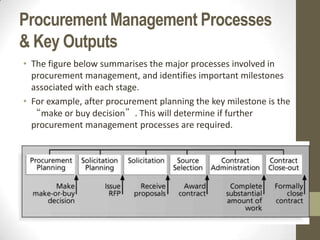
• The figure below summarises the major processes involved in
  procurement management, and identifies important milestones
  associated with each stage.
• For example, after procurement planning the key milestone is the
  “make or buy decision”. This will determine if further
  procurement management processes are required.
Procurement Planning
Procurement planning involves identifying which project needs
  can be best met by using products or services outside the
  organization. It includes deciding:
  •   Whether to procure.
  •   How to procure.
  •   What to procure.
  •   How much to procure.
  •   When to procure.
It is essential to be thorough and creative when planning
   procurement. Even though a company may be viewed as a
   competitor, it will often be advantageous to collaborate on
   some projects.
Inputs to Procurement
Planning
The inputs needed for procurement planning
  include:
   • The project scope statement.
   • Product description.
   • Market conditions.
   • Constraints and assumptions.
It is important to define the scope of the project, the
  products, market conditions, and constraints and
  assumptions. However, it is also essential to know
  exactly why you want to procure goods or services.
Tools and Techniques
Procurement management will often incorporate the following:
• Make-or-buy analysis: determining whether a particular product or
  service should be made or performed inside the organization or
  purchased from someone else. Often involves financial analysis.
• Experts, both internal and external, are valuable assets in
  procurement decisions.
    • Internal experts are particularly useful in providing knowledge of
      organizational and personnel issues.
    • External experts can provide expert judgment, especially with regard
      to vendors and technology issues.
Types of Contracts
A contract is a mutually and legally binding agreement
  that obligates the seller to provide specified
  products or services, and obligates the buyer to pay
  for them. Different types of contracts are suited to
  particular circumstances, there are three broad
  categories:
   • Fixed price or lump sum: involve a fixed total price
     for a well-defined product or service.
   • Cost reimbursable: involve payment to the seller
     for direct and indirect costs.
   • Unit price contracts: require the buyer to pay the
     seller a predetermined amount per unit of service.
Fixed Price Contracts
Fixed price or lump sum contracts involve a fixed total price for
  a well-defined product or service. These contracts are
  particularly suited where supplies or services can be clearly
  specified before tenders are invited. The buyer incurs little risk
  in this situation.
Fixed price contracts may also include incentives for meeting or
  exceeding project objectives. They may also include
  safeguards in the form of penalty clauses, however these may
  be difficult to apply before the consequences of delay are felt.
An important consideration is that any changes to resource
  requirements due to project revision (change) is likely to lead
  to additional claims by, and extra payment to the contractor.
Cost Reimbursable Contracts
Cost reimbursable or cost-plus contracts involve payment to the
  seller for direct and indirect actual costs. These contracts are
  often used for projects that include the provision of goods and
  services associated with new technologies. The buyer absorbs
  more risk with the type of contract, which has three forms:
   • Cost plus incentive fee (CPIF): the buyer pays the seller for
     allowable performance costs plus a predetermined fee and
     an incentive bonus.
   • Cost plus fixed fee (CPFF): the buyer pays the seller for
     allowable performance costs plus a fixed fee payment
     usually based on a percentage of estimated costs.
   • Cost plus percentage of costs (CPPC): the buyer pays the
     seller for allowable performance costs plus a
     predetermined percentage based on total costs.
Unit Price Contracts
Unit price contracts require the buyer to pay the seller a
  predetermined amount per unit of service, and the total value
  of the contract is a function of the quantities needed to
  complete the work.
Unit price contracts are also called a time and materials
  contract, and may incorporate volume discounts.
This type of contract is often used for services that are needed
  when the work cannot be clearly specified and total costs
  cannot be estimated in a contract. Many contract
  programmers and consultants prefer to use unit price
  contracts.
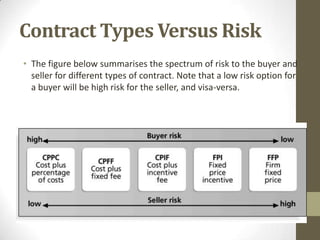
Contract Types Versus Risk
• The figure below summarises the spectrum of risk to the buyer and
  seller for different types of contract. Note that a low risk option for
  a buyer will be high risk for the seller, and visa-versa.
Many contracts include a statement of work (SOW). A
  statement of work is a description of the work required for the
  procurement. The SOW describes the work in sufficient detail
  to allow prospective sellers to determine if they are capable of
  providing the goods and services required, and to allow them
  to determine an appropriate price.
A good SOW gives bidders a better understanding of the buyer’s
  expectations, and therefore should be as clear, concise and as
  complete as possible. It should describe all the services
  required, and include performance reporting requirements.
  The SOW should specify the product of the project, use
  industry terms, and refer to industry standards.
Statement of Work (SOW)
Template

   I.     Scope of Work: Describe the work to be done to detail. Specify the hardware and
          software involved and the exact nature of the work.
   II.    Location of Work: Describe where the work must be performed. Specify the
          location of hardware and software and where the people must perform the work
   III.   Period of Performance: Specify when the work is expected to start and end,
          working hours, number of hours that can be billed per week, where the work must
          be performed, and related schedule information.
   IV.    Deliverables Schedule: List specific deliverables, describe them in detail, and
          specify when they are due.
   V.     Applicable Standards: Specify any company or industry-specific standards that
          are relevant to performing the work.
   VI.    Acceptance Criteria: Describe how the buyer organization will determine if the
          work is acceptable.
   VII.   Special Requirements: Specify any special requirements such as hardware or
          software certifications, minimum degree or experience level of personnel, travel
          requirements, and so on.
Solicitation Planning
Solicitation planning involves preparing of the documents
  needed for requesting bids (solicitation), and determining the
  evaluation criteria for the award of a contract. Common
  documents used in this process are:
  • Request for Proposals: used to solicit proposals from prospective
    sellers where there are several ways to meet the sellers’ needs.
  • Requests for Quotes: used to solicit quotes for well-defined
    procurements.
  • Invitations for bid or negotiation and initial contractor responses
    are also part of solicitation planning.
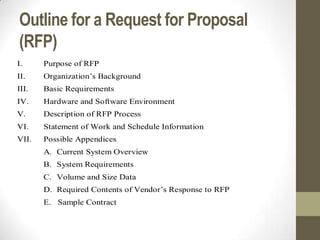
Outline for a Request for Proposal
(RFP)
I.     Purpose of RFP
II.    Organization’s Background
III.   Basic Requirements
IV.    Hardware and Software Environment
V.     Description of RFP Process
VI.    Statement of Work and Schedule Information
VII.   Possible Appendices
       A. Current System Overview
       B. System Requirements
       C. Volume and Size Data
       D. Required Contents of Vendor’s Response to RFP
       E. Sample Contract
Solicitation
Solicitation (or tendering) involves obtaining proposals, tenders
  or bids from prospective sellers. Prospective sellers do most
  the work in this process, usually at no cost to the buyer or the
  project. The buying organisation is responsible for advertising
  the “request to tender” (the solicitation).
Organizations can advertise to procure goods and services in
  several ways:
  • Approaching the preferred vendor.
  • Approaching several potential vendors.
  • Advertising to anyone interested.
A bidders’ conference or similar meeting between the buyer and
  the prospective sellers can help clarify the buyer’s
  expectations.
Source Selection
Once buyers receive proposals, they must select a
 vendor or decide to cancel the procurement.
 Source selection involves:
  •   Evaluating bidders’ proposals.
  •   Choosing the best one.
  •   Negotiating the contract.
  •   Awarding the contract.
It is highly recommended that buyers use formal
  evaluation procedures for selecting vendors.
Buyers often create a “short list”.
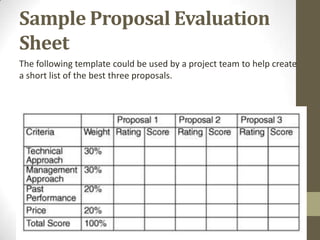
Sample Proposal Evaluation
Sheet
The following template could be used by a project team to help create
a short list of the best three proposals.
Source Selection
After developing a short list of possible sellers, organizations will
  often undertake more detailed evaluation.
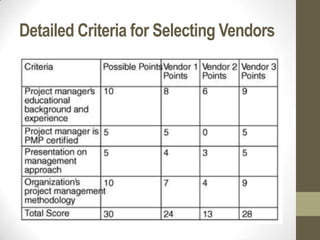
The following figure lists items that might be part of an
  evaluation of the top three vendors for a large information
  technology project.
All of the evaluation criteria are given a certain number of
  possible points (based on ranked importance), and the project
  team members and other stakeholders then evaluate each
  proposal by assigning points to each criteria.
Detailed Criteria for Selecting Vendors
Contract Administration
Contract administration ensures that the seller’s performance
meets contractual requirements. Contracts are legal
relationships, and are subject to the contract law in the country
where the project is conducted, and in the case of international
projects, the country of supply.
Contract Administration
However, due to their complexity, many project managers ignore
contractual issues. This can result in serious problems. Ideally,
the project manager and the project team should be actively
involved with contract law experts in the preparation and
administration of contracts.
Contract Administration
Project members must be aware of the legal problems they might
cause by not understanding a contract. In particular, most
projects involve changes, and these changes must be handled
properly for items under contract.
Change Control for Contracts
Change control is an important part of the contract administration
  process. The following change control process must be applied where
  there are contracts:
  • Changes to any part of the project need to be reviewed, approved, and
    documented by the same people in the same way that the original part of
    the plan was approved.
  • Evaluation of any change should include an impact analysis. How will the
    change affect the scope, time, cost, and quality of the goods or services
    being provided?
  • Changes must be documented in writing. Project team members should also
    document all important meetings and telephone phone calls.
Contract Close-out
Contract close-out is the final project procurement
 management process. It includes:
  • Product verification to determine if all work was
    completed correctly and satisfactorily.
  • Administrative activities to update records to
    reflect final results.
  • Archiving information for future use.
Procurement audits are often undertaken during
 contract close-out to identify lessons learned in the
 procurement process.
Conclusion - 1
It is essential that organizations obtain good contracts that
  minimize risk while ensuring optimum results through
  effective contract administration.
With the current competitive and demanding conditions found
  in information technology projects, it is very important to
  prepare contracts with great care and expert assistance. It is
  equally important to initiate and follow effective contract
  administration procedures.
Conclusion - 2
The following guidelines can help can assist in
 preparing proposals, contracts and administrative
 procedures:
  • Use checklists and templates where appropriate.
  • Evaluate risks by reference to suggested contract
    provisions where appropriate.
  • All major proposals and contracts, and contracts
    with questionable provisions, should be reviewed
    by a contract law expert.
  • Appropriate pricing and/or insuring of risk under
    the contract.
  • Periodic review, improvement and updating of
    contract    preparation     and    administration
    procedures.

Procurement ops450

  • 1.
  • 2.
    Introduction Procurement means acquiringgoods and/or services from an outside source. Procurement is the term generally used by government, while business uses the term purchasing and outsourcing is commonly used by the information technology industry. It is estimated that in the year 2003 the worldwide information technology outsourcing market has grown to over US$110 billion.
  • 3.
    Why Outsource? Outsourcing isa growing practice within the IT industry, and it is important to appreciate the reasons it is adopted: • To reduce both fixed and recurrent costs. • To allow the client organization to focus on its core business. • To access skills and technologies. • To provide flexibility. • To increase accountability.
  • 4.
    Procurement Management Processes Projectprocurement management includes the following processes for acquiring goods and services from outside the project organization: • Procurement planning: determining what to procure and when. • Solicitation planning: documenting product requirements and identifying potential sources. • Solicitation: obtaining quotations, bids, offers, or proposals as appropriate. • Source selection: choosing from among potential vendors. • Contract administration: managing the relationship with the vendor. • Contract close-out: completion and settlement of the contract.
  • 5.
    Procurement Management Processes &Key Outputs • The figure below summarises the major processes involved in procurement management, and identifies important milestones associated with each stage. • For example, after procurement planning the key milestone is the “make or buy decision”. This will determine if further procurement management processes are required.
  • 6.
    Procurement Planning Procurement planninginvolves identifying which project needs can be best met by using products or services outside the organization. It includes deciding: • Whether to procure. • How to procure. • What to procure. • How much to procure. • When to procure. It is essential to be thorough and creative when planning procurement. Even though a company may be viewed as a competitor, it will often be advantageous to collaborate on some projects.
  • 7.
    Inputs to Procurement Planning Theinputs needed for procurement planning include: • The project scope statement. • Product description. • Market conditions. • Constraints and assumptions. It is important to define the scope of the project, the products, market conditions, and constraints and assumptions. However, it is also essential to know exactly why you want to procure goods or services.
  • 8.
    Tools and Techniques Procurementmanagement will often incorporate the following: • Make-or-buy analysis: determining whether a particular product or service should be made or performed inside the organization or purchased from someone else. Often involves financial analysis. • Experts, both internal and external, are valuable assets in procurement decisions. • Internal experts are particularly useful in providing knowledge of organizational and personnel issues. • External experts can provide expert judgment, especially with regard to vendors and technology issues.
  • 9.
    Types of Contracts Acontract is a mutually and legally binding agreement that obligates the seller to provide specified products or services, and obligates the buyer to pay for them. Different types of contracts are suited to particular circumstances, there are three broad categories: • Fixed price or lump sum: involve a fixed total price for a well-defined product or service. • Cost reimbursable: involve payment to the seller for direct and indirect costs. • Unit price contracts: require the buyer to pay the seller a predetermined amount per unit of service.
  • 10.
    Fixed Price Contracts Fixedprice or lump sum contracts involve a fixed total price for a well-defined product or service. These contracts are particularly suited where supplies or services can be clearly specified before tenders are invited. The buyer incurs little risk in this situation. Fixed price contracts may also include incentives for meeting or exceeding project objectives. They may also include safeguards in the form of penalty clauses, however these may be difficult to apply before the consequences of delay are felt. An important consideration is that any changes to resource requirements due to project revision (change) is likely to lead to additional claims by, and extra payment to the contractor.
  • 11.
    Cost Reimbursable Contracts Costreimbursable or cost-plus contracts involve payment to the seller for direct and indirect actual costs. These contracts are often used for projects that include the provision of goods and services associated with new technologies. The buyer absorbs more risk with the type of contract, which has three forms: • Cost plus incentive fee (CPIF): the buyer pays the seller for allowable performance costs plus a predetermined fee and an incentive bonus. • Cost plus fixed fee (CPFF): the buyer pays the seller for allowable performance costs plus a fixed fee payment usually based on a percentage of estimated costs. • Cost plus percentage of costs (CPPC): the buyer pays the seller for allowable performance costs plus a predetermined percentage based on total costs.
  • 12.
    Unit Price Contracts Unitprice contracts require the buyer to pay the seller a predetermined amount per unit of service, and the total value of the contract is a function of the quantities needed to complete the work. Unit price contracts are also called a time and materials contract, and may incorporate volume discounts. This type of contract is often used for services that are needed when the work cannot be clearly specified and total costs cannot be estimated in a contract. Many contract programmers and consultants prefer to use unit price contracts.
  • 13.
    Contract Types VersusRisk • The figure below summarises the spectrum of risk to the buyer and seller for different types of contract. Note that a low risk option for a buyer will be high risk for the seller, and visa-versa.
  • 14.
    Many contracts includea statement of work (SOW). A statement of work is a description of the work required for the procurement. The SOW describes the work in sufficient detail to allow prospective sellers to determine if they are capable of providing the goods and services required, and to allow them to determine an appropriate price. A good SOW gives bidders a better understanding of the buyer’s expectations, and therefore should be as clear, concise and as complete as possible. It should describe all the services required, and include performance reporting requirements. The SOW should specify the product of the project, use industry terms, and refer to industry standards.
  • 15.
    Statement of Work(SOW) Template I. Scope of Work: Describe the work to be done to detail. Specify the hardware and software involved and the exact nature of the work. II. Location of Work: Describe where the work must be performed. Specify the location of hardware and software and where the people must perform the work III. Period of Performance: Specify when the work is expected to start and end, working hours, number of hours that can be billed per week, where the work must be performed, and related schedule information. IV. Deliverables Schedule: List specific deliverables, describe them in detail, and specify when they are due. V. Applicable Standards: Specify any company or industry-specific standards that are relevant to performing the work. VI. Acceptance Criteria: Describe how the buyer organization will determine if the work is acceptable. VII. Special Requirements: Specify any special requirements such as hardware or software certifications, minimum degree or experience level of personnel, travel requirements, and so on.
  • 16.
    Solicitation Planning Solicitation planninginvolves preparing of the documents needed for requesting bids (solicitation), and determining the evaluation criteria for the award of a contract. Common documents used in this process are: • Request for Proposals: used to solicit proposals from prospective sellers where there are several ways to meet the sellers’ needs. • Requests for Quotes: used to solicit quotes for well-defined procurements. • Invitations for bid or negotiation and initial contractor responses are also part of solicitation planning.
  • 17.
    Outline for aRequest for Proposal (RFP) I. Purpose of RFP II. Organization’s Background III. Basic Requirements IV. Hardware and Software Environment V. Description of RFP Process VI. Statement of Work and Schedule Information VII. Possible Appendices A. Current System Overview B. System Requirements C. Volume and Size Data D. Required Contents of Vendor’s Response to RFP E. Sample Contract
  • 18.
    Solicitation Solicitation (or tendering)involves obtaining proposals, tenders or bids from prospective sellers. Prospective sellers do most the work in this process, usually at no cost to the buyer or the project. The buying organisation is responsible for advertising the “request to tender” (the solicitation). Organizations can advertise to procure goods and services in several ways: • Approaching the preferred vendor. • Approaching several potential vendors. • Advertising to anyone interested. A bidders’ conference or similar meeting between the buyer and the prospective sellers can help clarify the buyer’s expectations.
  • 19.
    Source Selection Once buyersreceive proposals, they must select a vendor or decide to cancel the procurement. Source selection involves: • Evaluating bidders’ proposals. • Choosing the best one. • Negotiating the contract. • Awarding the contract. It is highly recommended that buyers use formal evaluation procedures for selecting vendors. Buyers often create a “short list”.
  • 20.
    Sample Proposal Evaluation Sheet Thefollowing template could be used by a project team to help create a short list of the best three proposals.
  • 21.
    Source Selection After developinga short list of possible sellers, organizations will often undertake more detailed evaluation. The following figure lists items that might be part of an evaluation of the top three vendors for a large information technology project. All of the evaluation criteria are given a certain number of possible points (based on ranked importance), and the project team members and other stakeholders then evaluate each proposal by assigning points to each criteria.
  • 22.
    Detailed Criteria forSelecting Vendors
  • 23.
    Contract Administration Contract administrationensures that the seller’s performance meets contractual requirements. Contracts are legal relationships, and are subject to the contract law in the country where the project is conducted, and in the case of international projects, the country of supply.
  • 24.
    Contract Administration However, dueto their complexity, many project managers ignore contractual issues. This can result in serious problems. Ideally, the project manager and the project team should be actively involved with contract law experts in the preparation and administration of contracts.
  • 25.
    Contract Administration Project membersmust be aware of the legal problems they might cause by not understanding a contract. In particular, most projects involve changes, and these changes must be handled properly for items under contract.
  • 26.
    Change Control forContracts Change control is an important part of the contract administration process. The following change control process must be applied where there are contracts: • Changes to any part of the project need to be reviewed, approved, and documented by the same people in the same way that the original part of the plan was approved. • Evaluation of any change should include an impact analysis. How will the change affect the scope, time, cost, and quality of the goods or services being provided? • Changes must be documented in writing. Project team members should also document all important meetings and telephone phone calls.
  • 27.
    Contract Close-out Contract close-outis the final project procurement management process. It includes: • Product verification to determine if all work was completed correctly and satisfactorily. • Administrative activities to update records to reflect final results. • Archiving information for future use. Procurement audits are often undertaken during contract close-out to identify lessons learned in the procurement process.
  • 28.
    Conclusion - 1 Itis essential that organizations obtain good contracts that minimize risk while ensuring optimum results through effective contract administration. With the current competitive and demanding conditions found in information technology projects, it is very important to prepare contracts with great care and expert assistance. It is equally important to initiate and follow effective contract administration procedures.
  • 29.
    Conclusion - 2 Thefollowing guidelines can help can assist in preparing proposals, contracts and administrative procedures: • Use checklists and templates where appropriate. • Evaluate risks by reference to suggested contract provisions where appropriate. • All major proposals and contracts, and contracts with questionable provisions, should be reviewed by a contract law expert. • Appropriate pricing and/or insuring of risk under the contract. • Periodic review, improvement and updating of contract preparation and administration procedures.