An Assignment On<br />International Business Encironment<br />“ GLOBAL OPERATIONS ”<br />Submitted to:<br />Dr. Gopalakrishna<br />Faculty<br />MBD Dept.<br />SDMCBM<br />Submitted by:<br />Anusha Joshi<br />II MBA, ‘B’<br />SDMCBM<br />Introduction to Global Operations:<br />Global business has become a centre issue for many international companies. The emergence of European, Japanese and Third World multinationals, setting up of NAFTA, European Union, and a progressive reduction in trade businesses around the world worked through WTO negotiations have awaited a new competitive environment. This has resulted in increasing number of multinational firms engaged in sourcing of component and products on a global scale. Indeed cross-national marketing transaction encompass both the buying (ie, sourcing) and selling (ie, market selection) aspects of the exchange process. Although marketing institutions are examined primarily in their roles as sellers rather than as buyers, the buying side of the exchange process should not be ignored.<br />The objective here is to examine the operational decisions from global perspective. Operational decisions are, in many ways, similar to foreign investment decisions. The initial foreign investment decisions involve the same consideration as ongoing decisions regarding procurement and delivery. The decisions are often different, however, because investment decisions are strategic, whereas operations decisions can be either strategic or tactical: big strategic decisions regarding plant locations, size of facilities, or so on; small or day-to-day tactical decisions regarding production schedules, delivery timetables and so on. As a result, operational management sometimes takes a long-term view or at times short-time view.<br />Once the firm decides to purchase rather than manufacture, then the question is whether it should purchase locally or internationally. Such sourcing strategies include a number of choices the companies make in deciding how to serve foreign markets.<br />Types of Outsourcing:<br />There are four types of ‘outsourcing’, based on the location and control/ownership as distinguishing criteria.<br />Captive onshore outsourcing: This implies a shift in intra-firm supplies affiliated firms in the home economy.
Non-captive onshore outsourcing: if the shift in sourcing of supplies benefits a affiliated firms in the home economy, one can describe it as non-captive onshore outsourcing. The term ‘onshore’ could be replaced in both cases by ‘locally’ or ‘domestically’.
Captive offshoring: It describes a situation in which future supplies are sourced from an affiliated firm abroad.
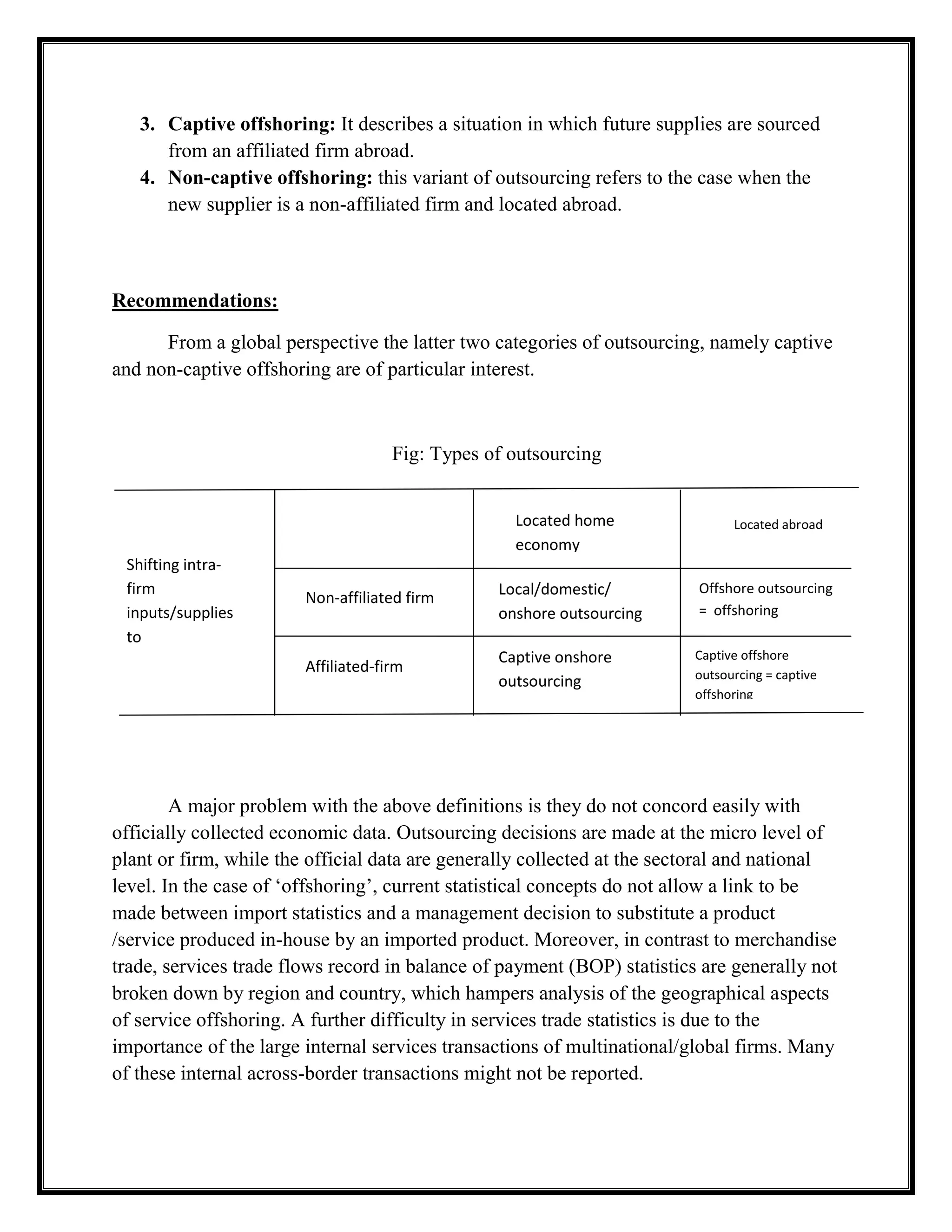
Non-captive offshoring: this variant of outsourcing refers to the case when the new supplier is a non-affiliated firm and located abroad.Recommendations:<br />From a global perspective the latter two categories of outsourcing, namely captive and non-captive offshoring are of particular interest.<br />Fig: Types of outsourcing<br />Captive offshore outsourcing = captive offshoringOffshore outsourcing =  offshoringCaptive onshore outsourcingLocal/domestic/ onshore outsourcingAffiliated-firmNon-affiliated firmShifting intra- firm inputs/supplies toLocated home economy<br />A major problem with the above definitions is they do not concord easily with officially collected economic data. Outsourcing decisions are made at the micro level of plant or firm, while the official data are generally collected at the sectoral and national level. In the case of ‘offshoring’, current statistical concepts do not allow a link to be made between import statistics and a management decision to substitute a product /service produced in-house by an imported product. Moreover, in contrast to merchandise trade, services trade flows record in balance of payment (BOP) statistics are generally not broken down by region and country, which hampers analysis of the geographical aspects of service offshoring. A further difficulty in services trade statistics is due to the importance of the large internal services transactions of multinational/global firms. Many of these internal across-border transactions might not be reported.<br />Another obstacle arises if one attempts to look at the sectoral breakdown of offshoring. The sectoral affiliation of a firm might not match the product or service which is offshored. An automobile company might offshore its accounting service and a bank might offshore its IT services. Employment and the net value added produced in the home country in the automobile (banking) sector might fall as a consequence of offshoring without a corresponding increase in the imports of automobile (financial services). These difficulties in the sectoral allocation of offshored activities also affect the estimate on the offshore potential of the economy. Obviously, services activities can also be offshored by non-service sectors.<br />Need and Importance of Outsourcing:<br />Standardization and automation are the important driving forces for the rise of outsourcing activities.
It is possible to combine the benefits of large-scale mass production with the benefits of a high degree of specialization within a single plant.
Use of highly specialized workers.
A network of several layer of suppliers located in various countries has emerged.

global operations

  • 1.
    An Assignment On<br/>International Business Encironment<br />“ GLOBAL OPERATIONS ”<br />Submitted to:<br />Dr. Gopalakrishna<br />Faculty<br />MBD Dept.<br />SDMCBM<br />Submitted by:<br />Anusha Joshi<br />II MBA, ‘B’<br />SDMCBM<br />Introduction to Global Operations:<br />Global business has become a centre issue for many international companies. The emergence of European, Japanese and Third World multinationals, setting up of NAFTA, European Union, and a progressive reduction in trade businesses around the world worked through WTO negotiations have awaited a new competitive environment. This has resulted in increasing number of multinational firms engaged in sourcing of component and products on a global scale. Indeed cross-national marketing transaction encompass both the buying (ie, sourcing) and selling (ie, market selection) aspects of the exchange process. Although marketing institutions are examined primarily in their roles as sellers rather than as buyers, the buying side of the exchange process should not be ignored.<br />The objective here is to examine the operational decisions from global perspective. Operational decisions are, in many ways, similar to foreign investment decisions. The initial foreign investment decisions involve the same consideration as ongoing decisions regarding procurement and delivery. The decisions are often different, however, because investment decisions are strategic, whereas operations decisions can be either strategic or tactical: big strategic decisions regarding plant locations, size of facilities, or so on; small or day-to-day tactical decisions regarding production schedules, delivery timetables and so on. As a result, operational management sometimes takes a long-term view or at times short-time view.<br />Once the firm decides to purchase rather than manufacture, then the question is whether it should purchase locally or internationally. Such sourcing strategies include a number of choices the companies make in deciding how to serve foreign markets.<br />Types of Outsourcing:<br />There are four types of ‘outsourcing’, based on the location and control/ownership as distinguishing criteria.<br />Captive onshore outsourcing: This implies a shift in intra-firm supplies affiliated firms in the home economy.
  • 2.
    Non-captive onshore outsourcing:if the shift in sourcing of supplies benefits a affiliated firms in the home economy, one can describe it as non-captive onshore outsourcing. The term ‘onshore’ could be replaced in both cases by ‘locally’ or ‘domestically’.
  • 3.
    Captive offshoring: Itdescribes a situation in which future supplies are sourced from an affiliated firm abroad.
  • 4.
    Non-captive offshoring: thisvariant of outsourcing refers to the case when the new supplier is a non-affiliated firm and located abroad.Recommendations:<br />From a global perspective the latter two categories of outsourcing, namely captive and non-captive offshoring are of particular interest.<br />Fig: Types of outsourcing<br />Captive offshore outsourcing = captive offshoringOffshore outsourcing = offshoringCaptive onshore outsourcingLocal/domestic/ onshore outsourcingAffiliated-firmNon-affiliated firmShifting intra- firm inputs/supplies toLocated home economy<br />A major problem with the above definitions is they do not concord easily with officially collected economic data. Outsourcing decisions are made at the micro level of plant or firm, while the official data are generally collected at the sectoral and national level. In the case of ‘offshoring’, current statistical concepts do not allow a link to be made between import statistics and a management decision to substitute a product /service produced in-house by an imported product. Moreover, in contrast to merchandise trade, services trade flows record in balance of payment (BOP) statistics are generally not broken down by region and country, which hampers analysis of the geographical aspects of service offshoring. A further difficulty in services trade statistics is due to the importance of the large internal services transactions of multinational/global firms. Many of these internal across-border transactions might not be reported.<br />Another obstacle arises if one attempts to look at the sectoral breakdown of offshoring. The sectoral affiliation of a firm might not match the product or service which is offshored. An automobile company might offshore its accounting service and a bank might offshore its IT services. Employment and the net value added produced in the home country in the automobile (banking) sector might fall as a consequence of offshoring without a corresponding increase in the imports of automobile (financial services). These difficulties in the sectoral allocation of offshored activities also affect the estimate on the offshore potential of the economy. Obviously, services activities can also be offshored by non-service sectors.<br />Need and Importance of Outsourcing:<br />Standardization and automation are the important driving forces for the rise of outsourcing activities.
  • 5.
    It is possibleto combine the benefits of large-scale mass production with the benefits of a high degree of specialization within a single plant.
  • 6.
    Use of highlyspecialized workers.
  • 7.
    A network ofseveral layer of suppliers located in various countries has emerged.
  • 8.
  • 9.
    Increases the numberof employment opportunities to countries taking outsourcing contracts.
  • 10.
    Increase in demandfor IT skills and English-speaking workers in service-exporting countries, will give rise to increase in wages and narrowing of the price gap between local and imported services.
  • 11.
    Comparative advantage fortrade between countries which are significantly different when it comes to relative factors of endowment.
  • 12.
    Vertical trade withinthe same industry due to offshoring of IT services and business processes.
  • 13.
    It’s a wayof avoiding expanding unit costs.
  • 14.
    The risk ofoutsourcing are lower, the better the institutional and infrastructural quality in the location of the contracting partner.
  • 15.
    Fixed managerial costs(fixes and variable), are limited to searching for a supplier and negotiating a contract and also variable managerial costs for monitoring and coordinating production, these costs can be considerably lower than setting up in-house productions.Global Manufacturing System and Practices:<br />The activities involved in creating a produce is termed as production. We use the term production to denote both service and manufacturing activities, since one can produce a service or produce s physical product.<br />Material management is the activity that controls the transmission of physical materials through the value chain, from procurement through production and into distribution. Material management includes logistics, which refers to the procurement and physical transmission of materials through supply chain, from suppliers to customers. Manufacturing and material management are closely linked, since a firm’s ability to perform its manufacturing functions efficiently depends on a continuous supply of high-quality material inputs, for which material management is responsible.<br />The manufacturing and material management functions of an international firm have a number of important strategic objectives. <br />One is to lower costs. Dispersing manufacturing activities to various locations around the globe where each activity can be performed most efficiently can lower costs. Costs can also be lowered by managing the global supply chain efficiently so as to better match supply and demand. Efficient supply chain management reduces the amount of inventory in the system and increases inventory turnover, which means the firm has to invest less working capital in inventory and is less likely to find excess inventory on hand that cannot be sold and has to be written off. A second strategic objective shared by manufacturing and material management is to increase product quality by eliminating defective products from both the supply chain and manufacturing process.<br />The objective of reducing costs and increasing quality are not independent of each other. The firm that improves the quality control will also reduce its costs of value creation. Improved quality control reduces costs in three ways:<br />Increases productivity because time is not wasted manufacturing poor-quality products that cannot be sold, leading to a direct reduction in unit costs.
  • 16.
    Lower rework andscrap costs associated with defective products.
  • 17.
    Lower the warrantycosts associated with fixing defective products.The effect is to lower the costs of value creation by reducing both manufacturing and service costs.<br />The main management technique that companies utilize to boost their product quality is Total Quality Management (TQM). TQM takes as its central focus the need to improve the quality of a company’s products and services. Which was developed by a number of American consultants such as late W. Edward Deming, Joseph Juran, and A. V. Feigenbaum. Deming identified a number of steps that should be part of any TQM program. He argued that management should embrace the states defects and poor-quality materials are not acceptable and should be eliminated. He suggests that the quality of supervision should be improves by allowing more time for supervisors to work with employees and ny providing them with the tools they need to do the job. Deming recommended that management should create an environment in which employees will not fear reporting problems or recommending improvement. He believes that work standards should not be only defined, but should also include some notion of quality to promote the production of defect-free outputs. He argued management has the responsibility to train employees in new skills to keep pace with changes in the workplace. In addition, he believed that achieving better quality requires the commitment of everyone in the company.<br />In recent years many companies have adopted a successor to TQM programs known as a six sigma program. Six sigma is a statistically bases philosophy that aims to reduce defects, boost productivity, eliminate waste, and cut costs throughout a company. Six sigma programs have been adopted by several major corporations, such as Motorola, GE, and Allied Signals. Sigma comes from the Greek letter that statisticians use to represrnt a standard deviation from mean, the higher the number of ‘sigmas’ the smaller the number of errors. At six sigma, a production process would be 99.99966 percent accurate., creating just 3.4 defect per million units. While it is almost impossible for a company to achive such perfection, six sigma quality is a goal that several strives toward. Increasingly, companies are adopting six sigma programs to try to boost their product quality and productivity.<br />In addition to lowering costs and improving quality, two other objectives have particular importance in the international business. First, manufacturing and material management must be able to accommodate demands for local responsiveness. Second, manufacturing and material management must be able to respond quickly to shift in customer demands since in recent years, time based competition has grown more important.<br />An essential decision facing international/global firms is where to locate its manufacturing activities to achieve the goals of minimizing costs and improving product quality. For the firm contemplating international production, a number of factors must be considered. These factors can be grouped under three broad categories: country factor, technological factor and product factor.<br />Recent Trends:<br />Use of Total Quality Management (TQM) system in manufacturing.
  • 18.
    Use of SixSigma program to improve quality and reduce defects.
  • 19.
    Use of just-in-timemanufacturing program wherein the products/services are produces just in time to be delivered, this reduces the inventory cost.
  • 20.
    Flexible manufacturing andmass customization: Emergence of Flexible manufacturing technologies, which allow the company to produce a wider variety of end products at a unit cost that at one-time could be achieved only through the mass production of a standardized output.