Reward Systems and Legal Issues
Overview
• Reward Systems
• Legal Issues

Prentice Hall, Inc. © 2006

Herman Aguinis, University of Colorado at Denver
Reward Systems: Overview
• Traditional and Contingent Pay (CP) Plans
– Reasons for Introducing CP Plans
– Possible Problems Associated with CP
– Selecting a CP Plan

• Putting Pay in Context
• Pay Structures

Prentice Hall, Inc. © 2006

Herman Aguinis, University of Colorado at Denver
Traditional Pay
• Salary and salary increases are based on
– Position
– Seniority

Prentice Hall, Inc. © 2006

Herman Aguinis, University of Colorado at Denver
Contingent Pay (CP)
• Salary and salary increases are based on
– Job performance

• Also called: Pay for Performance
• If not added to base pay, called:
– Variable pay

Prentice Hall, Inc. © 2006

Herman Aguinis, University of Colorado at Denver
Reasons for Introducing CP
• Performance management is more effective when
rewards are tied to results
• CP Plans force organizations to:
– Clearly define effective performance
– Determine what factors are necessary

• CP plans help to recruit and retain top performers
• CP plans project good corporate image

Prentice Hall, Inc. © 2006

Herman Aguinis, University of Colorado at Denver
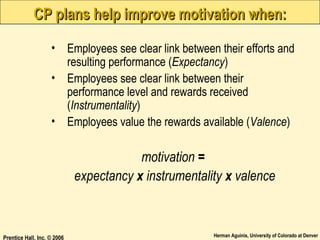
CP plans help improve motivation when:
• Employees see clear link between their efforts and
resulting performance (Expectancy)
• Employees see clear link between their
performance level and rewards received
(Instrumentality)
• Employees value the rewards available (Valence)

motivation =
expectancy x instrumentality x valence

Prentice Hall, Inc. © 2006

Herman Aguinis, University of Colorado at Denver
Possible Problems Associated with CP
•
•
•
•
•
•

Poor performance management system
Rewarding counterproductive behavior
Insignificant rewards
The reward becomes the driver
Extrinsic vs. intrinsic motivation
Disproportionately large rewards for executives

Prentice Hall, Inc. © 2006
Herman Aguinis, University of Colorado at Denver
Selecting a CP Plan: Issues to consider
A. Culture of organization
B. Strategic direction of organization

Prentice Hall, Inc. © 2006

Herman Aguinis, University of Colorado at Denver
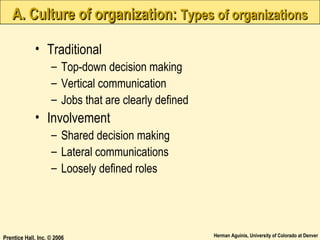
A. Culture of organization: Types of organizations
• Traditional
– Top-down decision making
– Vertical communication
– Jobs that are clearly defined

• Involvement
– Shared decision making
– Lateral communications
– Loosely defined roles

Prentice Hall, Inc. © 2006

Herman Aguinis, University of Colorado at Denver
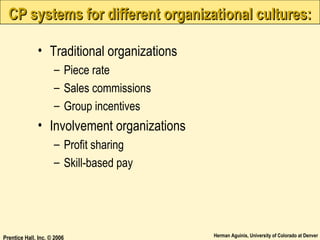
CP systems for different organizational cultures:
• Traditional organizations
– Piece rate
– Sales commissions
– Group incentives

• Involvement organizations
– Profit sharing
– Skill-based pay

Prentice Hall, Inc. © 2006

Herman Aguinis, University of Colorado at Denver
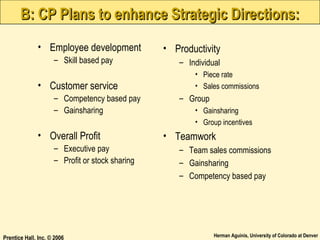
B: CP Plans to enhance Strategic Directions:
• Employee development
– Skill based pay

• Customer service
– Competency based pay
– Gainsharing

• Overall Profit
– Executive pay
– Profit or stock sharing

Prentice Hall, Inc. © 2006

• Productivity
– Individual
• Piece rate
• Sales commissions

– Group
• Gainsharing
• Group incentives

• Teamwork
– Team sales commissions
– Gainsharing
– Competency based pay

Herman Aguinis, University of Colorado at Denver
Putting Pay in Context
A reward increases the chance that
• Specific behaviors and results will be repeated, or
• Employee will engage in new behavior and
produce better results

Prentice Hall, Inc. © 2006

Herman Aguinis, University of Colorado at Denver
Rewards can include:
• Pay
• Recognition
– Public
– Private
– Status

• Time

Prentice Hall, Inc. © 2006

•
•
•
•
•

Trust & Respect
Challenge
Responsibility
Freedom
Relationships

Herman Aguinis, University of Colorado at Denver
How to Make Rewards Work
• Define and measure performance first and
then allocate rewards
• Only use rewards that are available
• Make sure all employees are eligible
• Rewards should be both
– Financial
– Non-financial
(continued)

Prentice Hall, Inc. © 2006

Herman Aguinis, University of Colorado at Denver
How to Make Rewards Work (continued)
• Rewards should be:
–
–
–
–

Prentice Hall, Inc. © 2006

Visible
Contingent
Timely
Reversible

Herman Aguinis, University of Colorado at Denver
Pay Structures
• Job Evaluation
• Broad-banding

Prentice Hall, Inc. © 2006

Herman Aguinis, University of Colorado at Denver
Pay structures
An organization’s pay structure
 Classifies jobs
Into categories
Based on their relative worth

 Is designed by job evaluation methods

Prentice Hall, Inc. © 2006

Herman Aguinis, University of Colorado at Denver
Job evaluation
• Method of data collection
– Determine the worth of various jobs to
– Create a pay structure

• Consideration of
– KSAs required for each job
– Value of job for organization
– How much other organizations pay

Prentice Hall, Inc. © 2006

Herman Aguinis, University of Colorado at Denver
Types of job evaluation methods:
• Ranking
• Classification
• Point

Prentice Hall, Inc. © 2006

Herman Aguinis, University of Colorado at Denver
Job evaluation methods: Ranking
• Create job descriptions
• Compare job descriptions
• Rank jobs

Prentice Hall, Inc. © 2006

Herman Aguinis, University of Colorado at Denver
Advantages of using Ranking method
• Requires little time
• Minimal effort needed for administration

Prentice Hall, Inc. © 2006

Herman Aguinis, University of Colorado at Denver
Disadvantages of using Ranking method
• Criteria for ranking may not be clear:
• Distances between each rank may not
be equal

Prentice Hall, Inc. © 2006

Herman Aguinis, University of Colorado at Denver
Job evaluation methods: Classification
• A series of classes or grades are created
• Each job is placed within a job class

Prentice Hall, Inc. © 2006

Herman Aguinis, University of Colorado at Denver
Advantages of using Classification method
• Jobs can be quickly slotted into structure
• Employees accept method because it seems
valid

Prentice Hall, Inc. © 2006

Herman Aguinis, University of Colorado at Denver
Disadvantages of using Classification method
• Requires extensive time and effort for
administration
• Differences between classification levels
may not be equal

Prentice Hall, Inc. © 2006

Herman Aguinis, University of Colorado at Denver
Job evaluation methods: Point method
• Identify compensable factors (job characteristics)
• Scale factors (e.g. on a scale of 1 – 5)
• Assign a weight to each factor so the sum of the
weights for all factors = 100%

Prentice Hall, Inc. © 2006

Herman Aguinis, University of Colorado at Denver
Advantages of using Point method
• Establish worth of each job relative to all
other jobs within organization
• Comprehensive measurement of relative
worth of each job in organization
• Easy to rank jobs when total points are
known for each job

Prentice Hall, Inc. © 2006

Herman Aguinis, University of Colorado at Denver
Disadvantages of using Point method
• Requires extensive administrative
– Time
– Effort

Prentice Hall, Inc. © 2006

Herman Aguinis, University of Colorado at Denver
Does job evaluation method matter?
– Fairness
– Evaluators
• Impartial
• Objective

Prentice Hall, Inc. © 2006

Herman Aguinis, University of Colorado at Denver
Compensation surveys
• Information on
– Base pay
– All other types of compensation

• Conducted in-house or by consultants, such as:
www.salary.com or www.haypaynet.com

Prentice Hall, Inc. © 2006

Herman Aguinis, University of Colorado at Denver
Broad-banding:
Pay structure collapses job classes into fewer
categories
Advantages:
•
•
•
•
•

Provides flexibility in rewarding people
Reflects changes in organization structure
Provides better base for rewarding growth in
competence
Gives more responsibility for pay decisions to
managers
Provides better basis for rewarding career progression

Prentice Hall, Inc. © 2006

Herman Aguinis, University of Colorado at Denver
Reward Systems: Summary
• Traditional and Contingent Pay (CP) Plans
– Reasons for Introducing CP Plans
– Possible Problems Associated with CP
– Selecting a CP Plan

• Putting Pay in Context
• Pay Structures

Prentice Hall, Inc. © 2006

Herman Aguinis, University of Colorado at Denver
Legal Issues: Overview
• Performance Management and the Law
• Some Legal Principles Affecting PM
• Laws Affecting PM

Prentice Hall, Inc. © 2006

Herman Aguinis, University of Colorado at Denver
Performance Management and the Law
• Performance management systems are legally
sound, if they are fair:
– Procedures are standardized
– Same procedures are used with all employees

Prentice Hall, Inc. © 2006

Herman Aguinis, University of Colorado at Denver
Some Legal Principles Affecting PM:
Overview
•
•
•
•
•
•

Employment-at-will
Negligence
Defamation
Misrepresentation
Adverse Impact
Illegal Discrimination

Prentice Hall, Inc. © 2006

Herman Aguinis, University of Colorado at Denver
Employment-at-will
• Employment relationship can be ended at any time by
– Employer
– Employee

• Exceptions
– Implied contract
– Possible violation of legal rights

Prentice Hall, Inc. © 2006

Herman Aguinis, University of Colorado at Denver
Negligence
• If organization documents describe a system
and
• It is Not implemented as described,
• Employee can challenge evaluation,
charging negligence

Prentice Hall, Inc. © 2006

Herman Aguinis, University of Colorado at Denver
Defamation
• Disclosure of performance information that is
– Untrue and
– Unfavorable

Prentice Hall, Inc. © 2006

Herman Aguinis, University of Colorado at Denver
Misrepresentation
• Disclosure of performance information that is
– Untrue and
– Favorable

Prentice Hall, Inc. © 2006

Herman Aguinis, University of Colorado at Denver
Adverse Impact / Unintentional Discrimination
• PM system has unintentional impact on a protected
class
• Organization must demonstrate:
– Specific KSA is a business requirement for the job
– All affected employees are evaluated in the same way

• Organization should review ongoing performance
score data by protected class to implement corrective
action as necessary

Prentice Hall, Inc. © 2006

Herman Aguinis, University of Colorado at Denver
Illegal Discrimination or Disparate Treatment
• Raters assign different scores to employees
based on factors that are NOT related to
performance
• Employees receive different treatment as result
of such ratings
• Employees can claim they were intentionally and
illegally treated differently due to their status

Prentice Hall, Inc. © 2006

Herman Aguinis, University of Colorado at Denver
Employee claim of illegal discrimination:
• Direct evidence of discrimination, or
• Evidence regarding the following:
– Membership in protected class
– Adverse employment decision
– Performance level deserved reward/different
treatment
– How others were treated (not in protected class)

Prentice Hall, Inc. © 2006

Herman Aguinis, University of Colorado at Denver
Employer response to claim of illegal discrimination
• Legitimate and non-discriminatory reason for action
• Related to performance
• Note: Good performance management system and
subsequent performance-related decision, used
consistently with all employees, provides defense

Prentice Hall, Inc. © 2006

Herman Aguinis, University of Colorado at Denver
Laws Affecting PM:
During past few decades, several countries have
passed laws prohibiting discrimination based on:
•Race or Ethnicity
•Sex
•Religion
•National Origin
•Age
•Disability status
•Sexual orientation

Prentice Hall, Inc. © 2006

Herman Aguinis, University of Colorado at Denver
Laws in the United Kingdom:
•
•
•
•
•

Equal Pay Act of 1970
Race Relations Act of 1976
Sex Discrimination Act of 1975
Disability Discrimination Act of 1995
Employment Equality (Sexual Orientation)
Regulations 2003
• Employment Equality (Religion or Belief)
Regulations 2003

Prentice Hall, Inc. © 2006

Herman Aguinis, University of Colorado at Denver
Laws in the United States of America
• Equal Pay Act of 1963
• Civil Rights Act of 1964
• Age Discrimination in Employment Act of 1967
(as amended in 1986)
• Americans with Disabilities Act of 1990

Prentice Hall, Inc. © 2006

Herman Aguinis, University of Colorado at Denver
Characteristics of Legally Sound PM Systems
• Organization:
– The system is formally explained and communicated to all
employees
– The system includes a formal appeals process
– Procedures are standardized and uniform for all employees
within a job group
– The system includes procedures to detect potentially
discriminatory effects or biases and abuses in the system

Prentice Hall, Inc. © 2006

Herman Aguinis, University of Colorado at Denver
Characteristics of Legally Sound PM Systems
• Management
– Supervisors are provided with formal training and information
on how to manage the performance of their employees
– Performance information is gathered from multiple, diverse,
and unbiased raters
– The system includes thorough and consistent documentation
including specific examples of performance based on firsthand knowledge

Prentice Hall, Inc. © 2006

Herman Aguinis, University of Colorado at Denver
Characteristics of Legally Sound PM Systems
• Employees
– Performance dimensions and standards are:
• Clearly defined and explained to the employee,
• Job-related, and
• Within the control of the employee

– Employees are given
• Timely information on performance deficiencies and
• Opportunities to correct them

– Employees are given a voice in the review process and
treated with courtesy and civility throughout the process

Prentice Hall, Inc. © 2006

Herman Aguinis, University of Colorado at Denver
Legal Issues: Summary
• Performance Management and the Law
• Some Legal Principles Affecting PM
• Laws Affecting PM

Prentice Hall, Inc. © 2006

Herman Aguinis, University of Colorado at Denver

Reward systems & legal issues

  • 1.
    Reward Systems andLegal Issues Overview • Reward Systems • Legal Issues Prentice Hall, Inc. © 2006 Herman Aguinis, University of Colorado at Denver
  • 2.
    Reward Systems: Overview •Traditional and Contingent Pay (CP) Plans – Reasons for Introducing CP Plans – Possible Problems Associated with CP – Selecting a CP Plan • Putting Pay in Context • Pay Structures Prentice Hall, Inc. © 2006 Herman Aguinis, University of Colorado at Denver
  • 3.
    Traditional Pay • Salaryand salary increases are based on – Position – Seniority Prentice Hall, Inc. © 2006 Herman Aguinis, University of Colorado at Denver
  • 4.
    Contingent Pay (CP) •Salary and salary increases are based on – Job performance • Also called: Pay for Performance • If not added to base pay, called: – Variable pay Prentice Hall, Inc. © 2006 Herman Aguinis, University of Colorado at Denver
  • 5.
    Reasons for IntroducingCP • Performance management is more effective when rewards are tied to results • CP Plans force organizations to: – Clearly define effective performance – Determine what factors are necessary • CP plans help to recruit and retain top performers • CP plans project good corporate image Prentice Hall, Inc. © 2006 Herman Aguinis, University of Colorado at Denver
  • 6.
    CP plans helpimprove motivation when: • Employees see clear link between their efforts and resulting performance (Expectancy) • Employees see clear link between their performance level and rewards received (Instrumentality) • Employees value the rewards available (Valence) motivation = expectancy x instrumentality x valence Prentice Hall, Inc. © 2006 Herman Aguinis, University of Colorado at Denver
  • 7.
    Possible Problems Associatedwith CP • • • • • • Poor performance management system Rewarding counterproductive behavior Insignificant rewards The reward becomes the driver Extrinsic vs. intrinsic motivation Disproportionately large rewards for executives Prentice Hall, Inc. © 2006 Herman Aguinis, University of Colorado at Denver
  • 8.
    Selecting a CPPlan: Issues to consider A. Culture of organization B. Strategic direction of organization Prentice Hall, Inc. © 2006 Herman Aguinis, University of Colorado at Denver
  • 9.
    A. Culture oforganization: Types of organizations • Traditional – Top-down decision making – Vertical communication – Jobs that are clearly defined • Involvement – Shared decision making – Lateral communications – Loosely defined roles Prentice Hall, Inc. © 2006 Herman Aguinis, University of Colorado at Denver
  • 10.
    CP systems fordifferent organizational cultures: • Traditional organizations – Piece rate – Sales commissions – Group incentives • Involvement organizations – Profit sharing – Skill-based pay Prentice Hall, Inc. © 2006 Herman Aguinis, University of Colorado at Denver
  • 11.
    B: CP Plansto enhance Strategic Directions: • Employee development – Skill based pay • Customer service – Competency based pay – Gainsharing • Overall Profit – Executive pay – Profit or stock sharing Prentice Hall, Inc. © 2006 • Productivity – Individual • Piece rate • Sales commissions – Group • Gainsharing • Group incentives • Teamwork – Team sales commissions – Gainsharing – Competency based pay Herman Aguinis, University of Colorado at Denver
  • 12.
    Putting Pay inContext A reward increases the chance that • Specific behaviors and results will be repeated, or • Employee will engage in new behavior and produce better results Prentice Hall, Inc. © 2006 Herman Aguinis, University of Colorado at Denver
  • 13.
    Rewards can include: •Pay • Recognition – Public – Private – Status • Time Prentice Hall, Inc. © 2006 • • • • • Trust & Respect Challenge Responsibility Freedom Relationships Herman Aguinis, University of Colorado at Denver
  • 14.
    How to MakeRewards Work • Define and measure performance first and then allocate rewards • Only use rewards that are available • Make sure all employees are eligible • Rewards should be both – Financial – Non-financial (continued) Prentice Hall, Inc. © 2006 Herman Aguinis, University of Colorado at Denver
  • 15.
    How to MakeRewards Work (continued) • Rewards should be: – – – – Prentice Hall, Inc. © 2006 Visible Contingent Timely Reversible Herman Aguinis, University of Colorado at Denver
  • 16.
    Pay Structures • JobEvaluation • Broad-banding Prentice Hall, Inc. © 2006 Herman Aguinis, University of Colorado at Denver
  • 17.
    Pay structures An organization’spay structure  Classifies jobs Into categories Based on their relative worth  Is designed by job evaluation methods Prentice Hall, Inc. © 2006 Herman Aguinis, University of Colorado at Denver
  • 18.
    Job evaluation • Methodof data collection – Determine the worth of various jobs to – Create a pay structure • Consideration of – KSAs required for each job – Value of job for organization – How much other organizations pay Prentice Hall, Inc. © 2006 Herman Aguinis, University of Colorado at Denver
  • 19.
    Types of jobevaluation methods: • Ranking • Classification • Point Prentice Hall, Inc. © 2006 Herman Aguinis, University of Colorado at Denver
  • 20.
    Job evaluation methods:Ranking • Create job descriptions • Compare job descriptions • Rank jobs Prentice Hall, Inc. © 2006 Herman Aguinis, University of Colorado at Denver
  • 21.
    Advantages of usingRanking method • Requires little time • Minimal effort needed for administration Prentice Hall, Inc. © 2006 Herman Aguinis, University of Colorado at Denver
  • 22.
    Disadvantages of usingRanking method • Criteria for ranking may not be clear: • Distances between each rank may not be equal Prentice Hall, Inc. © 2006 Herman Aguinis, University of Colorado at Denver
  • 23.
    Job evaluation methods:Classification • A series of classes or grades are created • Each job is placed within a job class Prentice Hall, Inc. © 2006 Herman Aguinis, University of Colorado at Denver
  • 24.
    Advantages of usingClassification method • Jobs can be quickly slotted into structure • Employees accept method because it seems valid Prentice Hall, Inc. © 2006 Herman Aguinis, University of Colorado at Denver
  • 25.
    Disadvantages of usingClassification method • Requires extensive time and effort for administration • Differences between classification levels may not be equal Prentice Hall, Inc. © 2006 Herman Aguinis, University of Colorado at Denver
  • 26.
    Job evaluation methods:Point method • Identify compensable factors (job characteristics) • Scale factors (e.g. on a scale of 1 – 5) • Assign a weight to each factor so the sum of the weights for all factors = 100% Prentice Hall, Inc. © 2006 Herman Aguinis, University of Colorado at Denver
  • 27.
    Advantages of usingPoint method • Establish worth of each job relative to all other jobs within organization • Comprehensive measurement of relative worth of each job in organization • Easy to rank jobs when total points are known for each job Prentice Hall, Inc. © 2006 Herman Aguinis, University of Colorado at Denver
  • 28.
    Disadvantages of usingPoint method • Requires extensive administrative – Time – Effort Prentice Hall, Inc. © 2006 Herman Aguinis, University of Colorado at Denver
  • 29.
    Does job evaluationmethod matter? – Fairness – Evaluators • Impartial • Objective Prentice Hall, Inc. © 2006 Herman Aguinis, University of Colorado at Denver
  • 30.
    Compensation surveys • Informationon – Base pay – All other types of compensation • Conducted in-house or by consultants, such as: www.salary.com or www.haypaynet.com Prentice Hall, Inc. © 2006 Herman Aguinis, University of Colorado at Denver
  • 31.
    Broad-banding: Pay structure collapsesjob classes into fewer categories Advantages: • • • • • Provides flexibility in rewarding people Reflects changes in organization structure Provides better base for rewarding growth in competence Gives more responsibility for pay decisions to managers Provides better basis for rewarding career progression Prentice Hall, Inc. © 2006 Herman Aguinis, University of Colorado at Denver
  • 32.
    Reward Systems: Summary •Traditional and Contingent Pay (CP) Plans – Reasons for Introducing CP Plans – Possible Problems Associated with CP – Selecting a CP Plan • Putting Pay in Context • Pay Structures Prentice Hall, Inc. © 2006 Herman Aguinis, University of Colorado at Denver
  • 33.
    Legal Issues: Overview •Performance Management and the Law • Some Legal Principles Affecting PM • Laws Affecting PM Prentice Hall, Inc. © 2006 Herman Aguinis, University of Colorado at Denver
  • 34.
    Performance Management andthe Law • Performance management systems are legally sound, if they are fair: – Procedures are standardized – Same procedures are used with all employees Prentice Hall, Inc. © 2006 Herman Aguinis, University of Colorado at Denver
  • 35.
    Some Legal PrinciplesAffecting PM: Overview • • • • • • Employment-at-will Negligence Defamation Misrepresentation Adverse Impact Illegal Discrimination Prentice Hall, Inc. © 2006 Herman Aguinis, University of Colorado at Denver
  • 36.
    Employment-at-will • Employment relationshipcan be ended at any time by – Employer – Employee • Exceptions – Implied contract – Possible violation of legal rights Prentice Hall, Inc. © 2006 Herman Aguinis, University of Colorado at Denver
  • 37.
    Negligence • If organizationdocuments describe a system and • It is Not implemented as described, • Employee can challenge evaluation, charging negligence Prentice Hall, Inc. © 2006 Herman Aguinis, University of Colorado at Denver
  • 38.
    Defamation • Disclosure ofperformance information that is – Untrue and – Unfavorable Prentice Hall, Inc. © 2006 Herman Aguinis, University of Colorado at Denver
  • 39.
    Misrepresentation • Disclosure ofperformance information that is – Untrue and – Favorable Prentice Hall, Inc. © 2006 Herman Aguinis, University of Colorado at Denver
  • 40.
    Adverse Impact /Unintentional Discrimination • PM system has unintentional impact on a protected class • Organization must demonstrate: – Specific KSA is a business requirement for the job – All affected employees are evaluated in the same way • Organization should review ongoing performance score data by protected class to implement corrective action as necessary Prentice Hall, Inc. © 2006 Herman Aguinis, University of Colorado at Denver
  • 41.
    Illegal Discrimination orDisparate Treatment • Raters assign different scores to employees based on factors that are NOT related to performance • Employees receive different treatment as result of such ratings • Employees can claim they were intentionally and illegally treated differently due to their status Prentice Hall, Inc. © 2006 Herman Aguinis, University of Colorado at Denver
  • 42.
    Employee claim ofillegal discrimination: • Direct evidence of discrimination, or • Evidence regarding the following: – Membership in protected class – Adverse employment decision – Performance level deserved reward/different treatment – How others were treated (not in protected class) Prentice Hall, Inc. © 2006 Herman Aguinis, University of Colorado at Denver
  • 43.
    Employer response toclaim of illegal discrimination • Legitimate and non-discriminatory reason for action • Related to performance • Note: Good performance management system and subsequent performance-related decision, used consistently with all employees, provides defense Prentice Hall, Inc. © 2006 Herman Aguinis, University of Colorado at Denver
  • 44.
    Laws Affecting PM: Duringpast few decades, several countries have passed laws prohibiting discrimination based on: •Race or Ethnicity •Sex •Religion •National Origin •Age •Disability status •Sexual orientation Prentice Hall, Inc. © 2006 Herman Aguinis, University of Colorado at Denver
  • 45.
    Laws in theUnited Kingdom: • • • • • Equal Pay Act of 1970 Race Relations Act of 1976 Sex Discrimination Act of 1975 Disability Discrimination Act of 1995 Employment Equality (Sexual Orientation) Regulations 2003 • Employment Equality (Religion or Belief) Regulations 2003 Prentice Hall, Inc. © 2006 Herman Aguinis, University of Colorado at Denver
  • 46.
    Laws in theUnited States of America • Equal Pay Act of 1963 • Civil Rights Act of 1964 • Age Discrimination in Employment Act of 1967 (as amended in 1986) • Americans with Disabilities Act of 1990 Prentice Hall, Inc. © 2006 Herman Aguinis, University of Colorado at Denver
  • 47.
    Characteristics of LegallySound PM Systems • Organization: – The system is formally explained and communicated to all employees – The system includes a formal appeals process – Procedures are standardized and uniform for all employees within a job group – The system includes procedures to detect potentially discriminatory effects or biases and abuses in the system Prentice Hall, Inc. © 2006 Herman Aguinis, University of Colorado at Denver
  • 48.
    Characteristics of LegallySound PM Systems • Management – Supervisors are provided with formal training and information on how to manage the performance of their employees – Performance information is gathered from multiple, diverse, and unbiased raters – The system includes thorough and consistent documentation including specific examples of performance based on firsthand knowledge Prentice Hall, Inc. © 2006 Herman Aguinis, University of Colorado at Denver
  • 49.
    Characteristics of LegallySound PM Systems • Employees – Performance dimensions and standards are: • Clearly defined and explained to the employee, • Job-related, and • Within the control of the employee – Employees are given • Timely information on performance deficiencies and • Opportunities to correct them – Employees are given a voice in the review process and treated with courtesy and civility throughout the process Prentice Hall, Inc. © 2006 Herman Aguinis, University of Colorado at Denver
  • 50.
    Legal Issues: Summary •Performance Management and the Law • Some Legal Principles Affecting PM • Laws Affecting PM Prentice Hall, Inc. © 2006 Herman Aguinis, University of Colorado at Denver