VERTICAL
INTEGRATION &
ZARA RETAILING
PRESENTED BY-
AMKOA, SALLY
LIN, XINQI
SENECHA, NIHARIKA
TOWERS, KATHLEEN
WHAT IS VERTICAL INTEGRATION?
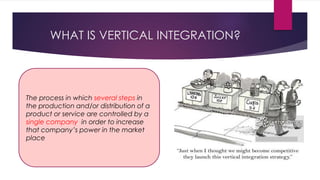
The process in which several steps in
the production and/or distribution of a
product or service are controlled by a
single company, in order to increase
that company’s power in the market
place
TYPES OF VERTICAL INTEGRATION
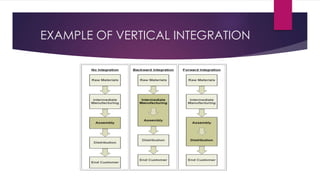
Example:
A firm that manufactures a product through an assembly process
Forward- expansion of activities downstream i.e.
company acquires its input supplier
Backward- expansion of activities upstream i.e.
company acquires companies in its distribution chain
EXAMPLE OF VERTICAL INTEGRATION
APPAREL PRODUCTION INDUSTRY
Three general market segments:
 High quality products for mass market
 Compete on price—hold largest market share
 High-end market
 Compete on brand equity—have biggest profit margin
 Affordable fashion clothes—ZARA’s market segment
 Compete on speed—customers constantly purchase new clothes to follow trends
 8 seasons to a fashion year
To compete in this market, apparel producers must seamlessly follow new
fashion trends of every new season.
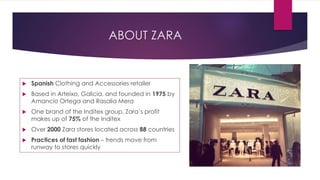
ABOUT ZARA
 Spanish Clothing and Accessories retailer
 Based in Arteixo, Galicia, and founded in 1975 by
Amancio Ortega and Rasalia Mera
 One brand of the Inditex group, Zara’s profit
makes up of 75% of the Inditex
 Over 2000 Zara stores located across 88 countries
 Practices of fast fashion – trends move from
runway to stores quickly
ZARA’S BUSINESS MODEL & STRATEGY
 “Super-responsive” buyer driven supply chain
Customer is the main driving force behind the Zara brand.
 Quick design to distribution process
Maximum time from conception to distribution center in 3 weeks
 Zero Advertising
Very low spending on marketing while high spending on stores
 Vertically Integrated
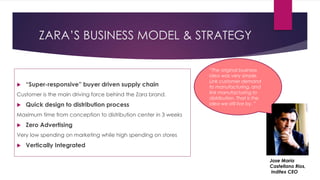
“The original business
idea was very simple.
Link customer demand
to manufacturing, and
link manufacturing to
distribution. That is the
idea we still live by. ”
Jose Maria
Castellano Rios,
Inditex CEO
ZARA’S COMPETITORS
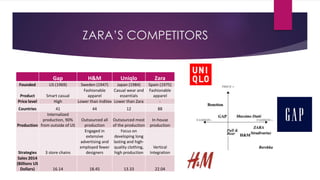
Gap H&M Uniqlo Zara
Founded US (1969) Sweden (1947) Japan (1984) Spain (1975)
Product Smart casual
Fashionable
apparel
Casual wear and
essentials
Fashionable
apparel
Price level High Lower than Inditex Lower than Zara -
Countries 41 44 12 88
Production
Internalized
production, 90%
from outside of US
Outsourced all
production
Outsourced most
of the production
In-house
production
Strategies 3 store chains
Engaged in
extensive
advertising and
employed fewer
designers
Focus on
developing long
lasting and high-
quality clothing,
high production
Vertical
Integration
Sales 2014
(Billions US
Dollars) 16.14 18.45 13.33 22.04
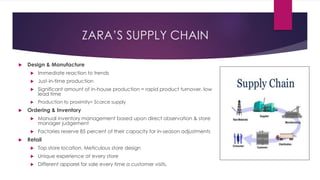
ZARA’S SUPPLY CHAIN
 Design & Manufacture
 Immediate reaction to trends
 Just-in-time production
 Significant amount of in-house production = rapid product turnover, low
lead time
 Production to proximity= Scarce supply
 Ordering & Inventory
 Manual inventory management based upon direct observation & store
manager judgement
 Factories reserve 85 percent of their capacity for in-season adjustments
 Retail
 Top store location, Meticulous store design
 Unique experience at every store
 Different apparel for sale every time a customer visits.
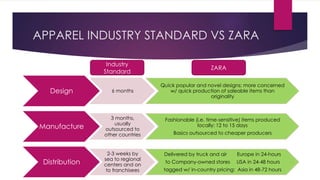
APPAREL INDUSTRY STANDARD VS ZARA
Design 6 months
Quick popular and novel designs; more concerned
w/ quick production of saleable items than
originality
Manufacture
3 months,
usually
outsourced to
other countries
Fashionable (i.e. time-sensitive) items produced
locally: 12 to 15 days
Basics outsourced to cheaper producers
Distribution
2-3 weeks by
sea to regional
centers and on
to franchisees
Delivered by truck and air Europe in 24-hours
to Company-owned stores USA in 24-48 hours
tagged w/ in-country pricing: Asia in 48-72 hours
Industry
Standard
ZARA
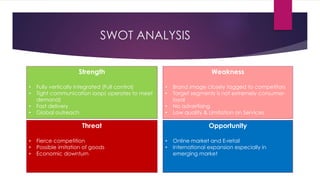
SWOT ANALYSIS
Strength
• Fully vertically integrated (Full control)
• Tight communication loop( operates to meet
demand)
• Fast delivery
• Global outreach
Weakness
• Brand image closely tagged to competitors
• Target segments is not extremely consumer-
loyal
• No advertising
• Low quality & Limitation on Services
Threat
• Fierce competition
• Possible imitation of goods
• Economic downturn
Opportunity
• Online market and E-retail
• International expansion especially in
emerging market
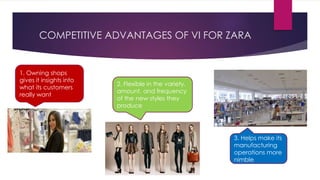
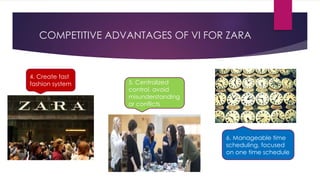
COMPETITIVE ADVANTAGES OF VI FOR ZARA
1. Owning shops
gives it insights into
what its customers
really want
2. Flexible in the variety,
amount, and frequency
of the new styles they
produce
3. Helps make its
manufacturing
operations more
nimble
COMPETITIVE ADVANTAGES OF VI FOR ZARA
5. Centralized
control, avoid
misunderstanding
or conflicts
4. Create fast
fashion system
6. Manageable time
scheduling, focused
on one time schedule
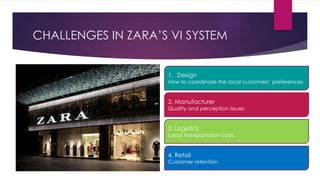
CHALLENGES IN ZARA’S VI SYSTEM
1. Design
How to coordinate the local customers’ preferences
2. Manufacturer
Quality and perception issues
3. Logistics
Local transportation costs
4. Retail
Customer retention
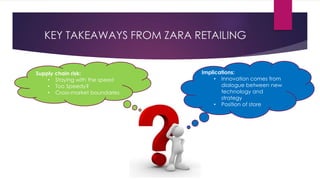
KEY TAKEAWAYS FROM ZARA RETAILING
Implications:
• Innovation comes from
dialogue between new
technology and
strategy
• Position of store
Supply chain risk:
• Staying with the speed
• Too Speedy?
• Cross-market boundaries
THANK YOU!
REFERENCES
 (2004) Andrew Mcafee, Vincent Dessain, Anders Sjoman “Zara: IT for fast fashion” Harvard Business
School
 (2005) "How Zara fashions its supply chain: Home is where the heart is", Strategic Direction, Vol. 21 Iss:
10, pp.28 – 3 http://www.emeraldinsight.com/doi/abs/10.1108/02580540510626709
 Scozzese, G., PhD. (2013). From the supply chain management to the demand chain management in
fast fashion: Zara's winning model. International Journal of Management Sciences and Business
Research, 2(5), 43-48. http://search.proquest.com/docview/1459583852?accountid=2909
 Carugati, A.; Liao, R.; Smith, P., "Speed-to-fashion: Managing global supply chain in
Zara," Management of Innovation and Technology, 2008. ICMIT 2008. 4th IEEE International Conference
on , vol., no., pp.1494,1499, 21-24 Sept.
2008 http://ieeexplore.ieee.org.proxy.libraries.uc.edu/stamp/stamp.jsp?tp=&arnumber=4654593&isnu
mber=4654323
 Qinghua Zhang, "Analysis on the Successful Case of Efficient Supply Chain in ZARA," Wireless
Communications, Networking and Mobile Computing, 2008. WiCOM '08. 4th International Conference
on , vol., no., pp.1,4, 12-14 Oct.
2008 http://ieeexplore.ieee.org.proxy.libraries.uc.edu/stamp/stamp.jsp?tp=&arnumber=4679487&isnu
mber=4677909

Vertical integration and Zara Retailing

  • 1.
    VERTICAL INTEGRATION & ZARA RETAILING PRESENTEDBY- AMKOA, SALLY LIN, XINQI SENECHA, NIHARIKA TOWERS, KATHLEEN
  • 2.
    WHAT IS VERTICALINTEGRATION? The process in which several steps in the production and/or distribution of a product or service are controlled by a single company, in order to increase that company’s power in the market place
  • 3.
    TYPES OF VERTICALINTEGRATION Example: A firm that manufactures a product through an assembly process Forward- expansion of activities downstream i.e. company acquires its input supplier Backward- expansion of activities upstream i.e. company acquires companies in its distribution chain
  • 4.
  • 5.
    APPAREL PRODUCTION INDUSTRY Threegeneral market segments:  High quality products for mass market  Compete on price—hold largest market share  High-end market  Compete on brand equity—have biggest profit margin  Affordable fashion clothes—ZARA’s market segment  Compete on speed—customers constantly purchase new clothes to follow trends  8 seasons to a fashion year To compete in this market, apparel producers must seamlessly follow new fashion trends of every new season.
  • 6.
    ABOUT ZARA  SpanishClothing and Accessories retailer  Based in Arteixo, Galicia, and founded in 1975 by Amancio Ortega and Rasalia Mera  One brand of the Inditex group, Zara’s profit makes up of 75% of the Inditex  Over 2000 Zara stores located across 88 countries  Practices of fast fashion – trends move from runway to stores quickly
  • 7.
    ZARA’S BUSINESS MODEL& STRATEGY  “Super-responsive” buyer driven supply chain Customer is the main driving force behind the Zara brand.  Quick design to distribution process Maximum time from conception to distribution center in 3 weeks  Zero Advertising Very low spending on marketing while high spending on stores  Vertically Integrated “The original business idea was very simple. Link customer demand to manufacturing, and link manufacturing to distribution. That is the idea we still live by. ” Jose Maria Castellano Rios, Inditex CEO
  • 8.
    ZARA’S COMPETITORS Gap H&MUniqlo Zara Founded US (1969) Sweden (1947) Japan (1984) Spain (1975) Product Smart casual Fashionable apparel Casual wear and essentials Fashionable apparel Price level High Lower than Inditex Lower than Zara - Countries 41 44 12 88 Production Internalized production, 90% from outside of US Outsourced all production Outsourced most of the production In-house production Strategies 3 store chains Engaged in extensive advertising and employed fewer designers Focus on developing long lasting and high- quality clothing, high production Vertical Integration Sales 2014 (Billions US Dollars) 16.14 18.45 13.33 22.04
  • 9.
    ZARA’S SUPPLY CHAIN Design & Manufacture  Immediate reaction to trends  Just-in-time production  Significant amount of in-house production = rapid product turnover, low lead time  Production to proximity= Scarce supply  Ordering & Inventory  Manual inventory management based upon direct observation & store manager judgement  Factories reserve 85 percent of their capacity for in-season adjustments  Retail  Top store location, Meticulous store design  Unique experience at every store  Different apparel for sale every time a customer visits.
  • 10.
    APPAREL INDUSTRY STANDARDVS ZARA Design 6 months Quick popular and novel designs; more concerned w/ quick production of saleable items than originality Manufacture 3 months, usually outsourced to other countries Fashionable (i.e. time-sensitive) items produced locally: 12 to 15 days Basics outsourced to cheaper producers Distribution 2-3 weeks by sea to regional centers and on to franchisees Delivered by truck and air Europe in 24-hours to Company-owned stores USA in 24-48 hours tagged w/ in-country pricing: Asia in 48-72 hours Industry Standard ZARA
  • 11.
    SWOT ANALYSIS Strength • Fullyvertically integrated (Full control) • Tight communication loop( operates to meet demand) • Fast delivery • Global outreach Weakness • Brand image closely tagged to competitors • Target segments is not extremely consumer- loyal • No advertising • Low quality & Limitation on Services Threat • Fierce competition • Possible imitation of goods • Economic downturn Opportunity • Online market and E-retail • International expansion especially in emerging market
  • 12.
    COMPETITIVE ADVANTAGES OFVI FOR ZARA 1. Owning shops gives it insights into what its customers really want 2. Flexible in the variety, amount, and frequency of the new styles they produce 3. Helps make its manufacturing operations more nimble
  • 13.
    COMPETITIVE ADVANTAGES OFVI FOR ZARA 5. Centralized control, avoid misunderstanding or conflicts 4. Create fast fashion system 6. Manageable time scheduling, focused on one time schedule
  • 14.
    CHALLENGES IN ZARA’SVI SYSTEM 1. Design How to coordinate the local customers’ preferences 2. Manufacturer Quality and perception issues 3. Logistics Local transportation costs 4. Retail Customer retention
  • 15.
    KEY TAKEAWAYS FROMZARA RETAILING Implications: • Innovation comes from dialogue between new technology and strategy • Position of store Supply chain risk: • Staying with the speed • Too Speedy? • Cross-market boundaries
  • 16.
  • 17.
    REFERENCES  (2004) AndrewMcafee, Vincent Dessain, Anders Sjoman “Zara: IT for fast fashion” Harvard Business School  (2005) "How Zara fashions its supply chain: Home is where the heart is", Strategic Direction, Vol. 21 Iss: 10, pp.28 – 3 http://www.emeraldinsight.com/doi/abs/10.1108/02580540510626709  Scozzese, G., PhD. (2013). From the supply chain management to the demand chain management in fast fashion: Zara's winning model. International Journal of Management Sciences and Business Research, 2(5), 43-48. http://search.proquest.com/docview/1459583852?accountid=2909  Carugati, A.; Liao, R.; Smith, P., "Speed-to-fashion: Managing global supply chain in Zara," Management of Innovation and Technology, 2008. ICMIT 2008. 4th IEEE International Conference on , vol., no., pp.1494,1499, 21-24 Sept. 2008 http://ieeexplore.ieee.org.proxy.libraries.uc.edu/stamp/stamp.jsp?tp=&arnumber=4654593&isnu mber=4654323  Qinghua Zhang, "Analysis on the Successful Case of Efficient Supply Chain in ZARA," Wireless Communications, Networking and Mobile Computing, 2008. WiCOM '08. 4th International Conference on , vol., no., pp.1,4, 12-14 Oct. 2008 http://ieeexplore.ieee.org.proxy.libraries.uc.edu/stamp/stamp.jsp?tp=&arnumber=4679487&isnu mber=4677909