Product Life Cycle (PLC)
in Marketing Management
BY
BRIJESH BHARDWAJ
(Assistant Professor)
ADVANCED EDUCATIONAL INSTITUTIONS
www.advanced.edu.in
Product Life Cycle
Meaning of Product Life Cycle (PLC)
Different Stages of Product Life Cycle
Examples of Product Life Cycle
 Marketing Strategies in Product Life Cycle
www.advanced.edu.in
Meaning of Product Life Cycle
As consumers, we buy millions of products every year. And just like
us, these products have a life cycle. Older, long-established products
eventually become less popular, while in contrast, the demand for
new, more modern goods usually increases quite rapidly after they
are launched.
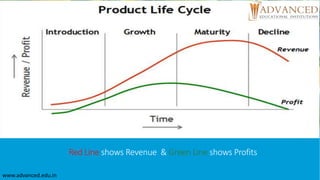
The Product Life Cycle is an important concept in marketing. It
describes the stages a product goes through from when it was first
thought of until it finally is removed from the market. Not all
products reach this final stage. Some continue to grow and others
rise and fall.
www.advanced.edu.in
Different Stages of Product Life Cycle
(1) Introduction Stage
(2) Growth Stage
(3) Maturity Stage
(4) Decline Stage
www.advanced.edu.in
Red Line shows Revenue & Green Line shows Profits
www.advanced.edu.in
(1) Introduction Stage
In the introduction stage, the firm seeks to build product awareness and develop a
market for the product. The impact on the marketing mix is as follows:
Product branding and quality level is established, and intellectual property
protection such as patents and trademarks are obtained.
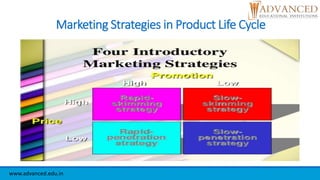
Pricing may be low penetration pricing to build market share rapidly, or high
skim pricing to recover development costs.
Distribution is selective until consumers show acceptance of the product.
Promotion is aimed at innovators and early adopters. Marketing
communications seeks to build product awareness and to educate potential
consumers about the product.
www.advanced.edu.in
(2) Growth Stage
In the growth stage, the firm seeks to build brand preference and increase
market share.
Product quality is maintained and additional features and support
services may be added.
Pricing is maintained as the firm enjoys increasing demand with little
competition.
Distribution channels are added as demand increases and customers
accept the product.
Promotion is aimed at a broader audience.
www.advanced.edu.in
(3) Maturity Stage
www.advanced.edu.in
At maturity, the strong growth in sales diminishes. Competition may
appear with similar products. The primary objective at this point is to
defend market share while maximizing profit.
Product features may be enhanced to differentiate the product from
that of competitors.
Pricing may be lower because of the new competition.
Distribution becomes more intensive and incentives may be offered
to encourage preference over competing products.
Promotion emphasizes product differentiation.
(4) Decline Stage
www.advanced.edu.in
As sales decline, the firm has several options:
Maintain the product, possibly rejuvenating it by adding
new features and finding new uses.
Harvest the product - reduce costs and continue to offer
it, possibly to a loyal niche segment.
Discontinue the product, liquidating remaining inventory
or selling it to another firm that is willing to continue the
product.
Marketing Decisions in the Decline Stage
The marketing decisions in the decline phase will depend on
the selected strategy.
For example :
The product may be changed if it is being rejuvenated, or
left unchanged if it is being harvested or liquidated.
The price may be maintained if the product is harvested, or
reduced drastically if liquidated.
www.advanced.edu.in
Examples of Different Stages of PLC
www.advanced.edu.in
It’s possible to provide examples of various products to illustrate the
different stages of the product life cycle more clearly. Here is the example of
watching recorded television and the various stages of each method:
Introduction – 3D TVs
Growth – Blueray discs/DVR
Maturity – DVD
Decline – Video cassette
However, the key to successful manufacturing is not just understanding this
life cycle, but also proactively managing products throughout their lifetime, applying
the appropriate resources and sales and marketing strategies, depending on what
stage products are at in the cycle.
Marketing Strategies in Product Life Cycle
www.advanced.edu.in
Conclusion
www.advanced.edu.in
The product life cycle stages explain the changes in
sales and profitability of products over their lifespan.
To improve profitability and market positions,
product managers need to use appropriate
strategies for each life cycle stage.
Brijesh Bhardwaj
Assistant Professor
Advanced Educational Institutions,
70 km Milestone,
Delhi-Mathura Road, Dist. Palwal, Haryana-121105
+91–1275–398400, 302222
email-Id: brijeshpalwal@gmail.com
www.advanced.edu.in
www.advanced.edu.in

Product Life Cycle

  • 1.
    Product Life Cycle(PLC) in Marketing Management BY BRIJESH BHARDWAJ (Assistant Professor) ADVANCED EDUCATIONAL INSTITUTIONS www.advanced.edu.in
  • 2.
    Product Life Cycle Meaningof Product Life Cycle (PLC) Different Stages of Product Life Cycle Examples of Product Life Cycle  Marketing Strategies in Product Life Cycle www.advanced.edu.in
  • 3.
    Meaning of ProductLife Cycle As consumers, we buy millions of products every year. And just like us, these products have a life cycle. Older, long-established products eventually become less popular, while in contrast, the demand for new, more modern goods usually increases quite rapidly after they are launched. The Product Life Cycle is an important concept in marketing. It describes the stages a product goes through from when it was first thought of until it finally is removed from the market. Not all products reach this final stage. Some continue to grow and others rise and fall. www.advanced.edu.in
  • 4.
    Different Stages ofProduct Life Cycle (1) Introduction Stage (2) Growth Stage (3) Maturity Stage (4) Decline Stage www.advanced.edu.in
  • 5.
    Red Line showsRevenue & Green Line shows Profits www.advanced.edu.in
  • 6.
    (1) Introduction Stage Inthe introduction stage, the firm seeks to build product awareness and develop a market for the product. The impact on the marketing mix is as follows: Product branding and quality level is established, and intellectual property protection such as patents and trademarks are obtained. Pricing may be low penetration pricing to build market share rapidly, or high skim pricing to recover development costs. Distribution is selective until consumers show acceptance of the product. Promotion is aimed at innovators and early adopters. Marketing communications seeks to build product awareness and to educate potential consumers about the product. www.advanced.edu.in
  • 7.
    (2) Growth Stage Inthe growth stage, the firm seeks to build brand preference and increase market share. Product quality is maintained and additional features and support services may be added. Pricing is maintained as the firm enjoys increasing demand with little competition. Distribution channels are added as demand increases and customers accept the product. Promotion is aimed at a broader audience. www.advanced.edu.in
  • 8.
    (3) Maturity Stage www.advanced.edu.in Atmaturity, the strong growth in sales diminishes. Competition may appear with similar products. The primary objective at this point is to defend market share while maximizing profit. Product features may be enhanced to differentiate the product from that of competitors. Pricing may be lower because of the new competition. Distribution becomes more intensive and incentives may be offered to encourage preference over competing products. Promotion emphasizes product differentiation.
  • 9.
    (4) Decline Stage www.advanced.edu.in Assales decline, the firm has several options: Maintain the product, possibly rejuvenating it by adding new features and finding new uses. Harvest the product - reduce costs and continue to offer it, possibly to a loyal niche segment. Discontinue the product, liquidating remaining inventory or selling it to another firm that is willing to continue the product.
  • 10.
    Marketing Decisions inthe Decline Stage The marketing decisions in the decline phase will depend on the selected strategy. For example : The product may be changed if it is being rejuvenated, or left unchanged if it is being harvested or liquidated. The price may be maintained if the product is harvested, or reduced drastically if liquidated. www.advanced.edu.in
  • 11.
    Examples of DifferentStages of PLC www.advanced.edu.in It’s possible to provide examples of various products to illustrate the different stages of the product life cycle more clearly. Here is the example of watching recorded television and the various stages of each method: Introduction – 3D TVs Growth – Blueray discs/DVR Maturity – DVD Decline – Video cassette However, the key to successful manufacturing is not just understanding this life cycle, but also proactively managing products throughout their lifetime, applying the appropriate resources and sales and marketing strategies, depending on what stage products are at in the cycle.
  • 12.
    Marketing Strategies inProduct Life Cycle www.advanced.edu.in
  • 13.
    Conclusion www.advanced.edu.in The product lifecycle stages explain the changes in sales and profitability of products over their lifespan. To improve profitability and market positions, product managers need to use appropriate strategies for each life cycle stage.
  • 14.
    Brijesh Bhardwaj Assistant Professor AdvancedEducational Institutions, 70 km Milestone, Delhi-Mathura Road, Dist. Palwal, Haryana-121105 +91–1275–398400, 302222 email-Id: brijeshpalwal@gmail.com www.advanced.edu.in www.advanced.edu.in