Experiment 1
To determine the length of the given
specimen using Vernier caliper and to find
out % error in measurement
Instructor
Mr. Gaurav Bharadwaj
Assistant Prof.
Department of ME
GLA University
Introduction
•Vernier caliper is a device that is used for precise measurement which
cannot be done accurately with the help of meter scale
•The minimum quantity that can be measured by Vernier caliper or
from which it will start to give output is called as least count of Vernier
caliper.
• The least count of Vernier caliper i.e. present in our lab is 0.02 mm.
Parts of Vernier Caliper
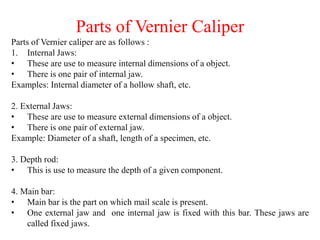
Parts of Vernier caliper are as follows :
1. Internal Jaws:
• These are use to measure internal dimensions of a object.
• There is one pair of internal jaw.
Examples: Internal diameter of a hollow shaft, etc.
2. External Jaws:
• These are use to measure external dimensions of a object.
• There is one pair of external jaw.
Example: Diameter of a shaft, length of a specimen, etc.
3. Depth rod:
• This is use to measure the depth of a given component.
4. Main bar:
• Main bar is the part on which mail scale is present.
• One external jaw and one internal jaw is fixed with this bar. These jaws are
called fixed jaws.
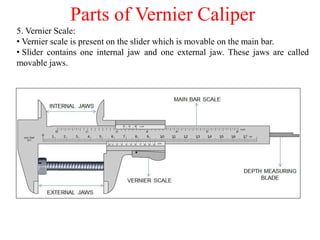
Parts of Vernier Caliper
5. Vernier Scale:
• Vernier scale is present on the slider which is movable on the main bar.
• Slider contains one internal jaw and one external jaw. These jaws are called
movable jaws.
Vernier caliper’s least count formula
Least count:
• Least Count refers to the smallest distance that can be measured using an
instrument.
• Least Count = Length of 1 MSD – Length of 1 VSD
Where MSD is Main Scale Division and VSD is Vernier Scale Division
respectively
Generally,
N divisions on Vernier scale coincide with N-1 divisions on main scale
1 VSD is equivalent to (N-1)/N main scale divisions
Using the formula for Least Count, we get
LC = 1 MSD – 1VSD
= 1 MSD – (N-1)/N MSD
= 1/N MSD
Example of Finding least count
•A vernier scale has the length of 49 main scale divisions and is
divided into 50 divisions.
•VSD = 49 / 50 mm = 0.98 mm
•MSD= 1 mm
•Least Count= 1 MSD- 1VSD = 1mm - 0.98mm = 0.02mm
*The least count may vary between different Vernier calipers.
Formula for Measurement
Although the least count may vary between different calipers.
The length formula for any caliper is as follows:
Length = MSR + (VSR * LC) ± ERROR
Where MSR = Main Scale Reading
VSR = Vernier Scale Reading
LC = Least Count.
Errors in Vernier caliper
Any Vernier caliper may have two types of errors:
1.Positive zero error
2. Negative zero error
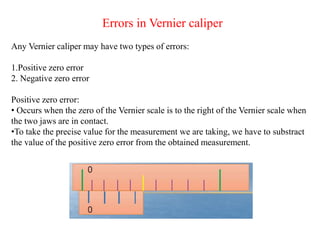
Positive zero error:
• Occurs when the zero of the Vernier scale is to the right of the Vernier scale when
the two jaws are in contact.
•To take the precise value for the measurement we are taking, we have to substract
the value of the positive zero error from the obtained measurement.
Static characteristics
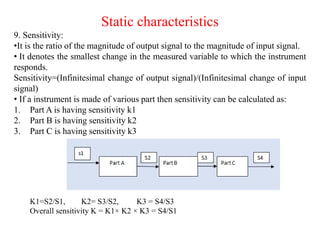
9. Sensitivity:
•It is the ratio of the magnitude of output signal to the magnitude of input signal.
• It denotes the smallest change in the measured variable to which the instrument
responds.
Sensitivity=(Infinitesimal change of output signal)/(Infinitesimal change of input
signal)
• If a instrument is made of various part then sensitivity can be calculated as:
1. Part A is having sensitivity k1
2. Part B is having sensitivity k2
3. Part C is having sensitivity k3
K1=S2/S1, K2= S3/S2, K3 = S4/S3
Overall sensitivity K = K1× K2 × K3 = S4/S1
Errors in Vernier caliper
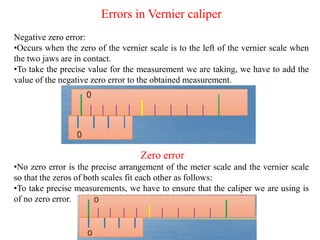
Negative zero error:
•Occurs when the zero of the vernier scale is to the left of the vernier scale when
the two jaws are in contact.
•To take the precise value for the measurement we are taking, we have to add the
value of the negative zero error to the obtained measurement.
Zero error
•No zero error is the precise arrangement of the meter scale and the vernier scale
so that the zeros of both scales fit each other as follows:
•To take precise measurements, we have to ensure that the caliper we are using is
of no zero error.
Procedure of taking Measurement
1. First find whether there’s an error on the caliper.
2. Second find its least count(LC)
3. Place the object between the appropriate jaws (outer/inner).
4. The reading of the main scale (MSR) which is to the left of the zero of the
vernier scale is the Main Scale Reading
5. Now look up for the no. of divisions on the vernier scale which exactly
coincides with any of the main scale reading. This is the Vernier Scale
Reading(VSR)
6. The length of the object is calculated using the formula:
Dimension = MSR + (VSR * LC)
7. If there’s an error in the caliper add or substract depending on the type (positive
error/negative error)
Procedure of taking Measurement
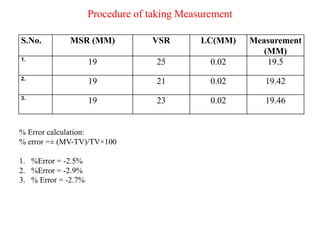
S.No. MSR (MM) VSR LC(MM) Measurement
(MM)
1.
19 25 0.02 19.5
2.
19 21 0.02 19.42
3.
19 23 0.02 19.46
% Error calculation:
% error =± (MV-TV)/TV×100
1. %Error = -2.5%
2. %Error = -2.9%
3. % Error = -2.7%
Thank you

Vernier caliper use

  • 1.
    Experiment 1 To determinethe length of the given specimen using Vernier caliper and to find out % error in measurement Instructor Mr. Gaurav Bharadwaj Assistant Prof. Department of ME GLA University
  • 2.
    Introduction •Vernier caliper isa device that is used for precise measurement which cannot be done accurately with the help of meter scale •The minimum quantity that can be measured by Vernier caliper or from which it will start to give output is called as least count of Vernier caliper. • The least count of Vernier caliper i.e. present in our lab is 0.02 mm.
  • 3.
    Parts of VernierCaliper Parts of Vernier caliper are as follows : 1. Internal Jaws: • These are use to measure internal dimensions of a object. • There is one pair of internal jaw. Examples: Internal diameter of a hollow shaft, etc. 2. External Jaws: • These are use to measure external dimensions of a object. • There is one pair of external jaw. Example: Diameter of a shaft, length of a specimen, etc. 3. Depth rod: • This is use to measure the depth of a given component. 4. Main bar: • Main bar is the part on which mail scale is present. • One external jaw and one internal jaw is fixed with this bar. These jaws are called fixed jaws.
  • 4.
    Parts of VernierCaliper 5. Vernier Scale: • Vernier scale is present on the slider which is movable on the main bar. • Slider contains one internal jaw and one external jaw. These jaws are called movable jaws.
  • 5.
    Vernier caliper’s leastcount formula Least count: • Least Count refers to the smallest distance that can be measured using an instrument. • Least Count = Length of 1 MSD – Length of 1 VSD Where MSD is Main Scale Division and VSD is Vernier Scale Division respectively Generally, N divisions on Vernier scale coincide with N-1 divisions on main scale 1 VSD is equivalent to (N-1)/N main scale divisions Using the formula for Least Count, we get LC = 1 MSD – 1VSD = 1 MSD – (N-1)/N MSD = 1/N MSD
  • 6.
    Example of Findingleast count •A vernier scale has the length of 49 main scale divisions and is divided into 50 divisions. •VSD = 49 / 50 mm = 0.98 mm •MSD= 1 mm •Least Count= 1 MSD- 1VSD = 1mm - 0.98mm = 0.02mm *The least count may vary between different Vernier calipers.
  • 7.
    Formula for Measurement Althoughthe least count may vary between different calipers. The length formula for any caliper is as follows: Length = MSR + (VSR * LC) ± ERROR Where MSR = Main Scale Reading VSR = Vernier Scale Reading LC = Least Count.
  • 8.
    Errors in Verniercaliper Any Vernier caliper may have two types of errors: 1.Positive zero error 2. Negative zero error Positive zero error: • Occurs when the zero of the Vernier scale is to the right of the Vernier scale when the two jaws are in contact. •To take the precise value for the measurement we are taking, we have to substract the value of the positive zero error from the obtained measurement.
  • 9.
    Static characteristics 9. Sensitivity: •Itis the ratio of the magnitude of output signal to the magnitude of input signal. • It denotes the smallest change in the measured variable to which the instrument responds. Sensitivity=(Infinitesimal change of output signal)/(Infinitesimal change of input signal) • If a instrument is made of various part then sensitivity can be calculated as: 1. Part A is having sensitivity k1 2. Part B is having sensitivity k2 3. Part C is having sensitivity k3 K1=S2/S1, K2= S3/S2, K3 = S4/S3 Overall sensitivity K = K1× K2 × K3 = S4/S1
  • 10.
    Errors in Verniercaliper Negative zero error: •Occurs when the zero of the vernier scale is to the left of the vernier scale when the two jaws are in contact. •To take the precise value for the measurement we are taking, we have to add the value of the negative zero error to the obtained measurement. Zero error •No zero error is the precise arrangement of the meter scale and the vernier scale so that the zeros of both scales fit each other as follows: •To take precise measurements, we have to ensure that the caliper we are using is of no zero error.
  • 11.
    Procedure of takingMeasurement 1. First find whether there’s an error on the caliper. 2. Second find its least count(LC) 3. Place the object between the appropriate jaws (outer/inner). 4. The reading of the main scale (MSR) which is to the left of the zero of the vernier scale is the Main Scale Reading 5. Now look up for the no. of divisions on the vernier scale which exactly coincides with any of the main scale reading. This is the Vernier Scale Reading(VSR) 6. The length of the object is calculated using the formula: Dimension = MSR + (VSR * LC) 7. If there’s an error in the caliper add or substract depending on the type (positive error/negative error)
  • 12.
    Procedure of takingMeasurement S.No. MSR (MM) VSR LC(MM) Measurement (MM) 1. 19 25 0.02 19.5 2. 19 21 0.02 19.42 3. 19 23 0.02 19.46 % Error calculation: % error =± (MV-TV)/TV×100 1. %Error = -2.5% 2. %Error = -2.9% 3. % Error = -2.7%
  • 13.