SCREW GAUGE
SCREW GAUGE
 A screw gauge is a precision instrument that is used
to measure small lengths with accuracy greater than
a Vernier Caliper.
 It is used for measuring diameter of circular objects
mostly wires, with an accuracy of 0.001cm.
 It is also called as micrometer screw gauge.
Unit 1: Physical Quantities and Measurement –Screw Gauge
2
INSIGHTS OF PHYSICS
Principle
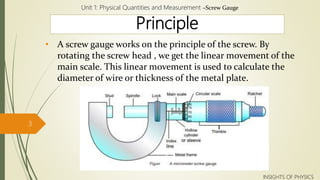
• A screw gauge works on the principle of the screw. By
rotating the screw head , we get the linear movement of the
main scale. This linear movement is used to calculate the
diameter of wire or thickness of the metal plate.
Unit 1: Physical Quantities and Measurement –Screw Gauge
3
INSIGHTS OF PHYSICS
Construction
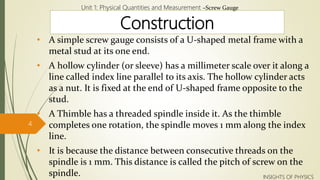
• A simple screw gauge consists of a U-shaped metal frame with a
metal stud at its one end.
• A hollow cylinder (or sleeve) has a millimeter scale over it along a
line called index line parallel to its axis. The hollow cylinder acts
as a nut. It is fixed at the end of U-shaped frame opposite to the
stud.
• A Thimble has a threaded spindle inside it. As the thimble
completes one rotation, the spindle moves 1 mm along the index
line.
• It is because the distance between consecutive threads on the
spindle is 1 mm. This distance is called the pitch of screw on the
spindle.
Unit 1: Physical Quantities and Measurement –Screw Gauge
4
INSIGHTS OF PHYSICS
Construction
 The thimble has 100 divisions around its one end. It is the
circular scale of the screw gauge.
 As thimble completes one rotation, 100 divisions pass the
index line and the thimble moves 1 mm along the main scale.
 Thus each division of circular scale crossing the index line
moves the thimble through 1/100 mm or 0.01 mm on the main
scale.
 Least count of a screw gauge can also be found as given below:
L.C. = (
Pitch of the screw
No. of circular scale divisions
)
Unit 1: Physical Quantities and Measurement –Screw Gauge
5
INSIGHTS OF PHYSICS
Least Count
Working ZERO-ERROR
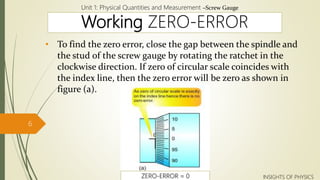
• To find the zero error, close the gap between the spindle and
the stud of the screw gauge by rotating the ratchet in the
clockwise direction. If zero of circular scale coincides with
the index line, then the zero error will be zero as shown in
figure (a).
Unit 1: Physical Quantities and Measurement –Screw Gauge
6
INSIGHTS OF PHYSICSZERO-ERROR = 0
ZERO-ERROR
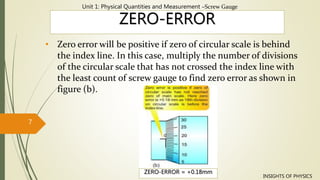
• Zero error will be positive if zero of circular scale is behind
the index line. In this case, multiply the number of divisions
of the circular scale that has not crossed the index line with
the least count of screw gauge to find zero error as shown in
figure (b).
Unit 1: Physical Quantities and Measurement –Screw Gauge
7
INSIGHTS OF PHYSICS
ZERO-ERROR = +0.18mm
ZERO-ERROR
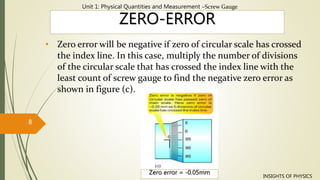
• Zero error will be negative if zero of circular scale has crossed
the index line. In this case, multiply the number of divisions
of the circular scale that has crossed the index line with the
least count of screw gauge to find the negative zero error as
shown in figure (c).
Unit 1: Physical Quantities and Measurement –Screw Gauge
8
INSIGHTS OF PHYSICS
Zero error = -0.05mm
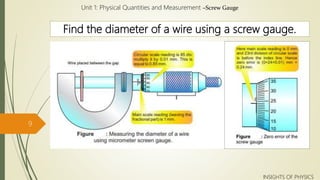
Find the diameter of a wire using a screw gauge.
Unit 1: Physical Quantities and Measurement –Screw Gauge
9
INSIGHTS OF PHYSICS
Quiz
1. What is the least count of a screw gauge?
Least count is 0.01mm for micrometer screw gauge.
2. What is the pitch of your laboratory screw gauge?
The pitch of the screw is the distance moved by the spindle per
revolution. The micrometers in our laboratory have a pitch of 0.50 mm
(two full turns are required to close the jaws by 1.00 mm).
3. What is the range of your laboratory screw gauge?
The range of screw gauge is 0.01 mm to 100mm.
4. Which one of the two instruments is more precise and why?
Vernier caliper and screw gauge because of their least count as 0.1 mm for
Vernier Calipers and 0.01mm for micrometer screw gauge.
Unit 1: Physical Quantities and Measurement –Screw Gauge
10
INSIGHTS OF PHYSICS
INSIGHTS OF PHYSICS
Thank you
Physical Quantities and Measurement UNIT 1

Screw gauge

  • 1.
  • 2.
    SCREW GAUGE  Ascrew gauge is a precision instrument that is used to measure small lengths with accuracy greater than a Vernier Caliper.  It is used for measuring diameter of circular objects mostly wires, with an accuracy of 0.001cm.  It is also called as micrometer screw gauge. Unit 1: Physical Quantities and Measurement –Screw Gauge 2 INSIGHTS OF PHYSICS
  • 3.
    Principle • A screwgauge works on the principle of the screw. By rotating the screw head , we get the linear movement of the main scale. This linear movement is used to calculate the diameter of wire or thickness of the metal plate. Unit 1: Physical Quantities and Measurement –Screw Gauge 3 INSIGHTS OF PHYSICS
  • 4.
    Construction • A simplescrew gauge consists of a U-shaped metal frame with a metal stud at its one end. • A hollow cylinder (or sleeve) has a millimeter scale over it along a line called index line parallel to its axis. The hollow cylinder acts as a nut. It is fixed at the end of U-shaped frame opposite to the stud. • A Thimble has a threaded spindle inside it. As the thimble completes one rotation, the spindle moves 1 mm along the index line. • It is because the distance between consecutive threads on the spindle is 1 mm. This distance is called the pitch of screw on the spindle. Unit 1: Physical Quantities and Measurement –Screw Gauge 4 INSIGHTS OF PHYSICS
  • 5.
    Construction  The thimblehas 100 divisions around its one end. It is the circular scale of the screw gauge.  As thimble completes one rotation, 100 divisions pass the index line and the thimble moves 1 mm along the main scale.  Thus each division of circular scale crossing the index line moves the thimble through 1/100 mm or 0.01 mm on the main scale.  Least count of a screw gauge can also be found as given below: L.C. = ( Pitch of the screw No. of circular scale divisions ) Unit 1: Physical Quantities and Measurement –Screw Gauge 5 INSIGHTS OF PHYSICS Least Count
  • 6.
    Working ZERO-ERROR • Tofind the zero error, close the gap between the spindle and the stud of the screw gauge by rotating the ratchet in the clockwise direction. If zero of circular scale coincides with the index line, then the zero error will be zero as shown in figure (a). Unit 1: Physical Quantities and Measurement –Screw Gauge 6 INSIGHTS OF PHYSICSZERO-ERROR = 0
  • 7.
    ZERO-ERROR • Zero errorwill be positive if zero of circular scale is behind the index line. In this case, multiply the number of divisions of the circular scale that has not crossed the index line with the least count of screw gauge to find zero error as shown in figure (b). Unit 1: Physical Quantities and Measurement –Screw Gauge 7 INSIGHTS OF PHYSICS ZERO-ERROR = +0.18mm
  • 8.
    ZERO-ERROR • Zero errorwill be negative if zero of circular scale has crossed the index line. In this case, multiply the number of divisions of the circular scale that has crossed the index line with the least count of screw gauge to find the negative zero error as shown in figure (c). Unit 1: Physical Quantities and Measurement –Screw Gauge 8 INSIGHTS OF PHYSICS Zero error = -0.05mm
  • 9.
    Find the diameterof a wire using a screw gauge. Unit 1: Physical Quantities and Measurement –Screw Gauge 9 INSIGHTS OF PHYSICS
  • 10.
    Quiz 1. What isthe least count of a screw gauge? Least count is 0.01mm for micrometer screw gauge. 2. What is the pitch of your laboratory screw gauge? The pitch of the screw is the distance moved by the spindle per revolution. The micrometers in our laboratory have a pitch of 0.50 mm (two full turns are required to close the jaws by 1.00 mm). 3. What is the range of your laboratory screw gauge? The range of screw gauge is 0.01 mm to 100mm. 4. Which one of the two instruments is more precise and why? Vernier caliper and screw gauge because of their least count as 0.1 mm for Vernier Calipers and 0.01mm for micrometer screw gauge. Unit 1: Physical Quantities and Measurement –Screw Gauge 10 INSIGHTS OF PHYSICS
  • 11.
    INSIGHTS OF PHYSICS Thankyou Physical Quantities and Measurement UNIT 1