PHYSICS
VERNEIR CALIPERS
GYANRAJ CHAVAN
EXPERIMENTS
Aim: To determine
I) The volume of the given cylinder by measuring its length and diameter
II) The volume of the given sphere by measuring its diameter.
VERNIER CALIPERS
Apparatus : Vernier Calipers, Cylinder and sphere.
Description of Vernier Calipers: A Vernier calipers consists of mainly two
parts
i) 2cm wide 15cm long rectangular metal strip .The left end bottom side of
this strip consists of a fixed jaw (A) and at the same end jaw (C) at the top
of this strip. On the strip a scale is graduated in Inches along the upper
edge and another scale is graduated in Centimeters along the lower edge.
This is called Main Scale ‘S’ .
VERNIER CALIPERS
VERNIER CALIPERS
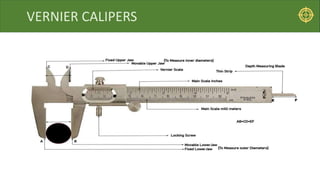
ii) A metal frame V called vernier slides over the Main Scale 'S' . At the bottom of this frame V a
button is attached, which helps to fix this vernier at any desired place on the main scale. This
vernier frame consists of jaw-B at the bottom and a jaw-D at the top .Two scales are graduated on
this frame, corresponding to two scales on the Main Scale 'S'. The two scales on the vernier are
called Vernier scale. Vernier scale consists of equal number of divisions. When we move vernier
frame over the main scale, a thin strip (EF) will be projected out. The projection will be exactly
equal to the distance between Jaws AB i.e. the thickness of the object between jaws.
 The lower jaws A&B are used to measure the thickness or external diameter of the tubes,
cylinders or spheres.
 The upper jaws C&D are used to measure the inner diameters of hallow bodies like tubes or
holes.
 The thin strip E is used to measure the depth of the objects like test tubes.
VERNIER CALIPERS
Theory : Principle of vernier callipers
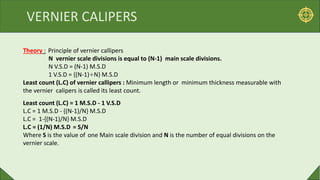
N vernier scale divisions is equal to (N-1) main scale divisions.
N V.S.D = (N-1) M.S.D
1 V.S.D = {(N-1)÷N} M.S.D
Least count (L.C) of vernier callipers : Minimum length or minimum thickness measurable with
the vernier calipers is called its least count.
Least count (L.C) = 1 M.S.D - 1 V.S.D
L.C = 1 M.S.D - {(N-1)/N} M.S.D
L.C = 1-{(N-1)/N} M.S.D
L.C = (1/N) M.S.D = S/N
Where S is the value of one Main scale division and N is the number of equal divisions on the
vernier scale.
VERNIER CALIPERS
Procedure : First we have to determine the least count of the given vernier callipers.
To determine the volume of the cylinder we have to determine
a)the length of the cylinder and
b) radius of the cylinder
substituting these values in the equation for the volume of the cylinder we can calculate it.
 To determine the length of the cylinder : Given cylinder is held gently between jaws AB of
the vernier calipers. The reading on the main scale just before the zero of the vernier is
noted. This is called Main scale reading (M.S.R).The number of that division (n) on the
vernier which coincides perfectly with any one of the main scale divisions is noted. This is
called vernier coincidence (V.C).The vernier coincidence (V.C=n) is multiplied by least count
to get the fraction of a main scale division. This is added to the main scale reading (M.S.R) to
calculate total reading or total length of the cylinder.
Total reading = M.S.R + VC×LC
VERNIER CALIPERS
Take the readings, keeping the cylinders between jaws AB at different positions. Post the
values of M.S.R and vernier coincidence (n) in the table. Take at least 5 readings, get the
average of these 5 readings which is mean length(l )of the cylinder.
 To determine the diameter of the cylinder : Place the cylinder diametrically
between the jaws AB of the vernier calipers, as in the above case post the values of
M.S.R and vernier coincidence (n) in the table. Take at least 5 readings, calculate the
average of these readings which gives the mean diameter ( d=2r ) of the cylinder.
I) To determine the volume of the cylinder :Substituting the values of mean length (l )
of the cylinder and mean diameter ( r) of the cylinder which is already determined, in
the formula V = πr2 × l cm3.
VERNIER CALIPERS
 To determine the diameter of the sphere : The given sphere is held firmly between jaws of
the vernier calipers, in such a way the points where the jaws are in contact with sphere
should be the two extremes of the chord of the cylinder. Post the values of the M.S.R and
vernier coincidence (n) in the table . Take at least 5 readings, calculate the average of these
readings which gives the mean diameter (d=2 r ) of the sphere.
II)To determine the volume of the sphere :Calculate the radius of the sphere r = d/2 .
Substitute the value of mean radius (r) in the formula of the volume of the sphere V =
(4/3)πr3 cm3 .
VERNIER CALIPERS
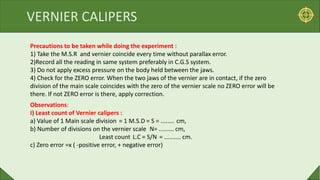
Precautions to be taken while doing the experiment :
1) Take the M.S.R and vernier coincide every time without parallax error.
2)Record all the reading in same system preferably in C.G.S system.
3) Do not apply excess pressure on the body held between the jaws.
4) Check for the ZERO error. When the two jaws of the vernier are in contact, if the zero
division of the main scale coincides with the zero of the vernier scale no ZERO error will be
there. If not ZERO error is there, apply correction.
Observations:
I) Least count of Vernier calipers :
a) Value of 1 Main scale division = 1 M.S.D = S = ........ cm,
b) Number of divisions on the vernier scale N= ......... cm,
Least count L.C = S/N = .......... cm.
c) Zero error =x ( -positive error, + negative error)
VERNIER CALIPERS
I) Volume of the Cylinder : To find the volume of the cylinder we have to determine
I) The length L of the cylinder
ii ) The Radius r of the cylinder substitute the values of L and r in the formula V = πr2 L .
Average length of the cylinder l = ......... cm.
 Length of the cylinder : Take the readings, keeping the cylinders between jaws AB at different
positions. Post the values of M.S.R and vernier coincidence (n) in the table. Take at least 5 readings,
get the average of these 5 readings which is mean length(l )of the cylinder.
S.NO
M.S.R
(a) cm
Vernier Coincidence
(n)
Fraction
b = (n±x) LC
Total Reading
(a+b) cm
1
2
3
4
5
VERNIER CALIPERS
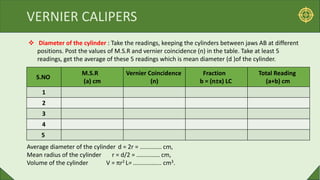
 Diameter of the cylinder : Take the readings, keeping the cylinders between jaws AB at different
positions. Post the values of M.S.R and vernier coincidence (n) in the table. Take at least 5
readings, get the average of these 5 readings which is mean diameter (d )of the cylinder.
S.NO
M.S.R
(a) cm
Vernier Coincidence
(n)
Fraction
b = (n±x) LC
Total Reading
(a+b) cm
1
2
3
4
5
Average diameter of the cylinder d = 2r = ............. cm,
Mean radius of the cylinder r = d/2 = .............. cm,
Volume of the cylinder V = πr2 L= ................. cm3.
VERNIER CALIPERS
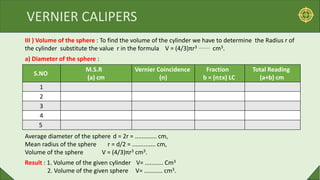
III ) Volume of the sphere : To find the volume of the cylinder we have to determine the Radius r of
the cylinder substitute the value r in the formula V = (4/3)πr3 .......... cm3.
a) Diameter of the sphere :
S.NO
M.S.R
(a) cm
Vernier Coincidence
(n)
Fraction
b = (n±x) LC
Total Reading
(a+b) cm
1
2
3
4
5
Average diameter of the sphere d = 2r = ............. cm,
Mean radius of the sphere r = d/2 = .............. cm,
Volume of the sphere V = (4/3)πr3 cm3.
Result : 1. Volume of the given cylinder V= ........... Cm3
2. Volume of the given sphere V= ........... cm3.
VERNIER CALIPERS
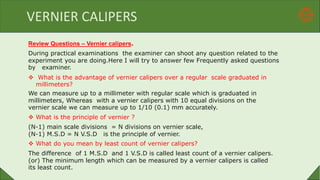
Review Questions – Vernier calipers.
During practical examinations the examiner can shoot any question related to the
experiment you are doing.Here I will try to answer few Frequently asked questions
by examiner.
 What is the advantage of vernier calipers over a regular scale graduated in
millimeters?
We can measure up to a millimeter with regular scale which is graduated in
millimeters, Whereas with a vernier calipers with 10 equal divisions on the
vernier scale we can measure up to 1/10 (0.1) mm accurately.
 What is the principle of vernier ?
(N-1) main scale divisions = N divisions on vernier scale,
(N-1) M.S.D = N V.S.D is the principle of vernier.
 What do you mean by least count of vernier calipers?
The difference of 1 M.S.D and 1 V.S.D is called least count of a vernier calipers.
(or) The minimum length which can be measured by a vernier calipers is called
its least count.
VERNIER CALIPERS
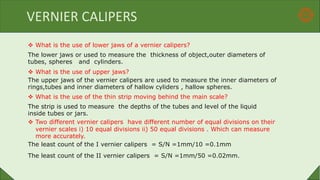
 What is the use of lower jaws of a vernier calipers?
The lower jaws or used to measure the thickness of object,outer diameters of
tubes, spheres and cylinders.
 What is the use of upper jaws?
The upper jaws of the vernier calipers are used to measure the inner diameters of
rings,tubes and inner diameters of hallow cyliders , hallow spheres.
 What is the use of the thin strip moving behind the main scale?
The strip is used to measure the depths of the tubes and level of the liquid
inside tubes or jars.
 Two different vernier calipers have different number of equal divisions on their
vernier scales i) 10 equal divisions ii) 50 equal divisions . Which can measure
more accurately.
The least count of the I vernier calipers = S/N =1mm/10 =0.1mm
The least count of the II vernier calipers = S/N =1mm/50 =0.02mm.
VERNIER CALIPERS
That is the II vernier calipers with 0.02mm of L.C can measure up to 0.02mm
accurately. Hence the accuracy of II vernier calipers in more than I vernier
calipers. Lower L.C more accuracy.
 What is the ZERO error of a vernier calipers?
When two lower jaws of the vernier calipers are in contact, if the zero division of main
scale does not coincide with the zeroth division of vernier scale, such vernier calipers
will have zero error.
 What is the formula of least count?
Least count L.C = S/N.
 What is the formula to calculate the volume of the cylinder?
Volume of the cylinder V =πr2l , where r = radius of the cylinder and
l = length of the cylinder.
 What is the formula to calculate the volume of a Sphere?
Volume of the Sphere V = (4/3)πr3 , where r = radius of the sphere.
VERNIER CALIPERS
 What is the formula to calculate total reading with a vernier calipers?
Total reading = M.S.R + n× L.C
 How many types of Zero errors will be possible in vernier calipers?
Two types of Zero errors are possible in vernier calipers they are i) Negative
Zero error ii) Positive Zero error
 What is Positive zero error, how do we correct such an error in a vernier calipers?
When two lower jaws of the vernier calipers are in contact, if the zero division of
main scale does not coincide with the zeroth division of vernier scale and the zero of
the vernier is to the right of zero of main scale such an error is called Positive Zero
error.So,the zero correction should be subtracted from the reading which is
measured.
VERNIER CALIPERS
Ex: When two lower jaws of the vernier calipers are in contact, if the zero
division of the vernier is to the right of zeroth division of main scale and if
the vernier coincidence is 1.Then the correction is subtraction i.e
Corrected Reading =Total Reading -1× L.C
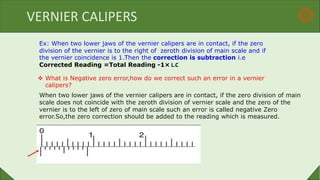
 What is Negative zero error,how do we correct such an error in a vernier
calipers?
When two lower jaws of the vernier calipers are in contact, if the zero division of main
scale does not coincide with the zeroth division of vernier scale and the zero of the
vernier is to the left of zero of main scale such an error is called negative Zero
error.So,the zero correction should be added to the reading which is measured.
VERNIER CALIPERS
Ex: When two lower jaws of the vernier calipers are in contact, if the zero division of
the vernier is to the left of zeroth division of main scale and if the vernier coincidence
is 8.Then the correction is addition i.e.
Corrected Reading =Total Reading +8× L.C
VERNIER CALIPERS
VERNIER CALIPERS

vernier Caliper Experiment.pptx

  • 1.
  • 2.
    Aim: To determine I)The volume of the given cylinder by measuring its length and diameter II) The volume of the given sphere by measuring its diameter. VERNIER CALIPERS Apparatus : Vernier Calipers, Cylinder and sphere. Description of Vernier Calipers: A Vernier calipers consists of mainly two parts i) 2cm wide 15cm long rectangular metal strip .The left end bottom side of this strip consists of a fixed jaw (A) and at the same end jaw (C) at the top of this strip. On the strip a scale is graduated in Inches along the upper edge and another scale is graduated in Centimeters along the lower edge. This is called Main Scale ‘S’ .
  • 3.
  • 4.
    VERNIER CALIPERS ii) Ametal frame V called vernier slides over the Main Scale 'S' . At the bottom of this frame V a button is attached, which helps to fix this vernier at any desired place on the main scale. This vernier frame consists of jaw-B at the bottom and a jaw-D at the top .Two scales are graduated on this frame, corresponding to two scales on the Main Scale 'S'. The two scales on the vernier are called Vernier scale. Vernier scale consists of equal number of divisions. When we move vernier frame over the main scale, a thin strip (EF) will be projected out. The projection will be exactly equal to the distance between Jaws AB i.e. the thickness of the object between jaws.  The lower jaws A&B are used to measure the thickness or external diameter of the tubes, cylinders or spheres.  The upper jaws C&D are used to measure the inner diameters of hallow bodies like tubes or holes.  The thin strip E is used to measure the depth of the objects like test tubes.
  • 5.
    VERNIER CALIPERS Theory :Principle of vernier callipers N vernier scale divisions is equal to (N-1) main scale divisions. N V.S.D = (N-1) M.S.D 1 V.S.D = {(N-1)÷N} M.S.D Least count (L.C) of vernier callipers : Minimum length or minimum thickness measurable with the vernier calipers is called its least count. Least count (L.C) = 1 M.S.D - 1 V.S.D L.C = 1 M.S.D - {(N-1)/N} M.S.D L.C = 1-{(N-1)/N} M.S.D L.C = (1/N) M.S.D = S/N Where S is the value of one Main scale division and N is the number of equal divisions on the vernier scale.
  • 6.
    VERNIER CALIPERS Procedure :First we have to determine the least count of the given vernier callipers. To determine the volume of the cylinder we have to determine a)the length of the cylinder and b) radius of the cylinder substituting these values in the equation for the volume of the cylinder we can calculate it.  To determine the length of the cylinder : Given cylinder is held gently between jaws AB of the vernier calipers. The reading on the main scale just before the zero of the vernier is noted. This is called Main scale reading (M.S.R).The number of that division (n) on the vernier which coincides perfectly with any one of the main scale divisions is noted. This is called vernier coincidence (V.C).The vernier coincidence (V.C=n) is multiplied by least count to get the fraction of a main scale division. This is added to the main scale reading (M.S.R) to calculate total reading or total length of the cylinder. Total reading = M.S.R + VC×LC
  • 7.
    VERNIER CALIPERS Take thereadings, keeping the cylinders between jaws AB at different positions. Post the values of M.S.R and vernier coincidence (n) in the table. Take at least 5 readings, get the average of these 5 readings which is mean length(l )of the cylinder.  To determine the diameter of the cylinder : Place the cylinder diametrically between the jaws AB of the vernier calipers, as in the above case post the values of M.S.R and vernier coincidence (n) in the table. Take at least 5 readings, calculate the average of these readings which gives the mean diameter ( d=2r ) of the cylinder. I) To determine the volume of the cylinder :Substituting the values of mean length (l ) of the cylinder and mean diameter ( r) of the cylinder which is already determined, in the formula V = πr2 × l cm3.
  • 8.
    VERNIER CALIPERS  Todetermine the diameter of the sphere : The given sphere is held firmly between jaws of the vernier calipers, in such a way the points where the jaws are in contact with sphere should be the two extremes of the chord of the cylinder. Post the values of the M.S.R and vernier coincidence (n) in the table . Take at least 5 readings, calculate the average of these readings which gives the mean diameter (d=2 r ) of the sphere. II)To determine the volume of the sphere :Calculate the radius of the sphere r = d/2 . Substitute the value of mean radius (r) in the formula of the volume of the sphere V = (4/3)πr3 cm3 .
  • 9.
    VERNIER CALIPERS Precautions tobe taken while doing the experiment : 1) Take the M.S.R and vernier coincide every time without parallax error. 2)Record all the reading in same system preferably in C.G.S system. 3) Do not apply excess pressure on the body held between the jaws. 4) Check for the ZERO error. When the two jaws of the vernier are in contact, if the zero division of the main scale coincides with the zero of the vernier scale no ZERO error will be there. If not ZERO error is there, apply correction. Observations: I) Least count of Vernier calipers : a) Value of 1 Main scale division = 1 M.S.D = S = ........ cm, b) Number of divisions on the vernier scale N= ......... cm, Least count L.C = S/N = .......... cm. c) Zero error =x ( -positive error, + negative error)
  • 10.
    VERNIER CALIPERS I) Volumeof the Cylinder : To find the volume of the cylinder we have to determine I) The length L of the cylinder ii ) The Radius r of the cylinder substitute the values of L and r in the formula V = πr2 L . Average length of the cylinder l = ......... cm.  Length of the cylinder : Take the readings, keeping the cylinders between jaws AB at different positions. Post the values of M.S.R and vernier coincidence (n) in the table. Take at least 5 readings, get the average of these 5 readings which is mean length(l )of the cylinder. S.NO M.S.R (a) cm Vernier Coincidence (n) Fraction b = (n±x) LC Total Reading (a+b) cm 1 2 3 4 5
  • 11.
    VERNIER CALIPERS  Diameterof the cylinder : Take the readings, keeping the cylinders between jaws AB at different positions. Post the values of M.S.R and vernier coincidence (n) in the table. Take at least 5 readings, get the average of these 5 readings which is mean diameter (d )of the cylinder. S.NO M.S.R (a) cm Vernier Coincidence (n) Fraction b = (n±x) LC Total Reading (a+b) cm 1 2 3 4 5 Average diameter of the cylinder d = 2r = ............. cm, Mean radius of the cylinder r = d/2 = .............. cm, Volume of the cylinder V = πr2 L= ................. cm3.
  • 12.
    VERNIER CALIPERS III )Volume of the sphere : To find the volume of the cylinder we have to determine the Radius r of the cylinder substitute the value r in the formula V = (4/3)πr3 .......... cm3. a) Diameter of the sphere : S.NO M.S.R (a) cm Vernier Coincidence (n) Fraction b = (n±x) LC Total Reading (a+b) cm 1 2 3 4 5 Average diameter of the sphere d = 2r = ............. cm, Mean radius of the sphere r = d/2 = .............. cm, Volume of the sphere V = (4/3)πr3 cm3. Result : 1. Volume of the given cylinder V= ........... Cm3 2. Volume of the given sphere V= ........... cm3.
  • 13.
    VERNIER CALIPERS Review Questions– Vernier calipers. During practical examinations the examiner can shoot any question related to the experiment you are doing.Here I will try to answer few Frequently asked questions by examiner.  What is the advantage of vernier calipers over a regular scale graduated in millimeters? We can measure up to a millimeter with regular scale which is graduated in millimeters, Whereas with a vernier calipers with 10 equal divisions on the vernier scale we can measure up to 1/10 (0.1) mm accurately.  What is the principle of vernier ? (N-1) main scale divisions = N divisions on vernier scale, (N-1) M.S.D = N V.S.D is the principle of vernier.  What do you mean by least count of vernier calipers? The difference of 1 M.S.D and 1 V.S.D is called least count of a vernier calipers. (or) The minimum length which can be measured by a vernier calipers is called its least count.
  • 14.
    VERNIER CALIPERS  Whatis the use of lower jaws of a vernier calipers? The lower jaws or used to measure the thickness of object,outer diameters of tubes, spheres and cylinders.  What is the use of upper jaws? The upper jaws of the vernier calipers are used to measure the inner diameters of rings,tubes and inner diameters of hallow cyliders , hallow spheres.  What is the use of the thin strip moving behind the main scale? The strip is used to measure the depths of the tubes and level of the liquid inside tubes or jars.  Two different vernier calipers have different number of equal divisions on their vernier scales i) 10 equal divisions ii) 50 equal divisions . Which can measure more accurately. The least count of the I vernier calipers = S/N =1mm/10 =0.1mm The least count of the II vernier calipers = S/N =1mm/50 =0.02mm.
  • 15.
    VERNIER CALIPERS That isthe II vernier calipers with 0.02mm of L.C can measure up to 0.02mm accurately. Hence the accuracy of II vernier calipers in more than I vernier calipers. Lower L.C more accuracy.  What is the ZERO error of a vernier calipers? When two lower jaws of the vernier calipers are in contact, if the zero division of main scale does not coincide with the zeroth division of vernier scale, such vernier calipers will have zero error.  What is the formula of least count? Least count L.C = S/N.  What is the formula to calculate the volume of the cylinder? Volume of the cylinder V =πr2l , where r = radius of the cylinder and l = length of the cylinder.  What is the formula to calculate the volume of a Sphere? Volume of the Sphere V = (4/3)πr3 , where r = radius of the sphere.
  • 16.
    VERNIER CALIPERS  Whatis the formula to calculate total reading with a vernier calipers? Total reading = M.S.R + n× L.C  How many types of Zero errors will be possible in vernier calipers? Two types of Zero errors are possible in vernier calipers they are i) Negative Zero error ii) Positive Zero error  What is Positive zero error, how do we correct such an error in a vernier calipers? When two lower jaws of the vernier calipers are in contact, if the zero division of main scale does not coincide with the zeroth division of vernier scale and the zero of the vernier is to the right of zero of main scale such an error is called Positive Zero error.So,the zero correction should be subtracted from the reading which is measured.
  • 17.
    VERNIER CALIPERS Ex: Whentwo lower jaws of the vernier calipers are in contact, if the zero division of the vernier is to the right of zeroth division of main scale and if the vernier coincidence is 1.Then the correction is subtraction i.e Corrected Reading =Total Reading -1× L.C  What is Negative zero error,how do we correct such an error in a vernier calipers? When two lower jaws of the vernier calipers are in contact, if the zero division of main scale does not coincide with the zeroth division of vernier scale and the zero of the vernier is to the left of zero of main scale such an error is called negative Zero error.So,the zero correction should be added to the reading which is measured.
  • 18.
    VERNIER CALIPERS Ex: Whentwo lower jaws of the vernier calipers are in contact, if the zero division of the vernier is to the left of zeroth division of main scale and if the vernier coincidence is 8.Then the correction is addition i.e. Corrected Reading =Total Reading +8× L.C
  • 19.
  • 20.