Experiment No: 03
Title:
How to use Vernier Caliper and how to take measurement from it.
Apparatus:
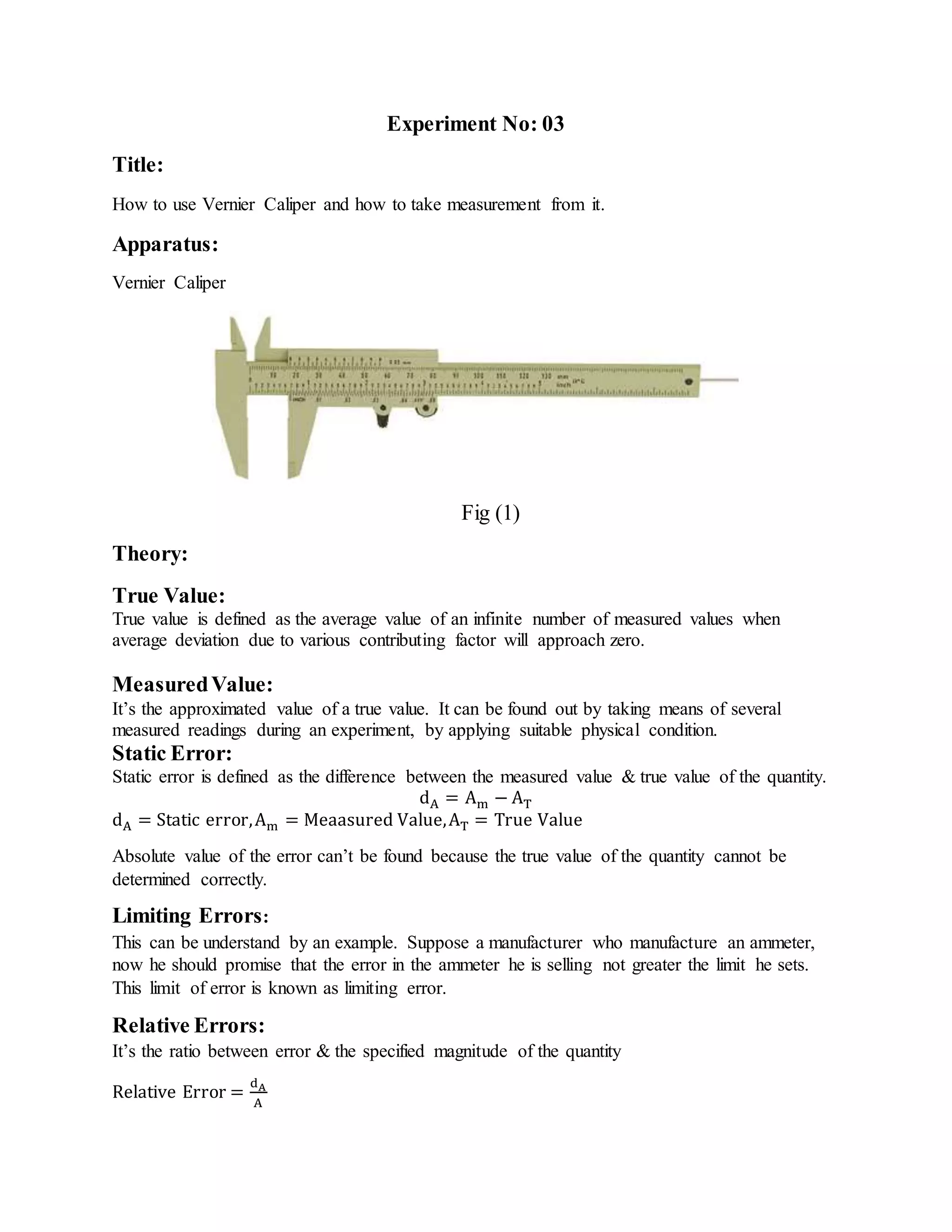
Vernier Caliper
Fig (1)
Theory:
True Value:
True value is defined as the average value of an infinite number of measured values when
average deviation due to various contributing factor will approach zero.
MeasuredValue:
It’s the approximated value of a true value. It can be found out by taking means of several
measured readings during an experiment, by applying suitable physical condition.
Static Error:
Static error is defined as the difference between the measured value & true value of the quantity.
dA = Am − AT
dA = Static error,Am = Meaasured Value,AT = True Value
Absolute value of the error can’t be found because the true value of the quantity cannot be
determined correctly.
Limiting Errors:
This can be understand by an example. Suppose a manufacturer who manufacture an ammeter,
now he should promise that the error in the ammeter he is selling not greater the limit he sets.
This limit of error is known as limiting error.
Relative Errors:
It’s the ratio between error & the specified magnitude of the quantity
Relative Error =
dA
A
Procedure:
1. Check both Vernier & Dial calipers for zero error.
2. Hold first specimen in the jaws of Vernier.
3. Check for main scale reading.
4. Note it down.
5. Now check & note down the Vernier scale reading.
6. Multiply Vernier scale reading with the least count (0.02mm).
7. Add both main scale & Vernier scale reading to get total reading.
8. Hold the same specimen into the jaws of dial caliper.
9. Note down the reading.
10. Calculate the error between both readings.
11. Change the specimen & repeat the same procedure for it.
Parts:
 Main scale
 Vernier scale
Function:
 Used to measure external diameter.
 Used to measure internal diameter.
 Used to measure depth of a body.
Zero error:
 Negative zero error
 Positive zero error
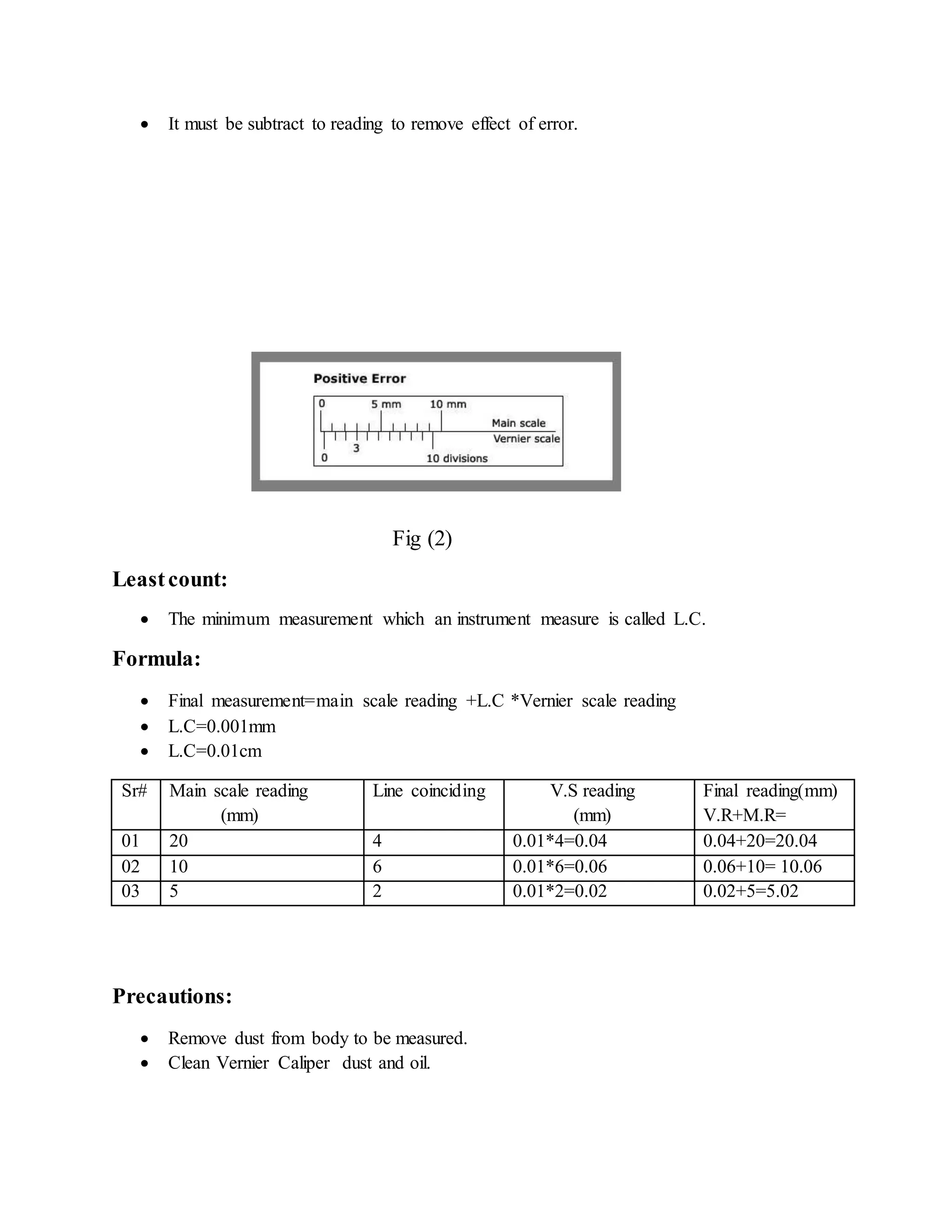
Negative zero error:
 If zero of Vernier scale is at left side of zero of main scale.
 It must be add to reading to remove effect of error.
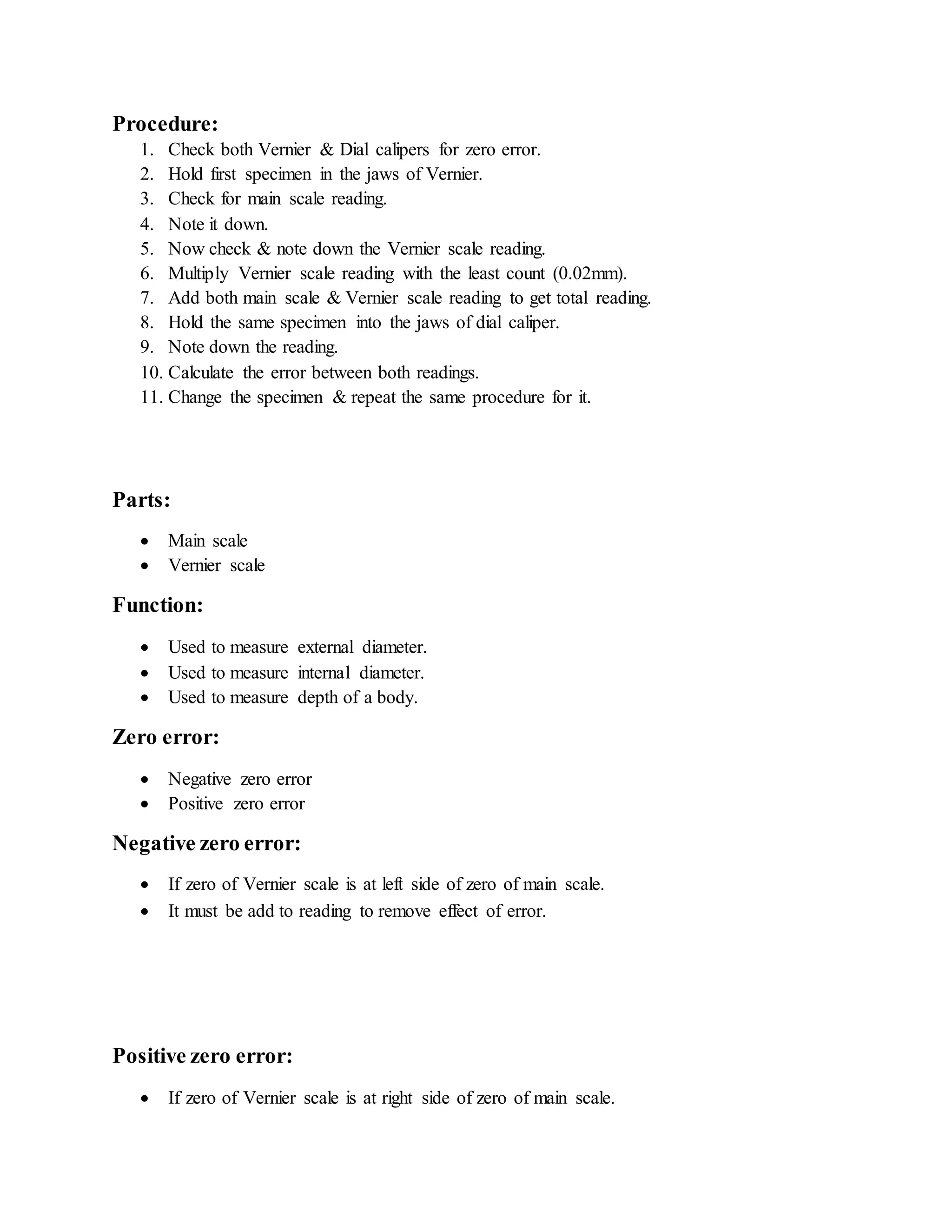
Positive zero error:
 If zero of Vernier scale is at right side of zero of main scale.
 It must be subtract to reading to remove effect of error.
Fig (2)
Leastcount:
 The minimum measurement which an instrument measure is called L.C.
Formula:
 Final measurement=main scale reading +L.C *Vernier scale reading
 L.C=0.001mm
 L.C=0.01cm
Sr# Main scale reading
(mm)
Line coinciding V.S reading
(mm)
Final reading(mm)
V.R+M.R=
01 20 4 0.01*4=0.04 0.04+20=20.04
02 10 6 0.01*6=0.06 0.06+10= 10.06
03 5 2 0.01*2=0.02 0.02+5=5.02
Precautions:
 Remove dust from body to be measured.
 Clean Vernier Caliper dust and oil.
Fig (3)
Comments:
We can read Vernier Caliper and get reading from it.

How to use Vernier Caliper and how to take measurement from it.

  • 1.
    Experiment No: 03 Title: Howto use Vernier Caliper and how to take measurement from it. Apparatus: Vernier Caliper Fig (1) Theory: True Value: True value is defined as the average value of an infinite number of measured values when average deviation due to various contributing factor will approach zero. MeasuredValue: It’s the approximated value of a true value. It can be found out by taking means of several measured readings during an experiment, by applying suitable physical condition. Static Error: Static error is defined as the difference between the measured value & true value of the quantity. dA = Am − AT dA = Static error,Am = Meaasured Value,AT = True Value Absolute value of the error can’t be found because the true value of the quantity cannot be determined correctly. Limiting Errors: This can be understand by an example. Suppose a manufacturer who manufacture an ammeter, now he should promise that the error in the ammeter he is selling not greater the limit he sets. This limit of error is known as limiting error. Relative Errors: It’s the ratio between error & the specified magnitude of the quantity Relative Error = dA A
  • 2.
    Procedure: 1. Check bothVernier & Dial calipers for zero error. 2. Hold first specimen in the jaws of Vernier. 3. Check for main scale reading. 4. Note it down. 5. Now check & note down the Vernier scale reading. 6. Multiply Vernier scale reading with the least count (0.02mm). 7. Add both main scale & Vernier scale reading to get total reading. 8. Hold the same specimen into the jaws of dial caliper. 9. Note down the reading. 10. Calculate the error between both readings. 11. Change the specimen & repeat the same procedure for it. Parts:  Main scale  Vernier scale Function:  Used to measure external diameter.  Used to measure internal diameter.  Used to measure depth of a body. Zero error:  Negative zero error  Positive zero error Negative zero error:  If zero of Vernier scale is at left side of zero of main scale.  It must be add to reading to remove effect of error. Positive zero error:  If zero of Vernier scale is at right side of zero of main scale.
  • 3.
     It mustbe subtract to reading to remove effect of error. Fig (2) Leastcount:  The minimum measurement which an instrument measure is called L.C. Formula:  Final measurement=main scale reading +L.C *Vernier scale reading  L.C=0.001mm  L.C=0.01cm Sr# Main scale reading (mm) Line coinciding V.S reading (mm) Final reading(mm) V.R+M.R= 01 20 4 0.01*4=0.04 0.04+20=20.04 02 10 6 0.01*6=0.06 0.06+10= 10.06 03 5 2 0.01*2=0.02 0.02+5=5.02 Precautions:  Remove dust from body to be measured.  Clean Vernier Caliper dust and oil.
  • 4.
    Fig (3) Comments: We canread Vernier Caliper and get reading from it.