A PRESENTATION ON DEER
Odocoileus virginianus (White tailed
Deer)
INTRODUCTION
Deer are even-toed ungaluate mammals
They from the family Cervidae
Wild deer have been present in the british
isles since pre-history
There re about 60 species
Six species(red,roe,fallow,sika,muntjac &
chinese water deer) living in the british
isles.
Taxanomy
 Kingdom : Animalia
 Phylum : Chordata
 Class : Mammalia
 Order : Artiodactyla
 Family : Cervidae
 Genus : Odocoileus
 Species : O. virginianus
 Lifespan : 4-5 years in the wild; 15-20 years in captivity
 Size : up to 80 inches long, 39 inches at the shoulder,
weight 50-300 pounds
 Offspring : 1-2 fawns, sometimes 3
 Status : Common, widespread
Charecteristics:
Cud chewing animal
Four chamber of stomach
Vision is best at night
Coat is reddish brown in summer & turn
to gray brown in winter
Have excellent smell & hearing capacity
Can run 40 miles per hours
Attractiveness powerof spotted deer
known as chital in india
Antlers:
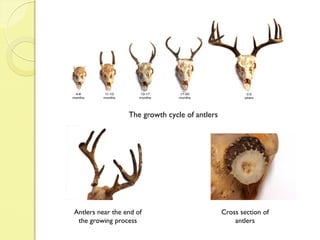
Only males have antler
The antlers are deciduous & drop off
after mating season
Male use it during the rutting season
A buck antlers are covered with
“VELVET” while they are growing.
The growth cycle of antlers
Antlers near the end of
the growing process
Cross section of
antlers
Many factors affect a antler development
,including
Diet- Nutrition
Age
Genetics
Herd Management
Habitat:
Do not make nest & dense
Find safe & comfortable place & low
hanging evergreen branches
Stay close where they find food
Eat grass, plants & weeds
An adult deer require 4-8 pounds of
forage per day.
Feeding Behavior:
 Deer are herbivores; they only eat vegetation
 For the most part, a deer's diet consists of
grass, small shrubs and leaves
 They will forage in trash bins and in gardens if
they cannot find the vegetation they need
elsewhere
 Deer have one main stomach and three "false
stomachs." Like cows, they chew their cud to
fully digest their food
Reproduction:
 Before the actual mating, does play "hard to get" for
several days
 The buck chases a doe, and she eventually allows him to
"catch" her.
 After copulating several times over a period of a few
days, the buck stays with the doe for a few more days
until she is out of estrus. He stays by her to keep other
bucks away.When he leaves, he might go on to find
other does with which to mate
 If the doe doesn't get pregnant during that cycle, she
goes into another estrus cycle within three to four
weeks
Social Behavior:
 Deer are very social and travel in groups called herds
 The herd is often led by a dominant male, though with
some species the herds are segregated by sex
 Sometimes the females will have their own herd and the
males will have a separate herd
 In other cases, a female herd is watched over by a herd
of males. Some caribou herds can have as many as
100,000 members, according to ADW
 Most deer are active throughout the day, though their
most active times are during sunrise and dusk.They
spend their days foraging for food
Restrainng:
Minimum two people are required for
handling.
Cover the eyes to clam the animl
Antlers may be used for holdings the
head
Roe deer may require sadation/ general
anesthesia
“Walk- towards” net may also used for
small deer
Thank you
Submitted by:
MD . ASIBUL HASAN
Roll:1801099 ; Reg: 3963
FVABS, SyLAU

A presentation on deer

  • 1.
    A PRESENTATION ONDEER Odocoileus virginianus (White tailed Deer)
  • 2.
    INTRODUCTION Deer are even-toedungaluate mammals They from the family Cervidae Wild deer have been present in the british isles since pre-history There re about 60 species Six species(red,roe,fallow,sika,muntjac & chinese water deer) living in the british isles.
  • 4.
    Taxanomy  Kingdom :Animalia  Phylum : Chordata  Class : Mammalia  Order : Artiodactyla  Family : Cervidae  Genus : Odocoileus  Species : O. virginianus  Lifespan : 4-5 years in the wild; 15-20 years in captivity  Size : up to 80 inches long, 39 inches at the shoulder, weight 50-300 pounds  Offspring : 1-2 fawns, sometimes 3  Status : Common, widespread
  • 5.
    Charecteristics: Cud chewing animal Fourchamber of stomach Vision is best at night Coat is reddish brown in summer & turn to gray brown in winter Have excellent smell & hearing capacity Can run 40 miles per hours Attractiveness powerof spotted deer known as chital in india
  • 6.
    Antlers: Only males haveantler The antlers are deciduous & drop off after mating season Male use it during the rutting season A buck antlers are covered with “VELVET” while they are growing.
  • 7.
    The growth cycleof antlers Antlers near the end of the growing process Cross section of antlers
  • 8.
    Many factors affecta antler development ,including Diet- Nutrition Age Genetics Herd Management
  • 9.
    Habitat: Do not makenest & dense Find safe & comfortable place & low hanging evergreen branches Stay close where they find food Eat grass, plants & weeds An adult deer require 4-8 pounds of forage per day.
  • 10.
    Feeding Behavior:  Deerare herbivores; they only eat vegetation  For the most part, a deer's diet consists of grass, small shrubs and leaves  They will forage in trash bins and in gardens if they cannot find the vegetation they need elsewhere  Deer have one main stomach and three "false stomachs." Like cows, they chew their cud to fully digest their food
  • 11.
    Reproduction:  Before theactual mating, does play "hard to get" for several days  The buck chases a doe, and she eventually allows him to "catch" her.  After copulating several times over a period of a few days, the buck stays with the doe for a few more days until she is out of estrus. He stays by her to keep other bucks away.When he leaves, he might go on to find other does with which to mate  If the doe doesn't get pregnant during that cycle, she goes into another estrus cycle within three to four weeks
  • 12.
    Social Behavior:  Deerare very social and travel in groups called herds  The herd is often led by a dominant male, though with some species the herds are segregated by sex  Sometimes the females will have their own herd and the males will have a separate herd  In other cases, a female herd is watched over by a herd of males. Some caribou herds can have as many as 100,000 members, according to ADW  Most deer are active throughout the day, though their most active times are during sunrise and dusk.They spend their days foraging for food
  • 13.
    Restrainng: Minimum two peopleare required for handling. Cover the eyes to clam the animl Antlers may be used for holdings the head Roe deer may require sadation/ general anesthesia “Walk- towards” net may also used for small deer
  • 14.
    Thank you Submitted by: MD. ASIBUL HASAN Roll:1801099 ; Reg: 3963 FVABS, SyLAU