INSECTIVOROUS
PLANTS


           -Aditi Hanumantha
                      VI C 7
INTRODUCTION
 There are many types of plants on our
  planet.This is about carnivorous plants.
 Insects are the most common prey for most
  carnivorous plants. That is why they are also
  called as insectivorous plants.
 There are 9 types and 600 species of
  insectivorous plants.
DIET

*The diet of insectivorous plants consists of frogs,
  small mammals and, of course insects.
*Most plants absorb nitrogen from soil. However,
  insectivorous plants receive nitrogen from its
  prey.
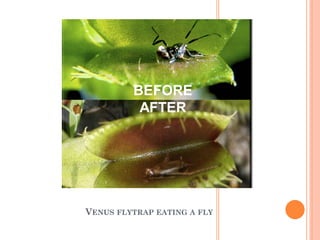
BEFORE
          AFTER


VENUS FLYTRAP EATING A FLY
HABITAT

*Insectivorous plants mostly live in areas where
  nutrients are low.
*Where they live, water and sunshine are found in
  enough quantities.
*Most of these plants are found in bogs and fens
  (marshes).
PITCHER PLANT IN A MARSH
TYPES OF TRAPS

*Insectivorous plants are mainly categorized by the
  type of trap they have. They are:
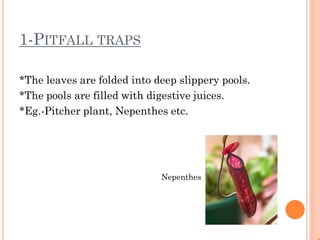
1-PITFALL TRAPS

*The leaves are folded into deep slippery pools.
*The pools are filled with digestive juices.
*Eg.-Pitcher plant, Nepenthes etc.


                             Nepenthes
2-FLYPAPER(OR ADHESIVE) TRAPS

*The leaves are covered with stalked glands.
*They send out slimy substances to attract insects.
*Eg.-Sundews, Butterworts etc.


     Sundew
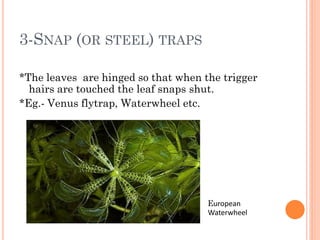
3-SNAP (OR STEEL) TRAPS

*The leaves are hinged so that when the trigger
  hairs are touched the leaf snaps shut.
*Eg.- Venus flytrap, Waterwheel etc.


                                     European
 Waterwheel                          Waterwheel
4-LOBSTER POT

*The traps are twisted into cannels lined with
  hairs and glands.
*Eg.- Corkskrew etc.


     Corkskrew

Insectivorous plants

  • 1.
    INSECTIVOROUS PLANTS -Aditi Hanumantha VI C 7
  • 2.
    INTRODUCTION  There aremany types of plants on our planet.This is about carnivorous plants.  Insects are the most common prey for most carnivorous plants. That is why they are also called as insectivorous plants.  There are 9 types and 600 species of insectivorous plants.
  • 3.
    DIET *The diet ofinsectivorous plants consists of frogs, small mammals and, of course insects. *Most plants absorb nitrogen from soil. However, insectivorous plants receive nitrogen from its prey.
  • 4.
    BEFORE AFTER VENUS FLYTRAP EATING A FLY
  • 5.
    HABITAT *Insectivorous plants mostlylive in areas where nutrients are low. *Where they live, water and sunshine are found in enough quantities. *Most of these plants are found in bogs and fens (marshes).
  • 6.
  • 7.
    TYPES OF TRAPS *Insectivorousplants are mainly categorized by the type of trap they have. They are:
  • 8.
    1-PITFALL TRAPS *The leavesare folded into deep slippery pools. *The pools are filled with digestive juices. *Eg.-Pitcher plant, Nepenthes etc. Nepenthes
  • 9.
    2-FLYPAPER(OR ADHESIVE) TRAPS *Theleaves are covered with stalked glands. *They send out slimy substances to attract insects. *Eg.-Sundews, Butterworts etc. Sundew
  • 10.
    3-SNAP (OR STEEL)TRAPS *The leaves are hinged so that when the trigger hairs are touched the leaf snaps shut. *Eg.- Venus flytrap, Waterwheel etc. European Waterwheel Waterwheel
  • 11.
    4-LOBSTER POT *The trapsare twisted into cannels lined with hairs and glands. *Eg.- Corkskrew etc. Corkskrew