Ventricular Assist Devices
Dr.Elamaran.E
Senior Resident
Dept. of CTVS
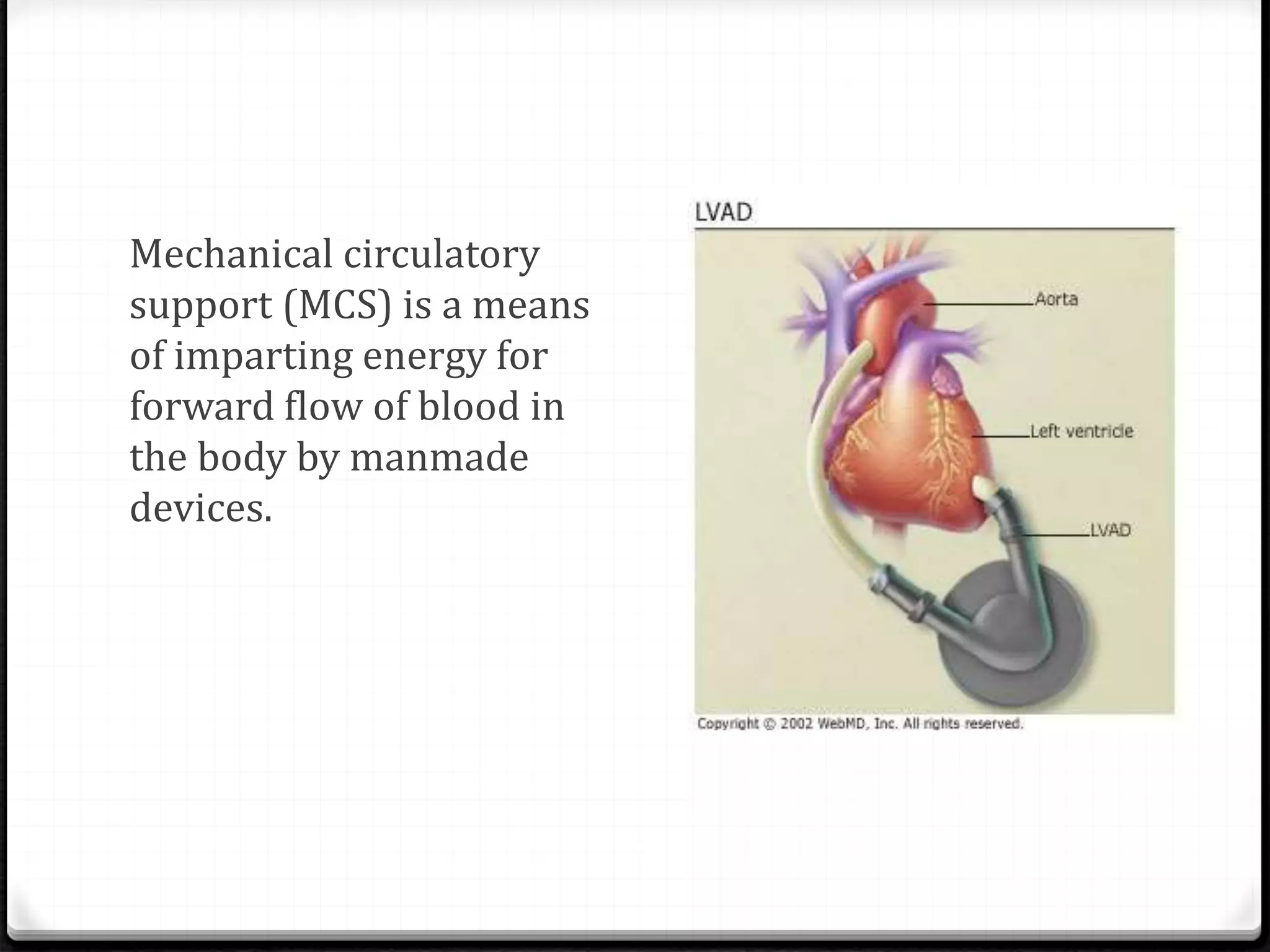
Mechanical circulatory
support (MCS) is a means
of imparting energy for
forward flow of blood in
the body by manmade
devices.
History
0 In the presence of prolonged cardiac unloading with
an LVAD, myocyte size and myocardial collagen
content and collagen production (fibrosis) generally
decline.
0 On an anatomic and functional level, chronic LVAD
support generally results in reduction in left
ventricular mass as well as left ventricular end-
systolic and end-diastolic volume - improvement in
left ventricular ejection fraction
Indications
Duration of use
0 Bridge to recovery
Postcardiotomy cardiogenic shock.
Post acute-myocardial infarction (MI) cardiogenic shock.
Myocarditis-induced cardiogenic shock
Support during medical or ablative therapy for
intractable dysrhythmias.
0 Bridge to Transplant
0 Bridge to Destination Therapy
Indications
1. NYHA functional class IV symptoms
2. Life expectancy < 2 years
3. Not a candidate for heart transplantation
4. Failure to respond to optimal medical management for at
least 60 of the last 90 days
5. Left ventricular ejection fraction 25%
6. Refractory cardiogenic shock or cardiac failure
7. Continued need for intravenous inotropic therapy limited by
symptomatic hypotension, decreasing renal function, or
worsening pulmonary congestion
8. Body surface area > 1.5 m2
Downloaded from http://circ.ahajournals.org/ by guest on June 13, 2014
Contraindications
0 Age > 65 years, unless minimal or no other clinical risk factors
0 Chronic kidney disease with serum creatinine level 3.0 mg/dL
0 Severe chronic malnutrition (BMI < 21 kg/m2 in males and
< 19 kg/m2 in females)
0 Morbid obesity (BMI 40 kg/m2)
0 Mechanical ventilation
0 Recent or evolving stroke
0 Neurological deficits impairing the ability to manage device
0 Coexisting terminal condition (eg, metastatic cancer, cirrhosis)
Downloaded from http://circ.ahajournals.org/ by guest on June 13, 2014
0 Abdominal aortic aneurysm > 5 cm
0 Biventricular failure in patients older than 65 years
0 Active systemic infection or major chronic risk for infection
0 Fixed pulmonary or portal hypertension
0 Severe pulmonary dysfunction (eg, FEV1 < 1 L)
0 Impending renal or hepatic failure
0 Multisystem organ failure
0 Heparin-induced thrombocytopenia
0 Significant underlying psychiatric illness or lack of social support
that may impair ability to maintain and operate VAD
Downloaded from http://circ.ahajournals.org/ by guest on June 13, 2014
Design of Ventricular Assist Device
Basic Components of VAD
1. Blood pump
2. Controller
3. Power source
4.Inflow cannula
5.Outflow cannula
Krishnamani, R. et al. (2010) Emerging ventricular assist devices for long-
term cardiac support
Nat. Rev. Cardiol. doi:10.1038/nrcardio.2009.222
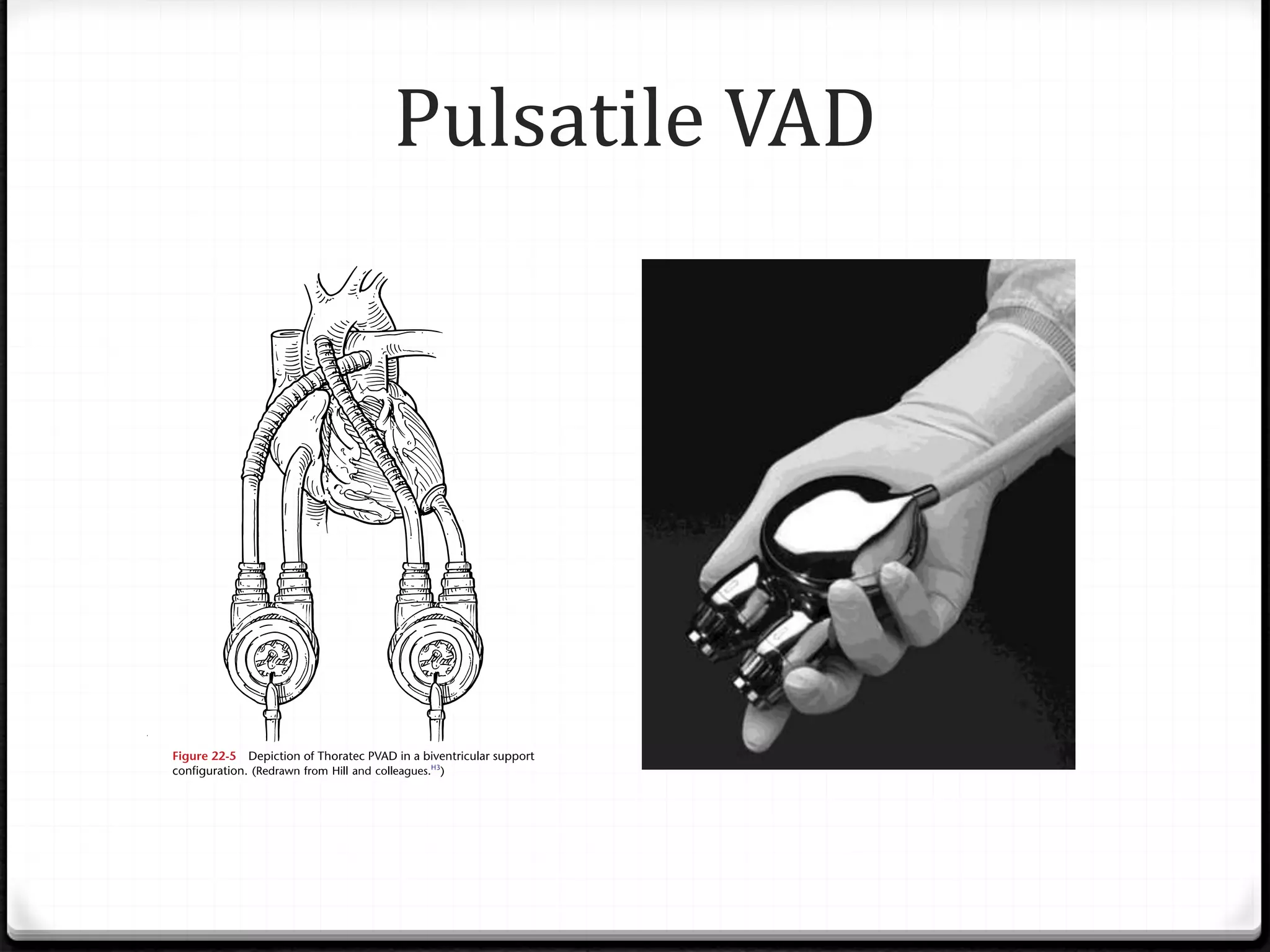
Pulsatile VAD
Continuous flow VAD
Technique of Insertion
0 Pulmonary artery catheter
0 Intraoperative TEE
 assessment of biventricular function
evaluation of aortic insufficiency
presence of a patent foramen ovale
identification of intracardiac and aortic air bubbles
during implantation and subsequent de-airing
maneuvers
assessment of inflow cannula position within the left
ventricle.
0 Device pocket creation
0 CPB established
0 Heart is maintained in a continuously beating state
without cardioplegic arrest
0 Left ventricular apex is displaced, and an opening is
created in the left ventricle for insertion of the apical
cannula
0 Deairing of the device
0 End-to-side anastomosis is then constructed to the
right lateral aspect of the ascending aorta
0 Drive line is brought out through a long subcutaneous
tunnel and passed off the surgical field and connected
to the pump console
0 Full pumping is established, and CPB is discontinued
with continued surveillance by TEE for air and right
ventricular function

Ventricular assist devices

  • 1.
  • 2.
    Mechanical circulatory support (MCS)is a means of imparting energy for forward flow of blood in the body by manmade devices.
  • 3.
  • 4.
    0 In thepresence of prolonged cardiac unloading with an LVAD, myocyte size and myocardial collagen content and collagen production (fibrosis) generally decline. 0 On an anatomic and functional level, chronic LVAD support generally results in reduction in left ventricular mass as well as left ventricular end- systolic and end-diastolic volume - improvement in left ventricular ejection fraction
  • 5.
    Indications Duration of use 0Bridge to recovery Postcardiotomy cardiogenic shock. Post acute-myocardial infarction (MI) cardiogenic shock. Myocarditis-induced cardiogenic shock Support during medical or ablative therapy for intractable dysrhythmias. 0 Bridge to Transplant 0 Bridge to Destination Therapy
  • 7.
    Indications 1. NYHA functionalclass IV symptoms 2. Life expectancy < 2 years 3. Not a candidate for heart transplantation 4. Failure to respond to optimal medical management for at least 60 of the last 90 days 5. Left ventricular ejection fraction 25% 6. Refractory cardiogenic shock or cardiac failure 7. Continued need for intravenous inotropic therapy limited by symptomatic hypotension, decreasing renal function, or worsening pulmonary congestion 8. Body surface area > 1.5 m2 Downloaded from http://circ.ahajournals.org/ by guest on June 13, 2014
  • 8.
    Contraindications 0 Age >65 years, unless minimal or no other clinical risk factors 0 Chronic kidney disease with serum creatinine level 3.0 mg/dL 0 Severe chronic malnutrition (BMI < 21 kg/m2 in males and < 19 kg/m2 in females) 0 Morbid obesity (BMI 40 kg/m2) 0 Mechanical ventilation 0 Recent or evolving stroke 0 Neurological deficits impairing the ability to manage device 0 Coexisting terminal condition (eg, metastatic cancer, cirrhosis) Downloaded from http://circ.ahajournals.org/ by guest on June 13, 2014
  • 9.
    0 Abdominal aorticaneurysm > 5 cm 0 Biventricular failure in patients older than 65 years 0 Active systemic infection or major chronic risk for infection 0 Fixed pulmonary or portal hypertension 0 Severe pulmonary dysfunction (eg, FEV1 < 1 L) 0 Impending renal or hepatic failure 0 Multisystem organ failure 0 Heparin-induced thrombocytopenia 0 Significant underlying psychiatric illness or lack of social support that may impair ability to maintain and operate VAD Downloaded from http://circ.ahajournals.org/ by guest on June 13, 2014
  • 10.
    Design of VentricularAssist Device Basic Components of VAD 1. Blood pump 2. Controller 3. Power source 4.Inflow cannula 5.Outflow cannula
  • 11.
    Krishnamani, R. etal. (2010) Emerging ventricular assist devices for long- term cardiac support Nat. Rev. Cardiol. doi:10.1038/nrcardio.2009.222
  • 12.
  • 13.
  • 16.
    Technique of Insertion 0Pulmonary artery catheter 0 Intraoperative TEE  assessment of biventricular function evaluation of aortic insufficiency presence of a patent foramen ovale identification of intracardiac and aortic air bubbles during implantation and subsequent de-airing maneuvers assessment of inflow cannula position within the left ventricle.
  • 17.
    0 Device pocketcreation 0 CPB established 0 Heart is maintained in a continuously beating state without cardioplegic arrest 0 Left ventricular apex is displaced, and an opening is created in the left ventricle for insertion of the apical cannula 0 Deairing of the device
  • 18.
    0 End-to-side anastomosisis then constructed to the right lateral aspect of the ascending aorta 0 Drive line is brought out through a long subcutaneous tunnel and passed off the surgical field and connected to the pump console 0 Full pumping is established, and CPB is discontinued with continued surveillance by TEE for air and right ventricular function