Left Ventricular Assist
Devices for Lifelong Support
Dr Siva Subramaniyan
PGIMER &Dr.RML Hospital
New Delhi
INTRODUCTION
 Heart disease is the leading cause of death in the Western world
 ~5 million people in the US have congestive heart failure (CHF)
 250,000 are in the most advanced stage of CHF
 ~500,000 new cases each year
 ~50,000 deaths each year
 only effective treatment for end stage CHF is heart transplant
stage D heart failure
• Despite the progress made in treating chronic systolic heart failure (HF), there
remains a need for the contemporary approach to the management of advanced
(stage D) HF to further evolve.
• For the past 3 decades, heart transplantation has been the established therapy of
choice for the roughly 2,200 people per year who possess the appropriate age
and freedom from significant comorbidity to be matched with a suitable donor .
• These individuals represent only a small fraction of the estimated 150,000 to
200,000 patients with stage D HF who endure a high symptom burden of
shortness of breath, congestion, and fatigue despite maximally tolerated
medication
ACCF/AHA guideline for the management of heart failure: a report of the ACC Foundation/American Heart
Association Task Force on Practice Guidelines. J Am Coll Cardiol 2013;62:e147–239
• It is for the larger group of individuals who face a high risk of short-term mortality
and little chance of receiving a transplant that the emergence of continuous-flow
(CF) left ventricular assist devices (LVADs) holds the greatest promise.
• These small implantable devices are capable of augmenting the circulation to
meet the body’s physiological needs, both at rest and with exercise, extending
survival and improving quality of life
ACCF/AHA guideline for the management of heart failure: a report of the ACC Foundation/American Heart
Association Task Force on Practice Guidelines. J Am Coll Cardiol 2013;62:e147–239
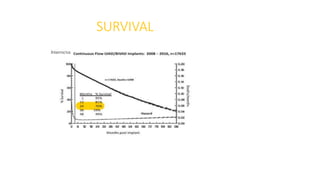
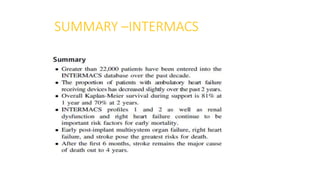
• One-year survival with current continuous-flow devices is reported to be 80%,
and 2-year survival, 70%.
• In patients awaiting heart transplantation, MCS provides a bridge to
transplantation, and for others who are ineligible for heart transplantation, MCS
provides permanent support or destination therapy.
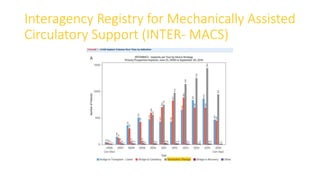
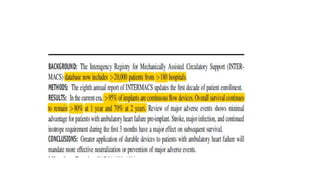
Interagency Registry for Mechanically Assisted
Circulatory Support (INTER- MACS)
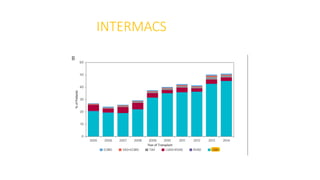
INTERMACS
VAD
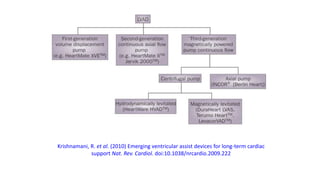
• Classification of Ventricular Assist Devices
On the basis of period of use:
a) Temporary, b) Permanent
On the basis of impaired ventricle:
a) LVAD, b) RVAD, c) Bi-VAD
On the basis of Pumping mechanism:
a) Pulsatile b) Non pulsatile
Krishnamani, R. et al. (2010) Emerging ventricular assist devices for long-term cardiac
support Nat. Rev. Cardiol. doi:10.1038/nrcardio.2009.222
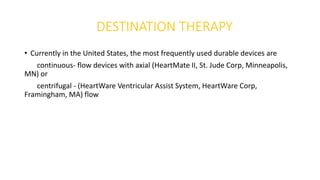
DESTINATION THERAPY
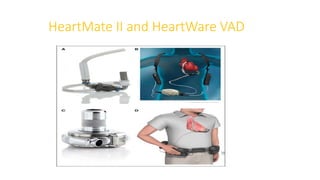
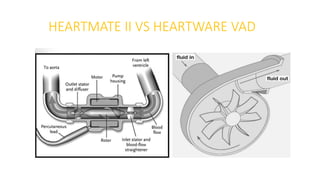
• Currently in the United States, the most frequently used durable devices are
continuous- flow devices with axial (HeartMate II, St. Jude Corp, Minneapolis,
MN) or
centrifugal - (HeartWare Ventricular Assist System, HeartWare Corp,
Framingham, MA) flow
HeartMate II and HeartWare VAD
DEVICE COMPONENT
1.The pump
2.The driveline
3.The controller
4.The batteries
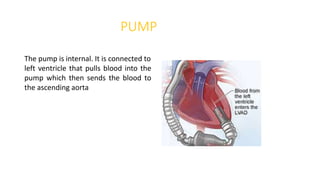
PUMP
The pump is internal. It is connected to
left ventricle that pulls blood into the
pump which then sends the blood to
the ascending aorta
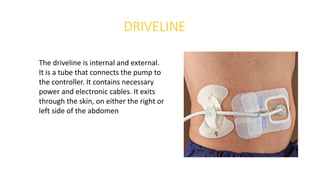
DRIVELINE
The driveline is internal and external.
It is a tube that connects the pump to
the controller. It contains necessary
power and electronic cables. It exits
through the skin, on either the right or
left side of the abdomen
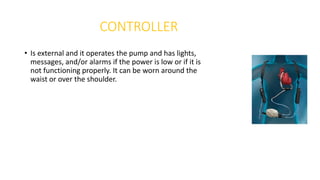
CONTROLLER
• Is external and it operates the pump and has lights,
messages, and/or alarms if the power is low or if it is
not functioning properly. It can be worn around the
waist or over the shoulder.
BATTERIES
Options for Power
• Batteries
• AC power sources
HEARTMATE II VS HEARTWARE VAD
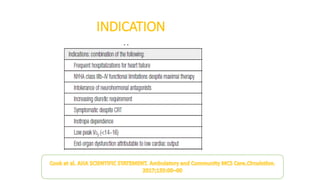
INDICATION
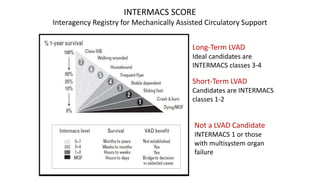
INTERMACS SCORE
Interagency Registry for Mechanically Assisted Circulatory Support
Long-Term LVAD
Ideal candidates are
INTERMACS classes 3-4
Short-Term LVAD
Candidates are INTERMACS
classes 1-2
Not a LVAD Candidate
INTERMACS 1 or those
with multisystem organ
failure
OPTIMIZING HEMODYNAMICS AND FLOW
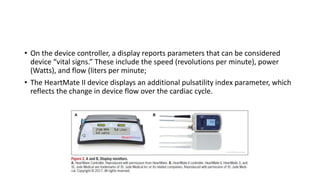
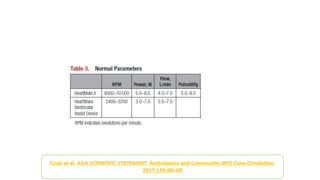
• On the device controller, a display reports parameters that can be considered
device “vital signs.” These include the speed (revolutions per minute), power
(Watts), and flow (liters per minute;
• The HeartMate II device displays an additional pulsatility index parameter, which
reflects the change in device flow over the cardiac cycle.
• Using a combination of CVP and PCWP, there are 5 patient profile possible:
1) normal resting hemodynamics (CVP 3 to 12 mm Hg, PCWP 8 to 18 mm Hg);
2) Rightsided HF (elevated CVP, normal PCWP);
3) Biventricular failure/fluid overload (elevated CVP and PCWP);
4) left-sided HF (normal CVP, elevated PCWP); and
5) hypovolemia (low CVP and PCWP)
• Only 40% to 60% of patients had “normal” hemodynamics (CVP <12 mm Hg and
PCWP <18 mm Hg) at their set speed.
• a patient with a left-sided HF profile would likely benefit from a pump speed
increase.
• Those with congestion or biventricular failure are likely best served by increased
volume removal with augmented diuretic therapy.
• Lastly, hypovolemia benefitted from volume replacement
• Current clinical guidelines support the use of an echocardiographic ramp test to
set pump speed .
• During such a test, pump speed is increased by a series of fixed increments over a
set period of time to determine the degree of volume unloading defined by
septal positioning, the presence and severity of mitral regurgitation, the
frequency of aortic valve opening, and changes in the LV end-diastolic diameter
(LVEDD) in the parasternal long-axis view.
COMANAGEMENT OF THE STABLE PATIENT
• Longitudinal care of patients with MCS requires a multidisciplinary team to
manage comorbid conditions.
• The implanting center typically maintains close follow-up; however, referring
physicians and other specialty providers (often in outlying locations) participate in
the coordinated plan of care
RETURNING TO NORMALCY
• Many signs and symptoms of heart failure (eg, shortness of breath, paroxysmal
nocturnal dyspnea, and fluid weight gain) abate fairly soon after surgery.
• Other symptoms may resolve over a longer period of time (eg, fatigue, poor
energy level, and decreased strength).
• Thus, early mobilization and rehabilitation are important to a successful recovery.
Aggressive physical and occupational therapy should begin as soon as possible
after MCS surgery, and cardiac rehabilitation should continue beyond hospital
discharge
• MCS self-care
• Family caregiver support is an important component of selfcare
• patients with MCS adjust to performing activities of daily living (eg, bathing,
dressing, sleeping, home management, and work) and engaging in leisure
activities
• Driving is allowed
ANTICOAGULATION
• Anticoagulation with warfarin is required for all continuous- flow devices.
• however, the level of anticoagulation may vary by center, practice, and device
type.
• Antiplatelet therapy with aspirin and often a second antiplatelet agent is
necessary because of the threat of stasis, thrombosis, shear-induced platelet
dysfunction, and hemolysis.
• Upregulation of platelet function is described with MCS and may contribute to
long-term risk of thromboembolic events.
HYPERTENSION AND HYPOTENSION
• Titration of medical therapy to maintain a mean arterial blood pressure in the
normal range is imperative to optimize forward flow and to prevent adverse
events.
• Hypertension after ventricular assist device (VAD) implantation is common, and
an increase in diastolic pressure with a continuous-flow device may exacerbate or
lead to hypertension.
• Increased afterload decreases pump flow and increases the risk of neurological
events and end-organ damage.
• Neurohormone-modifying agents such as ACEI, ARBs, β-blockers, and
mineralocorticoid receptor antagonists are used to decrease afterload, to
improve pump function, and to potentially contribute to ventricular recovery
RENAL FAILURE
• Renal insufficiency is common in end-stage heart failure. After MCS implantation,
67% of patients have been reported to experience improved renal function.
• while a minority experience AKI. AKI in the postoperative period is known to be a
negative predictor of outcomes after PF-LVAD implantation and has been
associated with an increased 1-year mortality in CF-LVAD recipients (relative risk
3)
causes of RF
• acute blood loss,
• volume shifts,
• arrhythmias, and
• the effect of multiple vasoactive medications influence renal hemodynamics.
The sudden change in renal blood flow characteristics due to LVAD support can lead
to AKI .
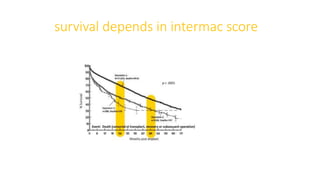
Patients with preoperative RV failure and patients with INTERMACS scores of 1 or
2 are at higher risk of AKI
• Continuous veno-venous hemodialysis and inpatient intermittent hemodialysis
are relatively common in the early postoperative recovery period.
MANAGEMENT OF CHRONIC COMPLICATIONS
RV Failure
• First, elevated preload from volume overload or blood resuscitation, for example,
increases wall stress and can lead to RV dilation and functional tricuspid
regurgitation.
• Second, high device speeds can lead to high CO, which may cause increased
venous return to the failing RV.
• Third, an underfilled LV may allow shifting or suction of the interventricular
septum. In this case, the loss of septal contribution to RV contractility can lead to
RV failure.
• Finally, increased RV afterload attributable to pulmonary hypertension and
elevated transpulmonary gradient is a common cause of RV failure.
• Transthoracic echocardiography may demonstrate RV dilation, hypocontractility,
and septal shifting toward the LV.
• Inotropes to support RV function, pulmonary vasodilators to decrease
transpulmonary gradient, or diuresis can be used in the short term to help the
impaired and failing RV.
• If increased LV filling pressures are suspected (findings of hypertension or
pulmonary edema), afterload reduction may improve RV function by augmenting
forward flow.
• Phosphodiesterase type 5 inhibitors can be used in this setting to reduce
pulmonary hypertension and to support the RV
AORTIC INSUFFICIENCY
• Aortic insufficiency is known to complicate ≈25% of patients with nonpulsatile
MCS. The understanding of aortic insufficiency after MCS is evolving; however,
continuous closure of the aortic valve is thought to be a central factor.
• Careful attention to outflow cannula orientation to prevent direct flow toward
the aortic valve can minimize stress on the valve.
• For patients requiring long duration of support, aortic insufficiency may become a
serious morbidity.
• Management of hypertension and intravascular volume optimization is
important. If aortic insufficiency persists when these factors are controlled,
further evaluation by the MCS center is necessary.
BLEEDING
• With continuous-flow devices, bleeding complications appear to be associated
with additional factors beyond the level of anticoagulation.
• Factors contributing to bleeding include platelet dysfunction, acquired von
Willebrand syndrome, and gastrointestinal bleeding related to arteriovenous
malformations.
• Events most commonly seen are gastrointestinal bleeds and epistaxis
• The mechanism by which these AVMs develop is not entirely certain but is
thought to be directly related to the lack of pulsatile blood flow, increased shear,
and oxidative stress at a microvascular level
MANAGEMENT
• Treatment of mucosal bleeding is mostly supportive.
• Management guidelines provide some instruction regarding the withholding and
gradual reintroduction of anticoagulation .
• Specific therapies targeting AVMs with octreotide or thalidomide have produced
some anecdotal success
HEMOLYSIS
• A baseline level of hemolysis occurs in patients with MCS and may be monitored
by periodic laboratory studies (eg, urinalysis, plasma free hemoglobin,
haptoglobin, and lactate dehydrogenase analysis).
• Baseline and serial measurements are helpful after changes in clinical status
when obstruction or thrombosis is considered.
• Elevation of lactate dehydrogenase above the patient’s baseline or 2.5 times the
upper level of normal requires evaluation at an MCS center
PUMP THROMBOSIS
• Thrombosis is a relatively frequent adverse event, with a reported incidence of
5.5% to 12.2% in patients with MCS.
• Thrombosis is associated with significant morbidity because device exchange is
typically necessary.
• INTERMACS data indicate that 2-year survival after pump exchange or no history
of thrombus is 56% and 69%, respectively.
• Factors that may contribute to thrombus formation are subtherapeutic
anticoagulation, low pump speed, and elevated blood pressure.
NEUROLOGICAL EVENTS
• Stroke is a relatively frequent adverse event of MCS.
• Among all devices, an incidence of 11% is observed at 1 year and of 17% at 2
years.
• Risk factors for stroke in patients on left VAD support remain poorly defined.
Because hypertension is a known major risk factor for ischemic and hemorrhagic
stroke, postimplantation hypertension should be avoided
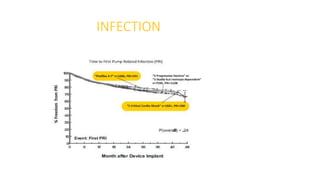
INFECTION
• Infection remains one of the most common causes of morbidity and mortality
during VAD support.
• Currently, the incidence of device infection is roughly 30% at 3 years. The
percutaneous lead exit site through the skin poses risk for infection,
• trauma is the leading cause because a break in the healing seal formed at the
driveline exit site provides a portal for infection.
• Patients and their families are trained in the immobilization of the percutaneous
lead, meticulous exit-site care, and the prevention of pulling or dropping the
external device components to minimize device infections
• The obligatory need for long-term antimicrobial therapy in such cases can lead to
the emergence of drug-resistant organisms, especially in biofilm producing
organisms such as Pseudomonas and Staphylococcus aureus
how effective is VAD?
SURVIVAL
survival depends in intermac score
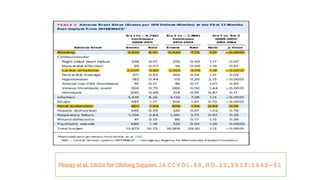
INFECTION
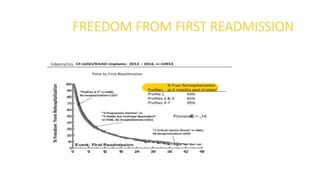
FREEDOM FROM FIRST READMISSION
SUMMARY –INTERMACS
complications of VAD
Is it BIOCOMPATIBLE? MOMENTUM 3 trail
• biocompatibility refers to the ability of an implantable device to function without
perturbing the body’s homeostatic systems
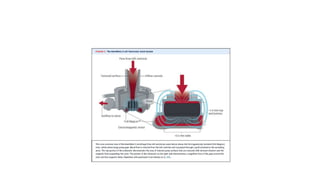
• The HeartMate 3 (Abbott, Inc.) is a next-generation centrifugal flow pump
designed to be more biocompatible and to reduce AEs
MOMENTUM 3
• The study met its pre-specified superiority threshold, driven primarily by the
infrequent need to replace the HeartMate 3 because of pump thrombosis.
• There were no significant differences between these 2 pumps with regard to
stroke, bleeding, right-sided HF, functional capacity, or QOL.
• Results from the short-term cohort have been presented and published . The
study’s primary endpoint, survival free of disabling or reoperation to replace or
remove the pump, was met by 86.2% of HeartMate 3 patients compared with
76.6% in the HeartMate II group (p 0.037).
• The study met its pre-specified superiority threshold, driven primarily by the
infrequent need to replace the HeartMate 3 because of pump thrombosis. There
were no significant differences between these 2 pumps with regard to stroke,
bleeding, right-sided HF, functional capacity, or QOL.
• At this point in time, it is premature to say that the HeartMate 3 is a fully
hemocompatible pump, but the absence of suspected or confirmed pump
thrombosis, at least in a short-term cohort, represents a significant incremental
advancement in the field
INNOVATIVE SURGICAL TO MINIMIZE COMPLICATION AND
IMPROVE THE OUTCOME IN LVAD
INNOVATIVE SURGICAL APPROACHES
• LVAD implantation surgery was previously one of the most morbid operations in
cardiac surgery, with very high mortality and morbidity. In the REMATCH trial the
hospital mortality rate for patients having a DT LVAD was 29%, the major
perioperative bleeding rate was 46%, and the median hospital stay post-LVAD
implantation was 29 days .
• The surgical results have since improved substantially, and a recent study of non–
inotrope-dependent DT patients reported an operative mortality of 1% and a
median hospital stay of 17 days.
• Although the basic surgical principles for implantation of all LVADs have remained
constant over the past 3 decades, there are some notable modifications in
surgical approach over recent years that deserve special mention.
LESS INVASIVE IMPLANTATION TECHNIQUES.
• Two Incision instead of sternotomy - 1 to gain access to the LV apex (usually a
small left thoracotomy or a subcostal incision), and 1 to access the ascending
aorta (usually a right minithoracotomy or an upper hemisternotomy)
• preliminary reports suggest a particularly low incidence of RV failure, bleeding
complications, and respiratory failure with nonsternotomy approaches
REPAIR OF THE NATIVE HEART
• MS, moderate or severe AR, ASD
• Tricuspid annuloplasty
• CABG
• Stem cell ??
MYOCARDIAL RECOVERY IS POSSIBLE?
THE POTENTIAL FOR MYOCARDIAL RECOVERY
• Clinical observations have demonstrated that patients treated with high-dose
neurohormonal antagonism–directed drugs or use of adjunctive cardiac
resynchronization therapy exhibit reverse remodeling, sometimes with a marked
improvement in cardiac structure and function.
• However, myocardial dysfunction in advanced-stage HF in patients who require
mechanical circulatory support that leads to spontaneous recovery, which allows
device explantation, is unusual, except in special reversible circumstances, such
as patients with acute myocarditis, peripartum cardiomyopathy, and toxic
cardiomyopathies.
• Several retrospective case series reported recovery, but it was only a decade ago
that a prospectively designed protocol to achieve myocardial recovery in patients
with advanced HF with nonischemic cardiomyopathy treated with a pulsatile
LVAD was introduced
• The Harefield strategy included a staged approach, beginning with optimizing
medical therapy using high doses of neurohormonal therapy, as well as digoxin
(25 mg of carvedilol 3 times daily, digoxin 0.125 mg/day, lisinopril 40 mg/day,
losartan 150 mg/day, and spironolactone 25 mg/day).
• These patients were then followed up for improvement in LV dimensions, and if
normalization “on and off” (15 min with transient discontinuation) device support
was noted, they transitioned into the next stage.
• At this stage, the nonselective b-blocker was transitioned to a b1-selective
blocker, and clenbuterol, a selective b2-agonist, was also added to facilitate
physiological hypertrophy.
• In this 15-patient series, 11 patients (73%) with nonischemic cardiomyopathy
supported by a first-generation pulsatile HeartMate LVAD were able to undergo
device explantation after an average support time of nearly 1 year. Freedom from
recurrent HF at 1 and 4 years was 100% and 88.9%, respectively, in these selected
patients.
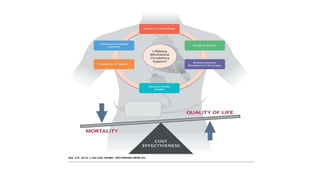
ACHIEVING COST-EFFECTIVENESS
• Although improvements in pump technology, medical management, and
insurance coverage expansion have allowed for increased utilization, the costs
associated with LVAD use remain high
• Initial reports have estimated an incremental cost-effectiveness ratio (ICER) at 5
years of close to $220,000 per quality-adjusted life-year (QALY) for inotrope
dependent recipients of LVADs compared with those who are medically managed.
• Cost reductions for device implantation, improvements in long-term survival, and
greater patient functional status have made CF-LVADs more cost-effective
• But the major cost drivers were the need for frequent hospital readmission and
the high costs of outpatient care distributed over a longer survival period.
• Therefore, even though the survival advantage of LVAD therapy is clear, further
reductions in AEs, as well as improvements in QOL, are needed to meet
conventional cost-effectiveness thresholds
CONCLUSION
• Continuous-flow LVADs have revolutionized advanced heart failure care.
• These compact, fully implantable heart pumps are capable of providing
meaningful increases in survival, functional capacity, and quality of life.
• Implantation volumes continue to grow, but several challenges remain to be
overcome before LVADs will be considered as the therapy of choice for all
patients with advanced heart failure.
• They must be able to consistently extend survival for the long term (7 to 10
years), rather than the midterm (3 to 5 years) more typical of contemporary
devices;
• They must incorporate design elements that reduce shear stress and avoid stasis
to reduce the frequent adverse events of bleeding, stroke, and pump thrombosis
and they must become more cost-effective.
• Now the focus on developing a more biocompatible device is translating into
meaningful clinical benefit, with improved durability and fewer AEs
• advances in QOL will come with a fully implantable device without need for an
external driveline, which will reduce infection risk and allow patients to swim and
bathe. All of these advances are within sight and point toward a bright future for
patients with advanced HF

LEFT VENTRICULAR ASSIST DEVICE- DESTINATION THERAPY

  • 1.
    Left Ventricular Assist Devicesfor Lifelong Support Dr Siva Subramaniyan PGIMER &Dr.RML Hospital New Delhi
  • 2.
    INTRODUCTION  Heart diseaseis the leading cause of death in the Western world  ~5 million people in the US have congestive heart failure (CHF)  250,000 are in the most advanced stage of CHF  ~500,000 new cases each year  ~50,000 deaths each year  only effective treatment for end stage CHF is heart transplant
  • 3.
    stage D heartfailure • Despite the progress made in treating chronic systolic heart failure (HF), there remains a need for the contemporary approach to the management of advanced (stage D) HF to further evolve. • For the past 3 decades, heart transplantation has been the established therapy of choice for the roughly 2,200 people per year who possess the appropriate age and freedom from significant comorbidity to be matched with a suitable donor . • These individuals represent only a small fraction of the estimated 150,000 to 200,000 patients with stage D HF who endure a high symptom burden of shortness of breath, congestion, and fatigue despite maximally tolerated medication ACCF/AHA guideline for the management of heart failure: a report of the ACC Foundation/American Heart Association Task Force on Practice Guidelines. J Am Coll Cardiol 2013;62:e147–239
  • 4.
    • It isfor the larger group of individuals who face a high risk of short-term mortality and little chance of receiving a transplant that the emergence of continuous-flow (CF) left ventricular assist devices (LVADs) holds the greatest promise. • These small implantable devices are capable of augmenting the circulation to meet the body’s physiological needs, both at rest and with exercise, extending survival and improving quality of life ACCF/AHA guideline for the management of heart failure: a report of the ACC Foundation/American Heart Association Task Force on Practice Guidelines. J Am Coll Cardiol 2013;62:e147–239
  • 5.
    • One-year survivalwith current continuous-flow devices is reported to be 80%, and 2-year survival, 70%. • In patients awaiting heart transplantation, MCS provides a bridge to transplantation, and for others who are ineligible for heart transplantation, MCS provides permanent support or destination therapy.
  • 6.
    Interagency Registry forMechanically Assisted Circulatory Support (INTER- MACS)
  • 7.
  • 8.
    VAD • Classification ofVentricular Assist Devices On the basis of period of use: a) Temporary, b) Permanent On the basis of impaired ventricle: a) LVAD, b) RVAD, c) Bi-VAD On the basis of Pumping mechanism: a) Pulsatile b) Non pulsatile
  • 9.
    Krishnamani, R. etal. (2010) Emerging ventricular assist devices for long-term cardiac support Nat. Rev. Cardiol. doi:10.1038/nrcardio.2009.222
  • 10.
    DESTINATION THERAPY • Currentlyin the United States, the most frequently used durable devices are continuous- flow devices with axial (HeartMate II, St. Jude Corp, Minneapolis, MN) or centrifugal - (HeartWare Ventricular Assist System, HeartWare Corp, Framingham, MA) flow
  • 11.
    HeartMate II andHeartWare VAD
  • 12.
    DEVICE COMPONENT 1.The pump 2.Thedriveline 3.The controller 4.The batteries
  • 13.
    PUMP The pump isinternal. It is connected to left ventricle that pulls blood into the pump which then sends the blood to the ascending aorta
  • 14.
    DRIVELINE The driveline isinternal and external. It is a tube that connects the pump to the controller. It contains necessary power and electronic cables. It exits through the skin, on either the right or left side of the abdomen
  • 15.
    CONTROLLER • Is externaland it operates the pump and has lights, messages, and/or alarms if the power is low or if it is not functioning properly. It can be worn around the waist or over the shoulder.
  • 16.
    BATTERIES Options for Power •Batteries • AC power sources
  • 17.
    HEARTMATE II VSHEARTWARE VAD
  • 18.
  • 20.
    INTERMACS SCORE Interagency Registryfor Mechanically Assisted Circulatory Support Long-Term LVAD Ideal candidates are INTERMACS classes 3-4 Short-Term LVAD Candidates are INTERMACS classes 1-2 Not a LVAD Candidate INTERMACS 1 or those with multisystem organ failure
  • 21.
  • 22.
    • On thedevice controller, a display reports parameters that can be considered device “vital signs.” These include the speed (revolutions per minute), power (Watts), and flow (liters per minute; • The HeartMate II device displays an additional pulsatility index parameter, which reflects the change in device flow over the cardiac cycle.
  • 24.
    • Using acombination of CVP and PCWP, there are 5 patient profile possible: 1) normal resting hemodynamics (CVP 3 to 12 mm Hg, PCWP 8 to 18 mm Hg); 2) Rightsided HF (elevated CVP, normal PCWP); 3) Biventricular failure/fluid overload (elevated CVP and PCWP); 4) left-sided HF (normal CVP, elevated PCWP); and 5) hypovolemia (low CVP and PCWP)
  • 25.
    • Only 40%to 60% of patients had “normal” hemodynamics (CVP <12 mm Hg and PCWP <18 mm Hg) at their set speed. • a patient with a left-sided HF profile would likely benefit from a pump speed increase. • Those with congestion or biventricular failure are likely best served by increased volume removal with augmented diuretic therapy. • Lastly, hypovolemia benefitted from volume replacement
  • 26.
    • Current clinicalguidelines support the use of an echocardiographic ramp test to set pump speed . • During such a test, pump speed is increased by a series of fixed increments over a set period of time to determine the degree of volume unloading defined by septal positioning, the presence and severity of mitral regurgitation, the frequency of aortic valve opening, and changes in the LV end-diastolic diameter (LVEDD) in the parasternal long-axis view.
  • 27.
    COMANAGEMENT OF THESTABLE PATIENT
  • 28.
    COMANAGEMENT OF THESTABLE PATIENT • Longitudinal care of patients with MCS requires a multidisciplinary team to manage comorbid conditions. • The implanting center typically maintains close follow-up; however, referring physicians and other specialty providers (often in outlying locations) participate in the coordinated plan of care
  • 29.
    RETURNING TO NORMALCY •Many signs and symptoms of heart failure (eg, shortness of breath, paroxysmal nocturnal dyspnea, and fluid weight gain) abate fairly soon after surgery. • Other symptoms may resolve over a longer period of time (eg, fatigue, poor energy level, and decreased strength). • Thus, early mobilization and rehabilitation are important to a successful recovery. Aggressive physical and occupational therapy should begin as soon as possible after MCS surgery, and cardiac rehabilitation should continue beyond hospital discharge
  • 30.
    • MCS self-care •Family caregiver support is an important component of selfcare • patients with MCS adjust to performing activities of daily living (eg, bathing, dressing, sleeping, home management, and work) and engaging in leisure activities • Driving is allowed
  • 31.
    ANTICOAGULATION • Anticoagulation withwarfarin is required for all continuous- flow devices. • however, the level of anticoagulation may vary by center, practice, and device type. • Antiplatelet therapy with aspirin and often a second antiplatelet agent is necessary because of the threat of stasis, thrombosis, shear-induced platelet dysfunction, and hemolysis. • Upregulation of platelet function is described with MCS and may contribute to long-term risk of thromboembolic events.
  • 32.
    HYPERTENSION AND HYPOTENSION •Titration of medical therapy to maintain a mean arterial blood pressure in the normal range is imperative to optimize forward flow and to prevent adverse events. • Hypertension after ventricular assist device (VAD) implantation is common, and an increase in diastolic pressure with a continuous-flow device may exacerbate or lead to hypertension. • Increased afterload decreases pump flow and increases the risk of neurological events and end-organ damage. • Neurohormone-modifying agents such as ACEI, ARBs, β-blockers, and mineralocorticoid receptor antagonists are used to decrease afterload, to improve pump function, and to potentially contribute to ventricular recovery
  • 33.
    RENAL FAILURE • Renalinsufficiency is common in end-stage heart failure. After MCS implantation, 67% of patients have been reported to experience improved renal function. • while a minority experience AKI. AKI in the postoperative period is known to be a negative predictor of outcomes after PF-LVAD implantation and has been associated with an increased 1-year mortality in CF-LVAD recipients (relative risk 3)
  • 34.
    causes of RF •acute blood loss, • volume shifts, • arrhythmias, and • the effect of multiple vasoactive medications influence renal hemodynamics. The sudden change in renal blood flow characteristics due to LVAD support can lead to AKI . Patients with preoperative RV failure and patients with INTERMACS scores of 1 or 2 are at higher risk of AKI • Continuous veno-venous hemodialysis and inpatient intermittent hemodialysis are relatively common in the early postoperative recovery period.
  • 35.
    MANAGEMENT OF CHRONICCOMPLICATIONS
  • 36.
    RV Failure • First,elevated preload from volume overload or blood resuscitation, for example, increases wall stress and can lead to RV dilation and functional tricuspid regurgitation. • Second, high device speeds can lead to high CO, which may cause increased venous return to the failing RV. • Third, an underfilled LV may allow shifting or suction of the interventricular septum. In this case, the loss of septal contribution to RV contractility can lead to RV failure. • Finally, increased RV afterload attributable to pulmonary hypertension and elevated transpulmonary gradient is a common cause of RV failure.
  • 37.
    • Transthoracic echocardiographymay demonstrate RV dilation, hypocontractility, and septal shifting toward the LV. • Inotropes to support RV function, pulmonary vasodilators to decrease transpulmonary gradient, or diuresis can be used in the short term to help the impaired and failing RV. • If increased LV filling pressures are suspected (findings of hypertension or pulmonary edema), afterload reduction may improve RV function by augmenting forward flow. • Phosphodiesterase type 5 inhibitors can be used in this setting to reduce pulmonary hypertension and to support the RV
  • 38.
    AORTIC INSUFFICIENCY • Aorticinsufficiency is known to complicate ≈25% of patients with nonpulsatile MCS. The understanding of aortic insufficiency after MCS is evolving; however, continuous closure of the aortic valve is thought to be a central factor. • Careful attention to outflow cannula orientation to prevent direct flow toward the aortic valve can minimize stress on the valve. • For patients requiring long duration of support, aortic insufficiency may become a serious morbidity. • Management of hypertension and intravascular volume optimization is important. If aortic insufficiency persists when these factors are controlled, further evaluation by the MCS center is necessary.
  • 39.
    BLEEDING • With continuous-flowdevices, bleeding complications appear to be associated with additional factors beyond the level of anticoagulation. • Factors contributing to bleeding include platelet dysfunction, acquired von Willebrand syndrome, and gastrointestinal bleeding related to arteriovenous malformations. • Events most commonly seen are gastrointestinal bleeds and epistaxis • The mechanism by which these AVMs develop is not entirely certain but is thought to be directly related to the lack of pulsatile blood flow, increased shear, and oxidative stress at a microvascular level
  • 40.
    MANAGEMENT • Treatment ofmucosal bleeding is mostly supportive. • Management guidelines provide some instruction regarding the withholding and gradual reintroduction of anticoagulation . • Specific therapies targeting AVMs with octreotide or thalidomide have produced some anecdotal success
  • 41.
    HEMOLYSIS • A baselinelevel of hemolysis occurs in patients with MCS and may be monitored by periodic laboratory studies (eg, urinalysis, plasma free hemoglobin, haptoglobin, and lactate dehydrogenase analysis). • Baseline and serial measurements are helpful after changes in clinical status when obstruction or thrombosis is considered. • Elevation of lactate dehydrogenase above the patient’s baseline or 2.5 times the upper level of normal requires evaluation at an MCS center
  • 42.
    PUMP THROMBOSIS • Thrombosisis a relatively frequent adverse event, with a reported incidence of 5.5% to 12.2% in patients with MCS. • Thrombosis is associated with significant morbidity because device exchange is typically necessary. • INTERMACS data indicate that 2-year survival after pump exchange or no history of thrombus is 56% and 69%, respectively. • Factors that may contribute to thrombus formation are subtherapeutic anticoagulation, low pump speed, and elevated blood pressure.
  • 43.
    NEUROLOGICAL EVENTS • Strokeis a relatively frequent adverse event of MCS. • Among all devices, an incidence of 11% is observed at 1 year and of 17% at 2 years. • Risk factors for stroke in patients on left VAD support remain poorly defined. Because hypertension is a known major risk factor for ischemic and hemorrhagic stroke, postimplantation hypertension should be avoided
  • 44.
    INFECTION • Infection remainsone of the most common causes of morbidity and mortality during VAD support. • Currently, the incidence of device infection is roughly 30% at 3 years. The percutaneous lead exit site through the skin poses risk for infection, • trauma is the leading cause because a break in the healing seal formed at the driveline exit site provides a portal for infection. • Patients and their families are trained in the immobilization of the percutaneous lead, meticulous exit-site care, and the prevention of pulling or dropping the external device components to minimize device infections
  • 45.
    • The obligatoryneed for long-term antimicrobial therapy in such cases can lead to the emergence of drug-resistant organisms, especially in biofilm producing organisms such as Pseudomonas and Staphylococcus aureus
  • 46.
  • 49.
  • 50.
    survival depends inintermac score
  • 51.
  • 52.
    FREEDOM FROM FIRSTREADMISSION
  • 53.
  • 55.
  • 58.
    Is it BIOCOMPATIBLE?MOMENTUM 3 trail
  • 59.
    • biocompatibility refersto the ability of an implantable device to function without perturbing the body’s homeostatic systems • The HeartMate 3 (Abbott, Inc.) is a next-generation centrifugal flow pump designed to be more biocompatible and to reduce AEs
  • 60.
    MOMENTUM 3 • Thestudy met its pre-specified superiority threshold, driven primarily by the infrequent need to replace the HeartMate 3 because of pump thrombosis. • There were no significant differences between these 2 pumps with regard to stroke, bleeding, right-sided HF, functional capacity, or QOL. • Results from the short-term cohort have been presented and published . The study’s primary endpoint, survival free of disabling or reoperation to replace or remove the pump, was met by 86.2% of HeartMate 3 patients compared with 76.6% in the HeartMate II group (p 0.037).
  • 61.
    • The studymet its pre-specified superiority threshold, driven primarily by the infrequent need to replace the HeartMate 3 because of pump thrombosis. There were no significant differences between these 2 pumps with regard to stroke, bleeding, right-sided HF, functional capacity, or QOL. • At this point in time, it is premature to say that the HeartMate 3 is a fully hemocompatible pump, but the absence of suspected or confirmed pump thrombosis, at least in a short-term cohort, represents a significant incremental advancement in the field
  • 63.
    INNOVATIVE SURGICAL TOMINIMIZE COMPLICATION AND IMPROVE THE OUTCOME IN LVAD
  • 64.
    INNOVATIVE SURGICAL APPROACHES •LVAD implantation surgery was previously one of the most morbid operations in cardiac surgery, with very high mortality and morbidity. In the REMATCH trial the hospital mortality rate for patients having a DT LVAD was 29%, the major perioperative bleeding rate was 46%, and the median hospital stay post-LVAD implantation was 29 days . • The surgical results have since improved substantially, and a recent study of non– inotrope-dependent DT patients reported an operative mortality of 1% and a median hospital stay of 17 days. • Although the basic surgical principles for implantation of all LVADs have remained constant over the past 3 decades, there are some notable modifications in surgical approach over recent years that deserve special mention.
  • 65.
    LESS INVASIVE IMPLANTATIONTECHNIQUES. • Two Incision instead of sternotomy - 1 to gain access to the LV apex (usually a small left thoracotomy or a subcostal incision), and 1 to access the ascending aorta (usually a right minithoracotomy or an upper hemisternotomy) • preliminary reports suggest a particularly low incidence of RV failure, bleeding complications, and respiratory failure with nonsternotomy approaches REPAIR OF THE NATIVE HEART • MS, moderate or severe AR, ASD • Tricuspid annuloplasty • CABG • Stem cell ??
  • 66.
  • 67.
    THE POTENTIAL FORMYOCARDIAL RECOVERY • Clinical observations have demonstrated that patients treated with high-dose neurohormonal antagonism–directed drugs or use of adjunctive cardiac resynchronization therapy exhibit reverse remodeling, sometimes with a marked improvement in cardiac structure and function. • However, myocardial dysfunction in advanced-stage HF in patients who require mechanical circulatory support that leads to spontaneous recovery, which allows device explantation, is unusual, except in special reversible circumstances, such as patients with acute myocarditis, peripartum cardiomyopathy, and toxic cardiomyopathies.
  • 68.
    • Several retrospectivecase series reported recovery, but it was only a decade ago that a prospectively designed protocol to achieve myocardial recovery in patients with advanced HF with nonischemic cardiomyopathy treated with a pulsatile LVAD was introduced • The Harefield strategy included a staged approach, beginning with optimizing medical therapy using high doses of neurohormonal therapy, as well as digoxin (25 mg of carvedilol 3 times daily, digoxin 0.125 mg/day, lisinopril 40 mg/day, losartan 150 mg/day, and spironolactone 25 mg/day). • These patients were then followed up for improvement in LV dimensions, and if normalization “on and off” (15 min with transient discontinuation) device support was noted, they transitioned into the next stage.
  • 69.
    • At thisstage, the nonselective b-blocker was transitioned to a b1-selective blocker, and clenbuterol, a selective b2-agonist, was also added to facilitate physiological hypertrophy. • In this 15-patient series, 11 patients (73%) with nonischemic cardiomyopathy supported by a first-generation pulsatile HeartMate LVAD were able to undergo device explantation after an average support time of nearly 1 year. Freedom from recurrent HF at 1 and 4 years was 100% and 88.9%, respectively, in these selected patients.
  • 70.
    ACHIEVING COST-EFFECTIVENESS • Althoughimprovements in pump technology, medical management, and insurance coverage expansion have allowed for increased utilization, the costs associated with LVAD use remain high • Initial reports have estimated an incremental cost-effectiveness ratio (ICER) at 5 years of close to $220,000 per quality-adjusted life-year (QALY) for inotrope dependent recipients of LVADs compared with those who are medically managed. • Cost reductions for device implantation, improvements in long-term survival, and greater patient functional status have made CF-LVADs more cost-effective
  • 71.
    • But themajor cost drivers were the need for frequent hospital readmission and the high costs of outpatient care distributed over a longer survival period. • Therefore, even though the survival advantage of LVAD therapy is clear, further reductions in AEs, as well as improvements in QOL, are needed to meet conventional cost-effectiveness thresholds
  • 72.
    CONCLUSION • Continuous-flow LVADshave revolutionized advanced heart failure care. • These compact, fully implantable heart pumps are capable of providing meaningful increases in survival, functional capacity, and quality of life. • Implantation volumes continue to grow, but several challenges remain to be overcome before LVADs will be considered as the therapy of choice for all patients with advanced heart failure. • They must be able to consistently extend survival for the long term (7 to 10 years), rather than the midterm (3 to 5 years) more typical of contemporary devices;
  • 73.
    • They mustincorporate design elements that reduce shear stress and avoid stasis to reduce the frequent adverse events of bleeding, stroke, and pump thrombosis and they must become more cost-effective. • Now the focus on developing a more biocompatible device is translating into meaningful clinical benefit, with improved durability and fewer AEs • advances in QOL will come with a fully implantable device without need for an external driveline, which will reduce infection risk and allow patients to swim and bathe. All of these advances are within sight and point toward a bright future for patients with advanced HF