PERIOPERATIVE BRIDGING
ANTICOAGULATION IN PATIENTS
WITH ATRIAL FIBRILLATION
BRIDGE STUDY
PUBLISHED IN NEJM ONJUNE22, 2015
NEERAJVARYANI
BACKGROUND
 For AF patients, need for perioperative
bridging anticoagulation has long been
uncertain and unanswered.
 Scenario affecting 1 in 6 warfarin treated
patients with AF.
 Warfarin is typically stopped 5 days before an
elective procedure and resumed when
hemostasis secured postprocedure ,
requiring 5 to 10 days treatment to attain
therapeutic anticoagulation.
Contd…
 Rationale of bridging with LMWH: to minimize
the time patient do not have adequate
anticoagulation so as to minimize the risk of
perioperative arterial thromboembolism.
 Observational studies have assessed the timing
and dosing of perioperative bridging with
LMWH.
 Because of lack of evidence, practice guidelines
have provided weak recommendations for
bridging anticoagulation.
Bridging Anticoagulation in
Patients who Require Temporary
Interruption of Warfarin Therapy
for an Elective Invasive Procedure
or Surgery(BRIDGE):Hypothesis
 Forgoing bridging would be noninferior to
bridging with LMWH for prevention of
perioperative arterial thromboembolism and
superior to bridging with regard to major
bleeding.
METHODS
 STUDY DESIGN AND OVERSIGHT
Randomized
 Double-blind
 Placebo-controlled
 Protocol designed by steering committee and
approved by institutional review board at each
center.
 Duke Clinical Research Institute managed the
study.
Contd..
 Clinical coordination center: coordination,
randomization and distribution of study drug.
 Data coordinating center:
database,validation and analyses.
 Eisai donated dalteparin and University of
Iowa Pharmaceuticals prepared matching
placebo.
 Eisai had no role in the study
PATIENTS
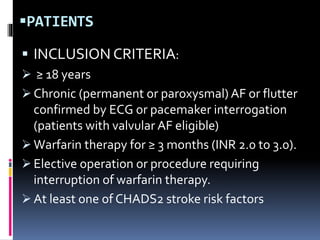
 INCLUSION CRITERIA:
 ≥ 18 years
 Chronic (permanent or paroxysmal) AF or flutter
confirmed by ECG or pacemaker interrogation
(patients with valvular AF eligible)
 Warfarin therapy for ≥ 3 months (INR 2.0 to 3.0).
 Elective operation or procedure requiring
interruption of warfarin therapy.
 At least one of CHADS2 stroke risk factors
EXCLUSION CRITERIA
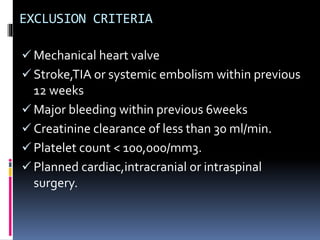
 Mechanical heart valve
 Stroke,TIA or systemic embolism within previous
12 weeks
 Major bleeding within previous 6weeks
 Creatinine clearance of less than 30 ml/min.
 Platelet count < 100,000/mm3.
 Planned cardiac,intracranial or intraspinal
surgery.
PROCEDURES
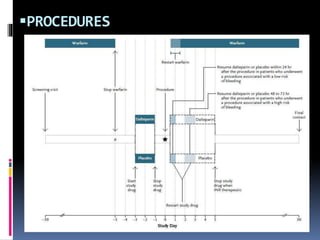
 Randomization stratified either with
interactive voice response system or through
internet.
 Study drugs were provided in identical vials.
 Postprocedure study drug was continued
until the INR was ≥ 2 on one occasion.
 Final determination of low or high bleeding
risk and perioperative management of
antiplatelet therapy was left to investigator’s
discretion.
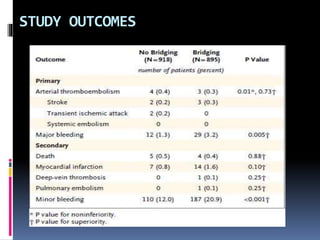
STUDY OUTCOMES
 Assessed by 37 days after procedure and
independently and blindly adjudicated
 PRIMARY EFFICACY OUTCOME: arterial thromboembolism
at 30 days including stroke( ischemic or hemorrhagic),TIA, and
systemic embolism.
 PRIMARY SAFETY OUTCOME: major bleeding at 30 days.
 SECONDARY EFFICACY OUTCOME : MI,DVT,PE and death.
 SECONDARY SAFETY OUTCOME: minor bleeding.
STATISTICAL
ANALYSIS
 Primary analysis of efficacy was a noninferiority
analysis. Bernard’s test was used for calculating
95% confidence interval for difference in event
rates. Confidence interval values calculated by
StatXact software,version 9( Cytel).
 Null hypothesis of no difference in incidence of
primary safety outcome tested with two-sided
test. P value calculated by fisher’s mid-P test and
95% confidence interval were calculated in SAS
software,version 9.3 .
 Sample size of 1882 was estimated to provide
90% power for the two primary end points.
RESULTS
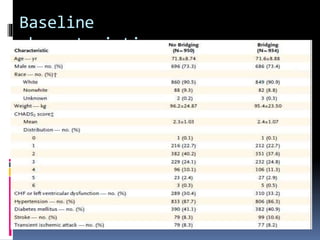
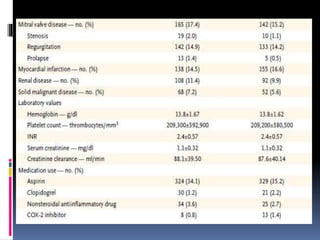
Baseline
characteristics
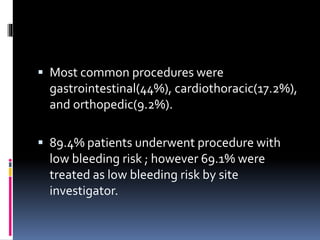
 Most common procedures were
gastrointestinal(44%), cardiothoracic(17.2%),
and orthopedic(9.2%).
 89.4% patients underwent procedure with
low bleeding risk ; however 69.1% were
treated as low bleeding risk by site
investigator.
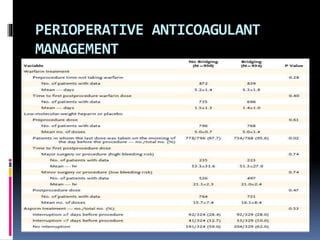
PERIOPERATIVE ANTICOAGULANT
MANAGEMENT
STUDY OUTCOMES
DISCUSSION
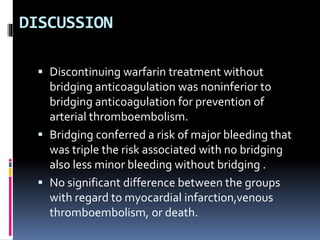
 Discontinuing warfarin treatment without
bridging anticoagulation was noninferior to
bridging anticoagulation for prevention of
arterial thromboembolism.
 Bridging conferred a risk of major bleeding that
was triple the risk associated with no bridging
also less minor bleeding without bridging .
 No significant difference between the groups
with regard to myocardial infarction,venous
thromboembolism, or death.
 Findings consistent with other nonrandomized
similar trials.
 Meta-analysis of observational studies with AF or
mechanical heart valves showed no significant
difference in arterial thromboembolism but higher
rate of major bleeding in association with bridging.
 In substudy of RE-LY trial bridging was associated
with higher rate of major bleeding than no bridging
with no significant effect on arterial
thromboembolism.
 ORBIT-AF study also showed higher rates of
bleeding if bridging was used during perioperative
interruption of warfarin treatment.
 BRIDGE trial and other nonrandomized trial
suggest perioperative arterial
thromboembolism in AF is overstated and may
not be mitigated by bridging and may be related
to type of procedure and intraoperative
alterations in blood pressure.
 Concept of rebound hypercoagulability on
warfarin interruption and prothrombotic milieu
leading to arterial thromboembolism is not
supported by this trial
LIMITATIONS
 Certain groups were underrepresented in the
the study population( surgeries with high
rates of thromboembolism and mechanical
valves)
 Rate of arterial thromboembolism was lower
affecting power of trial to detect benefit with
bridging.
 Rate of major bleeding in bridging group may
be considered to be modest
Contdd….
 Reduction in study sample size may raise
concerns.
 Diminished relevance in the treatment of AF
given availability of newer anticoagulants.
Bridge trial

Bridge trial

  • 1.
    PERIOPERATIVE BRIDGING ANTICOAGULATION INPATIENTS WITH ATRIAL FIBRILLATION BRIDGE STUDY PUBLISHED IN NEJM ONJUNE22, 2015 NEERAJVARYANI
  • 2.
    BACKGROUND  For AFpatients, need for perioperative bridging anticoagulation has long been uncertain and unanswered.  Scenario affecting 1 in 6 warfarin treated patients with AF.  Warfarin is typically stopped 5 days before an elective procedure and resumed when hemostasis secured postprocedure , requiring 5 to 10 days treatment to attain therapeutic anticoagulation.
  • 3.
    Contd…  Rationale ofbridging with LMWH: to minimize the time patient do not have adequate anticoagulation so as to minimize the risk of perioperative arterial thromboembolism.  Observational studies have assessed the timing and dosing of perioperative bridging with LMWH.  Because of lack of evidence, practice guidelines have provided weak recommendations for bridging anticoagulation.
  • 4.
    Bridging Anticoagulation in Patientswho Require Temporary Interruption of Warfarin Therapy for an Elective Invasive Procedure or Surgery(BRIDGE):Hypothesis  Forgoing bridging would be noninferior to bridging with LMWH for prevention of perioperative arterial thromboembolism and superior to bridging with regard to major bleeding.
  • 5.
    METHODS  STUDY DESIGNAND OVERSIGHT Randomized  Double-blind  Placebo-controlled  Protocol designed by steering committee and approved by institutional review board at each center.  Duke Clinical Research Institute managed the study.
  • 6.
    Contd..  Clinical coordinationcenter: coordination, randomization and distribution of study drug.  Data coordinating center: database,validation and analyses.  Eisai donated dalteparin and University of Iowa Pharmaceuticals prepared matching placebo.  Eisai had no role in the study
  • 7.
    PATIENTS  INCLUSION CRITERIA: ≥ 18 years  Chronic (permanent or paroxysmal) AF or flutter confirmed by ECG or pacemaker interrogation (patients with valvular AF eligible)  Warfarin therapy for ≥ 3 months (INR 2.0 to 3.0).  Elective operation or procedure requiring interruption of warfarin therapy.  At least one of CHADS2 stroke risk factors
  • 8.
    EXCLUSION CRITERIA  Mechanicalheart valve  Stroke,TIA or systemic embolism within previous 12 weeks  Major bleeding within previous 6weeks  Creatinine clearance of less than 30 ml/min.  Platelet count < 100,000/mm3.  Planned cardiac,intracranial or intraspinal surgery.
  • 9.
  • 10.
     Randomization stratifiedeither with interactive voice response system or through internet.  Study drugs were provided in identical vials.  Postprocedure study drug was continued until the INR was ≥ 2 on one occasion.  Final determination of low or high bleeding risk and perioperative management of antiplatelet therapy was left to investigator’s discretion.
  • 11.
    STUDY OUTCOMES  Assessedby 37 days after procedure and independently and blindly adjudicated  PRIMARY EFFICACY OUTCOME: arterial thromboembolism at 30 days including stroke( ischemic or hemorrhagic),TIA, and systemic embolism.  PRIMARY SAFETY OUTCOME: major bleeding at 30 days.  SECONDARY EFFICACY OUTCOME : MI,DVT,PE and death.  SECONDARY SAFETY OUTCOME: minor bleeding.
  • 12.
    STATISTICAL ANALYSIS  Primary analysisof efficacy was a noninferiority analysis. Bernard’s test was used for calculating 95% confidence interval for difference in event rates. Confidence interval values calculated by StatXact software,version 9( Cytel).  Null hypothesis of no difference in incidence of primary safety outcome tested with two-sided test. P value calculated by fisher’s mid-P test and 95% confidence interval were calculated in SAS software,version 9.3 .  Sample size of 1882 was estimated to provide 90% power for the two primary end points.
  • 13.
  • 14.
  • 16.
     Most commonprocedures were gastrointestinal(44%), cardiothoracic(17.2%), and orthopedic(9.2%).  89.4% patients underwent procedure with low bleeding risk ; however 69.1% were treated as low bleeding risk by site investigator.
  • 17.
  • 18.
  • 19.
    DISCUSSION  Discontinuing warfarintreatment without bridging anticoagulation was noninferior to bridging anticoagulation for prevention of arterial thromboembolism.  Bridging conferred a risk of major bleeding that was triple the risk associated with no bridging also less minor bleeding without bridging .  No significant difference between the groups with regard to myocardial infarction,venous thromboembolism, or death.
  • 20.
     Findings consistentwith other nonrandomized similar trials.  Meta-analysis of observational studies with AF or mechanical heart valves showed no significant difference in arterial thromboembolism but higher rate of major bleeding in association with bridging.  In substudy of RE-LY trial bridging was associated with higher rate of major bleeding than no bridging with no significant effect on arterial thromboembolism.  ORBIT-AF study also showed higher rates of bleeding if bridging was used during perioperative interruption of warfarin treatment.
  • 21.
     BRIDGE trialand other nonrandomized trial suggest perioperative arterial thromboembolism in AF is overstated and may not be mitigated by bridging and may be related to type of procedure and intraoperative alterations in blood pressure.  Concept of rebound hypercoagulability on warfarin interruption and prothrombotic milieu leading to arterial thromboembolism is not supported by this trial
  • 22.
    LIMITATIONS  Certain groupswere underrepresented in the the study population( surgeries with high rates of thromboembolism and mechanical valves)  Rate of arterial thromboembolism was lower affecting power of trial to detect benefit with bridging.  Rate of major bleeding in bridging group may be considered to be modest
  • 23.
    Contdd….  Reduction instudy sample size may raise concerns.  Diminished relevance in the treatment of AF given availability of newer anticoagulants.