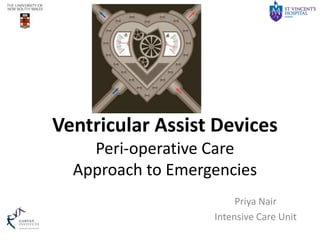
Ventricular Assist Devices
Peri-operative Care
Approach to Emergencies
Priya Nair
Intensive Care Unit
Immediate Pre-operative
considerations
Haemodynamic optimisation
•
•
•
•

Comprehensive assessment of RV function
Pulmonary artery catheter
CVP<15
Lowering PVR to optimise right heart function,
reduce RAP & hepatic congestion
• Aggressively managing volume
to minimise RV workload
• Inotropes, vasodilators +/- IABP
• V-A ECMO as bridge to decision
•
•
•
•
•
•

Renal Function
Hepatic Function
Nutrition
Infection
Coagulation status
Neurologic, psychosocial & psychiatric

Slaughter M et al, Clinical management of continuous flow LVADs in advanced heart failure.
Journal of Heart & Lung Transplantation, Vol 29, No 4S, April 2010.
Intraoperative issues
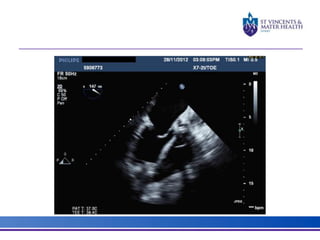
TOE assessment
•
•
•
•
•
•

PFO/septal abnormalities
Aortic Incompetence- may be under-estimated
Mitral Stenosis
LV Thrombus
Ascending Aorta
?TV annuloplasty

•
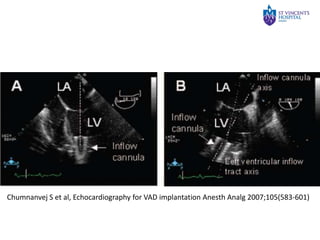
Chumnanvej S et al, Echocardiography for VAD implantation
Anesth Analg 2007;105(583-601)
•
Scalia GM et al, Clinical utility of echocardiography in the management of
implantable ventricular assist devices. J Am Soc Echocardiogr 2000;13
PFO/ septal abnormalities
Aortic Reguritation
LV thrombus
Aortic atheroma
Tricuspid Regurgitation
Inflow cannula orientation
Chumnanvej S et al, Echocardiography for VAD implantation Anesth Analg 2007;105(583-601)
Pump placement - pre
Pump placement - post
Inflow & Outflow Doppler

Chumnanvej S et al, Echocardiography for VAD implantation Anesth Analg 2007;105(583-601)
Determinants of Flow
Speed adjustment
•
•
•
•

MAP>65 mm Hg,
Midline interventricular septum position
Intermittent aortic valve opening
No more than mild MR
Chumnanvej S et al, Echocardiography for VAD implantation Anesth Analg 2007;105:583-601
Right-sided circulation
•
•
•
•
•

High capacitance
Low –pressure
Short isovolumic contraction time
Near-continuous systolic ejection period
Less tolerant to afterload changes
Response to RV & LV to experimental changes in afterload
MacNee et al, AJRCCM 1994
• Lower sarcomere Ca++ concentrations with
reduced maximal shortening
• Less Ca++ sensitivity during inotropic
stimulation
• Compromises rapidly leading to hepatic
dysfunction & coagulopathy
• Increases peri-op mortality from 10-15% to
38-43%
• Peri-op- TX-A2, TNF-α, Interleukin & catechol
release during CPB, blood products,
inadequate cardioprotection, vasoconstrictors
can trigger RVF
• LVAD adds to this
– shifts inter-ventricular septum to left,
– distorts TV lead to TR
– improved CO & sudden increase in venous return
Management of RV dysfunction
•
•
•
•
•
•
•
•

Meticulous haemostasis/ avoid blood products
Avoid excess RV preload, diuretics
Decrease RV afterload- iNO, Iloprost
Inotropes- Adrenaline, Milrinone, Dobutamine
Vasoconstrictors- to maintain perfusion pressure
Pacing
Decrease pump speed
Consider RCA bypass &/or TV annuloplasty

• V-PA ECMO
Immediate post-op ICU
care
•
•
•
•
•

Fluids/inotropes
Suction events
RV dysfunction
Bleeding & anticoagulation
Tamponade
Suction event

Mauermann W J et al. Anesth Analg 2008;107:791-792
Cyclical LVAD suction

Speed (RPM)

Flow (L/min)

6
5
4
3

Positive pressure ventilation

2

PEEP 18cmH2O

2800
2700
2600
75

85

Time (seconds)

95
Fischer L et al Management of pulmonary hypertension Anesth Analg
2003;96:1603–16

Day/Month/Year

Footnote to go here

Page 39
Pericardial collection
V-PA ECMO
Weaning from V-PA ECMO
Take home messages
•
•
•
•
•
•

Pre-op haemodynamic optimisation
Meticulous care of the RV
Avoid over-pumping
Serial echocardiography is vital
Cautious anticoagulation
VADs are preload dependent & afterload
sensitive
• Mortality and persistent heart failure
determined by inefficient unloading of left side
and persistent RV dysfunction
At discharge
• Comprehensive education of patient & NOK
• Easy contact with VAD coordinator & hospital
team
• Spare controller & battery packs
• Strict BP control
Emergency Department
presentations

• EMS guide January 2012, Mechanical Circulatory Support
Organisation
• www.jems.com
• emcrit.org/wee/left-ventricular-assist-devices-lvads
• heartware.org
• mylvad.com
Call VAD centre
Check with NOK
• Bleeding
– Anticoagulation-related
– Abnormal von Willebrand factor

• Infection
– Driveline
– Pump pocket
VAD emergencies
Patient in Extremis
1) AUSCULTATE FOR PUMP HUM
NO HUM

• Check cables and connections
• Check batteries
2) CHECK MAP, ASSESS PERFUSION
3) JUDICIOUS FLUID CHALLENGE

• Check pump flows and response.
<65mmHg- Adrenaline/Noradrenaline/Vasopressin
>65mmHg- Dobutamine/Milrinone
• Early arterial line with ultrasound guidance
• Care with CVC if RVAD in place
4)MONITOR +/- DEFIBRILLATE

• Check electrolytes, correct potassium
• Avoid chest compressions
5) URGENT ECHO

• RV small- hypovolaemia, bleeding, sepsis
• RV bigger than LV, D-shaped septum, TR- RV dysfunction
• Large LV (+MR)• High power- pump thrombosis (haemolysis, altered hum)
• Low power- inflow or outflow obstruction
• Ischaemic events
• Aortic Incompetence
AT ALL TIMES, BE GENTLE WITH THE RV
Pump flows & MAP OKLikely neurologic event
In short…
•
•
•
•
•
•
•

Call VAD centre
Check connections & cables
Auscultate for pump hum/doppler pulse
Check doppler BP, perfusion
Judicious fluid challenge, inotropes/pressors
Echo if possible
Consider non-VAD causes for presentation
Questions?

Ventricular Assist Devices