ADVANCED
VENTRICULAR
ASSIST DEVICE
By
Kaushik Bandopadhyay
NSEC, BME
What is a Ventricular Assist Device
(VAD)?
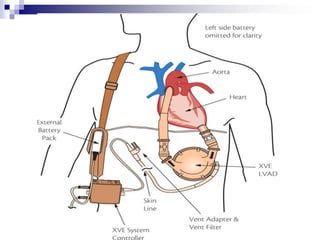
 Mechanical circulatory device that is used
 to replace the pumping action of a failing
 human heart.

Left ventricular failure is primarily treated
 using a VAD.
Need of Ventricular Assist Device

 5 million people suffer from Congestive
  heart failure (CHF).
 2,50,000 patients are in advanced stage of
  CHF.
 50,000 deaths are caused due to
  ventricular failure alone.
Classification of Ventricular Assist
Devices
   On the basis of period of use:
    a) Temporary, b) Permanent

   On the basis of impaired ventricle:
    a) LVAD, b) RVAD, c) Bi-VAD

   On the basis of Pumping mechanism:
    a) Pulsatile b) Non pulsatile
   On the basis of suspension of rotors:
    a) Bearing suspension
    b) Electromagnetic or Hydrodynamic
    suspension.
Advanced Ventricular Assist Device

 Termed as “Non pulsatile VAD” because the
 main difference between the pulsatile (earlier
 version of VADs) and non pulsatile ones is the
 pumping mechanism.

 Pulsatile VADs emulated the real contraction
 phenomenon of ventricles while Advanced VADs
 use continuous flow mechanisms.
Key features of Advanced VAD
   Enabled with continuous flow pumps
   ECG independent
   Soundless operation
   Patient has a weak or non-palpable pulse, which
    is normal, owing to the continuous flow
    mechanism of the pump
   Arterial pressure is in the range of (65-90)mm of
    Hg
The Pump
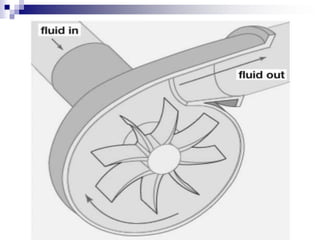
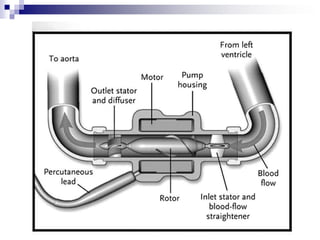
Advanced VADs use continuous flow pumps
 which are of two types:
a) Centrifugal Flow pump
b) Axial flow pump
Key Features of Continuous flow
pumps
 Flow:
  Measured in liters per minute (lpm): 3 to 10 lpm
  Flow is directly proportional to pump speed.
 Speed:
  Measured in rpm: 8000 to 15000rpm
 Power:
   Pulsatility Index (PI):
    Measure of the pressure difference
    between VAD’s pump chamber and the
    heart’s ventricle (if working, partially).
Shortcomings
 Coagulation and Thrombosis
 Haemolysis
 Infection
 Portability
Conclusion
 It has been a boon for cardiac patients.
 Future of VADs look bright as newer
 technologies and methods are being
 experimented to make the device
 better, lighter and easily portable.
Thank you

Advanced ventricular assist device ppt

  • 1.
  • 2.
    What is aVentricular Assist Device (VAD)? Mechanical circulatory device that is used to replace the pumping action of a failing human heart. Left ventricular failure is primarily treated using a VAD.
  • 3.
    Need of VentricularAssist Device  5 million people suffer from Congestive heart failure (CHF).  2,50,000 patients are in advanced stage of CHF.  50,000 deaths are caused due to ventricular failure alone.
  • 4.
    Classification of VentricularAssist Devices  On the basis of period of use: a) Temporary, b) Permanent  On the basis of impaired ventricle: a) LVAD, b) RVAD, c) Bi-VAD  On the basis of Pumping mechanism: a) Pulsatile b) Non pulsatile
  • 5.
    On the basis of suspension of rotors: a) Bearing suspension b) Electromagnetic or Hydrodynamic suspension.
  • 6.
    Advanced Ventricular AssistDevice Termed as “Non pulsatile VAD” because the main difference between the pulsatile (earlier version of VADs) and non pulsatile ones is the pumping mechanism. Pulsatile VADs emulated the real contraction phenomenon of ventricles while Advanced VADs use continuous flow mechanisms.
  • 7.
    Key features ofAdvanced VAD  Enabled with continuous flow pumps  ECG independent  Soundless operation  Patient has a weak or non-palpable pulse, which is normal, owing to the continuous flow mechanism of the pump  Arterial pressure is in the range of (65-90)mm of Hg
  • 10.
    The Pump Advanced VADsuse continuous flow pumps which are of two types: a) Centrifugal Flow pump b) Axial flow pump
  • 13.
    Key Features ofContinuous flow pumps  Flow: Measured in liters per minute (lpm): 3 to 10 lpm Flow is directly proportional to pump speed.  Speed: Measured in rpm: 8000 to 15000rpm  Power:
  • 14.
    Pulsatility Index (PI): Measure of the pressure difference between VAD’s pump chamber and the heart’s ventricle (if working, partially).
  • 15.
    Shortcomings  Coagulation andThrombosis  Haemolysis  Infection  Portability
  • 16.
    Conclusion It hasbeen a boon for cardiac patients. Future of VADs look bright as newer technologies and methods are being experimented to make the device better, lighter and easily portable.
  • 17.