VENDOR
DEVELOPMENT
Presented By :
Ma Swe Zin Lei
1
WHAT IS VENDOR ?
 Vendor means a person (or company) who sells and
supplies his (or its) products.
 An intelligent purchasing involves the rational selection of
sources from which materials can be obtained.
 Considerable efforts are needed in identifying, developing
and evaluating the prospective suppliers. It is also essential
to continuously appraise the performance of the current
suppliers
2
 How much quantity is required to be purchased?
 How much time is available for making such purchases?
 Will the material be required repeatedly or occasionally?
 What is the volume of purchase of the required materials?
 Which is the industry producing the required materials?
 What is commercial viability of the materials?
3
 Based on the answers, a list of potential supplier is drawn.
 For the purchase of items that are of repetitive nature, a
detailed evaluation procedure of suppliers is adopted.
 For a one-time purchase, elaborate inquiries and evaluation
procedures may not be necessary.
 Unless the item is costly and has a high technological content,
such as biological products.
 Effective negotiations can avoid many difficulties in regard to
supplies
4
VENDOR DEVELOPMENT FOUR STAGES:-
 First Stage Survey stage
 Second Stage Enquiry stage
 Third Stage Negotiation & Selection stage
 Fourth Stage Experience & Evaluation stage
5
SURVEY STAGE
 Source of information on potential vendors
 Involves collecting information on different suppliers of the
desired materials.
 Trade directories:-
 These give information regarding dealers addresses, regional
offices, names, types and range of products including spares.
Electronic digital interchange, for example :- computer based trade
directories, is useful source.
6
 Trade journals:-
 These contain advertisements of the materials related to specific industries,
namely chemicals, plastic , steel etc. these journals can be subscribed,
relevant information can be classified, indexed, updated and maintained in
proper files by the buyer.
 Telephone directories :-
 These contain classified advertisement arranged alphabetically, item-wise or
group- wise. Examples are, abrasives, air-conditioners, castings, diamonds
and so on. It is an easy and fast means of collecting the sources. 7
 Suppliers catalogues :-
 Many manufacturers periodically publish catalogues and pamphlets giving
details of the products they manufacture. These catalogues contain
considerable technical information, specifications, prices etc.
 Salesmen :-
 They trained person who continuously visit customers for the possible
business and orders. Through their sales presentations, it is possible to
collect the information and clarify doubts. They help in expanding the
knowledge to a great extent. 8
INQUIRY STAGE
 Selection of Potenial Supplier
 Technological competition
 Service competition
 Price competition
 Time based competition (TBC) i. e, response time for
delivery.
9
 Internal facilities of vendors
 Financial adequacy and stability
 Reputation of the vendor
 Location of the vendor’s factory
 Industrial relations
10
NEGOTIATION AND SELECTION STAGE-
 Finalization of vendors
 The vendors who are successful in the enquiry stage
may be called for negotiations in order to discuss
business possibilities.
 Can be decided various terms namely credit, quantity
discount, quality specifications etc,
 A list of approved vendor’s drawn.
 Purchase orders are placed with the approved vendors.
 Buying techniques are used at third stage.
11
EXPERIENCE AND EVALUATION STAGE:
 At this stage, the buyer evaluates and appraises the
performance of the vendor. The objective is to improve the
performance of vendors in which they are deficient.
 The evaluation is done especially on two counts, namely quality
(judged by rejection of lot- size ) and delivery ( judged by delays
on delivery).
12
VENDOR RATING
 A few ways by which a vendor can be
evaluated are listed below:-
1) categorical method
2) weighted point method
3) cost ratio method
13
 Categorical method :
 The buyer prepares a list of factors, which are considered
necessary for evaluation.
 At periodic intervals, say once in three- months , the buyer
prepares a performance report.
14
THE FORMAT SUCH A REPORT IS GIVEN :
Factors Grading
15
1. Supplies as per
quantity specified
Always
9 8
7
Usually
6 5
4
Seldom
3 2
1
Never
0
2. Deliveries are as per
schedule
3.Rigorous follow up are
not necessary
4.Solves his raw material
problem on his own
5.Willing to accommodate
when production
Always
9 8 7
Usually
6 5
4
Seldom
3 2 1
Never
0
6. Helps in
emergency
7. Behavior is
courteous and
considerate
8. Reasonable
in Pricing
9.
Miscellaneous 16
Factors Grading
.
 Each supplier is evaluated and a number-score is calculated.
 Then, it is converted into word rating. The conversion of scores
is as follows:
17
Point Remark
80-100 Excellent
70-80 Good
60-70 Average
50-60 Very poor
 Weighted point method : this type of evaluation involves a point
rating based on the quality of goods received, the promptness of
deliveries made and the quality of the service rendered by the
vendor.
 The point may be assigned as follows:-
18
Performance Points
Quantity 50 points
Delivery 30 points
Price 20 points
Total points 100
 The performance of each factor is separately quantified.
 For example, consider the quality aspect, Assume that 160 lots were
received during a year and 16 lots were rejected on account of poor
quality, the number lots accepted will be 144.
Quality rating = Number of lots accepted× rating points (i.e., 50
Number of lots received
quality rating = 144 × 50 = 45 160
similarly delivery rating can be obtained using below equation
Delivery rating = number of lots delivered in time × rating points total
number of lots delivered 19
 The price rating is calculated using equation
Price rating = least offer received × rating points supplier’s offer
 Cost – ratio method : it is an intricate system of determining the
actual costs incurred in purchasing, follow up, transportation,
packing, duties, receiving etc,
 Based on these costs, the unit cost incurred by the buyer is
calculated, the higher the cost, the lower the supplier’s comparative
rating .
20
 For example,
costs relating to quality works out to be Rs 2,000 and the total worth
of material purchased is Rs 2.0 lacks per year Quality cost ratio =
2,000 : 2,00,000, (i.e., 1%) Similarly, when the cost of delivery is Rs.
1000 then Delivery cost ratio = 1,000 : 2,00,000 (i.e., 0.5%)
 Similarly, all types of costs can be calculated. These ratios must be
maintained as minimum of possible.
21
.
 Using the methods mentioned above, a buyer can exercise
better judgment over retaining the vendors.
 However, many non- quantifiable factors namely integrity,
behavior, attitudes towards progressiveness etc., should also
be given importance.
 Thus, the buyers experience and judgment would ultimately
count.
22
We can understand vendor rating by this example:
Example :
The following information is available on 3 vendors: A, B and C. Using
the data below, determine the best source of supply under weighed
point method and substantiate your solution.
Vendor A: Delivered 56, lots 3, were rejected 2 were not according to
the schedule.
Vendor B: Supplied 38, lots 2 were rejected 3 were late.
Vendor C: Finished 42, lots 4were defective 5 were delayed deliveries.
Give 40 for quality and 30 weightage for service.
23
Solution: Quality performance (40% weightage)
= (quality accepted/total quantity supplied)*40
Delivery performance:
X, Adherence to time schedule(30%)
=(no. of delivery on the scheduled date/total scheduled
deliveries)*30
Y, Adherence to quantity schedule(30%)
=(no of correct lot size deliveries/tot no of scheduled
deliveries)*30
Total Vendor Rating =X+Y
24
Vendor A= (53/56)*40+(54/56)*30 =66.78
Vendor B=(36/38)*40+(35/38)*30 =65.52
Vendor C =(38/42)*40 +(37/42)*30 =62.62
So Vendor A is selected with best rating.
25
BUYING TECHNIQUES
 Purchasing involves procurement of materials, machinery an services needed
for production and maintenance.
 The purchasing department procures the right kind of material
(quality ) , in right – quantities, at right time and makes them available for the
production.
 It also concentrates on the right source and economic procurement, while
procuring the materials, the company pays the price.
26
 Price is defined as the amount of money at which a thing is
valued or the value that a seller sets on his goods in the market.
 Price is a greatest variable in purchasing. Very often price is
qualified by terms, best price, lowest price, economic price etc,
 In order to determine the right price, the buyer should be
conversant with business trends, trade cycles, supply and
demand, price advances and declines, quantity discounts .
27
QUOTATIONS
 Quotation is an inquiry to know whether the vendor can supply
the desired material and if so, by what price.
 Quotation are invited on a prescribed form or format from the
selected sources for the required items.
 The quotation also includes the terms and conditions namely
taxes, freight, cartage etc. 28
 At the top of this form, the words ‘THIS IS NOT AN ORDER’
is printed
 A minimum of three quotations each in duplicate is required
from different suppliers.
 The quotations are valid for at least one month from date of
opening.
 Quotation is not a purchase order
29
 Generally materials are bought by one of the following
techniques:-
 Spot quotations :-The buyer can go to the market and collect
minimum of three quotations from three different suppliers and
takes spot decision.
 This type of practice is not possible in the purchase of
pharmaceutical materials.
30
 This method is suitable for the purchasing of office stationery
and computer peripheries.
 The purchasing department selects the suppliers form the
approval list and accordingly does the purchasing.
31
 Floating a limited enquire :- This method is used when the value of
purchases is small. The company sends letters to a few reliable
vendors requesting for prices, analytical reports, and other details for
a particular material.
 A purchase enquiry form is usually prepared for this purpose.
 The quotations are collected in duplicate at least from three
suppliers.
 After getting quotations, these are opened and a comparative
statement is made.
32
 It is analyzed in the light of following points:-
1. Price of the material - Material specifications (quality)
2. Place of delivery - Delivery period –
3. Taxes - Terms of payment –
4. Validity of tender - Guarantee period etc.
 The comparative statement helps in studying and comparing different
quotations at a glance.
 Thus a quick decision can be taken as with whom to place order for
the purchase of a material.
33
TENDERS
 A tender is a written letter or a published document ( in news
papers) that is aimed at finding the price for procuring certain
materials or for getting a particular job done within the desired
period and under specified conditions.
Tenders are invited from recognized or registered firms. A few
types of tenders are given below;-
- single tender
- open tender
- closed tender or limited tender 34
.
 Single tender : Single tender is invited from one reliable supplier,
under certain conditions.
 It is applicable to proprietary items, high quality items and also C-
items such as clips, pins, pencils etc., when items are required
urgently.
35
 Open tender : Open tender method is used when the value of
purchases is high. When supply sources are not known or intended to
locate more supply sources, open tender ( or public tender ) is used.
Open tenders are very expensive.
 The buyer is not aware of the capability of the supplier.
 Therefore, tenders are invited from recognized or registered firms.
 Open tender is also called press tender, because it is published in the
news papers, trade journals etc
36
NEGOTIATIONS
• Negotiations may be defined as an art of arriving at a common
understanding through bargaining on the essentials of contract such
as delivery, specifications, prices and terms.
 Negotiations with the concerned vendor(s) are often necessary
before finalizing a purchase contract. The purpose is for fixing and
finalizing prices of materials, terms and conditions.
37
NEED FOR NEGOTIATIONS
In most cases, purchase orders are decided on the basis of
quotations. Negotiations are required when a change in the
scope of a contract is warranted. Negotiations are considered
essential in the following conditions:
- prices are related to large volumes or to a large value.
- terms and conditions are required for large volumes.
- contract is desired for a longer period.
38
CONTINUE….
 Variations in quantity to be purchased are possible.
 Changes in drawing and specifications are necessary.
 Changes in transportation, packing and delivery points are to be
decided.
 When no acceptable quotations are received from the responding
vendors.
39
 Process of negotiations : negotiations take place between two
individuals or two sets of individuals.
 Communication is an important ingredient in the art of negotiation.
 Through the communication of ideas, the purchasing department
persuades and convinces the vendors to agree with their view point,
 So that an agreement can be reached. Negotiations should attempt at
a ‘win-win, situation to both parties. It is mutually satisfactory
settlement.
40
DISCOUNTS :-
 Discounts are defined as the cash concessions offered by the vendor
in the payment price, on the goods purchased, in order to enhance
the volume of business opportunities.
 Reasons for offering discounts :- when large orders are placed, the
seller is able to obtain economies in production, packaging, billing,
selling etc.,
41
 When the bills are cleared immediately after
delivery, the supplier gets finance for his activities.
 Similarly transportations costs and other costs
provide economics.
 The supplier is prepared to give a part of his
savings to the buyer.
 Thus discounts are usually offered by a majority of
suppliers.
42
TYPES OF DISCOUNTS
 Materials may be purchased in three ways.
1. Volume contract
2. Deals
3. Discounts
.
43
CONTINUE……
 Volume contract : this type of contract is employed to cover
total purchase of ampoules, bottles and other accessories.
 Because of a large order, the seller is able to obtain
economies in production, packaging, billing, selling etc
 Volume contract discount may be defined as a method of
offering discount proportionate to the quantity of goods or
volume of material ordered.
 In this system, the manufacturer (buyer) estimates its annual
consumption of a class of products and signs an agreement
with the supplier
44
CONTINUE…
 Such contracts are executed for a period of one year.
 The advantage of this type of purchase is that contract price is
usually protected from an increase (or decrease) of prices.
 In some cases, the buyer directly pays to the supplier.
 In case of government purchases, payment is made through
Director general of supplies and disposals (DG, S & D ) Cash
discount : The normal credit period is 90 days for the payment
of bill.
45
CONTINUE….
 Cash discount is a method of offering discounts depending
on the time of payment made on the delivery.
 Cumulative discounts: in this case, quantity might not be
fixed in the contract.
 Cumulative discounts may be defined as a method of
offering proportionate discount on the basis of actual
purchases and appropriate to the quantity range in an year.
 For example, buying is continued during the course of the
year, but the price will be reduced beyond a certain volume.
46
 Consignment terms : This is frequently used in retailing
 In consignment terms, the buyer ( usually a trader ) pays the price
after selling the goods.
 A pharmaceutical company may agree or consignment terms of
payment with a chemist’s shop
47
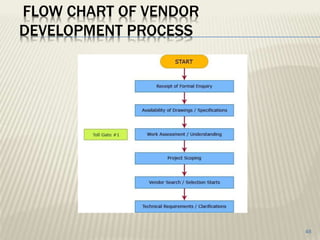
FLOW CHART OF VENDOR
DEVELOPMENT PROCESS
48
49
50
51
52
53
54
55
56
THANK YOU
57

Vendordevelopment

  • 1.
  • 2.
    WHAT IS VENDOR?  Vendor means a person (or company) who sells and supplies his (or its) products.  An intelligent purchasing involves the rational selection of sources from which materials can be obtained.  Considerable efforts are needed in identifying, developing and evaluating the prospective suppliers. It is also essential to continuously appraise the performance of the current suppliers 2
  • 3.
     How muchquantity is required to be purchased?  How much time is available for making such purchases?  Will the material be required repeatedly or occasionally?  What is the volume of purchase of the required materials?  Which is the industry producing the required materials?  What is commercial viability of the materials? 3
  • 4.
     Based onthe answers, a list of potential supplier is drawn.  For the purchase of items that are of repetitive nature, a detailed evaluation procedure of suppliers is adopted.  For a one-time purchase, elaborate inquiries and evaluation procedures may not be necessary.  Unless the item is costly and has a high technological content, such as biological products.  Effective negotiations can avoid many difficulties in regard to supplies 4
  • 5.
    VENDOR DEVELOPMENT FOURSTAGES:-  First Stage Survey stage  Second Stage Enquiry stage  Third Stage Negotiation & Selection stage  Fourth Stage Experience & Evaluation stage 5
  • 6.
    SURVEY STAGE  Sourceof information on potential vendors  Involves collecting information on different suppliers of the desired materials.  Trade directories:-  These give information regarding dealers addresses, regional offices, names, types and range of products including spares. Electronic digital interchange, for example :- computer based trade directories, is useful source. 6
  • 7.
     Trade journals:- These contain advertisements of the materials related to specific industries, namely chemicals, plastic , steel etc. these journals can be subscribed, relevant information can be classified, indexed, updated and maintained in proper files by the buyer.  Telephone directories :-  These contain classified advertisement arranged alphabetically, item-wise or group- wise. Examples are, abrasives, air-conditioners, castings, diamonds and so on. It is an easy and fast means of collecting the sources. 7
  • 8.
     Suppliers catalogues:-  Many manufacturers periodically publish catalogues and pamphlets giving details of the products they manufacture. These catalogues contain considerable technical information, specifications, prices etc.  Salesmen :-  They trained person who continuously visit customers for the possible business and orders. Through their sales presentations, it is possible to collect the information and clarify doubts. They help in expanding the knowledge to a great extent. 8
  • 9.
    INQUIRY STAGE  Selectionof Potenial Supplier  Technological competition  Service competition  Price competition  Time based competition (TBC) i. e, response time for delivery. 9
  • 10.
     Internal facilitiesof vendors  Financial adequacy and stability  Reputation of the vendor  Location of the vendor’s factory  Industrial relations 10
  • 11.
    NEGOTIATION AND SELECTIONSTAGE-  Finalization of vendors  The vendors who are successful in the enquiry stage may be called for negotiations in order to discuss business possibilities.  Can be decided various terms namely credit, quantity discount, quality specifications etc,  A list of approved vendor’s drawn.  Purchase orders are placed with the approved vendors.  Buying techniques are used at third stage. 11
  • 12.
    EXPERIENCE AND EVALUATIONSTAGE:  At this stage, the buyer evaluates and appraises the performance of the vendor. The objective is to improve the performance of vendors in which they are deficient.  The evaluation is done especially on two counts, namely quality (judged by rejection of lot- size ) and delivery ( judged by delays on delivery). 12
  • 13.
    VENDOR RATING  Afew ways by which a vendor can be evaluated are listed below:- 1) categorical method 2) weighted point method 3) cost ratio method 13
  • 14.
     Categorical method:  The buyer prepares a list of factors, which are considered necessary for evaluation.  At periodic intervals, say once in three- months , the buyer prepares a performance report. 14
  • 15.
    THE FORMAT SUCHA REPORT IS GIVEN : Factors Grading 15 1. Supplies as per quantity specified Always 9 8 7 Usually 6 5 4 Seldom 3 2 1 Never 0 2. Deliveries are as per schedule 3.Rigorous follow up are not necessary 4.Solves his raw material problem on his own 5.Willing to accommodate when production
  • 16.
    Always 9 8 7 Usually 65 4 Seldom 3 2 1 Never 0 6. Helps in emergency 7. Behavior is courteous and considerate 8. Reasonable in Pricing 9. Miscellaneous 16 Factors Grading
  • 17.
    .  Each supplieris evaluated and a number-score is calculated.  Then, it is converted into word rating. The conversion of scores is as follows: 17 Point Remark 80-100 Excellent 70-80 Good 60-70 Average 50-60 Very poor
  • 18.
     Weighted pointmethod : this type of evaluation involves a point rating based on the quality of goods received, the promptness of deliveries made and the quality of the service rendered by the vendor.  The point may be assigned as follows:- 18 Performance Points Quantity 50 points Delivery 30 points Price 20 points Total points 100
  • 19.
     The performanceof each factor is separately quantified.  For example, consider the quality aspect, Assume that 160 lots were received during a year and 16 lots were rejected on account of poor quality, the number lots accepted will be 144. Quality rating = Number of lots accepted× rating points (i.e., 50 Number of lots received quality rating = 144 × 50 = 45 160 similarly delivery rating can be obtained using below equation Delivery rating = number of lots delivered in time × rating points total number of lots delivered 19
  • 20.
     The pricerating is calculated using equation Price rating = least offer received × rating points supplier’s offer  Cost – ratio method : it is an intricate system of determining the actual costs incurred in purchasing, follow up, transportation, packing, duties, receiving etc,  Based on these costs, the unit cost incurred by the buyer is calculated, the higher the cost, the lower the supplier’s comparative rating . 20
  • 21.
     For example, costsrelating to quality works out to be Rs 2,000 and the total worth of material purchased is Rs 2.0 lacks per year Quality cost ratio = 2,000 : 2,00,000, (i.e., 1%) Similarly, when the cost of delivery is Rs. 1000 then Delivery cost ratio = 1,000 : 2,00,000 (i.e., 0.5%)  Similarly, all types of costs can be calculated. These ratios must be maintained as minimum of possible. 21
  • 22.
    .  Using themethods mentioned above, a buyer can exercise better judgment over retaining the vendors.  However, many non- quantifiable factors namely integrity, behavior, attitudes towards progressiveness etc., should also be given importance.  Thus, the buyers experience and judgment would ultimately count. 22
  • 23.
    We can understandvendor rating by this example: Example : The following information is available on 3 vendors: A, B and C. Using the data below, determine the best source of supply under weighed point method and substantiate your solution. Vendor A: Delivered 56, lots 3, were rejected 2 were not according to the schedule. Vendor B: Supplied 38, lots 2 were rejected 3 were late. Vendor C: Finished 42, lots 4were defective 5 were delayed deliveries. Give 40 for quality and 30 weightage for service. 23
  • 24.
    Solution: Quality performance(40% weightage) = (quality accepted/total quantity supplied)*40 Delivery performance: X, Adherence to time schedule(30%) =(no. of delivery on the scheduled date/total scheduled deliveries)*30 Y, Adherence to quantity schedule(30%) =(no of correct lot size deliveries/tot no of scheduled deliveries)*30 Total Vendor Rating =X+Y 24
  • 25.
    Vendor A= (53/56)*40+(54/56)*30=66.78 Vendor B=(36/38)*40+(35/38)*30 =65.52 Vendor C =(38/42)*40 +(37/42)*30 =62.62 So Vendor A is selected with best rating. 25
  • 26.
    BUYING TECHNIQUES  Purchasinginvolves procurement of materials, machinery an services needed for production and maintenance.  The purchasing department procures the right kind of material (quality ) , in right – quantities, at right time and makes them available for the production.  It also concentrates on the right source and economic procurement, while procuring the materials, the company pays the price. 26
  • 27.
     Price isdefined as the amount of money at which a thing is valued or the value that a seller sets on his goods in the market.  Price is a greatest variable in purchasing. Very often price is qualified by terms, best price, lowest price, economic price etc,  In order to determine the right price, the buyer should be conversant with business trends, trade cycles, supply and demand, price advances and declines, quantity discounts . 27
  • 28.
    QUOTATIONS  Quotation isan inquiry to know whether the vendor can supply the desired material and if so, by what price.  Quotation are invited on a prescribed form or format from the selected sources for the required items.  The quotation also includes the terms and conditions namely taxes, freight, cartage etc. 28
  • 29.
     At thetop of this form, the words ‘THIS IS NOT AN ORDER’ is printed  A minimum of three quotations each in duplicate is required from different suppliers.  The quotations are valid for at least one month from date of opening.  Quotation is not a purchase order 29
  • 30.
     Generally materialsare bought by one of the following techniques:-  Spot quotations :-The buyer can go to the market and collect minimum of three quotations from three different suppliers and takes spot decision.  This type of practice is not possible in the purchase of pharmaceutical materials. 30
  • 31.
     This methodis suitable for the purchasing of office stationery and computer peripheries.  The purchasing department selects the suppliers form the approval list and accordingly does the purchasing. 31
  • 32.
     Floating alimited enquire :- This method is used when the value of purchases is small. The company sends letters to a few reliable vendors requesting for prices, analytical reports, and other details for a particular material.  A purchase enquiry form is usually prepared for this purpose.  The quotations are collected in duplicate at least from three suppliers.  After getting quotations, these are opened and a comparative statement is made. 32
  • 33.
     It isanalyzed in the light of following points:- 1. Price of the material - Material specifications (quality) 2. Place of delivery - Delivery period – 3. Taxes - Terms of payment – 4. Validity of tender - Guarantee period etc.  The comparative statement helps in studying and comparing different quotations at a glance.  Thus a quick decision can be taken as with whom to place order for the purchase of a material. 33
  • 34.
    TENDERS  A tenderis a written letter or a published document ( in news papers) that is aimed at finding the price for procuring certain materials or for getting a particular job done within the desired period and under specified conditions. Tenders are invited from recognized or registered firms. A few types of tenders are given below;- - single tender - open tender - closed tender or limited tender 34
  • 35.
    .  Single tender: Single tender is invited from one reliable supplier, under certain conditions.  It is applicable to proprietary items, high quality items and also C- items such as clips, pins, pencils etc., when items are required urgently. 35
  • 36.
     Open tender: Open tender method is used when the value of purchases is high. When supply sources are not known or intended to locate more supply sources, open tender ( or public tender ) is used. Open tenders are very expensive.  The buyer is not aware of the capability of the supplier.  Therefore, tenders are invited from recognized or registered firms.  Open tender is also called press tender, because it is published in the news papers, trade journals etc 36
  • 37.
    NEGOTIATIONS • Negotiations maybe defined as an art of arriving at a common understanding through bargaining on the essentials of contract such as delivery, specifications, prices and terms.  Negotiations with the concerned vendor(s) are often necessary before finalizing a purchase contract. The purpose is for fixing and finalizing prices of materials, terms and conditions. 37
  • 38.
    NEED FOR NEGOTIATIONS Inmost cases, purchase orders are decided on the basis of quotations. Negotiations are required when a change in the scope of a contract is warranted. Negotiations are considered essential in the following conditions: - prices are related to large volumes or to a large value. - terms and conditions are required for large volumes. - contract is desired for a longer period. 38
  • 39.
    CONTINUE….  Variations inquantity to be purchased are possible.  Changes in drawing and specifications are necessary.  Changes in transportation, packing and delivery points are to be decided.  When no acceptable quotations are received from the responding vendors. 39
  • 40.
     Process ofnegotiations : negotiations take place between two individuals or two sets of individuals.  Communication is an important ingredient in the art of negotiation.  Through the communication of ideas, the purchasing department persuades and convinces the vendors to agree with their view point,  So that an agreement can be reached. Negotiations should attempt at a ‘win-win, situation to both parties. It is mutually satisfactory settlement. 40
  • 41.
    DISCOUNTS :-  Discountsare defined as the cash concessions offered by the vendor in the payment price, on the goods purchased, in order to enhance the volume of business opportunities.  Reasons for offering discounts :- when large orders are placed, the seller is able to obtain economies in production, packaging, billing, selling etc., 41
  • 42.
     When thebills are cleared immediately after delivery, the supplier gets finance for his activities.  Similarly transportations costs and other costs provide economics.  The supplier is prepared to give a part of his savings to the buyer.  Thus discounts are usually offered by a majority of suppliers. 42
  • 43.
    TYPES OF DISCOUNTS Materials may be purchased in three ways. 1. Volume contract 2. Deals 3. Discounts . 43
  • 44.
    CONTINUE……  Volume contract: this type of contract is employed to cover total purchase of ampoules, bottles and other accessories.  Because of a large order, the seller is able to obtain economies in production, packaging, billing, selling etc  Volume contract discount may be defined as a method of offering discount proportionate to the quantity of goods or volume of material ordered.  In this system, the manufacturer (buyer) estimates its annual consumption of a class of products and signs an agreement with the supplier 44
  • 45.
    CONTINUE…  Such contractsare executed for a period of one year.  The advantage of this type of purchase is that contract price is usually protected from an increase (or decrease) of prices.  In some cases, the buyer directly pays to the supplier.  In case of government purchases, payment is made through Director general of supplies and disposals (DG, S & D ) Cash discount : The normal credit period is 90 days for the payment of bill. 45
  • 46.
    CONTINUE….  Cash discountis a method of offering discounts depending on the time of payment made on the delivery.  Cumulative discounts: in this case, quantity might not be fixed in the contract.  Cumulative discounts may be defined as a method of offering proportionate discount on the basis of actual purchases and appropriate to the quantity range in an year.  For example, buying is continued during the course of the year, but the price will be reduced beyond a certain volume. 46
  • 47.
     Consignment terms: This is frequently used in retailing  In consignment terms, the buyer ( usually a trader ) pays the price after selling the goods.  A pharmaceutical company may agree or consignment terms of payment with a chemist’s shop 47
  • 48.
    FLOW CHART OFVENDOR DEVELOPMENT PROCESS 48
  • 49.
  • 50.
  • 51.
  • 52.
  • 53.
  • 54.
  • 55.
  • 56.
  • 57.