Vendor Management
Prepared by :
Ms. Chandrika Gudhainiya
“While we are free to choose our actions, we are
not free to chose the consequences of our
actions.”
-Stephen Covey
What is Vendor ?
A third party that performs function on your company behalf of provides
services, goods to your company or the individual know as vendor.
Vendor Management
• Vendor management is a discipline that enables organizations to control costs, drive service
excellence and mitigate risks to gain increased value from their vendors through out the deal life
cycle.
• This includes researching about the best suitable vendors, sourcing and obtaining pricing
information, gauging the quality of work, managing relationships in case of multiple vendors,
evaluating performance by setting organizational standards, and ensuring that the payments are
always made on time.
VENDOR DEVELOPMENT INVOLVES FOUR STAGES
• First Stage survey stage
• Second Stage enquiry stage
• Third Stage negotiation & selection stage
• Fourth Stage experience & evaluation stage
Survey stage-source of
information on potential
vendors
• Trade directories
• Telephone directories
• Trade journals
• Installation catalogs
• Salesman
• Market reference
Inquiry stage- selection of potential EPC Contractor
• After a list of possible Contractors are complied, the
next step is to inquire a few of them further.
• Technological competition
• Service competition
• Price competition
• Time based competition (TBC) i.e. response time for
Project delivery.
Negotiation and selection stage finalization of
vendors
• The vendors who are successful in the enquiry stage
• may be called for negotiations in order to discuss business possibilities.
• During this stage, various terms namely credit, discount, quality specifications
etc, can be decided.
• Finally, a list of approved vendor’s drawn.
• Accordingly, WO are placed with the approved vendors.
Experience and evaluation stage
• At this stage, the client evaluates and appraises the performance of the vendor.
The objective is to improve the performance of vendors in which they are
deficient.
• The evaluation is done especially on two counts, namely quality of installed project
(judged by rejection of lot- size ) and Project commissioned (judged by delays on
delivery).
Vendor Rating
• Vendor rating is a term used in business and refers to the process of evaluating
and approving potential vendor by quantitative assessment. The purpose of
vendor rating is to ensure a portfolio of best in class vendor is available for use.
• A few ways by which a vendor can be evaluated are listed below:-
a. categorical method
b. weighted point method
c. cost ratio method
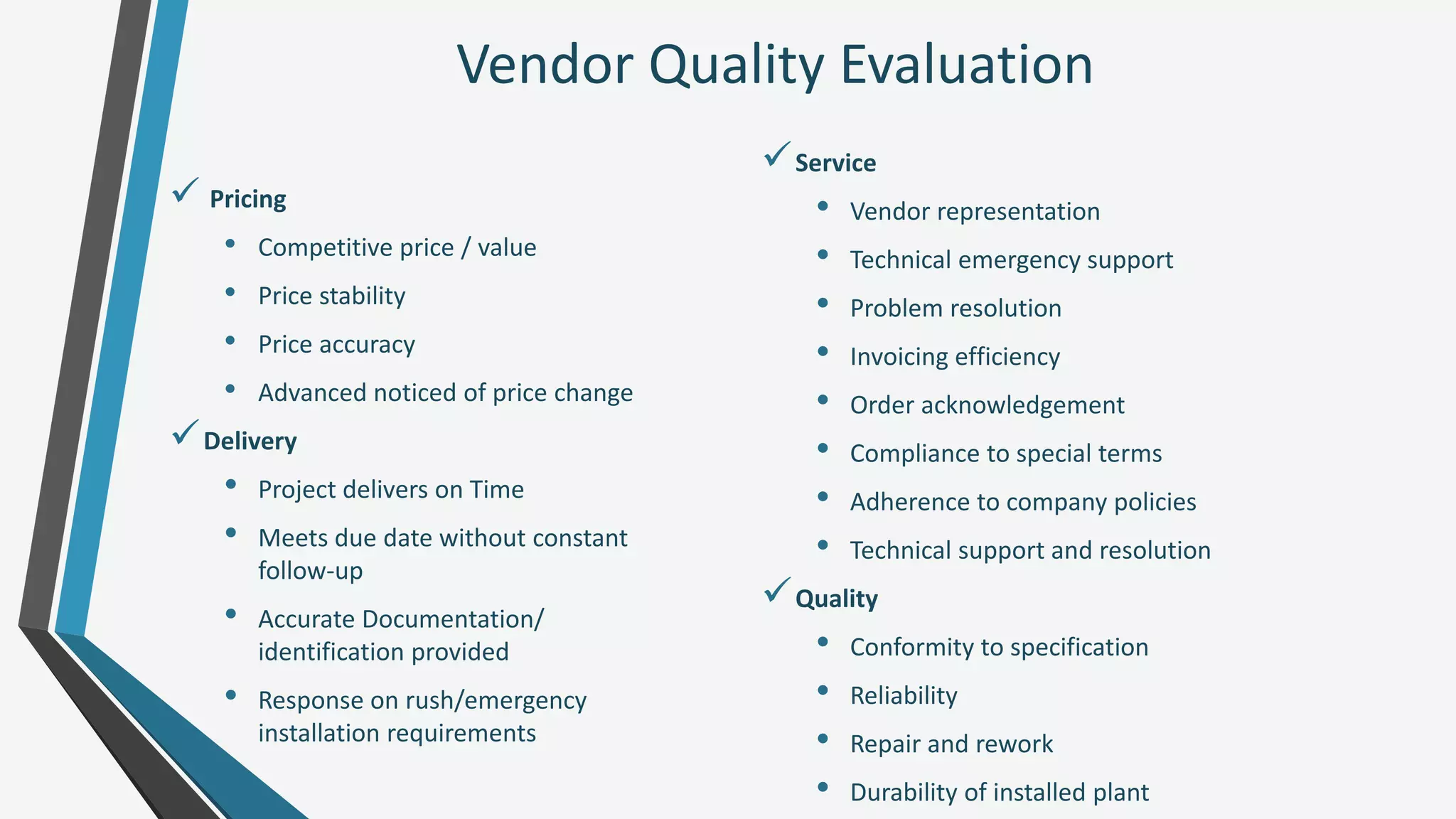
Vendor Quality Evaluation
 Pricing
• Competitive price / value
• Price stability
• Price accuracy
• Advanced noticed of price change
Delivery
• Project delivers on Time
• Meets due date without constant
follow-up
• Accurate Documentation/
identification provided
• Response on rush/emergency
installation requirements
Service
• Vendor representation
• Technical emergency support
• Problem resolution
• Invoicing efficiency
• Order acknowledgement
• Compliance to special terms
• Adherence to company policies
• Technical support and resolution
Quality
• Conformity to specification
• Reliability
• Repair and rework
• Durability of installed plant
Quotations
• Quotation is an inquiry to know whether the vendor can supply the desired
material and if so, by what price.
• Quotation are invited on a prescribed form or format from the selected sources
for the required items.
• The quotation also includes the terms and conditions namely taxes, freight,
cartage etc.
• A minimum of three quotations each in duplicate is required from different
suppliers.
• The quotations are valid for at least one month from date of opening.
• Quotation is not a purchase order.
Negotiations
• Negotiations may be defined as an art of arriving at a common understanding
through bargaining on the essentials of contract such as delivery, specifications,
prices and terms.
• Negotiations with the concerned vendor(s) are often necessary before finalizing
a purchase contract. The purpose is for fixing and finalizing prices of materials,
terms and conditions.
Need for negotiations
In most cases, purchase orders are decided on the basis of quotations. Negotiations
are required when a change in the scope of a contract is warranted. Negotiations are
considered essential in the following conditions:
• Prices are related to large capacity or to a large value.
• Terms and conditions are required for large capacity.
• Contract is desired for a longer period.
• Variations in capacity of plant is possible.
• Changes in drawing and specifications are necessary.
• When no acceptable quotations are received from the responding vendors.
Process of negotiations : negotiations take place between two individuals or
two sets of individuals.
Communication is an important ingredient in the art of negotiation. Through the
communication of ideas, the Project department persuades and convinces the
vendors to agree with their view point, So that an agreement can be reached.
Negotiations should attempt at a ‘win-win, situation to both parties. It is mutually
satisfactory settlement.
Developing Contracts and Finalizing Vendors
It’s time to complete the contracting process and get your vendor(s) onboard.
Typically, the contracting stage is assigned to the legal and finance team and the
senior management involved with the vendors. The rest of the business units receive
the contract and engage with the vendors after the finalization process. This tends to
be sub-optimal in the long run – the business units are the ones finally collaborating
with the vendors on a day-to-day basis and have valuable insights on how to
maximize the vendors operational performance. Hence, all the relevant stakeholders
need to be involved, at least in the decision-making process.
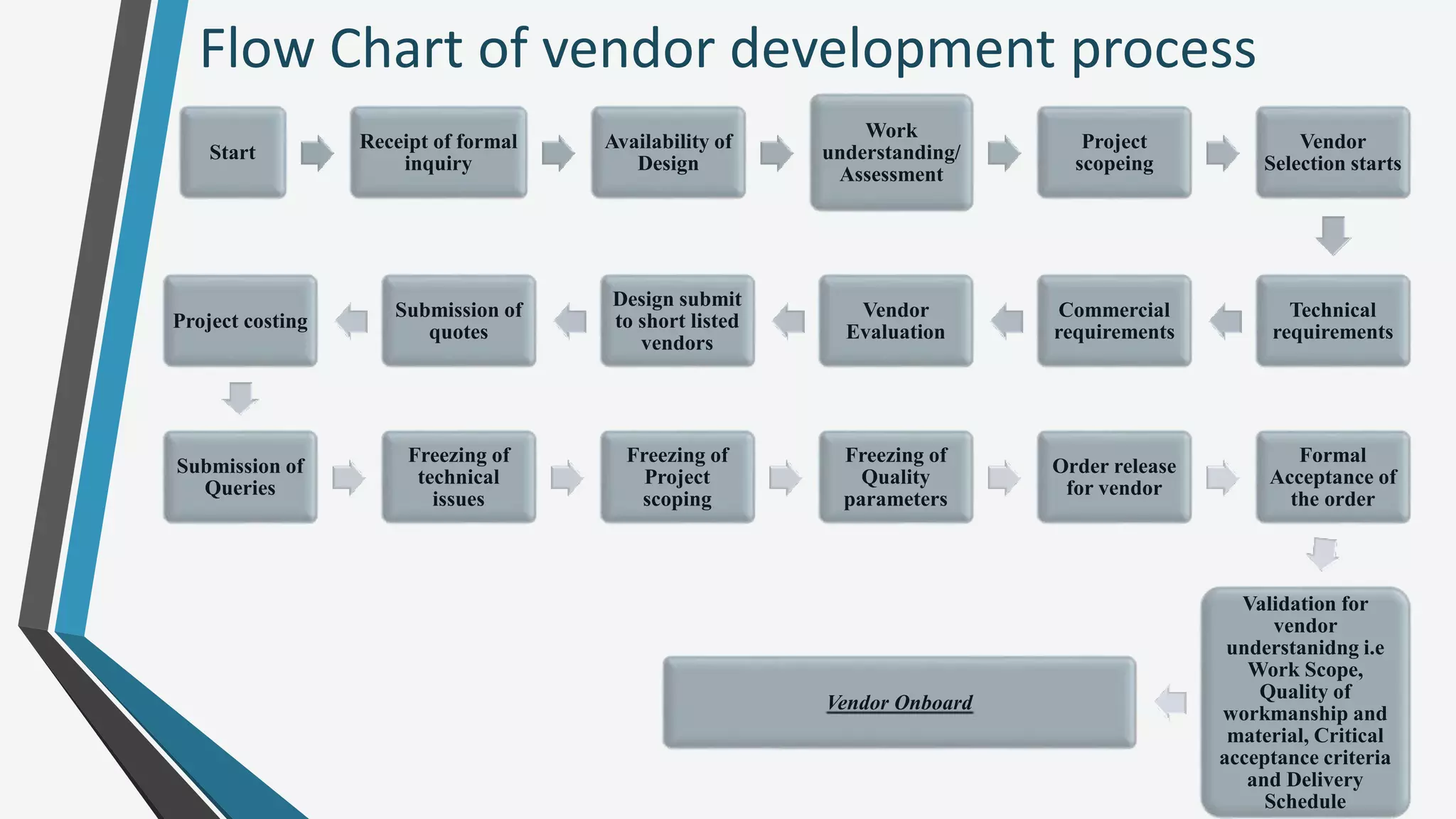
Flow Chart of vendor development process
Start
Receipt of formal
inquiry
Availability of
Design
Work
understanding/
Assessment
Project
scopeing
Vendor
Selection starts
Technical
requirements
Commercial
requirements
Vendor
Evaluation
Design submit
to short listed
vendors
Submission of
quotes
Project costing
Submission of
Queries
Freezing of
technical
issues
Freezing of
Project
scoping
Freezing of
Quality
parameters
Order release
for vendor
Formal
Acceptance of
the order
Validation for
vendor
understanidng i.e
Work Scope,
Quality of
workmanship and
material, Critical
acceptance criteria
and Delivery
Schedule
Vendor Onboard
Key Highlights of Vendor Development
Convey your expectations clearly
Ensure you set deadlines that are achievable and realistic
Collaborate with your vendors to maintain long-term relationships
Establish KPIs to measure Vendor Performance
Assess Vendor Risks to enable its Minimization
Benefits of Vendor Management
Better Selection-
By implementing appropriate vendor management in place, your organization can benefit from a larger
selection of vendors, resulting in more choices and ultimately better costs.
Better Contract Management
Better Performance Management-
An integrated view of the performance of all the vendors can be achieved through the implementation of a
vendor management system. This can give your organization a clear understanding of what is working and
what is not! This ultimately leads to improved efficiency, which in turns improves the overall performance of
the organization.
Cont.….
Better Vendor Relationship
It is never easy to manage multiple vendors at the same time. While some vendors may prove really fruitful,
others may not. But managing relationship among the vendors is the key to successful project completion.
By getting all vendor related information in a single place, you benefit from getting all required information
at once and it can influence your decision-making process, thereby simplifying it!
Better Value
Ultimately the goal of a vendor management system is to get the most value for your buck. So,
implementation of a vendor management system, when done properly can result in long-term savings as
well as improved earnings over a period of time.
Vendor management for Solar Projects

Vendor management for Solar Projects

  • 1.
    Vendor Management Prepared by: Ms. Chandrika Gudhainiya
  • 2.
    “While we arefree to choose our actions, we are not free to chose the consequences of our actions.” -Stephen Covey
  • 3.
    What is Vendor? A third party that performs function on your company behalf of provides services, goods to your company or the individual know as vendor.
  • 4.
    Vendor Management • Vendormanagement is a discipline that enables organizations to control costs, drive service excellence and mitigate risks to gain increased value from their vendors through out the deal life cycle. • This includes researching about the best suitable vendors, sourcing and obtaining pricing information, gauging the quality of work, managing relationships in case of multiple vendors, evaluating performance by setting organizational standards, and ensuring that the payments are always made on time.
  • 5.
    VENDOR DEVELOPMENT INVOLVESFOUR STAGES • First Stage survey stage • Second Stage enquiry stage • Third Stage negotiation & selection stage • Fourth Stage experience & evaluation stage
  • 6.
    Survey stage-source of informationon potential vendors • Trade directories • Telephone directories • Trade journals • Installation catalogs • Salesman • Market reference
  • 7.
    Inquiry stage- selectionof potential EPC Contractor • After a list of possible Contractors are complied, the next step is to inquire a few of them further. • Technological competition • Service competition • Price competition • Time based competition (TBC) i.e. response time for Project delivery.
  • 8.
    Negotiation and selectionstage finalization of vendors • The vendors who are successful in the enquiry stage • may be called for negotiations in order to discuss business possibilities. • During this stage, various terms namely credit, discount, quality specifications etc, can be decided. • Finally, a list of approved vendor’s drawn. • Accordingly, WO are placed with the approved vendors.
  • 9.
    Experience and evaluationstage • At this stage, the client evaluates and appraises the performance of the vendor. The objective is to improve the performance of vendors in which they are deficient. • The evaluation is done especially on two counts, namely quality of installed project (judged by rejection of lot- size ) and Project commissioned (judged by delays on delivery).
  • 10.
    Vendor Rating • Vendorrating is a term used in business and refers to the process of evaluating and approving potential vendor by quantitative assessment. The purpose of vendor rating is to ensure a portfolio of best in class vendor is available for use. • A few ways by which a vendor can be evaluated are listed below:- a. categorical method b. weighted point method c. cost ratio method
  • 11.
    Vendor Quality Evaluation Pricing • Competitive price / value • Price stability • Price accuracy • Advanced noticed of price change Delivery • Project delivers on Time • Meets due date without constant follow-up • Accurate Documentation/ identification provided • Response on rush/emergency installation requirements Service • Vendor representation • Technical emergency support • Problem resolution • Invoicing efficiency • Order acknowledgement • Compliance to special terms • Adherence to company policies • Technical support and resolution Quality • Conformity to specification • Reliability • Repair and rework • Durability of installed plant
  • 12.
    Quotations • Quotation isan inquiry to know whether the vendor can supply the desired material and if so, by what price. • Quotation are invited on a prescribed form or format from the selected sources for the required items. • The quotation also includes the terms and conditions namely taxes, freight, cartage etc. • A minimum of three quotations each in duplicate is required from different suppliers. • The quotations are valid for at least one month from date of opening. • Quotation is not a purchase order.
  • 13.
    Negotiations • Negotiations maybe defined as an art of arriving at a common understanding through bargaining on the essentials of contract such as delivery, specifications, prices and terms. • Negotiations with the concerned vendor(s) are often necessary before finalizing a purchase contract. The purpose is for fixing and finalizing prices of materials, terms and conditions.
  • 14.
    Need for negotiations Inmost cases, purchase orders are decided on the basis of quotations. Negotiations are required when a change in the scope of a contract is warranted. Negotiations are considered essential in the following conditions: • Prices are related to large capacity or to a large value. • Terms and conditions are required for large capacity. • Contract is desired for a longer period. • Variations in capacity of plant is possible. • Changes in drawing and specifications are necessary. • When no acceptable quotations are received from the responding vendors.
  • 15.
    Process of negotiations: negotiations take place between two individuals or two sets of individuals. Communication is an important ingredient in the art of negotiation. Through the communication of ideas, the Project department persuades and convinces the vendors to agree with their view point, So that an agreement can be reached. Negotiations should attempt at a ‘win-win, situation to both parties. It is mutually satisfactory settlement.
  • 16.
    Developing Contracts andFinalizing Vendors It’s time to complete the contracting process and get your vendor(s) onboard. Typically, the contracting stage is assigned to the legal and finance team and the senior management involved with the vendors. The rest of the business units receive the contract and engage with the vendors after the finalization process. This tends to be sub-optimal in the long run – the business units are the ones finally collaborating with the vendors on a day-to-day basis and have valuable insights on how to maximize the vendors operational performance. Hence, all the relevant stakeholders need to be involved, at least in the decision-making process.
  • 17.
    Flow Chart ofvendor development process Start Receipt of formal inquiry Availability of Design Work understanding/ Assessment Project scopeing Vendor Selection starts Technical requirements Commercial requirements Vendor Evaluation Design submit to short listed vendors Submission of quotes Project costing Submission of Queries Freezing of technical issues Freezing of Project scoping Freezing of Quality parameters Order release for vendor Formal Acceptance of the order Validation for vendor understanidng i.e Work Scope, Quality of workmanship and material, Critical acceptance criteria and Delivery Schedule Vendor Onboard
  • 18.
    Key Highlights ofVendor Development Convey your expectations clearly Ensure you set deadlines that are achievable and realistic Collaborate with your vendors to maintain long-term relationships Establish KPIs to measure Vendor Performance Assess Vendor Risks to enable its Minimization
  • 19.
    Benefits of VendorManagement Better Selection- By implementing appropriate vendor management in place, your organization can benefit from a larger selection of vendors, resulting in more choices and ultimately better costs. Better Contract Management Better Performance Management- An integrated view of the performance of all the vendors can be achieved through the implementation of a vendor management system. This can give your organization a clear understanding of what is working and what is not! This ultimately leads to improved efficiency, which in turns improves the overall performance of the organization.
  • 20.
    Cont.…. Better Vendor Relationship Itis never easy to manage multiple vendors at the same time. While some vendors may prove really fruitful, others may not. But managing relationship among the vendors is the key to successful project completion. By getting all vendor related information in a single place, you benefit from getting all required information at once and it can influence your decision-making process, thereby simplifying it! Better Value Ultimately the goal of a vendor management system is to get the most value for your buck. So, implementation of a vendor management system, when done properly can result in long-term savings as well as improved earnings over a period of time.