Testing the limits of university
teaching
MOOCs, Multimedia and Distributed
Collaboration
George Roberts
26/06/2012
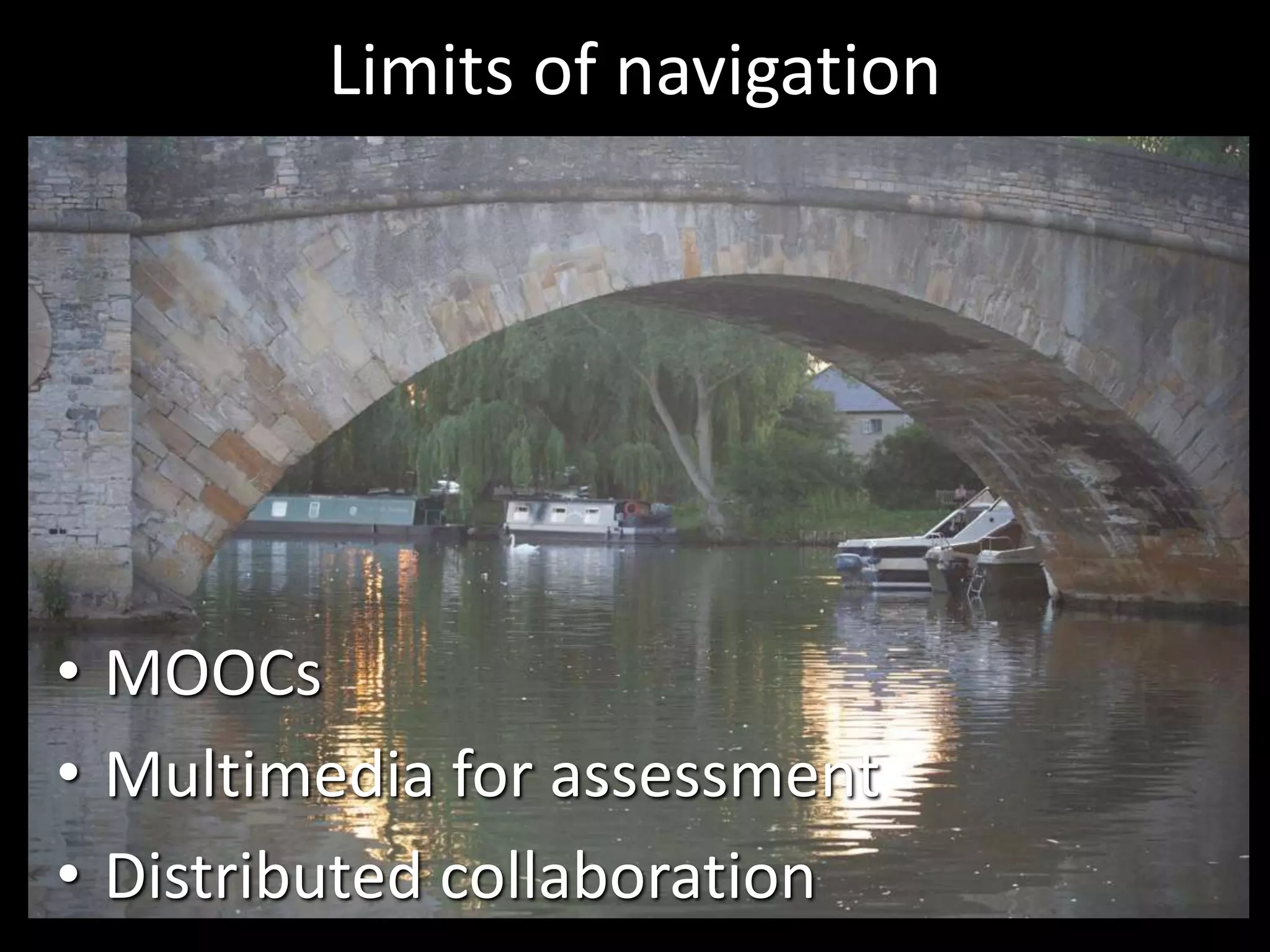
Limits of navigation
• MOOCs
• Multimedia for assessment
• Distributed collaboration
Audiographic Simulcast
• Blackboard Collaborate in use
• It is not that we ignore web-based and
internet technologies at our peril… In truth,
we ignore the traditional university at our
peril. (M Roberts 2012)
Matters affecting UVa
Superposition of randomness
• superposition of randomness leading to a
transforming experience
Related randomness?
• Identity
• Community
• Literacy
• Three topics:
– MOOCs
– Academic Multimedia
– Distributed Collaboration
Old MOOCs, new MOOCs, red
MOOCs blue MOOCs
MOOCs
Massive Open Online Courses
Old MOOCs from 2008
• Explicit pedagogical perspective
– Social constructivist, dialogic, actor networks
• Distributed, open source platform components
– Wikis, WordPress, Moodle
• Intentional social media conversations
– Twitter, Facebook, Blogs
• Open challenge to institutions
– Access, environment, IPR, assessment
New MOOCs from 2011
• Tacit pedagogical perspective
– Instructivist, pragmatic, realist,
– Authentic: employment oriented
• Consolidated platforms
– Incidental social media
• Institutional counter-position
– Elite, neo-colonial (?)
Our MOOC
• First Steps into Learning and Teaching in
Higher Education (FSLT12)
MOOC Problematics
• Old MOOC
– Navigation, chaos, disorientation, exposure,
tuition
• New MOOC
– Packaging, automation, two-tier
• All MOOCs
– Motivation
MOOC benefits
• Old MOOC
– Autonomy
• New MOOC
– Authority
• All MOOC
– Access, authenticity
MOOC Limits
• Identity
– Embodiment
– Preference: introversion extroversion
• Community
– Serendipity
• Literacy
– Genre, paralinguistics
Post-Text Problematics: Social Citation
and Valorisation of Knowledge
Multimedia for Assessment
Presentations to virtual conferences
• Diverse practice
– Audio enhanced
• Some excellent
– But, some 2000
word essays on
12 ppt slides
• Markers
unfamiliar with
the genre
– What is
scholarship in
this medium?
Other Multimedia Assessment
Examples
• Video essays
– Sustained inquiry
• Multimedia learning journals
– Reflective collection
• Audio feedback
Valorisation of knowledge
Multimedia scholarship
In 2003, Stephen Downes wrote
• multimedia computing … provides scholarly discourse with great
opportunities, but also problematizes that discourse (Ingraham, 2000)
• large bodies of continuous text … are likely to remain the primary medium
for the dissemination of scholarship (Ingraham & Bradburn, 2003)
• the 'electronic book' is likely to become the primary medium … for the
dissemination of text-mediated scholarly discourse (Ingraham & Bradburn,
2003a), [and] disseminating educational multimedia.
But, let’s have a look at Downes 2003
Multimedia assessment limits
• Community
– Traditions of the disciplines
• Identity
– Our scholarly selves
• Literacy
– The Genre is new
– The links degrade, coping with transience
Being together in the body
Distributed-collaborative learning sets
Distributed Learning Sets
• Explicit Intended Outcome
– As a group produce a seminar addressing a
current issue in higher education learning and
teaching
• Tacit Intended Outcome
– Discover ways to work as a group, which allow for
distributed collaboration: across the three Brookes
campuses and several other universities
Distribution in two ways
In small groups to collaborate in
production of the seminars
–Forums, email, Google Docs, wiki
In Plenary to attend/review sessions
–Matterhorn Lecture Capture + Podcast
Producer
Distribution issues
Small groups
– Defaulted to Face to face
• Disadvantage the minority
Plenary
– Groups focused on own performances
– Low attention/attendance to other groups
seminars
• Substantial curriculum input missed
A controlled classroom
environment isn’t a bad thing.
(Krauss 2012)
Distributed Collaboration Limits
• Identity
– We know ourselves in the reflection of others
• Community
– Cohesion through diversity
• Literacy
– Paralinguistics
Discussion
• Turn to the person beside you – or to the chat
stream in Collaborate
• In light of: MOOCs, Multimedia and
Distributed Collaboration
• Where are your limits of navigation?
Disruptive?
Technology
QUESTION: If SOPA/PIPA [or the
Digital Economy Act in the UK] had
been passed into U.S. law in 2002,
would Wikipedia exist today? If
either law had passed in 2012, would
Wikipedia exist in 2022? Why or why
not? Discuss.
If you cannot answer that
question, you are not literate
nor are you in control of your
life—even if you think you are.
Watersheds?
• Narrative ? > 50,000 years
• Writing c. 5,000 years
• Printing c. 500 years
• Perspective c. 500 years
• Steam c. 250 years
• Mass literacy c. 150 years
• Cinema c. 100 years
• Internet c. 35 years
Christ Handing the Keys to St. Peter, Perugino, 1481
Discourses around higher education are:
“… a field of competition for the
legitimate exercise of symbolic
violence,
… an arena of conflict between rival
principles of legitimacy, and
competition for political, economic
and cultural power
(Bourdieu 1993, 121)
Literacy - including digital - is
the practice of enunciation in a
community:
“speaking” in the broadest
sense, projecting an identity
with, through and to others
who concur
digital literacy cannot be
separated from other
educational - or social, or
economic, or political -
developments.
Digital literacy is far more than
skills with keyboard & apps.
It is how we & our students
negotiate the
ICT-mediated frontier between
rival principles.
Limits of navigation
• MOOCs
– Radical openness is not for
everyone
• Multimedia for assessment
– Text citation and commentary asserts itself through
every fissure
• Distributed collaboration
– We crave – and are good at – contact
Thank you
Dr George Roberts
OCSLD, Oxford Brookes University
June 2012
groberts@brookes.ac.uk

The limits of university teaching

  • 1.
    Testing the limitsof university teaching MOOCs, Multimedia and Distributed Collaboration George Roberts 26/06/2012
  • 2.
    Limits of navigation •MOOCs • Multimedia for assessment • Distributed collaboration
  • 3.
  • 6.
    • It isnot that we ignore web-based and internet technologies at our peril… In truth, we ignore the traditional university at our peril. (M Roberts 2012) Matters affecting UVa
  • 7.
    Superposition of randomness •superposition of randomness leading to a transforming experience
  • 8.
    Related randomness? • Identity •Community • Literacy • Three topics: – MOOCs – Academic Multimedia – Distributed Collaboration
  • 9.
    Old MOOCs, newMOOCs, red MOOCs blue MOOCs MOOCs Massive Open Online Courses
  • 10.
    Old MOOCs from2008 • Explicit pedagogical perspective – Social constructivist, dialogic, actor networks • Distributed, open source platform components – Wikis, WordPress, Moodle • Intentional social media conversations – Twitter, Facebook, Blogs • Open challenge to institutions – Access, environment, IPR, assessment
  • 12.
    New MOOCs from2011 • Tacit pedagogical perspective – Instructivist, pragmatic, realist, – Authentic: employment oriented • Consolidated platforms – Incidental social media • Institutional counter-position – Elite, neo-colonial (?)
  • 14.
    Our MOOC • FirstSteps into Learning and Teaching in Higher Education (FSLT12)
  • 15.
    MOOC Problematics • OldMOOC – Navigation, chaos, disorientation, exposure, tuition • New MOOC – Packaging, automation, two-tier • All MOOCs – Motivation
  • 16.
    MOOC benefits • OldMOOC – Autonomy • New MOOC – Authority • All MOOC – Access, authenticity
  • 17.
    MOOC Limits • Identity –Embodiment – Preference: introversion extroversion • Community – Serendipity • Literacy – Genre, paralinguistics
  • 18.
    Post-Text Problematics: SocialCitation and Valorisation of Knowledge Multimedia for Assessment
  • 19.
    Presentations to virtualconferences • Diverse practice – Audio enhanced • Some excellent – But, some 2000 word essays on 12 ppt slides • Markers unfamiliar with the genre – What is scholarship in this medium?
  • 20.
    Other Multimedia Assessment Examples •Video essays – Sustained inquiry • Multimedia learning journals – Reflective collection • Audio feedback
  • 21.
  • 23.
    Multimedia scholarship In 2003,Stephen Downes wrote • multimedia computing … provides scholarly discourse with great opportunities, but also problematizes that discourse (Ingraham, 2000) • large bodies of continuous text … are likely to remain the primary medium for the dissemination of scholarship (Ingraham & Bradburn, 2003) • the 'electronic book' is likely to become the primary medium … for the dissemination of text-mediated scholarly discourse (Ingraham & Bradburn, 2003a), [and] disseminating educational multimedia. But, let’s have a look at Downes 2003
  • 24.
    Multimedia assessment limits •Community – Traditions of the disciplines • Identity – Our scholarly selves • Literacy – The Genre is new – The links degrade, coping with transience
  • 25.
    Being together inthe body Distributed-collaborative learning sets
  • 26.
    Distributed Learning Sets •Explicit Intended Outcome – As a group produce a seminar addressing a current issue in higher education learning and teaching • Tacit Intended Outcome – Discover ways to work as a group, which allow for distributed collaboration: across the three Brookes campuses and several other universities
  • 28.
    Distribution in twoways In small groups to collaborate in production of the seminars –Forums, email, Google Docs, wiki In Plenary to attend/review sessions –Matterhorn Lecture Capture + Podcast Producer
  • 29.
    Distribution issues Small groups –Defaulted to Face to face • Disadvantage the minority Plenary – Groups focused on own performances – Low attention/attendance to other groups seminars • Substantial curriculum input missed
  • 30.
    A controlled classroom environmentisn’t a bad thing. (Krauss 2012)
  • 31.
    Distributed Collaboration Limits •Identity – We know ourselves in the reflection of others • Community – Cohesion through diversity • Literacy – Paralinguistics
  • 32.
    Discussion • Turn tothe person beside you – or to the chat stream in Collaborate • In light of: MOOCs, Multimedia and Distributed Collaboration • Where are your limits of navigation?
  • 33.
  • 35.
    QUESTION: If SOPA/PIPA[or the Digital Economy Act in the UK] had been passed into U.S. law in 2002, would Wikipedia exist today? If either law had passed in 2012, would Wikipedia exist in 2022? Why or why not? Discuss.
  • 36.
    If you cannotanswer that question, you are not literate nor are you in control of your life—even if you think you are.
  • 37.
    Watersheds? • Narrative ?> 50,000 years • Writing c. 5,000 years • Printing c. 500 years • Perspective c. 500 years • Steam c. 250 years • Mass literacy c. 150 years • Cinema c. 100 years • Internet c. 35 years
  • 38.
    Christ Handing theKeys to St. Peter, Perugino, 1481
  • 40.
    Discourses around highereducation are: “… a field of competition for the legitimate exercise of symbolic violence, … an arena of conflict between rival principles of legitimacy, and competition for political, economic and cultural power (Bourdieu 1993, 121)
  • 42.
    Literacy - includingdigital - is the practice of enunciation in a community: “speaking” in the broadest sense, projecting an identity with, through and to others who concur
  • 43.
    digital literacy cannotbe separated from other educational - or social, or economic, or political - developments.
  • 44.
    Digital literacy isfar more than skills with keyboard & apps. It is how we & our students negotiate the ICT-mediated frontier between rival principles.
  • 45.
    Limits of navigation •MOOCs – Radical openness is not for everyone • Multimedia for assessment – Text citation and commentary asserts itself through every fissure • Distributed collaboration – We crave – and are good at – contact
  • 46.
    Thank you Dr GeorgeRoberts OCSLD, Oxford Brookes University June 2012 groberts@brookes.ac.uk