Personal Learning Environments, Web 2.0 and the Future of Higher Education Marc Boots-Ebenfield Center for Teaching Innovation Meier Hall 115
Or The Death of Higher Education (again)  Marc Boots-Ebenfield Center for Teaching Innovation Meier Hall 115
Web 2.0 “ Your institution will be irrelevant by 2020” David Wiley, E-learn 2008,  Associate Professor of Instructional Technology at Utah State University PLEs are great. They’re just completely incompatible with the existing education system.”  Retrieved Jan 10, 2009 from  http://ltc.umanitoba.ca/wordpress/category/uncategorized/   Learning Technologies Centre Research Blog
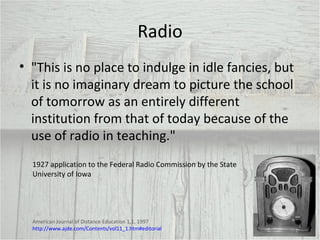
Radio "This is no place to indulge in idle fancies, but it is no imaginary dream to picture the school of tomorrow as an entirely different institution from that of today because of the use of radio in teaching." 1927 application to the Federal Radio Commission by the State University of Iowa American Journal of Distance Education 1,1, 1997  http://www.ajde.com/Contents/vol11_1.htm#editorial
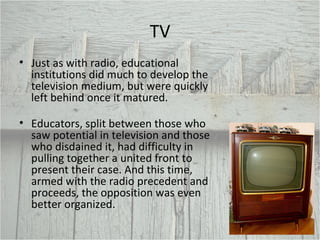
TV Just as with radio, educational institutions did much to develop the television medium, but were quickly left behind once it matured.   Educators, split between those who saw potential in television and those who disdained it, had difficulty in pulling together a united front to present their case. And this time, armed with the radio precedent and proceeds, the opposition was even better organized.
PLE: More than a Technology Web 2.0  Open Source/Access Movement Self-publication /Creativity Modularization Mobility Personalization Connectivity
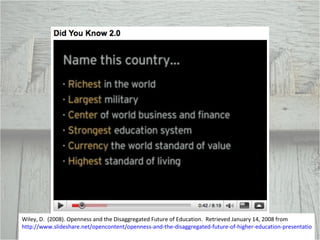
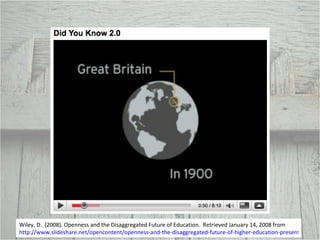
Wiley, D.  (2008). Openness and the Disaggregated Future of Education.  Retrieved January 14, 2008 from  http://www.slideshare.net/opencontent/openness-and-the-disaggregated-future-of-higher-education-presentation
Things Have Changed “… So James is in CIS and I am in English.  If you told us in graduate school that I was going to spend a lot of time coding web pages and that he was going to craft reflective writing assignments, we would’ve said you were crazy… p. 14” “’ Future of e-portfolio’ Roundtable” retrieved January 8, 2009 from  http://www.academiccommons.org/commons/essay/future-eportfolio-roundtable
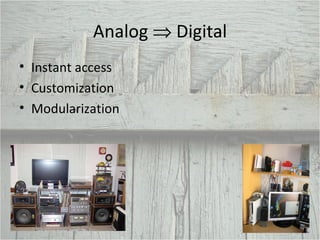
Analog    Digital Instant access Customization Modularization
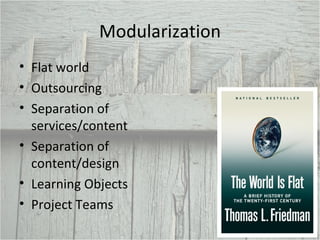
Modularization Flat world Outsourcing Separation of services/content Separation of content/design Learning Objects Project Teams
Open Access Open Courseware Initiative MIT  Open University in the Netherlands  Google Books Project Gutenberg Wikipedia Public Library of Science Arxiv.org Flat World Knowledge
Open Source “ distributed peer review and transparency of process” Google’s Open Social Linux Moodle Ubuntu Open Office
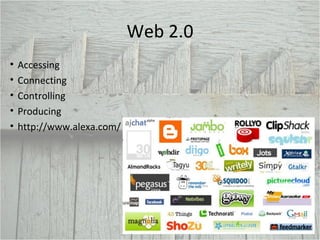
Web 2.0 Accessing Connecting Controlling Producing http://www.alexa.com/
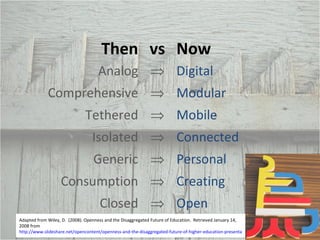
Adapted from Wiley, D.  (2008). Openness and the Disaggregated Future of Education.  Retrieved January 14, 2008 from  http://www.slideshare.net/opencontent/openness-and-the-disaggregated-future-of-higher-education-presentation Then vs Now Analog  Digital Comprehensive  Modular Tethered  Mobile Isolated  Connected Generic  Personal Consumption  Creating Closed  Open
Learning Management Systems LMS is a system largely set in place to restrict access Restrict access only to students who have registered Restrict access to current courses Restrict access to copyrighted materials Restrict access to student work (FERPA) Restrict access to faculty currently teaching Provide security from unsuitable materials
Personal Learning Environments “ systems that help learners take control of and manage their own learning. This includes providing support for learners to set their own learning goals manage their learning;  managing both content and process, communicate with others in the process of learning and thereby achieve learning goals.”  Mark van Harmelen, "Personal Learning Environments," icalt,pp.815-816, Sixth IEEE International Conference on Advanced Learning Technologies (ICALT'06), 2006
Personal Learning Environments Needs of lifelong learners  Assume multiple institutions of higher learning Formal mentoring Informal Learning Portable: Maintain portfolio of information and learning compatible with multiple institutions  Collaborative Openness is highly desirable Personalization highly desirable Locus of control shared between students and faculty members Extra-institutional Integrative
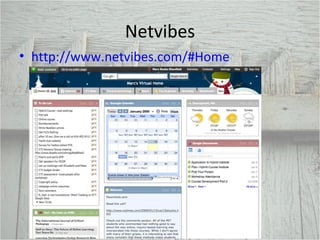
Netvibes http://www.netvibes.com/#Home
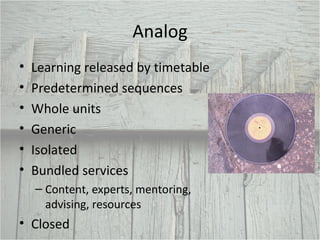
Analog Learning released by timetable Predetermined sequences Whole units Generic Isolated Bundled services Content, experts, mentoring, advising, resources  Closed
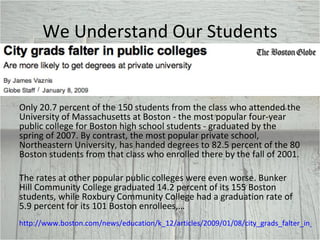
We Understand Our Students Only 20.7 percent of the 150 students from the class who attended the University of Massachusetts at Boston - the most popular four-year public college for Boston high school students - graduated by the spring of 2007. By contrast, the most popular private school, Northeastern University, has handed degrees to 82.5 percent of the 80 Boston students from that class who enrolled there by the fall of 2001. The rates at other popular public colleges were even worse. Bunker Hill Community College graduated 14.2 percent of its 155 Boston students, while Roxbury Community College had a graduation rate of 5.9 percent for its 101 Boston enrollees,… http://www.boston.com/news/education/k_12/articles/2009/01/08/city_grads_falter_in_public_colleges/
Yet we don’t adjust to the situation Faculty teach at multiple institutions Students take courses at multiple institutions Faculty bring external experiences to classroom Students bring external experiences to classroom Faculty have valuable connections outside SSC Students have valuable connections outside SSC
Ideal Situation Shared student /faculty locus of control Learning Communities Experiential learning Connect learning <- -> experience Interconnected courses Life-long connection with students Personalized learning / mentoring
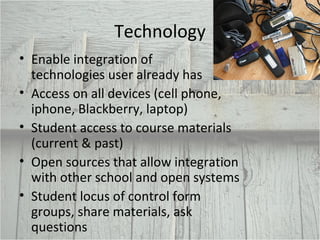
Technology Enable integration of  technologies user already has Access on all devices (cell phone, iphone, Blackberry, laptop) Student access to course materials (current & past) Open sources that allow integration with other school and open systems Student locus of control form groups, share materials, ask questions
Content Clear Objectives Majors, minors, concentrations Courses Competency/Proficiency Assessments Modular materials Individual mentoring Flexible programs
Problems Learner coordinates of technology Learner coordinates own learning Learner manages own resources (content & contacts) Unrealistic expectations for education
Bricolage “ The culture of everyday life is to be found in ‘ways of using imposed systems’: ‘People have to make do with what they have’.  ‘Making Do’ (or bricolage) means constructing our space within and against their place, of speaking our meaning with their language.” Kramsch, Claire. (1993). Context and Culture in Language Teaching.  Oxford University Press.  Quoting Michel de Certeau, pg 237
Constant Change “ The education system is constantly searching for better ways of coopting learners’ perceived needs by devising new courses for students to enroll in, developing new learning strategies for them to use, creating new materials for them to consume. But classroom teachers know that it is a losing battle… educational thought underestimates the incredible resources, both affective and cognitive, of the ‘popular culture’ of the [language] classroom.”  Kramsch, Claire. (1993). Context and Culture in Language Teaching.  Oxford University Press. pg 237
PLE Compatible Initiatives E-portfolios (student, not accreditation centered) Clear learning objectives Content mapping  Formative assessment Hybrid & online courses Inclusion of Web 2.0, open source technologies Learning communities Experiential learning Online services (library, registration) Active, collaborative learning
Then vs Now Analog  Digital Comprehensive  Modular Tethered  Mobile Isolated  Connected Generic  Personal Consumption  Creating Closed  Open
References Kramsch, Claire. (1993). Context and Culture in Language Teaching.  Oxford University Press.  Liber, O. (2007). “Inverting the Student - Institution Relationship: the Role of Personal Learning Environments”. Proceedings of Bolzano Conversation 2007. Retrieved November 24, 2008 from  http://www.copernicus-bz-pionieri.it/index.php?option=com_docman&task=doc_download&gid=52 Moore, M. (1997).  Editorial.  American Journal of Distance Education 1,1.  Retrieved January 8, 2008 from  http://www.ajde.com/Contents/vol11_1.htm#editorial Sclater, N. (2008) ‘Web 2.0, Personal Learning Environments and the Future of Learning Management Systems’, Educause Center for Applied Research, Research Bulletin, Boulder, Colorado, Volume 2008, Issue 13, June 24 2008 van Harmelen, M. (2006).  &quot;Personal Learning Environments,&quot; icalt,pp.815-816, Sixth IEEE International Conference on Advanced Learning Technologies (ICALT'06). Retrieved Wiley, D.  (2008). Openness and the Disaggregated  Future of Education.  Retrieved January 14, 2008 from  http://www.slideshare.net/opencontent/openness-and-the-disaggregated-future-of-higher-education-presentation

PLEs, Web 2.0 & Future of Higher Education

  • 1.
    Personal Learning Environments,Web 2.0 and the Future of Higher Education Marc Boots-Ebenfield Center for Teaching Innovation Meier Hall 115
  • 2.
    Or The Deathof Higher Education (again) Marc Boots-Ebenfield Center for Teaching Innovation Meier Hall 115
  • 3.
    Web 2.0 “Your institution will be irrelevant by 2020” David Wiley, E-learn 2008, Associate Professor of Instructional Technology at Utah State University PLEs are great. They’re just completely incompatible with the existing education system.” Retrieved Jan 10, 2009 from http://ltc.umanitoba.ca/wordpress/category/uncategorized/ Learning Technologies Centre Research Blog
  • 4.
    Radio &quot;This isno place to indulge in idle fancies, but it is no imaginary dream to picture the school of tomorrow as an entirely different institution from that of today because of the use of radio in teaching.&quot; 1927 application to the Federal Radio Commission by the State University of Iowa American Journal of Distance Education 1,1, 1997 http://www.ajde.com/Contents/vol11_1.htm#editorial
  • 5.
    TV Just aswith radio, educational institutions did much to develop the television medium, but were quickly left behind once it matured. Educators, split between those who saw potential in television and those who disdained it, had difficulty in pulling together a united front to present their case. And this time, armed with the radio precedent and proceeds, the opposition was even better organized.
  • 6.
    PLE: More thana Technology Web 2.0 Open Source/Access Movement Self-publication /Creativity Modularization Mobility Personalization Connectivity
  • 7.
    Wiley, D. (2008). Openness and the Disaggregated Future of Education. Retrieved January 14, 2008 from http://www.slideshare.net/opencontent/openness-and-the-disaggregated-future-of-higher-education-presentation
  • 8.
    Wiley, D. (2008). Openness and the Disaggregated Future of Education. Retrieved January 14, 2008 from http://www.slideshare.net/opencontent/openness-and-the-disaggregated-future-of-higher-education-presentation
  • 9.
    Things Have Changed“… So James is in CIS and I am in English. If you told us in graduate school that I was going to spend a lot of time coding web pages and that he was going to craft reflective writing assignments, we would’ve said you were crazy… p. 14” “’ Future of e-portfolio’ Roundtable” retrieved January 8, 2009 from http://www.academiccommons.org/commons/essay/future-eportfolio-roundtable
  • 10.
    Analog  Digital Instant access Customization Modularization
  • 11.
    Modularization Flat worldOutsourcing Separation of services/content Separation of content/design Learning Objects Project Teams
  • 12.
    Open Access OpenCourseware Initiative MIT Open University in the Netherlands Google Books Project Gutenberg Wikipedia Public Library of Science Arxiv.org Flat World Knowledge
  • 13.
    Open Source “distributed peer review and transparency of process” Google’s Open Social Linux Moodle Ubuntu Open Office
  • 14.
    Web 2.0 AccessingConnecting Controlling Producing http://www.alexa.com/
  • 15.
    Adapted from Wiley,D. (2008). Openness and the Disaggregated Future of Education. Retrieved January 14, 2008 from http://www.slideshare.net/opencontent/openness-and-the-disaggregated-future-of-higher-education-presentation Then vs Now Analog  Digital Comprehensive  Modular Tethered  Mobile Isolated  Connected Generic  Personal Consumption  Creating Closed  Open
  • 16.
    Learning Management SystemsLMS is a system largely set in place to restrict access Restrict access only to students who have registered Restrict access to current courses Restrict access to copyrighted materials Restrict access to student work (FERPA) Restrict access to faculty currently teaching Provide security from unsuitable materials
  • 17.
    Personal Learning Environments“ systems that help learners take control of and manage their own learning. This includes providing support for learners to set their own learning goals manage their learning; managing both content and process, communicate with others in the process of learning and thereby achieve learning goals.” Mark van Harmelen, &quot;Personal Learning Environments,&quot; icalt,pp.815-816, Sixth IEEE International Conference on Advanced Learning Technologies (ICALT'06), 2006
  • 18.
    Personal Learning EnvironmentsNeeds of lifelong learners Assume multiple institutions of higher learning Formal mentoring Informal Learning Portable: Maintain portfolio of information and learning compatible with multiple institutions Collaborative Openness is highly desirable Personalization highly desirable Locus of control shared between students and faculty members Extra-institutional Integrative
  • 19.
  • 20.
    Analog Learning releasedby timetable Predetermined sequences Whole units Generic Isolated Bundled services Content, experts, mentoring, advising, resources Closed
  • 21.
    We Understand OurStudents Only 20.7 percent of the 150 students from the class who attended the University of Massachusetts at Boston - the most popular four-year public college for Boston high school students - graduated by the spring of 2007. By contrast, the most popular private school, Northeastern University, has handed degrees to 82.5 percent of the 80 Boston students from that class who enrolled there by the fall of 2001. The rates at other popular public colleges were even worse. Bunker Hill Community College graduated 14.2 percent of its 155 Boston students, while Roxbury Community College had a graduation rate of 5.9 percent for its 101 Boston enrollees,… http://www.boston.com/news/education/k_12/articles/2009/01/08/city_grads_falter_in_public_colleges/
  • 22.
    Yet we don’tadjust to the situation Faculty teach at multiple institutions Students take courses at multiple institutions Faculty bring external experiences to classroom Students bring external experiences to classroom Faculty have valuable connections outside SSC Students have valuable connections outside SSC
  • 23.
    Ideal Situation Sharedstudent /faculty locus of control Learning Communities Experiential learning Connect learning <- -> experience Interconnected courses Life-long connection with students Personalized learning / mentoring
  • 24.
    Technology Enable integrationof technologies user already has Access on all devices (cell phone, iphone, Blackberry, laptop) Student access to course materials (current & past) Open sources that allow integration with other school and open systems Student locus of control form groups, share materials, ask questions
  • 25.
    Content Clear ObjectivesMajors, minors, concentrations Courses Competency/Proficiency Assessments Modular materials Individual mentoring Flexible programs
  • 26.
    Problems Learner coordinatesof technology Learner coordinates own learning Learner manages own resources (content & contacts) Unrealistic expectations for education
  • 27.
    Bricolage “ Theculture of everyday life is to be found in ‘ways of using imposed systems’: ‘People have to make do with what they have’. ‘Making Do’ (or bricolage) means constructing our space within and against their place, of speaking our meaning with their language.” Kramsch, Claire. (1993). Context and Culture in Language Teaching. Oxford University Press. Quoting Michel de Certeau, pg 237
  • 28.
    Constant Change “The education system is constantly searching for better ways of coopting learners’ perceived needs by devising new courses for students to enroll in, developing new learning strategies for them to use, creating new materials for them to consume. But classroom teachers know that it is a losing battle… educational thought underestimates the incredible resources, both affective and cognitive, of the ‘popular culture’ of the [language] classroom.” Kramsch, Claire. (1993). Context and Culture in Language Teaching. Oxford University Press. pg 237
  • 29.
    PLE Compatible InitiativesE-portfolios (student, not accreditation centered) Clear learning objectives Content mapping Formative assessment Hybrid & online courses Inclusion of Web 2.0, open source technologies Learning communities Experiential learning Online services (library, registration) Active, collaborative learning
  • 30.
    Then vs NowAnalog  Digital Comprehensive  Modular Tethered  Mobile Isolated  Connected Generic  Personal Consumption  Creating Closed  Open
  • 31.
    References Kramsch, Claire.(1993). Context and Culture in Language Teaching. Oxford University Press. Liber, O. (2007). “Inverting the Student - Institution Relationship: the Role of Personal Learning Environments”. Proceedings of Bolzano Conversation 2007. Retrieved November 24, 2008 from http://www.copernicus-bz-pionieri.it/index.php?option=com_docman&task=doc_download&gid=52 Moore, M. (1997). Editorial. American Journal of Distance Education 1,1. Retrieved January 8, 2008 from http://www.ajde.com/Contents/vol11_1.htm#editorial Sclater, N. (2008) ‘Web 2.0, Personal Learning Environments and the Future of Learning Management Systems’, Educause Center for Applied Research, Research Bulletin, Boulder, Colorado, Volume 2008, Issue 13, June 24 2008 van Harmelen, M. (2006). &quot;Personal Learning Environments,&quot; icalt,pp.815-816, Sixth IEEE International Conference on Advanced Learning Technologies (ICALT'06). Retrieved Wiley, D. (2008). Openness and the Disaggregated Future of Education. Retrieved January 14, 2008 from http://www.slideshare.net/opencontent/openness-and-the-disaggregated-future-of-higher-education-presentation